Vegan Sicilian Brioche with the Topknot, Reinterpreted | Brioche col Tuppo Vegana Rivisitata

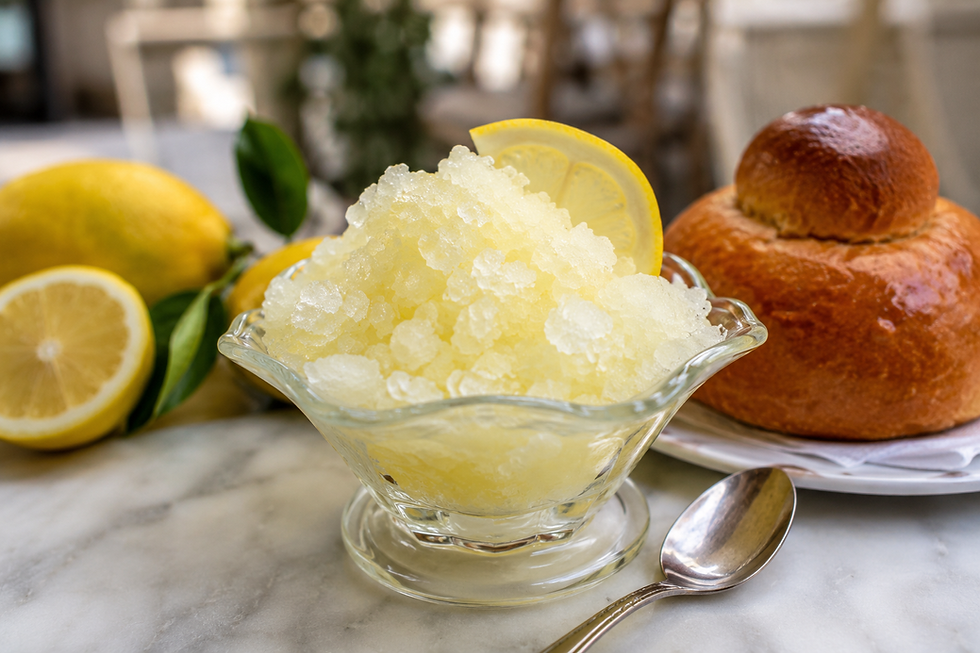
The brioche col tuppo is the round, golden bun that Sicilians tear and dip into granita on summer mornings. Its shape is unmistakable: a wide, domed base crowned by a small ball of dough, the tuppo, which bakes into a soft, glossy knot. The classic Sicilian bakery brioche is made with eggs, milk and butter or lard; this vegan version is a reinterpretation, built for that same purpose. The crumb is light, slightly sweet and scented with orange and vanilla, strong enough to scoop a spoonful of almond or lemon granita without falling apart, and made with extra virgin olive oil, oat milk and a cooked flour paste instead of the animal fats and dairy of the classic bakery recipe. It is a bread of patience: a cold overnight rise gives it its aroma and its fine, feathery texture.
Yield: 10 brioches. Prep: 40 minutes. Cook: 18 minutes. Rest: 12 to 14 hours of rising, plus 30 minutes cooling. Course: dolce. Region: Sicilia.
The Story
The word brioche is French, and so is the origin of the pastry. Rich, buttery breads of this kind were made in France for centuries, and the brioche reached Sicily through the island's long contact with French culture. It is often linked to the monsù, the French-trained cooks of the Sicilian aristocratic houses in the eighteenth and nineteenth centuries, whose name comes from the French monsieur. Over time the Sicilian brioche moved away from its French model: softer, sweeter, less buttery, and often made with other fats, it became a bakery product of its own.
Its name comes from its shape. In Sicilian, tuppo is the bun of hair that women gathered at the back of the head, and the small ball of dough set on top of the brioche recalls exactly that knot. The tuppo is not only decorative. It is the softest, most pleasant part of the bun, and many Sicilians start with it, tearing it off and dipping it first into the glass of granita.
The pairing with granita is the heart of the tradition, especially in eastern Sicily, around Catania and Messina, where in summer a breakfast of granita and brioche is a daily ritual. Granita of almond, lemon, black mulberry, coffee with a cap of cream or pistachio is served in a glass, with the brioche on the side for dipping and scooping. The same brioche is split and filled with gelato, a custom that turns it into an ice cream sandwich eaten in the street on warm evenings.
The classic bakery brioche of Sicily is made with a share of eggs, dairy, sugar and butter or another animal fat, so it is not vegan. This recipe keeps the Sicilian shape, the Sicilian aromas of orange and vanilla and the soft, dippable crumb, and replaces each element honestly. It is a reinterpretation, a brioche rivisitata, not the traditional bakery recipe. Oat milk gives sweetness and color, a Sicilian extra virgin olive oil and a small amount of plant butter give tenderness, and a cooked flour paste, the Asian tangzhong method, holds moisture the way a richer dough would. The result is a brioche that is fully plant based and still feels like a summer morning in Catania.
Ingredients
Use a strong flour with 12 to 13 percent protein, such as an Italian Manitoba flour or American bread flour: the brioche must rise tall and hold the weight of the tuppo without spreading. Choose a delicate, fruity extra virgin olive oil from Sicily, such as one from the Monti Iblei DOP area, mild enough to stay in the background. Use unsweetened oat milk, organic oranges for the zest and a real vanilla bean if possible, because the aroma of the brioche depends on them.
For the tangzhong
Bread flour, 3 tbsp (25 g)
Oat milk, unsweetened, 1/2 cup (120 ml)
For the dough
Manitoba or bread flour, 3 1/2 cups (450 g)
Fine granulated sugar, 1/3 cup plus 1 tbsp (80 g)
Instant dry yeast, 1 1/2 tsp (5 g)
Oat milk, unsweetened, cool, 2/3 cup (160 ml)
Fresh orange juice, strained, 3 tbsp (45 ml)
Extra virgin olive oil, delicate, 1/4 cup (60 ml)
Plant butter block, softened, 2 tbsp (28 g)
Orange zest, finely grated, from 1 large orange
Vanilla bean seeds, from 1 bean, or pure vanilla extract, 2 tsp (10 ml)
Fine sea salt, 1 tsp (6 g)
For the wash and finish
Oat milk, 3 tbsp (45 ml)
Maple syrup, 1 tsp (5 ml)
Extra virgin olive oil, 1 tsp (5 ml)
Granulated sugar, for a light sprinkle (optional)
Preparation
Step 1

Cook the tangzhong. Whisk 3 tbsp (25 g) of flour into 1/2 cup (120 ml) of cold oat milk in a small saucepan until there are no lumps. Cook over medium low heat, whisking without stopping, until it thickens into a smooth, glossy paste at about 150°F (65°C), after 2 to 3 minutes. Transfer it to a bowl, cover the surface with plastic wrap and cool it completely. The heat swells and gelatinizes the starch, which can then hold far more water than raw flour. That water stays in the crumb through baking and gives the brioche its soft, moist texture and a longer life.
Step 2

Knead the base dough. Put the flour, sugar and yeast in the bowl of a stand mixer. Add the cooled tangzhong, the cool oat milk, the orange juice, the zest and the vanilla. Mix with the dough hook on low speed for 4 minutes, until it forms a rough mass. Add the salt and knead on medium speed for 8 minutes, until the dough is smooth and pulls away from the bowl. Orange juice adds aroma and a touch of acidity, which strengthens the gluten slightly and helps the crumb stay tender and white.
Step 3

Work in the fats. With the mixer on medium low, add the olive oil in a thin stream over 2 to 3 minutes, waiting until the dough absorbs it each time it begins to slip. Add the soft plant butter in small pieces and knead for another 6 to 8 minutes, until the dough is glossy, elastic and very smooth. A piece stretched between your fingers should form a thin, translucent window. Check the temperature: it should not rise above 77°F (25°C), because warm fat leaks out of the gluten network and the dough turns oily and slack.
Step 4

Ferment in the cold. Shape the dough into a smooth ball, put it in a lightly oiled container with room to double, cover and leave at room temperature for 1 hour. Then refrigerate for 8 to 10 hours, or overnight. In the cold, the yeast works slowly and the dough develops lactic and fruity aromas that a fast rise cannot give. The chilled dough is also firm, which makes it much easier to shape the base and the tuppo cleanly.
Step 5

Shape the base and the tuppo. Turn the cold dough onto an unfloured surface and divide it into 10 pieces of about 2 3/4 oz (78 g) and 10 small pieces of about 1/2 oz (14 g). Round the large pieces into tight balls by cupping your hand over each one and moving it in small circles on the work surface, and place them on a baking sheet lined with parchment, 3 inches (7.5 cm) apart. Round the small pieces into balls and roll one end of each into a short point, like a teardrop. With a floured finger, press a deep hole in the center of each large ball, almost to the base, and push the pointed end of the small ball firmly into it. The point anchors the tuppo, so it stays upright and centered as the brioche rises.
Step 6

Proof until airy. Cover the brioches loosely and proof them at about 80°F (27°C), in a turned-off oven with a tray of hot water on the bottom rack, for 2 1/2 to 3 hours, until they have more than doubled and feel light and airy. A fingertip pressed gently at the side should leave a dent that fills back slowly. The long proof is essential: the brioche must expand fully before baking, because a rich, soft dough has little oven spring and an under-proofed bun bakes dense and cracks at the base.
Step 7

Brush and bake. Heat the oven to 350°F (175°C), conventional setting. Mix the oat milk, maple syrup and olive oil and brush the brioches very gently, without letting the wash pool at the base. Sprinkle with a few grains of sugar if you like. Bake on the middle rack for 16 to 18 minutes, until deep golden, glossy and at 195°F (90°C) in the center. The maple syrup and the sugars of the oat milk caramelize on the surface and give the brioche its shiny, mahogany-gold top.
Step 8

Cool and steam lightly. Move the brioches to a rack and, as soon as they come out of the oven, cover them loosely with a clean kitchen towel for 10 minutes. The trapped steam keeps the crust soft and thin, as a Sicilian brioche should be, rather than crisp like bread. Then uncover them and let them cool for at least 20 more minutes before serving. They are at their best lukewarm or at room temperature, within a few hours of baking.
Plating
Serve the brioche col tuppo at room temperature, on a small plate beside a glass of granita, as it is served in Sicily. For almond or lemon granita, use a chilled glass or cup kept in the freezer for 15 minutes, so the granita stays grainy and cold while the guest eats. Place the brioche whole, with the tuppo upright and the glossy dome facing the guest.
The guest tears off the tuppo first, dips it into the granita and continues with the rest of the bun, scooping the melting granita with each piece. For a summer dessert, split the brioche horizontally, fill it with two scoops of plant-based pistachio or almond gelato, replace the top and serve at once with a napkin, as Sicilian gelaterias do.
Professional Technique
The key ratio is the balance of sugar and fat. This dough carries about 18 percent sugar and 18 percent fat relative to the flour, counting oil and plant butter. That is the territory of a soft Sicilian brioche: sweet enough to stand next to a granita, rich enough to stay tender, but not so rich that the dough becomes cake. More fat would weigh it down; less sugar would make it taste like plain bread.
The hidden variable is gluten development. A rich dough needs a fully developed gluten network before the fat goes in, because fat coats proteins and stops new gluten from forming. That is why the windowpane test matters twice: once before adding the fats and again at the end. A brioche kneaded too little rises sideways, loses the tuppo and has a crumbly texture.
The doneness test is the internal temperature of 195°F (90°C), checked by sliding the thermometer probe in from the side of the base, under the tuppo. Color alone is misleading, because the sugar in the wash browns the top before the center is set. A finished brioche also feels light for its size and sounds hollow when tapped underneath.
Shape and Crumb Control
The tuppo is the most delicate part of the shaping. If the hole in the base is too shallow, the small ball sits on top and slides off as the dough rises; if the tuppo is too large, it weighs down the dome and sinks into it. A tuppo of about one fifth the weight of the base, anchored with a pointed end pushed almost to the bottom, stays upright and bakes into the classic knot.
Crumb structure depends on the proof. A fully proofed brioche has a fine, even, feathery crumb that pulls apart in soft strands, which is exactly what a granita needs. An under-proofed one has a tight crumb that resists dipping; an over-proofed one collapses in the oven and loses its dome. Proof at a steady, warm temperature and judge by volume and touch rather than by time.
Moisture keeps the brioche soft and dippable. The tangzhong retains water, the olive oil slows staling and the towel after baking keeps the crust thin. Bake no longer than necessary: every extra minute in the oven dries the crumb and thickens the crust, and a dry brioche falls apart in granita instead of soaking it up.
Professional Mise en Place
The dough is mixed the evening before. On the day, shaping takes 20 minutes, proofing about 3 hours and baking 18 minutes, so a brioche for a 10 o'clock breakfast means shaping by 6.
Equipment and tools
Stand mixer with dough hook, digital scale, dough scraper
Small saucepan and whisk for the tangzhong
Instant-read thermometer for the dough and the baked brioche
Baking sheets with parchment, soft pastry brush, cooling rack, clean kitchen towel
Prepared ahead
Tangzhong cooked and cooled, up to 1 day ahead, refrigerated
Dough kneaded and fermenting in the refrigerator overnight
Granita frozen and scraped, up to 2 days ahead
Wash mixed and refrigerated
Service setup
Brioches cooled under a towel, then uncovered
Granita glasses chilled in the freezer, spoons on the side
Plant-based gelato tempered at about 10°F (-12°C) for scooping, if filling the brioche
Small plates and napkins ready on the pass
Chef Tips
Weigh every piece of dough, base and tuppo alike. Uniform sizes bake evenly, look professional on the tray and keep the tuppo in proportion. A kitchen scale accurate to the gram is the most useful tool for this recipe.
For a deeper Sicilian aroma, add the finely grated zest of half a lemon and a tiny pinch of ground cinnamon to the dough, two scents that recur in many Sicilian sweets. Keep the quantities small: the brioche should taste of fresh citrus and vanilla, not of spice.
If you make granita at home, choose almond for the most traditional match. Blend 1 cup (140 g) of blanched almonds with 3 cups (710 ml) of water and 2/3 cup (130 g) of sugar, strain through a cloth, freeze and scrape with a fork every 30 minutes until grainy. Almond granita is naturally free of dairy and pairs perfectly with a vegan brioche.
Make a double batch and freeze half the brioches as soon as they cool. A frozen brioche warmed briefly in the oven tastes almost freshly baked, which means granita and brioche on any summer morning without starting the night before.
Common Mistakes
Using a weak flour. All-purpose flour cannot hold the rich, soft dough, and the brioches spread and lose the tuppo. Use Manitoba or bread flour.
Adding the oil all at once. A large amount of oil makes the dough slip around the bowl and never come back together. Add it in a thin stream, a little at a time.
Letting the dough overheat. Above 77°F (25°C) the fats separate and the dough becomes greasy. Use cool liquids and check the temperature.
Placing the tuppo on the surface. A small ball simply set on top slides off during proofing. Press a deep hole and anchor a pointed tuppo inside it.
Baking too early. An under-proofed brioche is heavy, splits at the sides and has a tight crumb. Wait until it has more than doubled.
Letting the wash pool. Wash that runs to the base burns on the tray and glues the brioche down. Brush lightly from the top down.
Skipping the towel. Uncovered brioches develop a firm crust that fights the soft texture. Cover them for 10 minutes after baking.
Wine Pairing
Malvasia delle Lipari DOC: The golden sweet wine of the Aeolian Islands, off the northeast coast of Sicily, with apricot, candied orange and dried fig. Its citrus notes mirror the orange zest of the brioche and its freshness balances the sweetness. Serve it at about 50°F (10°C).
Moscato di Noto DOC: From the baroque town of Noto in southeast Sicily, a Moscato with orange blossom, peach and grape aromas. Its floral perfume suits the brioche served with almond or lemon granita in an afternoon merenda. Serve it at about 46°F (8°C).
Passito di Pantelleria DOC: Made from sun-dried Zibibbo grapes on the island of Pantelleria, rich with apricot, raisin and candied citrus. It is the match for a brioche filled with pistachio gelato, holding its own against the sweetness and the nuttiness. Serve it at about 54°F (12°C).
Moscato di Siracusa DOC: A rare, historic sweet wine from the area of Syracuse, with notes of dried apricot, orange peel and Mediterranean herbs. Its gentle sweetness and long finish accompany the brioche at the end of a Sicilian meal. Serve it at about 50°F (10°C).
Storage & Reheating
Room temperature: the brioches keep for 2 days in an airtight container or a sealed bag, thanks to the tangzhong and the olive oil, though they are at their best on the day of baking. Do not refrigerate them: the cold accelerates staling and makes the crumb firm and dry. Freezer: wrap each brioche tightly as soon as it has cooled and freeze for up to 2 months; frozen brioches keep their texture very well.
Thaw frozen brioches at room temperature for 1 hour, still wrapped, so they reabsorb their own moisture. To refresh, warm them in an oven at 300°F (150°C) for 4 to 5 minutes, or for 10 to 15 seconds in the microwave at 50 percent power, which softens the crumb at once. Let them cool for a few minutes before serving with granita, so the heat does not melt it.
Nutrition
Per serving, based on 10 brioches:
Calories: 300 kcal
Total Fat: 9 g
Saturated Fat: 2 g
Trans Fat: 0 g
Unsaturated Fat: 7 g
Cholesterol: 0 mg
Sodium: 250 mg
Total Carbohydrates: 48 g
Fiber: 2 g
Total Sugars: 10 g
Added Sugars: 8 g
Protein: 7 g
Principal micronutrients: manganese, selenium, iron, folate, vitamin E, thiamin
These figures are estimates for one brioche without granita or gelato, calculated on the quantities listed and rounded to the nearest whole number. They vary with the flour, the oil absorbed and the amount of wash and sugar on top.




Comments