
Italian Dark Chocolate Budino | Budino al Cioccolato Fondente

Budino al cioccolato fondente is the spoon dessert Italian home cooks make with no oven and no gelatin. Milk, sugar, yolks, a little starch, cocoa and chopped dark chocolate go into one pan over low heat, and twelve minutes later there is a dense glossy pudding that sets on starch, yolk and cocoa solids alone.
The whole difficulty sits in one overlooked fact, and this page is built around it: cocoa powder is not only flavour. It carries starch of its own, and that starch thickens.
Yield: 6 servings in 5 oz (150 ml) glasses. Prep: 15 minutes. Cook: 15 minutes. Chill: 4 hours minimum. Total: about 4 hours 30 minutes. Difficulty: intermediate. Course: dolce. Region: northern and central Italy.
The Story
The Italian budino is older than the Italian dessert trolley and far humbler than it. The word shares a root with the English pudding and the French boudin, and for centuries it covered anything cooked in a cloth or a mould, savoury included. By the eighteenth century, once sugar had stopped being a pharmacy item, budino had narrowed to mean a sweet moulded custard, and the Neapolitan and Piedmontese court kitchens turned out elaborate versions bound with almond, rice flour, breadcrumb or beaten egg.
The chocolate version belongs to a later and much more ordinary moment. Cocoa reached Italy through Spanish Savoy and settled in Turin, which built the first industrial chocolate works in the country and gave Italy a domestic supply of cocoa powder long before the rest of the peninsula had one. Once tinned cocoa was cheap and sitting on grocery shelves, roughly from the late nineteenth century, a chocolate budino became something a family made on a Thursday rather than something a pastry chef assembled for a banquet.
What fixed the recipe in its modern shape was Pellegrino Artusi and the household manuals that followed him. Their instinct was always to remove work. Out went the water bath, out went the mould, out went the separately whipped whites. What remained is the version Italian kitchens still use: a pudding cooked in one saucepan and poured straight into glasses. It never became a restaurant dessert and never needed to. It is the chocolate dessert of the weeknight, eaten cold from the glass, and nobody in Italy treats it as a compromise.
It also stayed distinct from its two neighbours on the same table. Panna cotta sets with gelatin and contains no egg. Mousse sets with air. The budino sets with starch and yolk, and that is a different pleasure altogether: heavier on the spoon, glossier under the light, and far more tolerant of the bitter cocoa flavours that would bully a lighter set into tasting thin.
The glass, finally, is part of the tradition rather than a modern shortcut. Households poured budino into whatever small tumblers were in the cupboard, and it was carried to the table in them because unmoulding a starch set custard cleanly needs a firmer mixture than anybody wanted to eat. Pastry kitchens that do turn budino out raise the starch and lose exactly the loose spoonable quality that makes the domestic version worth making.
Ingredients
Two things matter more than brand. The chocolate should sit between 66 and 72 percent cocoa solids, because anything stronger sets hard and tastes chalky against the milk while anything sweeter pushes the sugar past where three yolks can carry it. And the cocoa must be natural unsweetened cocoa, not a drinking blend, which is mostly sugar and milk powder and would wreck the flavour and the set together. Weigh the cornstarch instead of scooping it. Two tablespoons is an unusually small amount for six servings and the Professional Technique section explains why.
For the chocolate base
Whole milk, 2 cups (480 ml)
Heavy cream, 1/2 cup (120 ml)
Dark chocolate, 70 percent, finely chopped, 5 oz (140 g)
Natural unsweetened cocoa powder, sifted, 3 tbsp (18 g)
Granulated sugar, 1/3 cup (67 g)
Cornstarch, 2 tbsp (16 g)
Egg yolks, large, 3
Fine sea salt, 1/4 tsp (1.5 g)
Vanilla extract, 1 tsp (5 ml)
Unsalted butter, cold, cut in pieces, 1 tbsp (14 g)
For finishing
Heavy cream, very lightly whipped, 1/2 cup (120 ml)
Dark chocolate, shaved with a peeler, 1/2 oz (15 g)
Flaky sea salt, a few grains per glass
Natural unsweetened cocoa powder, for dusting
Preparation
Step 1

Whisk the dry ingredients and bloom the cocoa. Put the sugar, cornstarch, sifted cocoa and salt in a heavy saucepan and whisk them dry, until the colour is even and no pale streaks of starch remain. Pour in about 1/2 cup (120 ml) of the cold milk and whisk to a smooth thick paste. Dry first, then wet, is what keeps cocoa from lumping: the particles are hydrophobic, they clump in hot liquid, and once a lump forms no whisking opens it.
Step 2
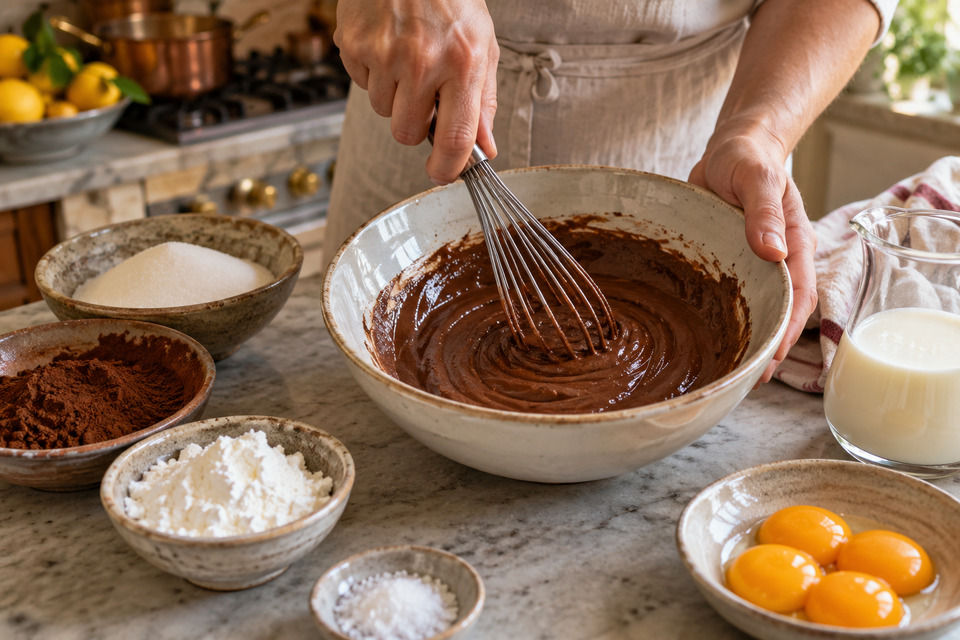
Whisk the yolks into the cold paste. Add the yolks straight into the cocoa paste and whisk until the mixture is glossy and slightly loosened. Doing this cold is deliberate. Yolks in a cold starch slurry are protected by the starch and the sugar, both of which raise the temperature at which the proteins set, so there is no risk of scrambling and no separate tempering stage later.
Step 3

Warm the remaining milk and cream. Pour the other 1 1/2 cups (360 ml) of milk and all the cream into a second pan and bring them to just below a simmer, until the surface trembles and steam rises but no bubbles break. Dairy boiled at this stage picks up a scalded note and thickens nothing, since the starch has not yet been heated. Add it to the paste in a thin stream, whisking constantly.
Step 4

Cook the base to the thickening point. Set the pan over medium low heat and stir constantly, reaching into the corners with a flat spatula rather than a whisk. The mixture stays thin for several minutes, then thickens in the space of thirty seconds as the starch granules swell and burst. Let it reach a slow bubble and hold it for 60 to 90 seconds, still stirring. That short cook removes the raw starch taste and deactivates the amylase in the yolks.
Step 5

Melt in the chocolate off the heat. Pull the pan off the burner, wait fifteen seconds, then add the chopped chocolate and the butter and stir slowly from the centre outward until both disappear. Residual heat is more than enough. Chocolate stirred in over the flame can seize or turn grainy, because the cocoa butter separates and the sugar crystallises. Add the vanilla last, once the chocolate is absorbed.
Step 6

Strain and fill the glasses. Pass the budino through a fine mesh sieve into a clean jug, pressing it through with a spatula. There is always a little cooked yolk and a few starch specks, and the sieve is the two minutes that separate a smooth pudding from a faintly grainy one. Divide it among six glasses immediately, while it is fluid, because it sets below roughly 120°F (50°C) and will not level itself.
Step 7
Chill with the surface protected. Lay a disc of plastic wrap directly onto the surface of each pudding, in contact with the chocolate, and press out any trapped air. This prevents the thick elastic skin that forms on any starch bound custard left open to cold air. Refrigerate for at least 4 hours and preferably overnight. The set continues for hours after the pudding feels cold, so a budino at three hours is looser than the same one at eight.
Plating
Serve the budino cold, in the glass it set in, and take the glasses out of the refrigerator ten minutes before they reach the table. Chocolate at 38°F (3°C) tastes muted and waxy because the cocoa butter is still firm; at around 50°F (10°C) the aromatics lift and the bitterness reads as depth.
Remove the plastic disc. If the surface dulled in the cold, pass the back of a warm spoon over it once and the gloss returns. Add a spoonful of cream whipped only until it slumps, off centre so some dark surface stays visible, shave chocolate over the cream, and finish with two grains of flaky salt.
A dusting of cocoa across half the glass adds a dry edge. Keep everything else off: berries fight the chocolate, a wafer only goes soft.
Professional Technique
The technical heart of this recipe is a dosage problem almost no printed budino acknowledges: cocoa powder contains starch, and that starch works. Natural unsweetened cocoa is roughly 10 to 12 percent native starch by weight, left in the solids once the cocoa butter is pressed out, and those granules gelatinise exactly as cornstarch does. Three tablespoons of cocoa therefore delivers close to half a tablespoon of working starch before a grain of cornstarch is weighed. Add the three or four a vanilla pudding calls for and the result is rubbery.
The second half of the problem is that cocoa powder and a chocolate bar are neither interchangeable thickeners nor interchangeable sweeteners. Cocoa powder is nearly all solids: bitterness, colour, starch, very little fat. A 70 percent bar brings those solids diluted, about 30 percent of its weight as cocoa butter and another 30 percent as sugar, and no useful starch. Cocoa butter gives melt but never gelatinises.
So the conversion runs both ways and belongs on paper before the pan goes on. Replacing 1 oz (28 g) of chopped 70 percent chocolate with cocoa means about 1/3 oz (10 g) of cocoa, adding back roughly 2 1/2 tsp (10 g) of the sugar the bar carried, then cutting the cornstarch by about 1/2 tsp because the cocoa brought its own. Going the other way you raise the cornstarch and drop the sugar. A base on cocoa alone needs about 2 1/2 tablespoons and reads leaner; one on chocolate alone needs nearer 3 and is glossier. This recipe uses both, so the cocoa supplies the bitter backbone and part of the set while the bar supplies the fat and the shine.
Texture and Moisture Control
A starch bound pudding has a narrow window and two ways out of it. Undercook the base and the granules never fully swell: it sets soft, then weeps a thin dark liquid into the bottom of the glass by morning. Overcook it, or stir it hard past the thickening point, and the swollen granules rupture, the network collapses, and the pudding comes out thinner and slightly slimy. Stir steadily, not violently.
The gloss is a moisture question as much as a fat one. What makes a budino shine is a continuous film of water held inside the starch and fat matrix, and it is lost by evaporation, which is why the disc sits on the surface and not across the rim, and by syneresis, water squeezed out as the network tightens. The second is why this dessert peaks between eight and forty eight hours.
Temperature governs the mouthfeel at both ends. The pudding must be poured hot and fluid, above roughly 120°F (50°C), or it sets with a dragged uneven surface. It must be served cool but not cold, because cocoa butter crystallises below about 45°F (7°C) and a budino straight from the refrigerator tastes flat.
Professional Mise en Place
This is a fifteen minute cook with a four hour wait behind it, and everything goes wrong while the starch is thickening, when there is no time to fetch anything.
Equipment and tools
Heavy bottomed saucepan, 2 quart, plus a pan for the dairy
Flat ended silicone spatula and a balloon whisk
Fine mesh conical sieve and a pouring jug
Digital thermometer, a gram scale, a sifter for the cocoa
Six glasses of 5 oz (150 ml) and six discs of plastic wrap
Prepared ahead
Chocolate chopped fine, at room temperature, never refrigerated
Cocoa sifted and whisked dry with the sugar, cornstarch and salt
Yolks separated and covered, out with the milk
Glasses lined on a tray so all six fill in one pass
The whole budino up to 2 days ahead, sealed and chilled
Service setup
Glasses out of the refrigerator 10 minutes before service
Cream whipped to a slump, not a peak
Chocolate shavings cut cold and kept cold so they do not curl
Flaky salt and a sieve of cocoa within reach
Chef Tips
Chop the chocolate finer than feels necessary. Lentil sized pieces melt evenly in residual heat in under a minute, while larger ones need so much stirring that the base cools. Couverture discs go in whole.
Taste the base before the chocolate goes in and again after. The cocoa stage tastes harsh alone, and that is correct, because 5 oz of 70 percent chocolate is about to add roughly 1 1/2 tablespoons of sugar. Judging sweetness before the bar goes in is how this dessert turns cloying.
If it sets too firm it can be rescued. Scrape it into a bowl, add a tablespoon of warm milk, beat it until it regains its gloss, then chill. Starch gels are shear thinning, which is also why you never beat the base hard while it cooks.
Use Dutch processed cocoa only for a rounder, darker pudding. Alkalising mutes the acidity and leaves slightly less effective starch, so add an extra 1/2 tsp of cornstarch.
Common Mistakes
Whisking cocoa into hot milk. The particles are coated in fat and repel water, so they clump instantly and never open. Whisk the cocoa dry with the sugar and starch first.
Rounding up the cornstarch. This is what makes a chocolate budino rubbery, because the cocoa already supplied starch and a heaped third spoon pushes the total too far. Weigh it: 16 g.
Pulling the pan off as soon as it thickens. The base looks finished a minute before it is. Without 60 to 90 seconds at a slow bubble the raw starch flavour stays and the pudding weeps by morning.
Adding the chocolate over the flame. The cocoa butter separates and the sugar recrystallises, and the base turns grainy. Take the pan off, count to fifteen, then stir it in.
Covering the glass instead of the surface. Wrap across the rim leaves an air gap, the pudding loses water, and a tough skin forms. It has to touch the chocolate.
Using drinking chocolate. A sweetened mix is mostly sugar and milk powder, so the pudding is pale, oversweet and badly set.
Wine Pairing
Recioto della Valpolicella DOCG: The most reliable Italian match for dark chocolate. Dried Corvina gives sweet black cherry and dried fig with real tannin behind it, and the tannin is the point: it meets the tannin in a 70 percent bar head on instead of being stripped by it. Its residual sugar sits just above the pudding, so it never turns sour.
Montefalco Sagrantino Passito DOCG: The most tannic sweet red in the country, the technical choice rather than the safe one. Sagrantino keeps an enormous polyphenol load even when made sweet, and those tannins bind to the fat in the cream and the cocoa butter rather than the proteins in the mouth. It reads as balanced against a fatty dessert, brutal against a lean one.
Moscato di Scanzo DOCG: Italy's smallest red appellation and an unexpectedly precise pairing. A dried grape Moscato from a few hectares outside Bergamo, carrying rose, dried plum and a light grip of tannin. The perfume lifts the cocoa where the cherry driven wines only match its weight.
Marsala DOC: A Superiore Dolce, for oxidative flavour instead of fruit. Years in cask give walnut, dried apricot, caramel and a salty finish, and those roasted notes run parallel to the roasted cocoa. The alcohol is high enough to cut the cream.
Vin Santo del Chianti Classico DOC: The lightest option, and the one that asks least of the dessert. Malvasia and Trebbiano dried on mats give honey, almond and dried fig with acidity that refreshes between spoonfuls. No tannin, so keep it for a milder bar at the 66 percent end.
Storage & Reheating
Keep the budini in their glasses with the plastic disc still on the surface, in the coldest part of the refrigerator. They are best from 8 hours to 2 days and remain good for 3. By day four the network has tightened and begun to squeeze out water, so a thin dark liquid gathers at the bottom. Do not store them near anything aromatic, since cocoa butter takes up other smells.
Freezing does not work. A starch gel ruptures as the water inside it turns to ice and does not reform on thawing, so what comes out is a watery grainy sauce.
There is no reheating, since this is served cold, but a stiffened pudding revives: turn it into a bowl, add a tablespoon of warm milk, beat it until glossy, then chill for 20 minutes. Never microwave it.
Nutrition
Per serving, based on 6 portions, cream and shavings included:
Calories: 385 kcal
Total Fat: 25 g
Saturated Fat: 15 g
Trans Fat: 0 g
Unsaturated Fat: 9 g
Cholesterol: 135 mg
Sodium: 150 mg
Total Carbohydrates: 34 g
Fiber: 4 g
Total Sugars: 25 g
Added Sugars: 19 g
Protein: 7 g
Lactose: 5 g
Principal micronutrients: iron, magnesium, copper, manganese, potassium, calcium, riboflavin
These figures are estimates. The largest variable is the bar: 70 percent chocolate carries about half the sugar of a 55 percent one.


Comments