Italian Chicken Broth | Brodo di Pollo
Updated: Oct 24

Brodo di pollo is the quietest thing an Italian kitchen makes and the one everything else leans on. It is not a soup that happens to be thin but a deliberately clear extraction of chicken, vegetables and time, judged on clarity, body and cleanness, and a cook who cannot make it cannot make tortellini in brodo, risotto, or any sauce that needs a proper base.
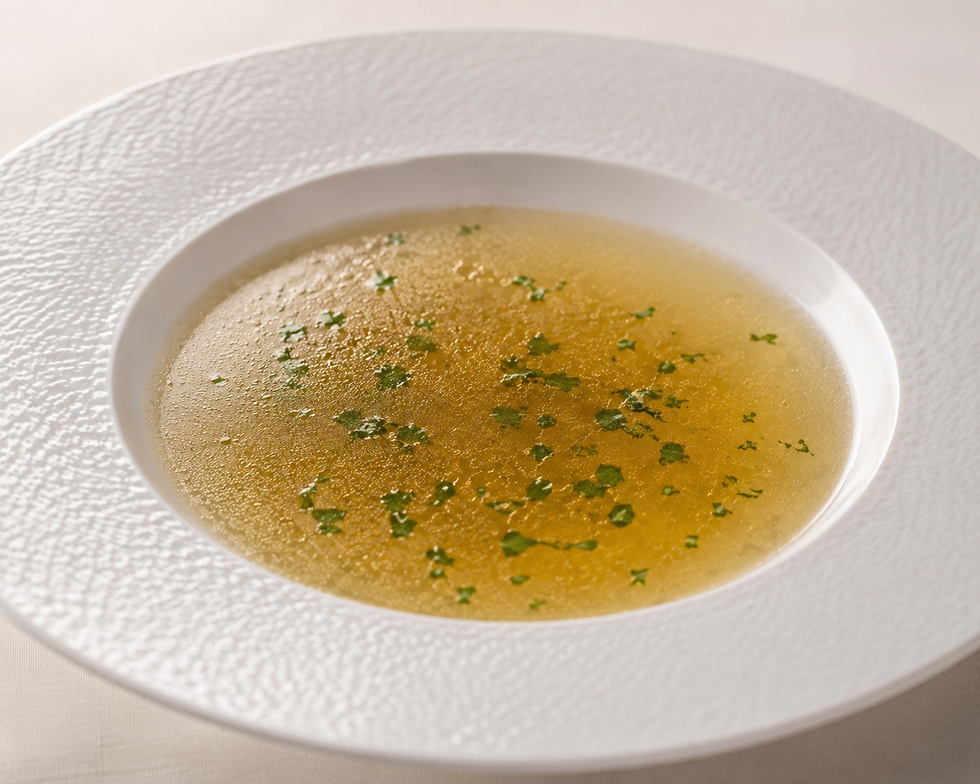
The Italian brodo is not the French fond blanc and it is not American chicken soup. The bones are not roasted, so there is no colour and no caramel note, the vegetables are few and never browned, and nothing is thickened or reduced hard. The finished liquid should be pale gold and transparent enough to read the pattern on the bottom of the bowl.
Everything that separates a good brodo from a cloudy grey one happens in the first twenty minutes and in the temperature held afterwards: cold water start, patient skimming, and a surface that trembles rather than boils. Get those three right and the rest is waiting.
Yield: about 3 quarts (2.8 liters) of finished broth, 8 servings. Prep: 20 minutes. Cook: 3 hours 30 minutes. Total: about 4 hours. Difficulty: easy but unforgiving. Course: base preparation and primo piatto. Region: made everywhere in Italy, with Emilia Romagna as its spiritual home.
The Story
Brodo belongs to the Sunday kitchen of northern and central Italy, and above all to Emilia Romagna, where it exists to carry tortellini. In Bologna and Modena the broth is not an accompaniment to the pasta, it is half the dish, and families argue about it with the seriousness other regions reserve for ragu. The classic Emilian version mixes chicken with beef and sometimes pork, but chicken alone has always been the everyday one.
Its origins are economic rather than gastronomic. A laying hen past her useful life was tough, sinewy and useless roasted, but boiled slowly she gave a broth of extraordinary depth and a bowl of shredded meat for the second course. That is the old gallina vecchia fa buon brodo, the old hen makes good broth, and it is literally true: older birds carry far more connective tissue and much more flavour than the young chickens sold today.
Brodo is also the standard Italian convalescent food, given to anyone ill or elderly and to new mothers. That role is not sentimental: a well made broth is warm, salted, hydrating and easy to absorb, and the winter habit of keeping a pot going comes from households where it was the most reliable thing anyone could be given.
Ingredients
For the chicken
Whole chicken, or an equivalent weight of backs, wings and necks, 4 lb (1.8 kg)
Chicken feet, cleaned, 8 oz (225 g), optional but strongly recommended
Cold water, 5 quarts (4.7 liters), enough to cover by 2 inches (5 cm)
For the vegetables
Yellow onion, halved and left unpeeled for colour, 1 large (8 oz, 225 g)
Carrots, peeled and halved, 2 medium (6 oz, 170 g)
Celery stalks with leaves, 2 (4 oz, 115 g)
Leek, white and pale green, split and washed, 1 small
For the aromatics
Flat leaf parsley stems, 8
Bay leaf, 1
Black peppercorns, whole, 10
Whole clove, 1
Fine sea salt, 2 tsp (12 g), added only at the end
For serving as a primo
Small pasta such as quadrucci, stelline or capellini spezzati, 4 oz (115 g)
Parmigiano Reggiano, finely grated, 1/2 cup (45 g)
Flat leaf parsley, very finely chopped, 1 tbsp
Freshly ground black pepper, to taste
Preparation
Breaking down and rinsing the chicken
Joint the bird into eight pieces, or use backs, wings and necks, which give more gelatin per pound than breast ever will. Rinse under cold water and pick off the loose fat pockets around the cavity, since that fat only has to be removed later. Add the feet if you have them: they are the cheapest source of body in the pot.
The cold water start
Put the chicken and feet in a tall narrow stockpot and cover with cold water by about 2 inches (5 cm). Cold is not a detail: proteins that dissolve in cold water rise slowly as a coherent grey raft you can lift off, while a hot start seizes and disperses them through the liquid, where they stay and cloud the broth permanently.
Coming to temperature and skimming
Bring the pot up over medium low heat, uncovered, over 30 to 40 minutes, and never rush it. As the surface approaches 175°F (80°C) grey foam gathers at the edges: take it off with a ladle every few minutes for about 20 minutes, until only a clean rim of fat remains. This step decides clarity and nothing later can undo it.
Adding the vegetables and aromatics
Only once the skimming is finished do the onion halves, carrots, celery, leek, parsley stems, bay leaf, peppercorns and clove go in. Added earlier they trap foam and make skimming impossible. Leave the onion unpeeled: the skins give the pale gold colour without any browning.
Holding the simmer
Settle the heat so the surface barely trembles, one bubble breaking every second or two and no rolling movement. The range is 185°F to 195°F (85°C to 90°C). Hold it there uncovered, or with the lid ajar, for 3 hours. A lid clamped on climbs to a boil without you noticing and undoes three hours of care in twenty minutes.
Straining
Lift out the large solids with tongs and a spider, then pour the broth through a fine mesh sieve lined with damp muslin set over a clean pot and let it drain under its own weight. Do not press the solids: pressing forces fine particles through the cloth and clouds a broth that was clear a moment earlier.
Chilling and degreasing
Cool the broth quickly, in a sink of iced water or in shallow trays, then refrigerate until cold. The fat sets into a solid pale disc and lifts off in one piece with a spoon, which removes far more than blotting the hot surface with paper. A good broth will have set to a soft jelly underneath.
Seasoning and serving
Season only now, with the broth reheated and tasting as it will be eaten, because three hours of evaporation concentrate everything added early. Add fine sea salt in small amounts, tasting between each. To serve as a primo, bring it to a simmer, cook the small pasta directly in it, and ladle out at once with grated Parmigiano Reggiano and parsley.
Plating
Serve brodo in a wide shallow soup plate rather than a deep bowl, warmed well, because a thin liquid in a cold dish loses several degrees before it reaches the table. Fill to about two thirds, never to the rim: the point is a pale gold surface with room around it, and a broth this clear should be allowed to be looked at.
If you are serving it with pastina or tortellini, the pasta belongs at the bottom in a small heap, not stirred through. Ladle the broth over it so it settles, then add a very small amount of finely chopped parsley on the surface and nothing else. Resist floating vegetables in it. The carrots and celery have given everything they had and their place is out of the pot.
Parmigiano Reggiano goes at the table and not in the kitchen, in a small bowl with a spoon, so each person adds their own. Cheese stirred in before service clouds the broth within a minute, which after three hours of skimming is an unnecessary way to lose the thing you worked for.
Professional Technique
The governing technique is temperature control, and it rests on a single fact: clarity and agitation are opposites. Collagen hydrolyses into gelatin at around 160°F (71°C) and continues steadily up to about 200°F (93°C), so a broth held at 190°F (88°C) extracts everything a boiling one does. What boiling adds is movement, and movement emulsifies fat and breaks suspended protein into particles too fine to strain out. That is the whole difference between a transparent brodo and a grey one.
The second is the cold water start and the skim that follows. Soluble albumin proteins leave the meat below 140°F (60°C) and coagulate as they warm. Started cold they migrate to the surface and gather into a raft that lifts off; dropped into hot water they set inside the liquid and stay there. This is why the order is fixed: chicken and cold water, skim to completion, vegetables afterwards.
The third is knowing what to put in the pot. Gelatin comes from connective tissue, not muscle, so wings, backs, necks and above all feet are worth more than breast. Feet are almost pure skin, cartilage and tendon, and 8 oz (225 g) will take a broth from watery to one that sets to a jelly in the refrigerator. That set is the visible proof of extraction and what gives weight in the mouth without any fat.
Texture and Moisture Control
A broth has no starch to manage, so everything that would be texture in a pasta dish is here a question of clarity, body and temperature. Clarity is decided in the first hour. Skim continuously from the moment foam appears until it stops forming, using a ladle rather than a slotted spoon so you take liquid with the scum. A broth that goes cloudy in hour one is cloudy for good: no filtration is fine enough to recover it.
Body comes from collagen, and collagen needs time at the right temperature rather than heat. Three hours at a trembling simmer converts the connective tissue in wings, necks and feet into gelatin that gives the liquid a faint clinging weight on the lips. Push the pot to a boil to speed this up and you gain nothing in extraction while driving fat into permanent emulsion, which reads as greasiness and looks like turbidity.
Hold the surface between 185°F and 195°F (85°C and 90°C) and judge it by eye: one bubble breaking every second or two, the surface shivering, no current running through the pot. Leave the lid off or resting ajar, because a sealed pot climbs to a boil quietly and you will not see it until the damage is done.
Finally, control how much water leaves. Roughly a fifth of the volume evaporates over three hours, concentrating both flavour and salt, which is why the salt goes in at the end. If the level drops below the solids, top up with boiling water, never cold, which would drop the pot out of its range.
Professional Mise en Place
Brodo is the one preparation in a professional kitchen that is never made to order. It is made the day before, chilled, degreased and portioned, and at service it is only reheated and seasoned.
Equipment and tools
Tall narrow stockpot, 8 quarts (7.5 liters), which limits evaporation and surface agitation
Ladle and a fine skimmer kept beside the pot for the first hour
Fine mesh conical sieve and damp muslin for straining
Shallow trays or an iced water bath for rapid cooling
Probe thermometer, or a diffuser if your burner runs hot
Prepared ahead
Broth made, strained and chilled the day before, fat lifted off cold
Broth portioned into 1 quart (950 ml) containers, dated, refrigerated or frozen
Chicken meat picked from the bones while warm and kept for a second course
Pasta weighed per portion and held dry, never precooked
Service setup
Broth at a bare simmer in a small pan, seasoned only after it is hot
Soup plates warming, and Parmigiano Reggiano grated to order
Pasta cooked directly in the broth to order, never held
Parsley chopped at the last minute so it stays green
Chef Tips
Ask the butcher for chicken feet and for a boiling fowl if he has one. Feet cost almost nothing and do more for body than anything else, and an old hen gives a broth no supermarket chicken will match. If you use a hen, extend the simmer to 4 hours.
Save the carcass and wing tips from every roast chicken in the freezer until you have 4 lb (1.8 kg). Roasted bones make a darker broth than the Italian style wants, so keep them to a third of the total and leave the rest raw.
Freeze the finished broth in a way that suits how you cook. One quart containers for soup, and an ice cube tray for the small quantities that finish a risotto or loosen a sauce. Frozen cubes go straight into a hot pan with no thawing and are far more useful than a single large block.
Never throw away the fat you lift off the cold broth. Chicken fat keeps two weeks refrigerated in a sealed jar and is excellent for starting a soffritto, roasting potatoes or enriching a plain vegetable soup.
Common Mistakes
Starting with hot water. Soluble proteins seize inside the liquid instead of rising, and the broth is cloudy from the first minute with no way back. Always cover the chicken with cold water and bring it up slowly.
Letting it boil. A rolling boil emulsifies the fat and shatters the protein raft, producing a broth that is grey, greasy and flat. Hold the surface at a tremble, 185°F to 195°F (85°C to 90°C), lid ajar.
Adding the vegetables at the start. They trap the rising foam and make proper skimming impossible, and after three hours they taste stewed rather than clean. Put them in only once the skimming is finished.
Salting at the beginning. A fifth of the water evaporates over three hours, so a broth correctly seasoned at the start is unpleasantly salty at the end. Salt after straining, with the broth hot.
Pressing the solids in the sieve. Pressing forces fine particles through the cloth and clouds a broth that was clear a second earlier. Let it drain under its own weight.
Using breast meat as the main ingredient. Muscle gives some flavour but almost no gelatin, so the broth stays thin and watery. Build the pot on wings, backs, necks and feet, where the connective tissue is.
Wine Pairing
Soave Superiore DOCG: The most natural match, because Garganega is a low aroma grape and a broth is a low aroma dish. Its almond and white flower notes and gentle acidity sit beside the chicken without reaching past it, and the waxy weight of a Superiore gives the pairing enough substance to survive a salted liquid.
Verdicchio di Matelica DOC: Grown inland in the Marche at altitude, this is the leanest and most mineral Verdicchio, with brisk acidity and the bitter almond finish the grape is known for. That bitterness cuts the salinity of a well seasoned broth and stops a gelatinous mouthfeel turning cloying.
Collio Friulano DOC: Dry, textured and faintly nutty, Friulano has a savoury edge that follows the glutamates in a long simmered broth rather than fighting them. It is a particularly good choice when the brodo is served with tortellini, where the filling brings pork and Parmigiano and the wine needs a little more grip.
Trento DOC: The traditional method sparkler of the Alps, bone dry and high in acidity, with fine bubbles and a bready autolytic character from time on the lees. It works by contrast: the mousse and acidity lift a dish that has none of its own, and make a plain broth feel like a first course.
Erbaluce di Caluso DOCG: A Piedmontese white of real cut, with piercing acidity, low alcohol and a stony, faintly citrus profile. Its restraint is the point: there is nothing in it to overwhelm a delicate broth, while the acidity refreshes the palate between spoonfuls of something warm, savoury and slightly gelatinous.
Storage & Reheating
Cool the strained broth quickly, over iced water or in shallow trays, then refrigerate. It keeps 4 days in an airtight container, and leaving the fat cap in place until you need it seals the surface and buys an extra day. Freeze it in 1 quart (950 ml) containers or in ice cube trays for up to 4 months, leaving headroom because liquid expands as it freezes.
Reheat only what you need, in a small pan over medium heat, and bring it just to a simmer rather than a boil. A broth reboiled repeatedly turns flat and slightly muddy, so decant a portion and leave the rest cold. Taste and adjust the salt after reheating, since a frozen broth often needs a little more than it did fresh.
Never store broth with pasta in it. The pastina keeps absorbing liquid in the refrigerator, swells to twice its size and turns the broth starchy and thick overnight, which is the most common way a beautiful brodo is ruined after it has been made. Cook the pasta in the broth portion by portion, at the moment of serving, and store the two apart.
Nutrition
Per serving, based on 8 servings of degreased broth with pastina and cheese:
Calories: 165 kcal
Total Fat: 4 g
Saturated Fat: 1.8 g
Trans Fat: 0 g
Unsaturated Fat: 2 g
Cholesterol: 18 mg
Sodium: 620 mg
Total Carbohydrates: 12 g
Fiber: 0.5 g
Total Sugars: 1 g
Added Sugars: 0 g
Protein: 18 g
Lactose: 0.2 g
Principal micronutrients: collagen peptides, glycine, proline, potassium, phosphorus, calcium, selenium, vitamin B3, vitamin B6
These figures are estimates. Broth taken without pasta or cheese falls to roughly 45 kcal and 8 g of protein per serving, and the sodium depends entirely on how you salt it, since none of the salt is discarded.




Comments