Italian Potato Gnocchi | Gnocchi di Patate
Updated: Oct 24

A plate of gnocchi di patate is judged in the first second. They either give way under the tooth with almost no resistance, tasting of potato and butter, or they sit heavy and taste of raw flour. The whole recipe is four ingredients, and the outcome is decided long before the water boils, in the choice of potato and in how little flour the cook is willing to use.
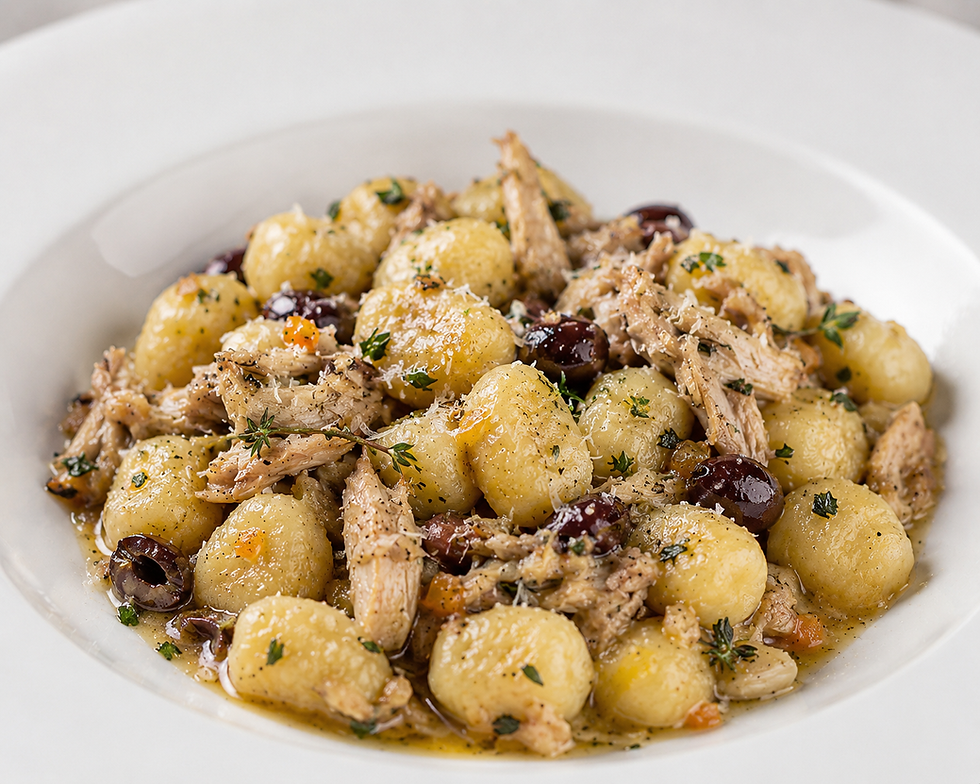
This is the classic version, made with white fleshed floury potatoes boiled whole in their skins, riced while still steaming, and bound with the smallest amount of flour that will hold a rope together. One egg goes in for insurance, as it does in most home kitchens of the Veneto, and the dressing is the oldest there is: butter taken to the colour of hazelnut shell, sage crisped in it, Parmigiano Reggiano over the top.
Read the method before you start, because gnocchi dough waits for nobody. Potato starch releases water as it cools, and a dough left on the board for twenty minutes demands more flour than the same dough shaped hot. From the moment the ricer comes out the clock is running.
Yield: 4 generous first course servings. Prep: 35 minutes. Cook: 50 minutes. Total: about 1 hour 25 minutes. Difficulty: intermediate. Course: primo piatto. Region: Veneto and the north of Italy.
The Story
Verona has done something no other Italian city has managed: it has given potato gnocchi a public holiday. On the last Friday of carnival, Venerdi Gnocolar, the Veronese elect a Papa del Gnoco, an old man in a red robe carrying a giant forked stick with a single gnocco on the end, and the San Zeno quarter eats gnocchi in the street. The custom is traced to 1531, when a famine and a flour shortage ended with the wealthy of the district paying for food to be handed out to the poor.
The potato itself arrived much later than the ritual. Gnocchi existed in Italy for centuries before the potato did, made of bread and milk, of semola, of chestnut flour or of ricotta, and the word simply meant a small lump of dough dropped in liquid. The potato reached Italian tables in useful quantity only in the late eighteenth century, pushed by agronomists and by famine, and it took another fifty years before northern cooks understood that a floury potato could replace most of the flour rather than merely stretch it.
What followed was the rule that still separates a good plate from a bad one. Every region that adopted the potato gnoccho reduced the flour as far as it dared, and Veneto and Friuli treat flour as a necessary defect. The same logic explains the dressing: burro e salvia costs almost nothing, adds no moisture to a dumpling that needs none, and lets the potato speak. Tomato and meat sauces travelled further, but in San Zeno the gnocco is still eaten with butter, sage and grated cheese.
Ingredients
For the gnocchi
White fleshed floury potatoes, russet or similar, 3 lb (1.35 kg), of even size
All purpose flour, 1 1/2 cups (190 g), plus up to 1/2 cup (60 g) more if needed
Egg, large, 1 (about 50 g), lightly beaten
Fine sea salt, 1 tsp (6 g)
Freshly grated nutmeg, 1 small pinch
Coarse salt for the cooking water, 2 tbsp (30 g) for every 4 quarts (3.8 l)
For the butter and sage
Unsalted butter, 6 tbsp (85 g)
Fresh sage leaves, 16
Freshly ground black pepper, 1/2 tsp (1 g)
For finishing
Parmigiano Reggiano, grated, 1 cup (90 g), aged 24 months
Reserved gnocchi cooking water, 1/4 cup (60 ml)
Preparation
Step 1

Boil the potatoes whole in their skins. Choose potatoes of similar size so they finish together, scrub them and put them into cold unsalted water. Bring to a gentle boil and cook for 35 to 45 minutes, until a thin knife slides to the centre with no resistance. The skins stay on and the water stays unsalted for the same reason: to stop the potato drinking the water it cooks in, since every extra gram of moisture is paid for later in flour.
Step 2

Peel them while they are still hot. Drain the potatoes and peel them at once, holding each in a folded towel and pulling the skin away with a paring knife. It is uncomfortable work and it cannot be postponed. A potato left to cool sets its starch, turns gummy under the ricer and gives a dough that never becomes light.
Step 3

Rice them hot onto the board. Pass the hot peeled potatoes through a ricer straight onto a wide cool surface, letting them fall in a loose snowy layer rather than a mound, then spread that layer and leave it 5 minutes. The steam rising off it is water leaving the dough for free. Never use a food processor, which shears the starch and turns potato to glue.
Step 4

Season the potato and add the flour by feel. Scatter the fine salt and the nutmeg over the cooled potato, pour the beaten egg across the surface, then sift about two thirds of the flour over the top. Bring it together with a bench scraper, folding rather than kneading, adding more flour only in small showers and only where the dough is still tacky. Stop the moment it holds and no longer clings to your palm, which takes 1 1/2 to 2 cups (190 to 250 g) in all.
Step 5

Roll the dough into ropes. Cut the dough into six pieces and work with one at a time, keeping the rest covered. Dust the surface very lightly and roll each piece outwards from the centre with flat fingers into a rope about 3/4 inch (2 cm) thick. Use no more pressure than it takes to move the dough along, and stop if the rope tears, which means it is dry and wants a few drops of water rather than flour.
Step 6

Cut the ropes into even pieces. Cut each rope straight across into pieces about 3/4 inch (2 cm) long, moving the blade cleanly so the ends stay square instead of squashed. Keep them the same length, because a tray of uneven gnocchi cannot be cooked to one point. Dust them with the least flour possible and keep them separated on a floured tray.
Step 7

Shape them on the ridged board. Roll each piece down a ridged gnocchi board, or the back of a fork, with your thumb, pressing just enough to leave ridges on one face and a hollow on the other. That shape is not decoration: the grooves hold sauce and the hollow lets heat reach the centre faster. Return them to the tray in one layer and cook within 30 minutes.
Step 8

Bring the water up and salt it properly. Fill a wide pot with 4 quarts (3.8 l) of water for each batch, bring it to a boil and add 2 tbsp (30 g) of coarse salt. Then lower the heat until the surface moves but no longer rolls. Gnocchi are fragile and a hard boil batters them apart, so hold a strong simmer at around 205°F (96°C), with the butter pan alongside.
Step 9

Brown the butter and crisp the sage. Melt the butter in a wide sauté pan over medium heat and add the sage leaves whole. Let it foam, then watch the milk solids turn from pale gold to the colour of a hazelnut shell, about 3 to 4 minutes, and pull the pan aside the moment it smells nutty. Burnt butter is bitter and cannot be corrected, so stop early rather than late.
Step 10

Cook the gnocchi and finish them in the pan. Slide the gnocchi into the simmering water in batches of no more than thirty. They sink, then rise within 1 1/2 to 2 minutes, and from the moment one floats it needs 30 seconds more. Lift them with a spider into the brown butter with a splash of the cooking water, and swirl for 20 seconds until butter and starch pull into a glossy film. Add half the Parmigiano off the heat and serve.
Plating
Warm the plates before the gnocchi go into the water, not after. A cold plate drops the temperature of a small dumpling within seconds and the butter sets into a dull film. Shallow wide bowls beat flat plates: they keep the gnocchi in one layer and stop the sauce running to the rim.
Spoon the gnocchi out of the pan rather than tipping them, letting them fall loosely so they do not stack, about twenty to a portion. Pour whatever butter is left over the top and divide the crisp sage so every plate gets four leaves. Finish with the remaining Parmigiano and a grind of black pepper and send immediately: gnocchi are at their best for perhaps two minutes.
Professional Technique
The technique of classic potato gnocchi is a fight against water. A boiled potato holds roughly 78 percent water, and every point above that has to be absorbed by flour, which is why a waterlogged potato gives a dough that eats like paste. Boiling whole in the skin is the first defence. Ricing hot and spreading thin is the second, and five minutes of open steam removes more moisture than extra flour could ever compensate for.
The second control is starch temperature. Potato starch gelatinises during cooking and then begins to retrograde, or recrystallise, as the potato cools, and retrograded starch is tough, sticky and unwilling to bind. That is the real reason for peeling and ricing hot. It is not bravado: it is the narrow window in which the starch is still soft enough to make a dough that needs almost no flour, and no later technique recovers the lightness lost outside it.
The third is gluten, the enemy of a gnoccho, which should be tender rather than elastic. Folding with a bench scraper instead of kneading keeps development to almost nothing, and stopping the instant the dough coheres keeps it there. The proof is the cooking: a gnoccho built this way rises in under two minutes, light enough to float long before it is overcooked.
Texture and Moisture Control
One test is worth three minutes. Before shaping the whole batch, drop two gnocchi into the simmering water. If they hold their shape, rise in about 90 seconds and cut with no chalky core, the dough is right. If they dissolve, fold in another 2 tbsp (16 g) of flour and test again. If they are rubbery, there is already too much flour and the only cure is to rice a further hot potato into the dough. Never assume the ratio: potato moisture changes with variety, storage and season.
The cooking water is also the sauce. Butter alone slides off a gnoccho and pools, but a quarter cup of starchy gnocchi water swirled into the brown butter emulsifies it into something that clings to every ridge. Keep the heat low while you swirl, because a boiling emulsion breaks. Add the Parmigiano only off the heat, since cheese proteins tighten and go stringy above about 180°F (82°C).
Professional Mise en Place
Gnocchi are made in one continuous run and finished in three minutes, so everything is set out before the potatoes come off the heat.
Equipment and tools
Potato ricer with a fine plate, never a food processor
Large pot for boiling the potatoes and a wide pot for cooking the gnocchi
Bench scraper, thin paring knife and a clean folded towel
Ridged gnocchi board or a large fork, plus two floured trays
Wide sauté pan for the butter, spider skimmer, warm shallow bowls
Prepared ahead
Potatoes boiled and peeled, but never riced ahead: the dough must be built hot
Parmigiano grated and covered at room temperature, up to 4 hours
Sage picked, washed and dried completely, up to 1 day, refrigerated
Cooking water brought up and salted while the dough is rolled
Service setup
Shaped gnocchi on floured trays, in one layer, cooked within 30 minutes
Butter pan on a low burner beside the pot, sage already crisp
Ladle of reserved cooking water within reach of the pan
Plates warmed, cheese and pepper at the pass, all portions sent together
Chef Tips
Buy the oldest floury potatoes you can find. A potato out of the ground for a few months has lost moisture and converted sugar to starch, which is the condition you want. New potatoes are waxy, wet and sweet, and they drink flour without ever becoming light.
Weigh the riced potato before you add anything. Three pounds of raw potato yields roughly 2 lb 6 oz (1.08 kg) peeled, and flour at about 15 percent of that weight is the ceiling. If the arithmetic says more, the potato was too wet.
Keep the flour in a sieve rather than a bowl. Sifting spreads a fine veil that mixes in with two folds, while a handful thrown at the dough has to be worked twice as long, and that extra working builds the gluten you are avoiding.
If the gnocchi are for later in the day, freeze them rather than refrigerate them. Spread the tray in the freezer for 2 hours until the pieces are solid, then bag them. Refrigerated raw gnocchi weep, stick and go grey within hours.
Common Mistakes
Peeling and boiling the potatoes in cubes. Cut surfaces absorb water throughout the cooking, and cubed potatoes come out several points wetter than whole ones. That water has to be taken up by flour, and the gnocchi turn dense.
Letting the potatoes cool before ricing. Cooled potato starch retrogrades and turns sticky and tough, so the dough needs more flour and never lightens. Peel and rice while they are hot enough to be awkward to handle.
Kneading the dough like bread. Gnocchi dough needs coherence, not gluten. Working it on the heel of the hand builds elasticity that makes the finished gnocchi chewy. Fold with a bench scraper and stop the moment it holds.
Boiling them hard. A rolling boil knocks gnocchi against the pot and tears the surface, which then leaks starch and clouds the water. Hold a strong simmer where the surface moves without breaking.
Waiting for them to float and then walking away. Floating means nearly done, not done. Thirty seconds after they rise is the whole margin, and a minute past that the outside is saturated and begins to collapse.
Wine Pairing
Bianco di Custoza DOC: The wine of the moraine hills south of Verona, and so the local pour for a dish the city treats as its own. The blend of Garganega, Trebbiano and Cortese gives white flower and almond with acidity that stays polite rather than sharp, and that restraint suits a plate of potato, butter and cheese.
Colli Bolognesi Pignoletto DOCG: Chosen for the fat rather than the flavour. Pignoletto is brisk, dry and faintly bitter, with green apple and a chalky grip, and it scrubs browned butter off the palate better than a rounder white. It also copes with the salt of a heavy grating of Parmigiano, which turns softer wines flabby.
Erbaluce di Caluso DOCG: A steely high acid white from the Canavese in northern Piedmont, the most cutting bottle here. Its citrus and wet stone profile gives no ground to the butter, and its long saline finish echoes the aged cheese instead of arguing with it.
Trentino Marzemino DOC: For anyone who wants a red and does not want to bury the gnocchi. Marzemino is light in tannin, dark in fruit and faintly herbal, and that green edge runs parallel to the crisped sage rather than fighting it. Serve it at 57°F (14°C).
Alto Adige Santa Maddalena DOC: Schiava from the slopes above Bolzano, pale, gentle and finishing on a bitter almond note that picks up the toasted milk solids in the butter. There is almost no tannin to dry the mouth, so the texture of the gnocchi stays intact. Pour it at around 55°F (13°C).
Storage & Reheating
Raw shaped gnocchi freeze well and refrigerate badly. Spread the tray in the freezer for about 2 hours until every piece is hard, then bag them and keep for up to 1 month. They go into the simmering water straight from frozen, with no thawing, and need about 1 minute longer than fresh.
Cooked and dressed gnocchi keep sealed in the refrigerator for up to 2 days. To bring them back, do not boil them again: melt 1 tbsp (15 g) of butter in a nonstick pan with 2 tbsp (30 ml) of water, add the gnocchi, cover and warm over low heat for 3 to 4 minutes, shaking the pan.
The better second life is the pan. Cold leftover gnocchi fry well: get a little butter hot, lay them in one layer and leave them 2 minutes a side until the flat faces are golden, then finish with Parmigiano. Do not freeze cooked gnocchi, which collapse on thawing, and do not use a microwave.
Nutrition
Per serving, based on 4 first course portions:
Calories: 610 kcal
Total Fat: 25 g
Saturated Fat: 15 g
Trans Fat: 0.8 g
Unsaturated Fat: 8 g
Cholesterol: 105 mg
Sodium: 780 mg
Total Carbohydrates: 79 g
Fiber: 6 g
Total Sugars: 3 g
Added Sugars: 0 g
Protein: 19 g
Lactose: 1.2 g
Principal micronutrients: potassium, vitamin C, vitamin B6, calcium, phosphorus, vitamin A
These figures are estimates. Most of the salt in the cooking water is discarded with it, and the final sodium depends on how much Parmigiano reaches the plate.



Comments