
Italian Potato Gnocchi with Brown Butter, Parmigiano and Alba White Truffle | Gnocchi di Patate al Burro Nocciola e Tartufo Bianco d'Alba

For about ten weeks a year Alba smells of something no kitchen can reproduce. Tuber magnatum pico, the white truffle of the Langhe, is dug between October and late December and sold within days, because it loses aroma by the hour and nothing preserves it. A cook holding one has a short window and one obligation: carry that aroma to the table, then get out of its way.
Potato gnocchi are the vehicle Piedmont chose. They are mild, warm, faintly sweet, and porous enough to catch melted butter and hold it. Nothing about them argues with the truffle. A tomato sauce or a stock reduction would fill the very space the truffle needs.
The technique is therefore subtractive. The butter is taken to the hazelnut stage and stopped early. The Parmigiano is weighed, not showered on. The pepper is white, because black pepper carries its own perfume into the register the truffle occupies. And the truffle is never heated: it is shaved at the table, in front of the person about to eat it.
Yield: 4 servings. Potato cooking and cooling: 1 hour. Dough and shaping: 40 minutes. Sauce and service: 10 minutes. Total: about 1 hour 50 minutes. Difficulty: intermediate. Course: primo piatto. Region: Piedmont, the Langhe and Roero hills around Alba.
The Story
The white truffle of Alba was for centuries a local peculiarity rather than a luxury. It grows wild in symbiosis with oak, poplar, willow and linden along the Tanaro and through the Langhe, Roero and Monferrato, and it cannot be farmed, which is the fact that governs everything else. Every one sold in Alba was found by a trifulau and his dog, at night, in woods the man refuses to name even to his family.
Its international reputation was manufactured by one hotelier. Giacomo Morra of the Albergo Savona began shipping the best truffle of each season to a famous name abroad in the late 1940s, among them Winston Churchill and Alfred Hitchcock. The coverage turned a regional autumn ingredient into a global one, and the Fiera Internazionale del Tartufo Bianco d'Alba, running since 1929, became the market that sets the price of the season.
Gnocchi arrived with the potato, late, once the tuber moved from curiosity to field crop across the eighteenth century. The mountain valleys grow a great deal of it, and the gnocco became a staple, usually dressed with butter and cheese. Putting truffle over gnocchi was no chef's invention: it was what a family in the Langhe did in November with what was in the house.
Ingredients
For the gnocchi
Floury potatoes, unpeeled, of even size, 2 lb (900 g)
All purpose flour, 3/4 cup plus 2 tbsp (115 g), plus a little for the work surface
Egg yolk, large, 1
Fine sea salt, 1 tsp (6 g)
Freshly grated nutmeg, 1 small pinch
Coarse salt for the cooking water, 1 tbsp (18 g) per 4 quarts (4 liters)
For the brown butter
Unsalted butter, cold, cut into cubes, 5 oz (140 g)
Sage leaves, small, 4
Parmigiano Reggiano, aged 24 months, finely grated, 2 oz (55 g)
Reserved gnocchi cooking water, about 1/3 cup (80 ml)
Freshly ground white pepper, to taste
For finishing
Tartufo Bianco d'Alba, fresh, brushed clean, 1 oz (30 g) total, about 1/4 oz (7 g) per plate
Parmigiano Reggiano, extra for the table, 1/2 oz (15 g)
Fine sea salt, a few grains per plate
Preparation
Cook the potatoes whole and in their skins
Choose floury potatoes of the same size so they finish together, and do not peel them. Start them in cold salted water, bring the pan to a bare simmer and cook until a thin knife slides to the centre without resistance, 35 to 45 minutes. Peeling or cutting them first lets water into the flesh, and every gram of it is paid for later with flour.
Rice the potatoes hot and let the steam escape
Drain and peel them while they are too hot to hold comfortably, using a cloth and a small knife. Pass them straight through a ricer onto a large cool tray, letting the threads fall loosely. Spread them thin and leave them 10 minutes. Flour absorbs far less once that steam has gone: this is the second lever for keeping the flour low.
Bring the dough together without kneading it
Scatter the salt, the nutmeg and two thirds of the flour over the cooled potato, add the egg yolk and bring it together with a bench scraper, folding rather than working. Add the rest only if the mass still sticks to your palm, and stop the moment it holds a shape. Every extra fold tightens it, and there is no way back.
Roll, cut and ridge the gnocchi
Cut the dough into four and roll each piece into a rope about 3/4 inch (2 cm) thick on a lightly floured surface. Cut equal lengths and roll each down a fork or a gnocchi board with your thumb, leaving ridges on one side and a hollow on the other: the ridges hold the butter and the hollow traps it. Lay them on a floured tray.
Set the water and test a single gnoccho
Bring a wide pan of water to a gentle boil and salt it at about 1 tablespoon (18 g) per 4 quarts (4 liters), less than pasta water, since butter and Parmigiano both carry salt. Drop one in and taste it. If it disintegrates, fold another tablespoon of flour into the dough. If it is dense, roll the remaining ropes thinner.
Take the butter to the hazelnut stage and stop it
Put the cold butter into a wide saute pan over medium heat with the sage. It foams, the foam subsides, the milk solids begin to colour. The moment they turn the colour of a hazelnut skin and the pan smells nutty rather than toasted, pull it off and add two tablespoons of gnocchi water to arrest it. Thirty seconds later it would be dark, roasted, and loud enough to bury the truffle.
Cook the gnocchi and lift them at the float
Cook them in two batches so the pan is never crowded and the water never stops moving. They are ready a few seconds after they rise, about 90 seconds in, and more time never improves them. Lift them out with a spider, never a colander. Reserve a cup of the cooking water first.
Mantecare the gnocchi in the pan
Return the butter pan to low heat, tip in the gnocchi and add two tablespoons of the reserved water. Shake it steadily, tilting it away from you, so they roll instead of being stirred and broken. Off the heat, rain in the Parmigiano in three additions, shaking between each, adding water by the spoonful until the sauce turns glossy and clings. Season with white pepper and serve at once.
Plating
Warm the plates to about 140°F (60°C), before the gnocchi go into the water rather than after. Butter sets on a cold plate within twenty seconds, and the warmth rising off a hot one is what volatilises the aroma of the truffle.
Use shallow bowls with a wide flat base. Spoon the gnocchi into a low mound at the centre, eight to ten per person, letting the sauce settle around them rather than pooling beneath. Scrape the pan clean and divide whatever remains, since that residue is the most concentrated part of the sauce. Add no garnish.
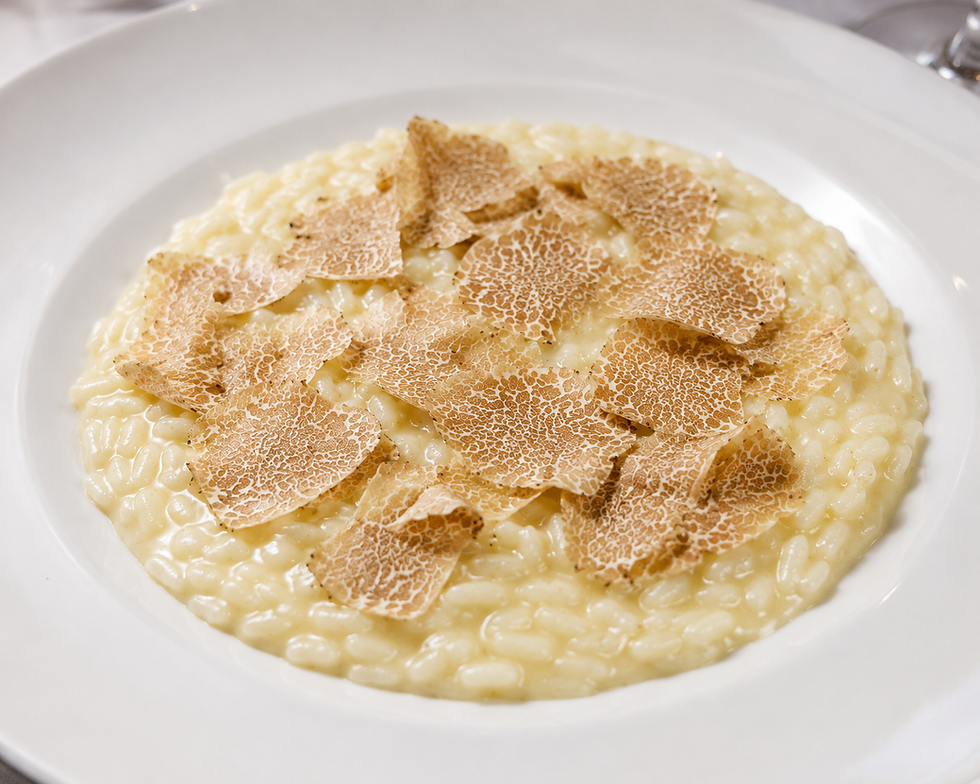
Then shave the truffle at the table, plate by plate, with a proper slicer set as fine as it goes. Hold it close so the shavings land flat on the hot gnocchi. Weigh the portions beforehand if you like, around 1/4 oz (7 g) each, but shave in front of the guest: half of what a white truffle gives arrives through the nose in the first thirty seconds.
Professional Technique
The governing technique is flour minimisation, and every earlier decision serves it. A potato boiled in its skin, riced hot and steamed off takes roughly a third less flour than one boiled peeled and riced cold. The ratio here is about 115 g of flour to 900 g of raw potato, and only that sequence makes it possible. Cooks who need far more are compensating for water they let in.
The second is arresting the brown butter. Beurre noisette is a continuous reaction, not a state: the solids keep browning after the pan leaves the flame. Adding starchy cooking water at the hazelnut point drops the temperature at once and supplies the aqueous phase the emulsion needs. Without it the Parmigiano seizes into strings and the sauce breaks into an oily pool.
The third is restraint with the truffle. Tuber magnatum pico owes its aroma to volatile sulphur compounds, bis methylthiomethane chief among them, which give it the garlic, fermented cheese and wet earth character it is famous for. Heat destroys them and air disperses them. That is why the truffle goes on at the table, and why no cook in Alba deliberately cooks one.
Texture and Moisture Control
Gnocchi have one texture worth having, a yielding pillowy interior that gives way under no pressure, and two ways of losing it. Too much flour makes them dense; too much water makes them slack, so they collapse or demand still more flour. The trial gnoccho is the only test that tells you where you stand. Adjust once and commit, because endless adjustment undoes what the ricer achieved.
The sauce is a butter emulsion held by two starches at once, the one dissolved in the cooking water and the one shed by the gnocchi. Potato starch emulsifies more efficiently than wheat starch, which is why gnocchi water pulls a butter sauce together faster than pasta water. Add it a spoonful at a time, and stop when the butter turns opaque and begins coating rather than running off.
Cheese temperature is the last control. Parmigiano added over the flame separates, releasing fat and leaving stringy protein behind. Take the pan off, let it drop a few seconds, then add the cheese in three stages while shaking. If it splits, a tablespoon of cold water and hard shaking off the heat usually brings it back. Never reheat a split butter sauce.
Professional Mise en Place
The preparation is long and quiet, the service window under three minutes, so the aim is to leave nothing to decide once the gnocchi hit the water.
Equipment and tools
Potato ricer or food mill with the fine disc, never a blender or a masher
Bench scraper, gnocchi board or a fork with widely spaced tines
Wide saute pan, pale inside so the butter can be judged by eye
Spider or slotted spoon, and large flat trays dusted with flour
Truffle slicer with an adjustable blade, and a soft dry brush
Prepared ahead
Gnocchi shaped up to 3 hours ahead, single layer on floured trays, uncovered and refrigerated
Parmigiano grated on the day, covered at room temperature so it melts evenly
Truffle brushed clean, never washed, wrapped in paper inside a sealed jar
Salted water at a boil and holding, in a wide pan rather than a tall stockpot
Cold butter cubed and weighed, sage leaves picked and dry
Service setup
Plates in a low oven at 140°F (60°C), counted and ready
Cooking water reserved in a cup beside the pan before anything is drained
Butter pan on a warm corner of the stove, arrested and waiting
Truffle and slicer on a small tray to carry to the table
White pepper mill and fine salt within reach, black pepper put away
Chef Tips
Buy the truffle the day you cook and hold it before you pay. It should feel firm and heavy for its size, smell powerful from a distance, and show no soft spots. It loses aroma every day it sits, which is why good restaurants in Alba buy daily and in small quantities.
Never wash a truffle. Brush the soil off dry, into the folds, and use a knife tip for anything stubborn. Water penetrates the surface, strips aroma and speeds decay. Store it wrapped in absorbent paper in a closed jar, changing the paper daily to draw out the moisture that would rot it.
Make the dough with the potatoes you actually have rather than the weight printed here. Varieties differ enormously in dry matter, and an old potato in February behaves nothing like a new one in July. Hold back a quarter of the flour every time and add it only if the dough asks.
If you have no truffle, do not buy truffle oil instead. Almost all of it is flavoured with a synthetic compound and tastes of itself, in one flat note anyone who knows the real thing spots instantly. Serve the gnocchi with brown butter, sage and Parmigiano, and call the dish by its proper name.
Common Mistakes
Boiling the potatoes peeled or cut up. Water enters through every cut surface and has to be absorbed later by flour, which is what makes gnocchi heavy. Cook them whole in their skins and peel them hot.
Working the dough like bread. Every fold past the point where it holds together tightens the texture permanently. Bring it together with a scraper in under a minute and stop while it still looks slightly rough.
Taking the butter past the hazelnut point. Thirty seconds too long turns a sweet nutty butter into a dark roasted one that sits in the truffle's register and buries it. Stop it with cooking water while the solids are still hazelnut coloured.
Adding the Parmigiano over direct heat. The cheese separates, the fat runs out and the sauce turns stringy. Take the pan off the flame, let it drop, and add the cheese in three stages while shaking.
Cooking or warming the truffle. Heat destroys the volatile compounds the whole dish exists to deliver. It is shaved raw at the table onto hot gnocchi, never stirred into the pan.
Using black pepper. Black pepper is aromatic in the same range as the truffle and competes with it directly. White pepper gives the heat without the perfume, which is why Piedmontese kitchens reach for it in season.
Wine Pairing
Roero Arneis DOCG: Grown on the sandy left bank of the Tanaro, across the river from Alba, and the local white poured with this plate more often than any other. Its pear and white flower aromatics are gentle enough not to crowd the truffle, and the acidity cuts the butter without tasting sharp. A soft almond bitterness on the finish finds the Parmigiano.
Nebbiolo d'Alba DOC: The everyday Nebbiolo of the same hills, lighter and earlier drinking than its two famous neighbours, and an easier partner for gnocchi because of it. Rose petal and dried cherry sit alongside the truffle rather than beneath it, and the tannin is fine enough not to clash with butter. Serve it at about 60°F (16°C).
Barbaresco DOCG: The occasion pairing, worth the expense when the truffle is a good one. With age it develops tar, leather, dried mushroom and undergrowth, notes that align almost uncannily with the aroma of Tuber magnatum. Choose a bottle with eight or more years behind it, since young tannin runs straight over a dish this delicate.
Alta Langa DOCG: Piedmont's traditional method sparkling wine, from Pinot Nero and Chardonnay grown high in the hills south of Alba, and the choice if this course opens the meal. The bead scours butter off the palate between forkfuls, and long lees ageing brings a brioche and hazelnut note that echoes the beurre noisette. Pour it cold, in a white wine glass.
Erbaluce di Caluso DOCG: From the morainic amphitheatre north of Turin, the most cutting of the Piedmontese whites, with high natural acidity and a mineral austerity some find severe on its own. Against a rich butter and cheese emulsion that severity becomes an asset, resetting the palate after every bite. Its restrained citrus profile stays clear of the truffle.
Storage & Reheating
The finished plate does not keep and should never be built ahead. Raw gnocchi do: hold them in a single layer on a floured tray, uncovered, in the refrigerator for up to 3 hours, or freeze them on the tray and bag them for up to 1 month. Cook frozen ones straight from the freezer with 30 seconds added, since thawed gnocchi turn sticky.
Cooked leftovers keep in an airtight container for up to 2 days, though they tighten. Do not reheat them in boiling water, which makes them waterlogged. Melt butter in a nonstick pan over medium heat, lay them in a single layer, colour them for 2 minutes, turn them, then add a spoonful of water and cover for a further minute.
The truffle cannot really be stored at all. Brushed, wrapped in paper and sealed in a jar it stays usable for 4 to 6 days and declines every one of them. Never freeze it: the cell walls rupture and it thaws into a damp grey nothing. If a truffle is on its last day, shave all of it.
Nutrition
Per serving, based on 4 servings:
Calories: 620 kcal
Total Fat: 36 g
Saturated Fat: 22 g
Trans Fat: 1 g
Unsaturated Fat: 11 g
Cholesterol: 145 mg
Sodium: 780 mg
Total Carbohydrates: 58 g
Fiber: 4 g
Total Sugars: 3 g
Added Sugars: 0 g
Protein: 17 g
Lactose: 1 g
Principal micronutrients: calcium, phosphorus, potassium, vitamin A, vitamin B12, selenium
These figures are estimates. The largest variables are how much butter reaches the plate rather than staying in the pan, and the salt carried by the Parmigiano.




Comments