
Italian Carnaroli Risotto with Parmigiano Reggiano and Alba White Truffle | Risotto al Parmigiano e Tartufo Bianco d'Alba
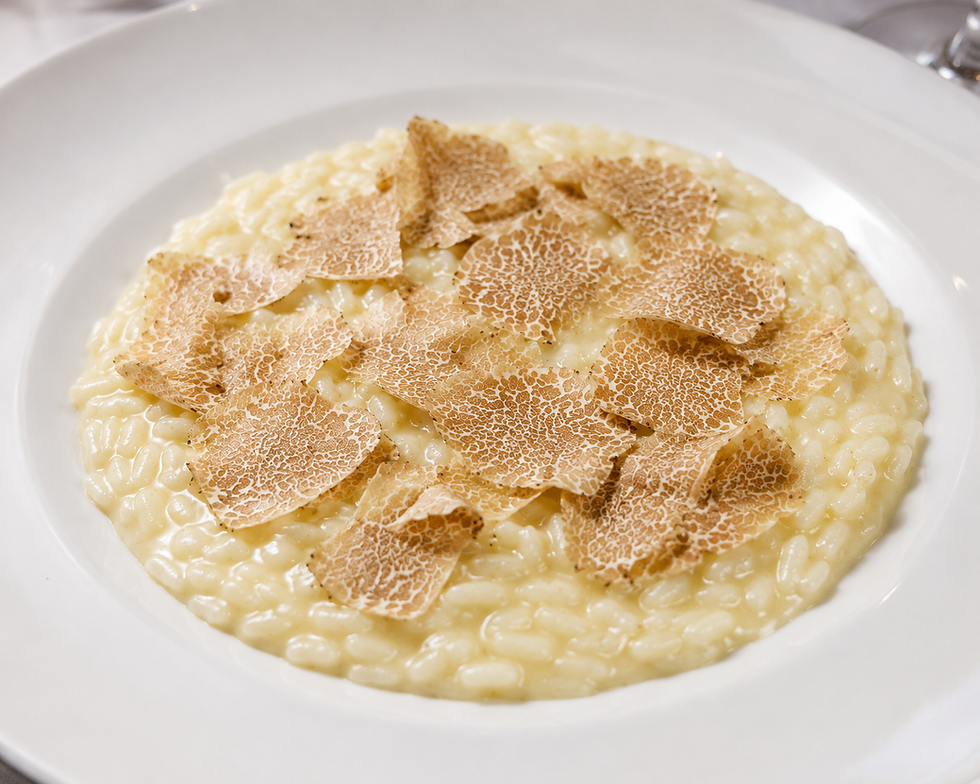
There is no shorter ingredient list in the Piedmontese repertoire and no dish where the cooking is more exposed. Carnaroli rice, a light brodo, cold butter, Parmigiano Reggiano, salt. Then, at the table and never before, the shavings of Tartufo Bianco d'Alba the whole preparation exists to carry. Nothing is fried, browned or reduced. The risotto is a warm, moving, gently savoury surface built to receive an aroma.
Everything normally added to a risotto is deliberately left out. No onion, no shallot, no garlic, no white wine. Each is a good ingredient and each would put a second aroma next to the truffle, which is the one thing this plate cannot afford. What remains is starch, fat and salt, and the only way to make those three taste like a finished dish is to handle them correctly.
The risotto has to arrive all'onda, flowing in a slow wave when the plate is tipped, hot enough to lift the truffle aroma the moment it is shaved and not so hot that it cooks it. That window closes fast, so have everyone seated before the last ladle of brodo goes into the pan.
Yield: 4 servings. Prep: 15 minutes. Cook: 25 minutes. Total: about 40 minutes. Difficulty: intermediate. Course: primo piatto. Region: Piedmont, the Langhe and Roero hills around Alba. Season: October to late December, when Tartufo Bianco d'Alba is at its peak.
The Story
Tuber magnatum pico grows unprompted in the calcareous marl soils of the Langhe, the Roero and the Monferrato, on the roots of oak, poplar, willow and linden, and no one has ever managed to farm it. Every truffle sold in Alba was found by a trifolau walking at night with a trained dog, which is why the price moves as it does: the supply is whatever the autumn rain and the dogs deliver. The Fiera Internazionale del Tartufo Bianco d'Alba has run every October since 1929.
Rice reached the plain below those hills much earlier. Cistercian monks drained and irrigated the flatlands of Vercelli and Novara from the twelfth century onward, and by the Renaissance the Po valley was the rice bowl of southern Europe. Carnaroli itself is recent, bred in 1945 by crossing Vialone with Lencino, and selected for exactly the qualities this dish needs.
Putting the two together is a Piedmontese habit rather than a chef's invention. In Alba the truffle is shaved over tajarin with butter, over a fried egg, over raw veal, over fonduta and over risotto, and in every case the base is chosen for its silence. The old trattorie of the Langhe held that if you could taste the cook, something had been overdone.
Ingredients
For the brodo
Light unsalted vegetable brodo, 6 cups (1.4 liters)
Fine sea salt, to taste, added to the rice and not to the brodo
For the risotto
Carnaroli rice, 1 1/2 cups (320 g)
Unsalted butter for the tostatura, 2 tbsp (30 g)
Very cold unsalted butter, cubed, for the mantecatura, 4 tbsp (60 g)
Parmigiano Reggiano, aged 24 months, finely grated, 3/4 cup (75 g)
Fine sea salt, 1 tsp (6 g), or to taste
For finishing
Fresh Tartufo Bianco d'Alba, 1 to 1 1/2 oz (30 to 45 g)
Parmigiano Reggiano, a small piece, for the table
Preparation
Step 1
Bring the brodo up and hold it. Put the vegetable brodo in a saucepan beside the risotto pan, bring it to a bare simmer and hold it there throughout. It must go into the rice hot: cold liquid drops the pan temperature and stops the grains releasing starch. Leave it unsalted, because the risotto concentrates as it cooks.
Step 2
Toast the rice in butter. Melt the 2 tablespoons of butter in a wide heavy pan over medium heat, tip in the Carnaroli and stir constantly for about 2 minutes, until the grains are hot to the touch and translucent at the edges with an opaque white core still visible. Do not let the butter colour: a brown butter note is a direct competitor here.
Step 3
Start the brodo additions. Add the first ladle of hot brodo. It will hiss and steam hard, which is correct. Stir, then let it be absorbed almost completely before the next goes in, roughly half a cup at a time, just enough to cover the rice. The pan holds a steady lively simmer throughout, never a hard boil and never a lazy one.
Step 4
Stir with intent, not constantly. Creaminess comes from friction: grains rubbing against grains and against the base shed their outer starch into the liquid, and that is the sauce. Stir firmly every twenty or thirty seconds, scraping the bottom and corners, then leave it alone. Frantic stirring turns the risotto pasty; no stirring gives you rice in soup.
Step 5
Salt part way through and taste. At around the ten minute mark, when the rice has taken up half the brodo, add the teaspoon of salt and taste. Season it properly but slightly short, because the Parmigiano going in at the end carries a large amount of salt with it. Taste again five minutes later and adjust in small pinches.
Step 6
Judge the cooking point by biting a grain. After about 18 minutes, bite one in half and look at the cross section: the outer layers tender and creamy, a fine white thread of resistance still at the centre. It keeps cooking during the mantecatura and on the plate, so pull the pan while that thread is visible.
Step 7
Leave the risotto deliberately loose. Add one last small ladle of brodo and do not let it be absorbed. It should look slightly too wet now, almost soupy, because the cold butter and the cheese are about to thicken it considerably. Take the pan off the heat and wait thirty seconds for it to stop simmering.
Step 8
Mantecare off the heat. Add the cold cubed butter all at once and beat it in hard with a wooden spoon, or shake the pan sharply forward and back, until it disappears. Add the Parmigiano and beat again until the surface turns glossy and the risotto moves as one mass. The butter must be cold and the pan off the flame, or the emulsion splits.
Plating
Warm the plates to about 140 degrees Fahrenheit (60 degrees Celsius) and use wide shallow ones rather than bowls, which pile the risotto up and never show the onda. Spoon a quarter onto each plate slightly off centre, then tap the underside of the rim once or twice with the flat of your hand. It should spread into an even low disc on its own; if you have to push it out with a spoon it is too tight, and a spoonful of hot brodo will fix it.
Shave the truffle at the table, over each plate in turn, with a slicer set as fine as it will go, the moment the plate lands in front of the guest and not one second earlier. Brush the truffle clean with a dry soft brush beforehand, never wash it and never cook it. Leave the piece of Parmigiano and the slicer on the table. Nothing else goes on this plate: no oil, no herbs, no pepper, no garnish of any kind.
Professional Technique
The technical heart of this risotto is that the sauce is made of nothing. No cream, no stock reduction, no soffritto, no wine, so all the body comes from the starch the Carnaroli gives up and the emulsion formed at the end. Carnaroli carries an unusually high proportion of amylose in the core, which keeps the centre firm, while the outer layers are rich in amylopectin, which dissolves readily. Handled correctly you exploit both at once: a grain that stays distinct, suspended in a sauce made of its own outside.
The mantecatura is the second technique and it decides how the plate looks. Cold butter added off the heat melts slowly, and its fat is beaten into the starchy liquid in fine droplets the dissolved starch holds in suspension. That suspension produces the gloss and the flowing onda. Warm butter, or butter added over the flame, melts too fast for the starch to catch it. The Parmigiano goes in second because it needs a stable base to join rather than a broken one.
Truffle aroma is the third technique. The compounds responsible, mostly sulphur bearing volatiles, are extremely light and heat drives them off almost instantly, which is why the truffle is never stirred in, warmed or infused into the butter. Shaved thinly onto a hot but not scalding surface it releases in one wave. A truffle cooked into a dish gives you the cost of a white truffle and the flavour of a mushroom.
Texture and Moisture Control
Three things decide the texture: the ratio of liquid to rice at each moment, the vigour of the simmer and the temperature at mantecatura. The liquid should never more than just cover the rice. Too much and the grains float rather than rub, so no starch is released; too little and the base catches and they cook unevenly. A steady lively simmer keeps them moving, while a hard boil tears them open and gives a gluey mass with hard centres.
Judge the final consistency in the pan, off the heat, before anything reaches a plate. Tilt it: the risotto should slide down in a slow single wave and level itself within two or three seconds. If it slumps and separates it is too wet and needs thirty seconds back over low heat. If it moves as a solid block, beat in hot brodo a tablespoon at a time. Both corrections are impossible once it is on a warm plate absorbing liquid.
Serving temperature matters as much as consistency. The risotto should reach the plate at roughly 165 degrees Fahrenheit (74 degrees Celsius), hot enough to volatilise the truffle aroma on contact and cool enough not to scorch it. Served boiling hot it flattens the truffle within seconds; served lukewarm it never lifts it at all.
Professional Mise en Place
This dish has almost nothing to prepare and no margin in the execution, so the mise en place is about position and timing. Everything below should be within arm's reach of the pan before the rice is toasted.
Equipment and tools
Wide heavy based pan, about 11 inches (28 cm), that spreads the rice in a shallow layer
Saucepan for the brodo on the next burner, with a ladle in it
Wooden spoon and a fine grater for the Parmigiano
Truffle slicer and a dry soft brush
Prepared ahead
Brodo made and strained, up to 2 days ahead, reheated to a bare simmer
Parmigiano grated fine within the hour, kept covered at room temperature
Butter cubed and returned to the refrigerator until the moment it is needed
Truffle brushed clean, wrapped in paper, kept cool and whole until service
Service setup
Guests seated and plates warming before the first ladle of brodo goes in
Salt and a tasting spoon beside the pan for the checks at ten and fifteen minutes
Truffle and slicer carried to the table, never used in the kitchen
Nothing else plated alongside: this risotto is served alone
Chef Tips
Buy the truffle by smell and by weight in the hand. A good Tartufo Bianco d'Alba is firm under light pressure, heavy for its size and smells assertive from a few inches away. Softness, a damp surface or a faint smell mean it has been out of the ground too long. Buy it the day you cook it.
Store it wrapped loosely in kitchen paper inside a closed glass jar in the warmest part of the refrigerator and change the paper daily. Do not store it in rice. Burying a truffle in a jar of rice perfumes the rice, but it does so by pulling moisture and aroma out of the truffle, and it is the truffle you paid for.
Make the brodo light. Onion, carrot, celery and a bay leaf, simmered forty minutes and strained, is exactly right. Anything darker or more concentrated brings its own strong aroma and puts the truffle into a competition it cannot win. If the brodo tastes good enough to drink on its own it is too strong for this dish.
If you cook this without a truffle, do not simply leave it out and serve the same plate. What you have then is a risotto alla parmigiana, and it needs a point of its own: a spoon of aged balsamic, some sauteed porcini, or more Parmigiano and a grind of pepper.
Common Mistakes
Cooking the truffle. Stirring shavings into the pan, warming them in butter or plating them in the kitchen destroys the aroma before anyone smells it. The truffle is shaved raw over the plate at the table and never touches heat.
Adding onion, shallot or wine. A soffritto puts a sweet vegetal note next to the truffle and white wine adds acidity and its own perfume. Both are pleasant, and both blur exactly the thing you are paying for.
Flooding the pan with brodo. A large quantity of liquid at once lets the rice boil rather than rub, so no starch is released and the risotto ends up thin. Add half a cup at a time and wait for it to be almost absorbed.
Salting the brodo instead of the rice. The liquid concentrates as it reduces into the rice, so a brodo salted at the start gives a finished risotto that is far too salty once the Parmigiano goes in. Salt part way through cooking and taste twice.
Mantecatura on the heat or with soft butter. Either splits the emulsion: the fat separates into a greasy layer and the risotto beneath turns dull and grainy. Take the pan off the flame, let it stop simmering, and use butter straight from the refrigerator.
Stopping when the risotto looks right in the pan. It should look too loose, because the butter and cheese tighten it and the warm plate absorbs more. A risotto that looks perfect in the pan arrives at the table as a mound that does not move.
Wine Pairing
Barolo DOCG: The classic answer and, with a bottle of ten years or more, the right one. Age turns Nebbiolo tannin fine and dusty and brings out tar, rose and dried earth notes that meet the truffle on its own ground, while the high acidity cuts the butter and the Parmigiano fat cleanly. A young tannic Barolo strips the palate and should be avoided.
Barbaresco DOCG: Grown a few miles from where the truffles are dug and softer in build than Barolo. Gentler tannins and aromatics of violet and dried cherry sit more lightly on a dish with no meat in it, and there is enough acid for the mantecatura and enough perfume to stand beside the truffle without another decade in the cellar.
Nebbiolo d'Alba DOC: The everyday Nebbiolo of the same hills and the most practical of the three reds, giving the raspberry and rose signature of the grape and a firm line of acidity at a fraction of the weight and price. Serve it at around 61 degrees Fahrenheit (16 degrees Celsius), since a little cool keeps it fresh against the butter.
Roero Arneis DOCG: The local white, grown in the sandy soils across the Tanaro from Alba. Pear and white flower aromatics, a low acid roundness and a bitter almond finish give it a gentle texture that flatters the creaminess of the risotto, while its mild aromatic profile stays well underneath the truffle.
Alta Langa DOCG: Piedmont's traditional method sparkling wine and a genuinely good match for a rich buttery risotto. The bead and sharp acidity scour the fat between mouthfuls, while long lees ageing leaves bread and hazelnut notes that echo the Parmigiano. Choose a brut with real bottle age; a young lean one tastes thin beside the cheese.
Storage & Reheating
This risotto is made to be eaten within two minutes of leaving the pan and does not store in any useful sense. Cool leftovers quickly in a shallow tray, cover and refrigerate for up to 2 days. Never store a plate with truffle on it: remove the shavings first, since they are worth nothing by the next day and taint the rice with a stale note as they sit.
To reheat, put the cold risotto in a pan with about 2 tablespoons of hot brodo or water per portion and warm it over low heat, stirring, until it loosens and moves again. Finish off the heat with a small knob of cold butter and a little Parmigiano to rebuild some of the emulsion. Avoid the microwave, which heats unevenly and turns the grains chalky at the edges.
The better answer is to change the dish. Chill the risotto firm in a tray, then shape it around a cube of fontina and fry it, or press it into a hot buttered pan and let it crust on both sides as risotto al salto. The truffle does not freeze: wrapped in paper it holds about 5 days in the refrigerator, losing aroma every one of them.
Nutrition
Per serving, based on 4 servings:
Calories: 560 kcal
Total Fat: 26 g
Saturated Fat: 16 g
Trans Fat: 0.8 g
Unsaturated Fat: 8 g
Cholesterol: 70 mg
Sodium: 780 mg
Total Carbohydrates: 64 g
Fiber: 1.5 g
Total Sugars: 1 g
Added Sugars: 0 g
Protein: 17 g
Lactose: 0.6 g
Principal micronutrients: calcium, phosphorus, vitamin A, vitamin B12, selenium, zinc
These figures are estimates. Sodium depends almost entirely on the brodo and on how much Parmigiano goes on at the table, and the truffle contributes almost nothing beyond aroma.


Comments