
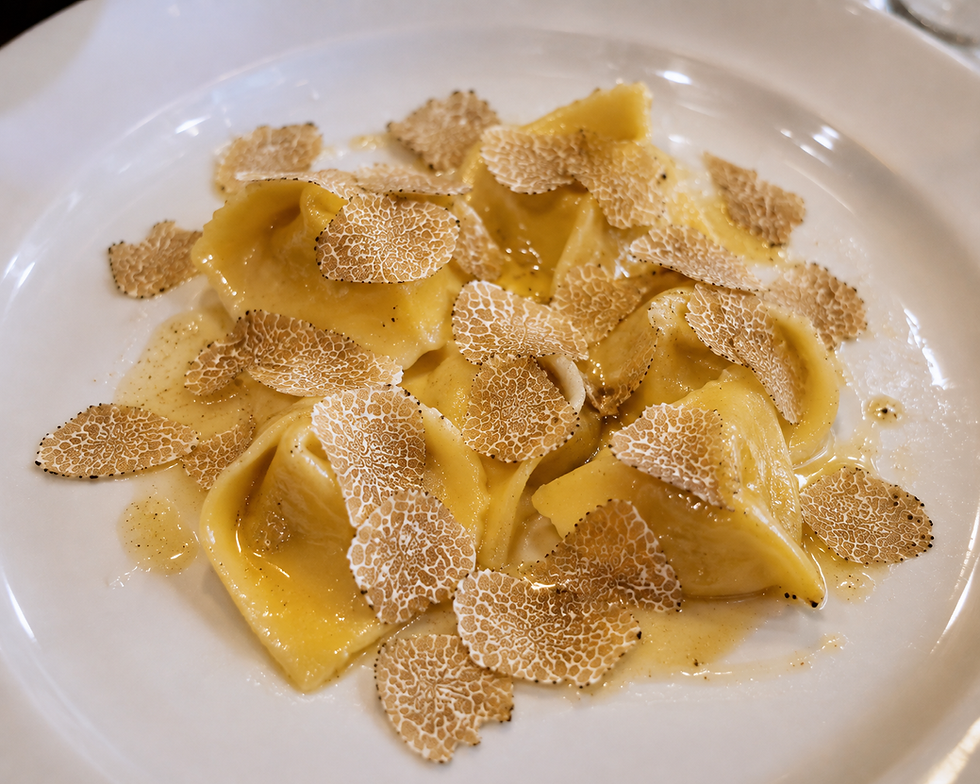
Italian Open Raviolo with Parmigiano Fondue, Soft Egg Yolk and Alba White Truffle | Raviolo Aperto con Fonduta di Parmigiano, Tuorlo Morbido e Tartufo Bianco d'Alba

This plate has four ingredients and no hiding place. A sheet of egg pasta, a Parmigiano fondue, a yolk warmed until it thickens but never sets, and white truffle from Alba shaved at the table. Every one is naked, which is why the recipe is about temperature rather than cooking.
The yolk is the technical centre. It is warmed to 149°F (65°C) and held there, the point at which yolk proteins thicken into something like custard while the white truffle fat still reads as liquid on the tongue. Two degrees too far and it turns granular and pale. Two degrees short and it runs off the pasta and thins the fondue into a puddle.
The truffle is bought, not cooked. It goes on last, raw, over a warm surface that lifts its aroma without heating it, and it is the one ingredient where the correct technique is to do nothing. Everything else exists to carry it.
Yield: 4 servings. Prep: 1 hour. Cook: 25 minutes. Rest: 1 hour for the dough. Difficulty: advanced. Course: primo. Region: Piedmont, the Langhe and Alba.
The Story
Tuber magnatum pico grows in the calcareous marl of the Langhe and the Roero, around the Tanaro and the hills south of Alba, and has never been cultivated anywhere. It is found by dogs, in the dark, from late September to January, and the annual quantity is small enough that the price moves with the autumn rainfall. Its scent is the reason for the whole dish: garlic, aged cheese, wet earth and something close to gas, all volatile and all gone within days.
The market that made it famous was built by one man. Giacomo Morra ran the Albergo Savona in Alba and in 1928 began organising a fair around the truffle, then spent decades mailing the largest specimen of each season to a famous name: Churchill, Truman, Marilyn Monroe, Joe DiMaggio. It cost him almost nothing and turned a local ingredient into an international one. The Fiera Internazionale del Tartufo Bianco d'Alba still runs every autumn on the back of it.
The pasta under it is Piedmontese too. The Langhe have always made tajarin from an extravagant number of yolks and almost no white, a habit from farms where eggs were plentiful and butter was the only fat worth using. The same dough, rolled into sheets instead of ribbons, sits here. The fondue is the borrowed element: fonduta in Italy means Valle d'Aosta and fontina, and Parmigiano Reggiano gives a sharper, saltier, less elastic sauce that does not mask the truffle the way melted fontina would.
Ingredients
For the pasta
Tipo 00 flour, 1 1/2 cups (190 g)
Durum wheat semola rimacinata, 1/3 cup (55 g)
Egg yolks, 7
Whole egg, 1
Fine sea salt, 1/4 tsp (1.5 g)
For the Parmigiano fondue
Parmigiano Reggiano, 24 months, finely grated, 5 oz (140 g)
Whole milk, 3/4 cup (180 ml)
Heavy cream, 1/4 cup (60 ml)
Egg yolk, 1
Cornstarch, 1 tsp (3 g)
Freshly ground white pepper, to taste
For the yolks
Very fresh egg yolks, large, 4
Fine sea salt, 1 small pinch
For finishing
Fresh white truffle from Alba, 3/4 oz (20 g)
Unsalted butter, 2 tbsp (28 g)
Parmigiano Reggiano, grated, 2 tbsp (12 g)
Coarse salt for the water, 2 tbsp (30 g)
Freshly ground black pepper, to taste
Preparation
Making the yolk rich dough
Mix the flours with the salt on a board, make a well and add the seven yolks and the whole egg. Draw the flour in with a fork until it forms a rough mass, then knead 10 minutes. The dough feels tight and dry at first and softens as the yolk fat spreads through it. Wrap and rest it 1 hour at room temperature, never in the refrigerator, where the fat firms up and the sheet cracks at the edges.
Rolling and cutting the sheets
Roll the dough to the second thinnest setting, flouring lightly with semola between passes. You want a sheet you can read print through that still holds its shape when lifted by a corner. Cut eight squares of about 4 1/2 inches (11 cm), lay them on a semola dusted tray in one layer under a cloth and use them within two hours, since a yolk rich sheet dries faster than standard egg dough.
Building the Parmigiano fondue
Whisk the cornstarch into the cold milk in a saucepan, add the cream and bring it to just below a simmer. Take it off the heat and add the Parmigiano in three additions, whisking each until melted before the next goes in. Return it to the lowest heat, whisk in the single yolk and cook 1 minute more, stirring constantly, until it coats a spoon. Season with white pepper only; the cheese carries all the salt this sauce needs.
Straining and holding the fondue
Pass the fondue through a fine mesh sieve into a clean bowl. Aged Parmigiano carries tyrosine crystals and undissolved fragments of rind that no whisking removes, and they are what make a homemade fondue feel gritty. Hold it covered over a bain marie at about 140°F (60°C) and whisk it once before serving. If it thickens, loosen it with hot milk rather than water.
Warming the yolks
Separate the four yolks into individual cups, keeping each whole. Bring a pan of water to 149°F (65°C) and hold it there with a thermometer, adjusting with a splash of cold water when it climbs. Slide the yolks in, still in their cups, and leave them 12 to 14 minutes. They are ready when they hold their shape under a spoon but give way immediately. Above 158°F (70°C) the proteins set hard and the dish is over before it starts.
Cooking the pasta
Bring 4 quarts (3.8 l) of water to a rolling boil and salt with 2 tablespoons (30 g). That is less than pasta normally takes, because the fondue and the Parmigiano finish are already salty and the sheets absorb fast at this thickness. Cook the squares two at a time for 80 to 90 seconds from the moment the water returns to the boil, until supple and free of any pale line at the edge.
Glossing the sheets and warming the plates
Lift the squares out with a spider and slide them into a wide pan off the heat with the butter and two tablespoons of cooking water, turning once so they take a light gloss. The starch in that water is what makes the butter cling instead of sliding off. Keep the sheets separated. Meanwhile the plates warm to about 140°F (60°C), enough to carry the truffle aroma upward but not to keep cooking the yolk.
Plating
Spoon three tablespoons of warm fondue into the centre of each plate and tilt it so the sauce spreads into a shallow disc slightly wider than the pasta. Lay the first square over it, letting the corners fall naturally.
Set one warmed yolk in the middle of the sheet. Use a slotted spoon and take your time; a yolk held at 149°F (65°C) is fragile and a broken one cannot be replaced at service. Season it with a few grains of salt and nothing else. Lay the second square on top at an angle, leaving the yolk visible through the gap between the two sheets.
Grate a little Parmigiano over the top, grind black pepper around the plate rather than over the yolk, and shave the truffle last, at the table. Hold the slicer almost flat so the shavings come off wide and thin. Serve immediately: the aroma peaks for perhaps ninety seconds after the first shaving falls.
Professional Technique
The defining technique is holding the yolk between 149°F and 158°F (65°C and 70°C). Egg yolk contains several proteins that coagulate at different temperatures, and livetin begins to set at around 149°F while the rest follows over the next ten degrees. Held at the lower end for 12 to 14 minutes, the yolk thickens uniformly to a set custard and stays glossy and orange. Driven higher it turns opaque, crumbly and slightly sulphurous, exactly the smell that ruins a truffle plate.
The second is stabilising the fondue against the age of the cheese. Parmigiano Reggiano at 24 months has lost much of its moisture and its casein network breaks into strings rather than melting smoothly, which is why grated Parmigiano dropped into hot milk forms a rubbery clump. The cornstarch coats the protein and keeps it dispersed, the single yolk emulsifies the fat that separates, and adding the cheese off the heat in three stages avoids the temperature spike that causes stringing.
The third is treating aroma as an ingredient with its own rules. The compounds that make white truffle recognisable are volatile and mostly lost above about 122°F (50°C), so it is never cooked, never stored with the pasta and never shaved more than seconds before the table. The warm plate and fondue give those compounds a gentle lift, nothing more.
Texture and Moisture Control
Three consistencies have to stay distinct for as long as it takes to eat. The fondue is the base and should be thick enough to hold a shallow disc without creeping to the rim. If it spreads flat, it was undercooked or overheated after the yolk went in, and a minute over the bain marie with a whisk usually brings it back. If it sets into a paste, hot milk fixes it.
The pasta has to be supple rather than firm. This is one of very few Italian dishes where al dente is the wrong target: a sheet with resistance left drags when the diner cuts it, and the yolk bursts sideways instead of flowing down. Eighty to ninety seconds and a generous quantity of yolk in the dough give a sheet that yields at once under a fork.
The yolk carries most of the moisture and must not be wet outside. Lift each one with a slotted spoon, let it drain a few seconds and set it straight onto the pasta, because water running off thins the fondue underneath. Keep the plates warm but never hot: a hot plate keeps cooking the yolk from below, and by the table the centre has set.
Professional Mise en Place
Everything except the pasta and the truffle stands ready, and the last two minutes decide the dish. Set the water bath first, since it takes longest to stabilise.
Equipment and tools
Digital thermometer, accurate to one degree
Wide pan or immersion circulator for the 149°F (65°C) bath
Pasta machine and a straight wheel cutter
Fine mesh sieve, balloon whisk, slotted spoon
Truffle slicer and a soft brush
Prepared ahead
Pasta dough made and rested, up to 1 day ahead, wrapped and refrigerated
Pasta squares cut and held under a cloth, up to 2 hours
Fondue made and strained, up to 4 hours ahead, held over a bain marie
Yolks separated into individual cups and kept cold
Truffle brushed clean and dry in a sealed jar until service
Service setup
Water bath steady at 149°F (65°C), thermometer in it
Salted pasta water at a rolling boil, 4 quarts (3.8 l)
Fondue warm at 140°F (60°C), whisked once before plating
Butter and a ladle of pasta water ready in a wide pan off the heat
Plates at 140°F (60°C), truffle and slicer at the table
Chef Tips
Buy the truffle from someone who lets you smell it and weigh it in front of you. A genuine Alba specimen is firm, pale ochre outside and marbled inside, and the aroma reaches you before it is close to your face. Anything soft, damp or faintly of ammonia is past its point.
Use the freshest eggs you can find and separate them cold, because a cold yolk holds its membrane far better. Let them come to room temperature in their cups for 20 minutes before the bath, so all four warm at the same rate.
Grate the Parmigiano yourself on the finest holes, on the day. Pregrated cheese is dried at the surface and often carries anticaking starch, and both stop it dispersing cleanly into milk. Take the rind off completely and keep it for a broth.
If you have no thermometer, do not attempt the bath as written. Bring a pan of water to a simmer, take it off the heat, wait 4 minutes and lower the yolks in for 15 minutes with the lid on. It is less precise, but far better than guessing at a nine degree window.
Common Mistakes
Adding the Parmigiano to milk that is still on the heat. The proteins in a 24 month cheese contract and knot into strings the moment they meet a boiling liquid, and the sauce turns into cheese threads in thin milk. Take the pan off the flame first and add the cheese in three stages.
Letting the yolk go above 158°F (70°C). It turns from glossy custard to pale crumb within a couple of degrees, and there is no way back. Keep a thermometer in the water for the whole 12 to 14 minutes and correct upward drift with a splash of cold water.
Shaving the truffle in the kitchen. Most of what you paid for reaches the dining room as a smell in the corridor. Carry the truffle and the slicer to the table and shave over the plate in front of whoever is eating.
Warming the plates too much. A plate at serving temperature for a roast will keep cooking the yolk from underneath and will set it before the first forkful. Hold the plates at about 140°F (60°C), warm to the hand and no more.
Cooking the pasta to al dente. A sheet with bite drags when it is cut and tears the yolk sideways across the plate. Eighty to ninety seconds is enough, and the sheet should be supple rather than firm.
Wine Pairing
Barbaresco DOCG: The great Langhe red and the one grown closest to where the truffle was dug. Nebbiolo from Barbaresco is softer and more perfumed than its neighbour, and the rose and dried cherry of a bottle with a few years on it meet white truffle aroma directly rather than competing. Its acidity cuts the fat of fondue and yolk together, which no white here does as cleanly.
Roero Arneis DOCG: The white grown on the sandy left bank of the Tanaro, opposite Alba, and the local answer when a red feels heavy for a first course. Arneis gives pear, white flowers and low acidity with a faintly bitter almond close, and that gentleness is the point: it lifts the fondue without adding an aromatic for the truffle to argue with. Serve at 50°F (10°C).
Nebbiolo d'Alba DOC: Lighter and younger than Barbaresco, from the same hills, and easier to open on a weeknight. It brings the same red cherry and tar signature with softer tannin and more immediate fruit, which suits a dish that is delicate rather than powerful. Serve slightly cool, around 61°F (16°C), so the tannin stays in the background.
Alta Langa DOCG: The Piedmontese metodo classico, from Pinot Nero and Chardonnay in the high hills south of Alba, aged at least thirty months on the lees. Those years give a bready, hazelnut depth that runs alongside aged Parmigiano, and the bead scours butter and yolk off the palate between mouthfuls. The most refreshing option here without being neutral.
Erbaluce di Caluso DOCG: From the moraine hills north of Turin and the most acidic white here. Erbaluce is lean, citric and distinctly mineral, and that severity is useful against a plate built almost entirely from fat: it resets the mouth after every bite instead of layering on more richness. Choose the still dry version.
Storage & Reheating
The assembled dish cannot be stored and the warmed yolk has no second life, so everything here is about what you hold before service. The fondue keeps refrigerated in a sealed container for 2 days and rewarms over a bain marie with a tablespoon of hot milk whisked in; never microwave it and never set it over direct heat, which splits the emulsion and forces the cheese fat out.
Uncooked squares keep on a semola dusted tray under a cloth for 2 hours, or refrigerated between parchment for 1 day. They freeze flat on a tray for 1 month and go into boiling water straight from the freezer with 20 seconds added. Cooked sheets and warmed yolks do not keep at all.
White truffle is the most perishable thing here and loses aroma by the hour. Wrap it in a dry paper towel, change the towel daily, and keep it in a sealed glass jar in the warmest part of the refrigerator for no more than three days. Never store it in rice, which draws out moisture and aroma together, and never freeze it. Surplus goes into softened butter, which holds the aroma a month in the freezer.
Nutrition
Per serving, based on 4 servings:
Calories: 640 kcal
Total Fat: 38 g
Saturated Fat: 19 g
Trans Fat: 0 g
Unsaturated Fat: 16 g
Cholesterol: 620 mg
Sodium: 720 mg
Total Carbohydrates: 44 g
Fiber: 2 g
Total Sugars: 4 g
Added Sugars: 0 g
Protein: 28 g
Lactose: 2.6 g
Principal micronutrients: calcium, phosphorus, vitamin A, vitamin B12, riboflavin, selenium, choline
These figures are estimates. Cholesterol is high because the dish is built on yolks, and most of the salt in the pasta water is discarded rather than eaten.




Comments