
Italian Fresh Tagliolini with Alba White Truffle and Parmigiano Reggiano 36 Months | Tagliolini al Tartufo Bianco d'Alba e Parmigiano Reggiano 36 Mesi

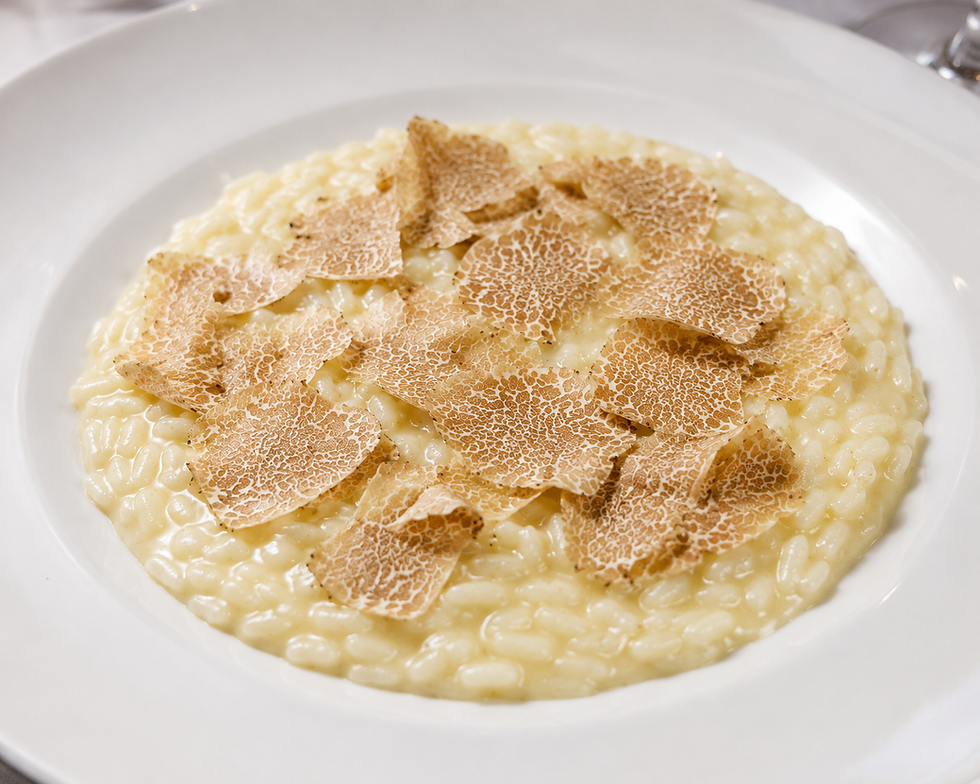
There is no cooking in this dish worth the name. A white truffle from Alba is never heated, never washed, never sliced in advance. It is shaved raw over a hot plate at the last second, and everything under it exists only to carry its aroma to the person sitting down. That is why five ingredients are harder to serve well than most dishes with twenty.
The pasta is a yolk heavy tagliolino in the Langhe style, rolled thin, cut narrow and cooked in a deliberately small volume of water. The sauce is butter and Parmigiano Reggiano aged 36 months, emulsified off the heat with that concentrated starchy water until it coats without weight. No cream, no stock, no garlic, nothing that puts a second aroma next to the truffle. The plate is warm enough to release the volatiles and cool enough not to destroy them.
Yield: 4 servings. Dough: 25 minutes plus 1 hour rest. Rolling and cutting: 30 minutes. Service: 5 minutes. Difficulty: advanced. Course: primo piatto. Season: October to December. Region: Piedmont, the Langhe and Roero.
The Story
Tuber magnatum Pico does not grow. It is found. Nobody has succeeded in cultivating the white truffle commercially, which is why it costs what it costs, and why the trifolau still work at night with a trained dog on the hills between Alba, Roero and Monferrato. They go in the dark partly because the dog works better without distraction and partly so nobody learns where their trees are. A productive oak or poplar is inherited, not shared.
The season runs from the first week of October to the end of December, and the fair that organises the trade, the Fiera Internazionale del Tartufo Bianco d'Alba, has been held in the town every autumn since 1929. What is sold there is judged by nose before scales: one that smells of ammonia has begun to go, one that smells of nothing was dug too early or kept too long. The perfume lasts about five days from the ground and declines measurably every one of them.
Tagliolini are the Piedmontese answer to that perfume. The local version, tajarin, uses a quantity of egg yolk that seems absurd anywhere else, historically thirty or more yolks to a kilo of flour, giving a deep yellow pasta with almost no free water in the dough. It was a feast pasta in the Langhe because eggs were valuable, and it was cut into ribbons narrower than tagliatelle so more surface would meet the butter. Truffle and tajarin reached the same table because they come from the same hills in the same weeks.
Ingredients
For the tagliolini
Italian 00 flour, 2 cups (250 g)
Large egg yolks, 14, about 8 oz (230 g)
Whole egg, 1
Extra virgin olive oil, 1 tsp (5 ml)
Fine sea salt, 1/2 tsp (3 g)
Semola rimacinata for dusting, 1/3 cup (50 g)
For the butter and Parmigiano emulsion
Unsalted butter, cold and diced, 5 oz (140 g)
Parmigiano Reggiano aged 36 months, finely grated, 3 oz (85 g)
Coarse sea salt for the water, 1 tbsp (15 g) for 2 quarts (1.9 l)
Freshly ground white pepper, to taste
For finishing
White truffle from Alba, Tuber magnatum Pico, 1 1/2 oz (40 g)
Parmigiano Reggiano aged 36 months, in one piece for the table, 1/2 oz (15 g)
Preparation
Mix the yolk dough
Sift the flour onto a board and make a wide well. Add the yolks, the whole egg, the olive oil and the salt, and work them together with your fingertips, pulling flour in from the walls a little at a time. This dough carries almost no free water, so it comes together slowly and looks crumbly long after a normal dough would be smooth. Resist adding liquid: keep working and the fat in the yolks will do it.
Knead and rest
Once it holds, knead for 10 minutes until the surface is satin and a pressed thumb springs back slowly. Wrap it tightly and rest it at room temperature for 1 hour. The rest matters more here than in a white pasta: the gluten needs time to relax against the fat, and an unrested yolk dough springs back under the pin and never rolls thin enough.
Roll the sheet very thin
Cut the dough into four pieces and keep three wrapped. Roll each through the machine down to the second thinnest setting, about 1/32 in (0.8 mm). You should see the shape of your hand through the sheet but not read print through it. Lay each finished sheet on a semola dusted cloth for 10 minutes to dry slightly on the surface, which is what stops the cut ribbons welding together.
Cut and nest the tagliolini
Dust the sheet generously, roll it loosely and cut ribbons about 1/16 in (1.5 mm) wide, or pass it through the narrow cutter. Lift and shake each handful at once so the strands separate, toss them in semola and coil them into small loose nests. Leave them uncovered at cool room temperature. They cook in about 90 seconds, so nothing about this pasta is forgiving later.
Clean the truffle
Use a soft dry brush and work into the folds, with no running water at all. Wipe with barely damp paper only if soil remains, and dry it at once. Water is the enemy: it drives into the flesh and takes the perfume with it as it evaporates. Keep the truffle wrapped in dry paper in a sealed jar in the refrigerator until service, and change that paper every day.
Cook the tagliolini in a small volume of water
Bring only 2 quarts (1.9 l) of water to a boil and salt it with 1 tablespoon (15 g). A yolk dough sheds far less starch than a semola one, so the water must stay small and concentrated to make up for it; a stockpot here is the surest way to a thin sauce. Shake the semola off the nests, drop them in and cook 80 to 90 seconds from the return to the boil. Reserve 1 cup (240 ml).
Emulsify the butter and Parmigiano off the heat
Put the cold diced butter in a wide pan off the heat with half a ladle of pasta water and swirl until it turns opaque and creamy rather than oily. Add the drained tagliolini and the grated Parmigiano Reggiano in three additions, tossing continuously and loosening with pasta water. Keep the pan below 150°F (65°C). Finish with white pepper only, no salt, and go straight to the plates while the sauce still looks slightly loose.
Shave the truffle at the table
Divide the pasta between four warm plates, twisting each portion into a low nest. Take the truffle and the shaver out and shave it over each plate in front of the guest, in wide thin slices, about 1/3 oz (10 g) per person. Doing this in the kitchen loses half of what you paid for: the aroma peaks within seconds of the cut, and the walk from the pass is long enough to waste it.
Plating
Warm the plates to about 140°F (60°C), no hotter. Too cold and the truffle stays mute; too hot and the aromatic compounds are driven off before the plate reaches the table. A wide flat plate with a shallow well beats a bowl, because the shaved slices need surface to lie on and the rising heat has to reach them evenly.
Twist each portion with a carving fork into a low open nest rather than a tall coil. Height works against you here: a tight tower traps heat inside and presents a small surface to the truffle. Keep the pasta central, leave a clean rim, and add no leaf, drop of oil or grind of black pepper as decoration.
Shave at the table, over the pasta, never in advance and never onto a cold surface. Carry the piece of Parmigiano Reggiano and a grater out with the shaver so anyone who wants more can have it. This dish has a life of roughly three minutes from the last slice.
Professional Technique
The aroma of Tuber magnatum is carried mainly by bis(methylthio)methane and a small group of related sulphur compounds, all highly volatile and none heat stable. They are released by warmth and destroyed by cooking, which is why the truffle is shaved raw onto a plate held at 140°F (60°C) rather than stirred into a pan. Anything that heats the slices directly, a hot pan, a gratin, an oven, turns an expensive ingredient into an ordinary mushroom in under a minute.
The second technique is a butter emulsion built on very little starch. A dough made almost entirely of yolks releases far less amylose than a semola dough, so the usual mantecatura has weaker material to work with. Two things compensate: the water is kept to 2 quarts (1.9 l) so what starch there is stays concentrated, and the butter goes in cold and diced rather than melted, so its own water and milk proteins help form the emulsion before the fat can separate.
The third is the choice of a 36 month Parmigiano Reggiano over a younger wheel, a flavour decision with a physical consequence. At that age the cheese has lost most of its moisture and nearly all its lactose, the tyrosine crystals are fully developed and free glutamate is at its highest, giving enormous savoury depth from a small quantity. It also melts reluctantly and grainily if rushed, so it goes in finely grated, in three additions, off the flame.
Texture and Moisture Control
The dough is the first control point and it runs on fat rather than water. Fourteen yolks to 250 g of flour gives a paste that is stiff, slow to hydrate and feels wrong for the first five minutes of kneading. Adding water at that stage is the common repair and it ruins the pasta: the sheet loses elasticity, tears at the thin settings and cooks slack. The answer is more kneading and a full hour of rest, after which it rolls to 1/32 in (0.8 mm) without complaint.
At the stove the margin is very narrow. Tagliolini this thin pass from raw to overcooked in about 20 seconds, and since they then sit in a hot pan for another 40 seconds of tossing, they must leave the water still firm. The finished sauce should look slightly too loose in the pan, because the pasta keeps absorbing all the way to the table. Fat separation is the last risk: butter and Parmigiano split above about 150°F (65°C) or if the water goes in all at once, and on this plate there is nothing to hide it. Work off the heat, add water in tablespoons, and if free butter shows at the edge, swirl in a spoonful of cold pasta water.
Professional Mise en Place
The truffle sets the clock, so it is bought as late as possible and everything else is ready before it leaves the refrigerator.
Equipment and tools
Truffle shaver with an adjustable blade, bone dry
Pasta machine with a narrow cutter, or a very sharp long knife
Soft dry brush and a sealed jar with dry paper
Wide pan, 12 in (30 cm), heavy enough to hold a steady low heat
Microplane for the cheese and a carving fork for twisting
Prepared ahead
Dough made and rested, up to 4 hours ahead at room temperature
Tagliolini cut and nested on semola, up to 3 hours uncovered
Parmigiano Reggiano grated fine, on the day only, kept covered and cool
Butter diced and returned to the refrigerator so it stays cold
Truffle brushed clean, rewrapped in dry paper and weighed
Service setup
2 quarts (1.9 l) of salted water at a rolling boil, never a larger pot
Plates warming to 140°F (60°C), checked with a probe
Pan off the heat with the cold butter already in it
Truffle, shaver and the piece of Parmigiano on a tray
Everyone seated before the pasta goes into the water
Chef Tips
Buy the truffle by smell and buy it the same day you serve it. A good one has a penetrating perfume of garlic, hay and something faintly gassy that fills a room from a closed hand. Weight loss runs around 5 percent a day and aroma loss is faster, so one bought on Monday for Saturday is a far poorer ingredient.
Keep it in dry paper in a sealed jar, never in rice. Rice is the most repeated advice in Italian kitchens and it is wrong: it pulls moisture out of the truffle and takes on the aroma you paid for.
Fourteen yolks and one whole egg is the ratio that gives colour, richness and enough structure to roll thin. If you cannot face the waste, tajarin dough freezes well in a wrapped block for a month, so make a double batch and use it twice.
Set the shaver thin and test it on the edge of the truffle first. Slices thicker than a sheet of paper taste of raw mushroom and feel rubbery; at the right thickness they curl slightly off the blade and dissolve against the hot pasta.
Common Mistakes
Cooking the truffle. Sauteing it, folding it into the pan or warming it in butter destroys the sulphur compounds that carry the aroma and leaves you with an expensive mushroom. It goes onto the plate raw, at the table, after the pasta is in front of the guest.
Washing the truffle under the tap. Water penetrates the flesh and carries the perfume out with it as it evaporates, and a washed truffle never recovers. Brush it dry, and use barely damp paper only on stubborn soil, drying it immediately afterwards.
Using too much water for the pasta. A yolk dough gives up very little starch, so a big pot leaves you with water that cannot bind anything. Use 2 quarts (1.9 l) and reserve a full cup before draining.
Melting the butter before the pasta goes in. Melted butter has already separated into fat and water and will not emulsify properly with so little starch. Start with cold diced butter and a splash of pasta water, off the heat, and let the pan do the work.
Adding garlic, cream, stock or herbs. Every one of them puts a competing aroma beside a truffle that costs more than the rest of the dish combined. Butter, Parmigiano Reggiano, pasta water and white pepper. Nothing else belongs here.
Wine Pairing
Gavi DOCG: The white to pour when you want the truffle to have the plate to itself. Cortese from south eastern Piedmont gives a dry, quiet wine with green apple, a chalky finish and acidity sharp enough to cut a butter and Parmigiano emulsion. Its lack of loud fruit is the virtue: nothing in the glass argues with the fork.
Erbaluce di Caluso DOCG: The forgotten white of northern Piedmont and sharper than Gavi. Erbaluce has unusually high natural acidity and a bitter citrus pith on the finish that scrubs butter fat between mouthfuls rather than layering onto it. Good bottles carry a faint smoky note from the moraine soils around Lake Viverone that suits aged Parmigiano.
Barbera d'Asti DOCG: The red the Langhe actually drinks with rich pasta. Barbera carries high acidity with almost no tannin, so it refreshes a fatty dish without the astringency that would clash with egg yolks and butter. Choose an unoaked bottling: barrel spice is one more aroma competing with the truffle.
Dolcetto d'Alba DOC: Grown on the same slopes the truffles come from, and the most local pairing here. Dolcetto is softer in acid than Barbera and gently tannic, with dark plum fruit and a bitter almond finish that echoes the depth of a 36 month Parmigiano. Serve at 60°F (16°C) so the fruit stays lifted and the tannin quiet.
Franciacorta DOCG: For a first course served as an occasion, a dry metodo classico earns its place. Bubbles and acidity scour butter fat off the palate faster than any still wine, and the bread and hazelnut notes from long lees ageing run alongside the truffle rather than across it. Ask for Brut or Extra Brut: any sweetness would sit badly here.
Storage & Reheating
The plated dish cannot be kept ten minutes, let alone reheated. The truffle aroma is gone within a few minutes of shaving and the butter emulsion sets into a film as it cools, so cook only what will be eaten at once. There is no honest way to hold this on a pass.
The truffle keeps 4 to 5 days at most, wrapped in dry paper inside a sealed glass jar in the warmest part of the refrigerator, with the paper changed daily. If it must go further, make truffle butter: grate what remains into soft unsalted butter, roll it and freeze for up to 3 months. Freezing a whole truffle destroys its structure and most of its perfume.
Uncooked tagliolini nests hold 24 hours on a semola dusted tray, or freeze solid on the tray, go into a bag and cook straight from frozen with about 20 extra seconds. They also dry well: leave the nests uncovered for 48 hours until brittle and keep them in a tin for a month. Parmigiano Reggiano loses aroma fast once grated, so grate it to order.
Nutrition
Per serving, based on 4 servings:
Calories: 810 kcal
Total Fat: 47 g
Saturated Fat: 26 g
Trans Fat: 1 g
Unsaturated Fat: 18 g
Cholesterol: 640 mg
Sodium: 780 mg
Total Carbohydrates: 51 g
Fiber: 2 g
Total Sugars: 1 g
Added Sugars: 0 g
Protein: 27 g
Lactose: 0.3 g
Principal micronutrients: calcium, phosphorus, vitamin A, vitamin D, vitamin B12, choline, selenium, zinc
These figures are estimates. Cholesterol is high because the pasta is built on egg yolks, and lactose is negligible because a Parmigiano aged 36 months has effectively none left.




Comments