
Italian Saffron Risotto | Risotto allo Zafferano

This is a risotto about one ingredient. Rice, butter, onion and Parmigiano all do real work in the pan, but the dish is named for the spice, and the spice is the only element that can ruin it before the burner is lit. Buy the wrong saffron and no technique rescues the plate: it will be pale, or orange in the wrong way, or it will taste of hay and medicine instead of honey and leather.
Everything below is organised around getting colour and aroma out of a few tenths of a gram of dried stigma and into a pan of rice without losing either: what you bought, why threads and powder behave differently, how the pigment dissolves, and the exact minute the infusion should go in. The risotto method itself is classical and unhurried, because saffron does not need a clever dish underneath it.
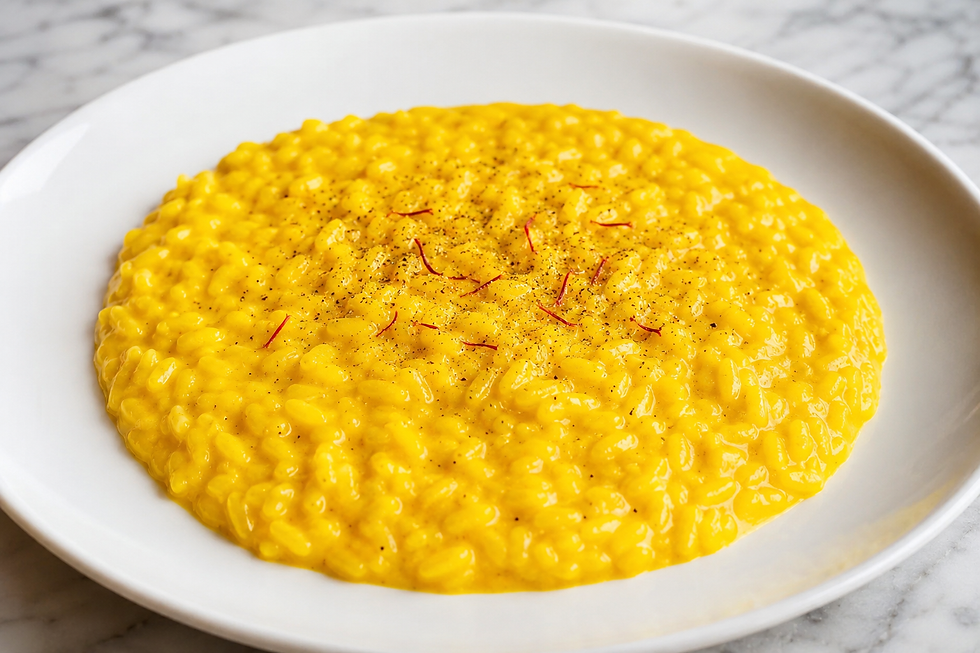
What you want is a risotto the colour of old gold rather than bright yellow, flowing slowly across a warm plate, tasting first of toasted rice and cheese and then, a beat later, of something floral and faintly bitter. If it tastes only of butter and salt, the saffron was the problem. If it tastes of iodine, you used too much.
Yield: 4 servings. Prep: 20 minutes. Saffron infusion: 40 minutes. Cook: 22 minutes. Total: about 1 hour 20 minutes. Difficulty: intermediate. Course: primo piatto. Rice: Carnaroli.
The Story
Crocus sativus is a sterile autumn flowering crocus that cannot reproduce without human hands, which tells you most of what you need to know about its price. Every corm is lifted and replanted by a person, every flower picked at dawn while still closed, the three red stigmas inside pulled out by hand the same day. It takes near 150,000 flowers to produce one kilogram of dried saffron, and nothing has been mechanised in three thousand years.
Italy grows saffron in two places that matter. The Navelli plateau in Abruzzo, high and cold at around 2,500 feet, produces Zafferano dell'Aquila DOP, sold as whole threads and among the most intensely coloured saffron in the world. The other is San Gavino Monreale in southern Sardinia, where Zafferano di Sardegna DOP has been grown since the Middle Ages on the Campidano plain and where one small town still accounts for most of the national harvest by weight.
The reason a spice this expensive ended up in a bowl of rice is that saffron was never only food. It was a dyestuff, a medicine and a currency, kept in the workshops of glaziers and apothecaries and traded by weight against silver. Rice arrived in the Po valley in the fifteenth century and spread across the flooded plains around Novara, Vercelli and Pavia. A costly colouring agent from the south met a cheap starch crop from the north, and the result looked aristocratic while costing almost nothing to build around.
Ingredients
For the saffron infusion
Saffron threads, Category I, lightly packed 1/2 tsp (0.4 g)
Hot stock or water, 3 tbsp (45 ml)
For the risotto
Carnaroli rice, 1 1/2 cups (300 g)
Light beef or chicken stock, 5 cups (1.2 L)
Yellow onion, very finely minced, 1/3 cup (50 g)
Unsalted butter, 2 tbsp (28 g)
Dry white wine, room temperature, 1/2 cup (120 ml)
Fine sea salt, about 1 tsp (6 g), adjusted at the end
For the mantecatura
Cold unsalted butter, cut into cubes, 3 tbsp (42 g)
Parmigiano Reggiano aged 30 months, finely grated, 3/4 cup (75 g)
Freshly ground white pepper, to taste
For finishing
Whole saffron threads, 8 to 12, for the surface
Fine sea salt, a final correction only
Preparation
Judge the saffron before you use it
Tip the threads onto a white plate. Real stigmas are trumpet shaped, frayed and wider at one end, tapering to a thin pale tail at the other. They are deep red, not orange, and a few pale yellow styles among them are honest. Crush one between your fingers: it should be brittle enough to snap and should scent your skin at once. Then weigh them. Half a teaspoon lightly packed is about 0.4 g, and eyeballing it is how people end up with a bitter plate.
Bloom the threads in warm liquid
Heat 3 tbsp of stock to roughly 150°F (65°C), hot to the finger but nowhere near simmering, and pour it over the threads in a small cup. Leave them covered for at least 40 minutes and up to 4 hours. The liquid should go from clear to amber to a saturated brick orange as the pigment leaves the stigma. Crush the softened threads against the side of the cup after twenty minutes. Do not discard them: they go into the pan with their liquid.
Season and hold the stock
Bring the stock to a bare simmer in a separate pot and taste it. It should be pleasant but slightly under salted, because it concentrates over twenty minutes and the Parmigiano brings a great deal of salt at the end. Keep it simmering on a neighbouring burner throughout. Cold stock hitting hot rice drops the pan temperature, stalls starch release and gives grains chalky inside and blown out at the edges.
Sweat the onion
Melt 2 tbsp of butter in a wide heavy pan over low heat and add the minced onion with a pinch of salt. You want it translucent, soft and sweet after about 6 minutes, with no colour anywhere. Browned onion introduces a caramel note that fights saffron directly, and saffron loses that fight. Mince it finer than feels necessary so it disappears instead of turning up as texture.
Toast the rice
Add the dry rice and raise the heat to medium. Stir continuously for 2 to 3 minutes. The grains should turn from chalky white to faintly translucent at the edges with an opaque core still visible, and the pan should smell of warm bread. Put a few grains against your lip: they should be genuinely hot. This tostatura sets the outside of each grain so it holds shape through twenty minutes of stirring, and skipping it is the commonest cause of porridge.
Deglaze and begin the absorption
Pour in the wine and stir until the sharp alcohol smell has gone and the pan is almost dry, about 90 seconds. Now add the simmering stock a ladle at a time, stirring often and waiting until each addition is mostly absorbed before the next goes in. Keep the rice at a lively but not violent simmer. Total absorption for Carnaroli runs 17 to 19 minutes, and you should start tasting grains at 14.
Add the saffron at the right moment
At roughly 12 minutes, with the rice still firm and two thirds hydrated, stir in the entire infusion including the spent threads. Earlier and the aromatic compounds spend too long over heat and evaporate; later and the pigment cannot distribute evenly, leaving streaks of orange against pale rice. The pan goes from beige to gold almost instantly. Continue with the stock and adjust salt once, now, while liquid is still moving.
Mantecare off the heat
When the grains are al dente with only the faintest resistant centre, pull the pan off the burner and wait thirty seconds for the boiling to stop. Add the cold cubed butter and the grated Parmigiano and beat hard with a wooden spoon for a full minute. It looks broken for fifteen seconds, then pulls together, glossy and cohesive. Loosen with hot stock until it flows slowly. Grind in white pepper, taste, correct.
Plating
Use warm flat plates, not bowls and not hot plates. A plate at around 110°F (45°C) holds temperature long enough to eat without cooking the risotto further, while one from a hot cupboard tightens the emulsion within a minute. Spoon a portion slightly off centre, then tap the plate sharply against the heel of your hand. It should spread into a flat even disc without help from a spoon.
That spread is the test Italians call all'onda, on the wave. Too tight and it sits in a dome; too loose and it runs to the rim and pools. Adjust with hot stock a teaspoon at a time before it reaches the plate, never after. Lay the reserved whole threads across the surface last, no more than a dozen, so a diner can see what coloured the dish. Add nothing else.
Professional Technique
The craft of this dish sits in the infusion, and the infusion is chemistry. Three compounds matter. Crocin is the pigment and it is water soluble, which is why threads sitting dry in a pan colour almost nothing while threads left in warm liquid colour everything. Picrocrocin is the bitter principle. Safranal, the honeyed hay and leather aroma, is volatile and forms as picrocrocin degrades, which is why a gentle 150°F (65°C) soak builds perfume that a boil drives off into the air.
This is also the honest answer to the threads against powder argument. Powder disperses instantly and colours evenly, and good powder from a named producer is a legitimate tool. The problem is that powder is invisible: once ground, saffron cannot be inspected, and adulteration with turmeric, safflower or dyed plant fibre is undetectable by eye. Threads can be looked at, smelled, weighed and crushed.
Fraud is worth naming plainly because it is the largest risk here. Drop a few threads into cold water: real saffron releases colour slowly over several minutes and the thread stays red, while dyed substitutes bleed instantly and go white. Rub a thread on wet paper: a clean yellow stain is right, an orange or reddish stain is dye. Safflower, sold as Mexican saffron, is flat and petal shaped rather than trumpet shaped. Any saffron cheap enough to feel like a bargain is not saffron.
Texture and Moisture Control
Carnaroli holds more amylose in its core than Arborio and sheds amylopectin from its surface more gradually, which widens the margin between correctly cooked and collapsed. That surface starch is the sauce. There is no cream in a risotto and no flour: the whole body of the dish comes from starch that stirring has scrubbed off the grains and suspended in the stock. Stir enough to keep that happening and not so much that you smash the grains apart.
Hydration is managed by keeping the rice barely covered rather than swimming. A ladle at a time, absorbed before the next, keeps the liquid concentrated with starch instead of diluting it. Flood the pan and the rice boils rather than risottas, the starch disperses into a watery broth, and you cannot get it back. A pan that runs dry between additions lets the grains scorch on the base, which puts a burnt note through everything.
The mantecatura is an emulsion and behaves like one. Cold butter added off the heat melts slowly enough for its fat to disperse into the starchy liquid as droplets rather than pooling on top, and the Parmigiano supplies protein and emulsifying salts that hold those droplets in suspension. Heat is the enemy: butter added to a boiling pan splits, and cheese over direct heat turns stringy and then grainy.
Professional Mise en Place
Risotto cannot be paused. From the first ladle to the plate is twenty minutes of continuous attention, so everything that can be measured, minced or heated in advance must be.
Equipment and tools
Wide heavy pan, straight sided, about 10 inches (26 cm) across
Second pot for stock held at a bare simmer on an adjacent burner
Small scale reading to 0.01 g for the saffron
Flat wooden spoon, a ladle of known volume, a fine grater
Prepared ahead
Saffron infusion, made 40 minutes to 4 hours ahead and kept covered
Stock made and seasoned, up to 3 days ahead and refrigerated
Onion minced fine, up to 4 hours ahead, covered and cold
Butter cubed and returned to the refrigerator, Parmigiano grated within 2 hours
Service setup
Stock simmering, ladle in the pot, within arm's reach of the pan
Saffron infusion beside the stove with a spoon, threads included
Cold butter and grated cheese together on a small tray, still cold
Reserved whole threads in a dish, plates warmed to around 110°F (45°C)
Chef Tips
Buy saffron in sealed glass, from a producer who names the harvest year, and buy small. It does not spoil, it fades, and a jar opened eighteen months ago has lost much of its crocin to light and air. Store it dark, tightly closed, never above the stove.
Weigh it. A scale reading to 0.01 g costs very little and removes the only genuinely dangerous variable here. Past roughly 1 g in a dish this size the picrocrocin turns openly medicinal and the plate is finished. Under dosing is merely disappointing, so if you must guess, guess low.
If all you can find is powder from a source you trust, use about half the weight you would use in threads, whisk it into the warm liquid and give it 15 minutes rather than 40. Ground saffron has far more surface area and extracts much faster, and treating it like threads is how it turns bitter.
Make the stock light. A dark reduced beef stock buries saffron entirely. A pale simple broth, barely seasoned, is the correct background for this dish.
Common Mistakes
Adding saffron threads dry to the pan. Crocin needs time in liquid to leave the stigma. Threads dropped straight into the rice give visible orange specks and a dish that is essentially colourless, wasting most of what you paid for.
Boiling the infusion. Safranal is volatile and simmering the soaking liquid sends the aroma straight up the extractor hood. Hot to the finger, around 150°F (65°C), is correct, and time does the rest.
Using turmeric to help the colour. Turmeric is earthy and slightly muddy and its yellow is opaque where saffron is luminous, so the plate goes the colour of a curry and the fraud is obvious to anyone.
Overdosing. More saffron is not more flavour past a point. Beyond about double the dose here the bitterness dominates and the risotto tastes metallic and medicinal.
Adding the butter over heat. A boiling pan splits the emulsion and leaves a slick of melted fat on the surface with dry rice underneath. Off the burner, thirty seconds of waiting, cold butter, hard beating.
Cooking the rice to complete softness. Risotto keeps cooking on the plate from its own residual heat. Take it off with a firm centre still detectable under the tooth, because a risotto that is perfect in the pan is overcooked at the table.
Wine Pairing
Erbaluce di Caluso DOCG: The most precise match here. Erbaluce has severe acidity and a mineral, almost chalky finish that cuts through the butter and the emulsified cheese without adding fruit weight of its own. That restraint is the point: saffron is a delicate aromatic and most whites talk over it, whereas Erbaluce leaves it the stage.
Oltrepò Pavese Metodo Classico DOCG: Lombardy's own traditional method sparkling, built on Pinot Nero grown an hour south of Milan. The bead scrubs the butter off the palate between mouthfuls, and long lees ageing gives a bready, faintly nutty depth that sits underneath the toasted rice rather than against it. Serve at 46°F (8°C) in a white wine glass, not a flute.
Collio Friulano DOC: Friulano brings a waxy, almost oily texture and a strong bitter almond finish, and both matter here. The texture matches the weight of a properly mantecato risotto so neither element feels thin, while the bitter almond runs alongside the faint bitterness saffron always carries, turning a flaw into a deliberate echo.
Verdicchio di Matelica DOC: The inland, higher and tighter of the two Verdicchios, with more acidity and less generosity than its coastal cousin. It has the structure to stand up to Parmigiano aged 30 months, a salty and insistent cheese, and its lemon peel and fennel aromatics give the saffron something floral to answer.
Valtellina Superiore DOCG: For anyone who wants a red with risotto, this is the one, and it is Lombardy again. Nebbiolo grown on the terraces above the Adda is lighter and more perfumed than its Piedmontese versions, with rose and tar aromatics and fine dusty tannin that the butter softens rather than fights. Serve it cool, around 57°F (14°C).
Storage & Reheating
Risotto is not a dish you store, it is a dish you plan. The emulsion tightens as it cools, the grains keep absorbing until saturated, and a portion refrigerated overnight will never flow again. Leftovers do keep in a sealed container in the refrigerator for 2 days and are useful, just not as risotto.
To reheat, put the cold risotto in a wide pan with a splash of hot stock, roughly 2 tbsp (30 ml) per portion, set it over low heat and stir continuously until it loosens. Finish with a knob of cold butter off the heat to rebuild some gloss. Never microwave it and never add water, which dilutes the starch and leaves the rice tasting washed out.
The better answer is arancini. Spread the leftover risotto on a tray, refrigerate until firm, roll into balls around a cube of mozzarella, coat in flour, egg and breadcrumbs and fry at 350°F (175°C) until deep gold. The finished risotto does not freeze usefully, but arancini freeze very well raw and fry from frozen with 2 extra minutes.
Nutrition
Per serving, based on 4 servings:
Calories: 560 kcal
Total Fat: 24 g
Saturated Fat: 14 g
Trans Fat: 0.6 g
Unsaturated Fat: 8 g
Cholesterol: 60 mg
Sodium: 780 mg
Total Carbohydrates: 65 g
Fiber: 1.5 g
Total Sugars: 2 g
Added Sugars: 0 g
Protein: 16 g
Lactose: 0.8 g
Principal micronutrients: calcium, phosphorus, selenium, manganese, vitamin A, vitamin B12
These are estimates. Sodium varies most, depending on how the stock was seasoned and how much Parmigiano goes in at the end.


Comments