
Italian Roasted Red Onion with Balsamic and Hazelnuts | Cipolla Rossa al Forno, Balsamico e Nocciole
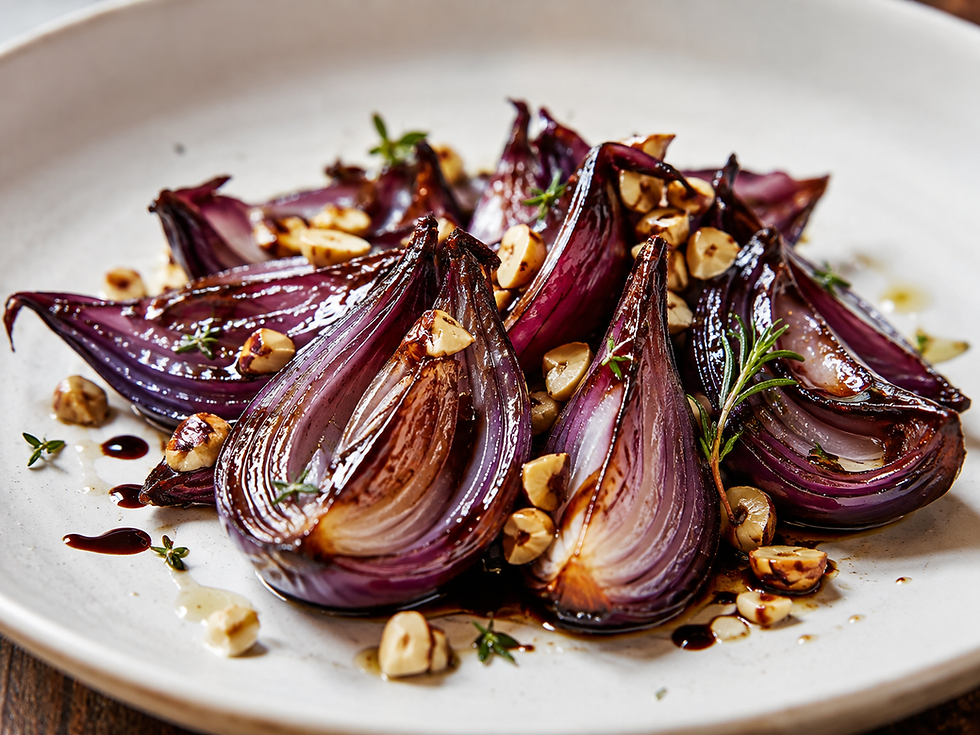
Roasted red onion looks like nothing written down and then takes over the table. Wedges go into a hot oven with olive oil and salt, and three quarters of an hour later the outer layers are dark and collapsing while the centre has turned translucent and sweet. Nothing was added to make that happen. The sugar was already in the onion, waiting for dry heat to concentrate it.
What turns a tray of onions into a plate is the finish. A balsamic reduction, used sparingly and never poured, lays a line of acidity under the sweetness so the dish never turns cloying. Toasted hazelnuts, crushed by hand rather than chopped to dust, give the one texture roasted onion cannot produce on its own. Lemon zest and fresh herbs go on at the very end, off the heat.
It happens to be entirely plant based without announcing it, and it works at three temperatures. Straight from the oven it is a contorno for roast lamb or pork. Warm it is an antipasto with good bread. At room temperature, refreshed with a few drops of oil, it holds on a buffet for an hour.
Yield: 4 servings as a side dish, or 6 on an antipasto table. Prep: 20 minutes. Roast: 45 minutes. Rest: 10 minutes. Total: about 1 hour 15 minutes. Difficulty: easy. Course: contorno or antipasto. Region: Piedmont and Emilia.
The Story
Italy grows red onions with more local pride than almost any other vegetable. Calabria has the Cipolla Rossa di Tropea IGP, long and violet and sweet enough to eat raw. Umbria has the onions of Cannara, celebrated every September at a sagra the town has run since 1981. Lombardy has the Cipolla Rossa di Breme, a Slow Food presidium from the Lomellina rice plain. These varieties are low in the sulphur compounds that make a yellow onion sharp, which is why they can be roasted and served as a vegetable in their own right rather than disappearing into a soffritto.
Cooking them this way is old cucina povera and predates any recipe. The onion was the cheapest thing in the kitchen garden and the wood oven was already hot from the week's bread, so whole onions went in among the cooling embers with their skins on. They came out an hour later, were split open and dressed with oil, salt and whatever vinegar the house had. The version that survives in trattorie across the north is still recognisably that dish, only cut into wedges and moved to a tray.
The balsamic and the hazelnut are the modern part, and both come from real places. Aceto balsamico is cooked grape must aged in a descending battery of casks in the lofts of Modena and Reggio Emilia, and even the commercial version carries some of that cooked fruit depth. The hazelnut is the Tonda Gentile Trilobata of the Langhe, sold as Nocciola Piemonte IGP. Putting the two with onion is restaurant thinking of the last forty years rather than peasant tradition, but it rests on two things Italy makes better than anywhere else.
Ingredients
For the onions
Red onions, medium, 4, about 1 3/4 lb (800 g)
Extra virgin olive oil, 3 tbsp (45 ml)
Fine sea salt, 1 tsp (6 g)
Freshly ground black pepper, 1/2 tsp (1 g)
Fresh thyme leaves, 1 tsp (1 g)
Rosemary sprigs, 2
Garlic cloves, crushed but whole, 2
Crushed red pepper flakes, 1/4 tsp (0.5 g), optional
For the balsamic reduction
Balsamic vinegar of Modena, good quality, 1/2 cup (120 ml)
Water, 2 tbsp (30 ml)
Maple syrup or agave nectar, 1 tsp (7 g), optional
For finishing
Hazelnuts, skin on, 1/3 cup (45 g)
Lemon, finely grated zest of 1
Fresh mint leaves, small, 10
Flat leaf parsley leaves, 2 tbsp (5 g)
Flaky sea salt, to taste
Extra virgin olive oil, 1 tbsp (15 ml)
Preparation
Cutting the onions so they hold together
Heat the oven to 400°F (200°C) with a rack in the upper third. Peel the onions but leave the root end completely intact, then stand each one on its root and cut it into six wedges from top to root, so every wedge keeps a piece of that root holding its layers together. This detail decides whether you serve wedges or a tray of loose petals. Do not trim the root off at any point.
Toasting and crushing the hazelnuts
Spread the hazelnuts on a small tray and toast them at 350°F (175°C) for 8 to 10 minutes, until the skins crack and the kitchen smells sweet. Tip them onto a clean towel, fold it over and rub firmly: most of the skins come away and the stubborn flakes do no harm. Let them cool, then crush them under the flat of a knife into rough halves and quarters. Never use a food processor, which turns them to powder and loses the texture entirely.
Seasoning the wedges and roasting them covered
Arrange the wedges cut side up in a single layer in a roasting dish, packed close but not stacked. Drizzle over the olive oil, season with the salt, pepper, thyme and the pepper flakes if using, and tuck the rosemary and the crushed garlic between the wedges. Cover the dish tightly with foil and roast for 25 minutes. Under the foil the onions steam in their own moisture and the layers soften through to the centre before any colour develops.
Uncovering and building the colour
Remove the foil, baste the wedges with the oil and onion juices collected in the dish, and return them uncovered for 18 to 22 minutes. Now the surface moisture leaves and the edges caramelize. Look for deep mahogany tips and a few genuinely dark outer layers, not an even golden tan. Baste once more halfway through. If the pan runs dry before the colour arrives, add a tablespoon of water rather than more oil.
Reducing the balsamic while the onions roast
Put the balsamic vinegar and the water in a small saucepan and bring them to a bare simmer over low heat. Reduce until roughly half the volume remains and the liquid coats the back of a spoon, about 8 to 12 minutes. Keep the heat low: boiled hard, vinegar turns flat and harsh and there is no correcting it. Add the maple syrup only if your vinegar is aggressive. Stop while it is still fluid, because it thickens considerably as it cools.
Resting the onions and finishing off the heat
Take the dish out and let it stand for 10 minutes, then discard the rosemary and the garlic. Tear the mint and parsley by hand rather than chopping, so the cut edges do not blacken, and scatter them over with the lemon zest and the crushed hazelnuts. Brush the balsamic reduction over in thin lines, then add the raw olive oil and the flaky salt. Everything here goes on after the oven, and that is what keeps the dish tasting fresh rather than baked.
Plating
Serve this warm rather than hot. Straight from the oven the balsamic smells sharper than it tastes, while at around body temperature the sweetness reads properly and the hazelnut aroma comes forward. Ten minutes of rest is not a suggestion. Use room temperature plates: a warmed plate keeps driving moisture out of the onions and softens the nuts within a couple of minutes.
On an individual plate, set three wedges leaning against each other with the cut faces turned towards the diner, because the visible ringed layers are the whole picture. Spoon over any juices left in the roasting dish first, then the balsamic in thin deliberate lines, never as a pool. Finish with the hazelnuts, the torn herbs and the zest last of all so they stay dry. As a shared contorno, bring the roasting dish to the table and dress it there. On an antipasto board it wants a second thread of raw olive oil before it goes out.
Professional Technique
The technique that defines this dish is the two stage roast, covered and then uncovered, and it solves a real conflict. A red onion wedge is mostly water held between layers, and the heat needed to caramelize its surface is far more than the heat needed to cook its centre. Roast it uncovered from the start and the outside blackens while the core is still raw. Steam it throughout and it cooks evenly but stays pale and slack, tasting boiled. Covering the dish for 25 minutes cooks the interior in trapped moisture, and removing the foil lets that moisture escape so the last 20 minutes do nothing but colour.
The second technique is the intact root end, which is structural rather than decorative. An onion is a series of concentric leaves anchored at a single basal plate, and that plate is the only thing holding them together. Cut through it and the wedge falls apart the moment it softens. The third is keeping every fresh element off the heat: lemon zest, mint, parsley, raw oil and the crushed nuts all go on after the dish leaves the oven, because their volatile aromatics are exactly what roasting destroys. It is the logic of gremolata on ossobuco.
Texture and Moisture Control
Onions are roughly nine parts water in ten, and almost every fault in this recipe is a moisture fault. Crowding is the first: wedges packed into a heap release steam faster than the oven can carry it away and poach instead of roasting. A single layer is what allows the uncovered stage to work. The second is the sugar itself. Onion sugars caramelize readily but they also burn readily, which is why the uncovered stage is watched rather than left. Basting keeps the exposed edges from drying to paper before the colour is deep enough.
The balsamic reduction is a separate moisture problem. Reduced correctly it is a syrup that clings to a wedge and stays where it is put. Reduced too far it sets to a tacky lacquer and pulls the onion apart when you spread it. Reduced too little it runs straight off, collects at the bottom of the plate and makes everything sitting in it soggy and sour. The hazelnuts are the last thing to guard: dry and brittle when they go on, they begin absorbing moisture immediately, so they are scattered at the door and never stirred through in advance.
Professional Mise en Place
Almost everything here can be done in advance, and the only genuinely last minute actions are the herbs, the nuts and the final oil.
Equipment and tools
Shallow roasting dish or heavy sheet pan large enough for a single layer
Aluminium foil for the covered stage
Small heavy saucepan for the vinegar reduction
Mortar or the flat of a heavy knife for crushing the hazelnuts
Microplane for the lemon zest, pastry brush or teaspoon for the reduction
Prepared ahead
Balsamic reduction, up to 2 weeks ahead, sealed at cool room temperature
Hazelnuts toasted, skinned and crushed, up to 3 days ahead in an airtight jar
Onions cut into wedges with the root left on, up to 6 hours ahead, covered and refrigerated
Onions fully roasted, up to 1 day ahead, undressed and refrigerated
Service setup
Herbs washed, dried and left whole, torn only at the moment of plating
Lemon zested to order, since the oils go dull within the hour
Reduction in a squeeze bottle, loosened with a drop of water if it has set
Plates at room temperature, never warmed
Chef Tips
Buy the flattest onions you can find rather than the roundest. A squat onion cuts into wedges that sit stably on their cut face and present it upwards, which is both how they roast evenly and how they look on the plate. Tall onions give you rocking wedges that fall over and colour on one random side.
Taste the vinegar before you reduce anything. Balsamic of Modena varies from thin and acetic at the cheap end to sweet and syrupy at the good end, and one recipe cannot fit both. If yours tastes sharp in the bottle, add the maple syrup and reduce a little further. If it already tastes of cooked fruit, reduce it less and leave the sweetener out.
For a nut free version, crisped chickpeas work better than any substitute. Toss drained chickpeas with oil and salt and roast them alongside the onions during the uncovered stage. They bring the same dry contrasting crunch and read as belonging on the plate, which toasted seeds never quite do.
Save the juices. What collects at the bottom of the roasting dish is concentrated sweet onion liquid with oil, thyme and garlic in it, and it is far too good to leave behind. Spoon it over the wedges before the balsamic goes on, and use it rather than fresh oil to bring the dish back the next day.
Common Mistakes
Cutting the root end off. It is the only thing anchoring the layers, and without it every wedge collapses into loose petals during the roast. Stand the onion on its root, cut down through it so each wedge keeps a piece, and do not tidy it away afterwards.
Roasting uncovered from the start. The outer layers scorch and turn bitter long before the centre is tender, and no extra time fixes an onion that is burnt outside and raw inside. The 25 minutes under foil are what cook the interior.
Crowding the dish. Wedges piled on one another trap steam and stew rather than roast, finishing pale and slack with no caramelized edges. Use a dish that holds them in one layer, or roast in two batches.
Reducing the balsamic over high heat. Hard boiling drives off the aromatic esters and leaves a flat scorched acidity that dominates the plate. Keep a bare simmer and stop while the syrup still runs off the spoon, because it sets as it cools.
Cooking the herbs and the zest. Mint, parsley and lemon zest added before or during roasting lose their volatile aroma and turn dark and muddy. Everything fresh goes on after the dish has left the oven and rested.
Wine Pairing
Gavi DOCG: The reference dry white of southern Piedmont and the cleanest answer to the balsamic. Cortese gives sharp green apple acidity with very little aromatic noise, so it cuts the sweetness of the roasted onion without adding another flavour to a plate that already carries vinegar, nut and herb. Its faintly bitter mineral finish echoes the toasted hazelnut skins.
Roero Arneis DOCG: From the sandy hills across the Tanaro from the Langhe hazelnut country, the local bottle in the most literal sense. Arneis is rounder and lower in acid than Gavi, with pear, white flowers and a distinct hazelnut note on the finish that runs directly alongside the crushed nuts. Its softer texture suits the melting interior of the onion.
Lambrusco di Sorbara DOC: Choose the secco version and serve it properly cold. This is the wine of the same plain that produces the balsamic, pale and high in acidity with a fine mousse, and the carbonation scrubs the sticky reduction off the palate between mouthfuls in a way no still wine manages.
Dolcetto d'Alba DOC: The red option when the onions go alongside roast meat rather than standing alone. Dolcetto is deeply coloured but low in acid and soft in tannin, with dark plum fruit, so it meets the sweetness of the dish without the tannic clash a Nebbiolo would create against the vinegar. Serve it at 59°F (15°C).
Alta Langa DOCG: The Piedmontese metodo classico, and the bottle for serving this as an antipasto. Extended lees ageing gives a toasted bread and hazelnut character that doubles the nuts on the plate, while the firm acidity and the bead handle the raw olive oil and the balsamic together.
Storage & Reheating
Roasted onions keep well, so store them undressed. Transfer the wedges with their pan juices to an airtight container and refrigerate for up to 4 days, holding the balsamic, the nuts and the herbs separately. Dressed leftovers go soft and sour overnight because the vinegar keeps working on the onion and the nuts turn to sponge. The reduction lasts several weeks sealed at cool room temperature, and the toasted hazelnuts keep 3 days in a jar or several weeks in the freezer.
To bring them back, spread the wedges in a single layer, spoon the reserved juices over them and reheat uncovered at 375°F (190°C) for 8 to 10 minutes, until warm through and the edges have crisped again. Never use a microwave, which steams the onion and destroys the caramelized surface. Then dress from scratch. Better still, do not reheat at all: this dish is genuinely good at room temperature, so take it out an hour ahead, dress it and serve it as it is. Freezing is not worth it, since the layers turn to mush on thawing.
Nutrition
Per serving, based on 4 side dish portions:
Calories: 265 kcal
Total Fat: 18 g
Saturated Fat: 2 g
Trans Fat: 0 g
Unsaturated Fat: 15.5 g
Cholesterol: 0 mg
Sodium: 590 mg
Total Carbohydrates: 23 g
Fiber: 4 g
Total Sugars: 13 g
Added Sugars: 1 g
Protein: 4 g
Lactose: 0 g
Principal micronutrients: vitamin C, vitamin E, manganese, copper, folate, potassium, quercetin
These figures are estimates. The dish is entirely plant based, so there is no cholesterol and no lactose. Sodium depends on how heavily you finish with flaky salt, and the sugar is mostly the onion's own.


Comments