Modena Flatbreads with Lardo, Garlic and Rosemary Spread and Parmigiano Reggiano | Crescentine Modenesi con la Cunza

Crescentine are the small round breads of the Modenese Apennines, cooked between two hot discs and known all over Italy by the name of those discs, tigelle. They are split while still hot and spread with cunza, cured lardo pounded with garlic and rosemary until it turns to a cream, then finished with Parmigiano Reggiano. The heat of the bread melts the lardo into the crumb and releases the scent of rosemary. This version uses a slow, cold-fermented dough for a lighter crumb and a deeper flavor, and a cunza worked to a perfectly smooth paste, so each crescentina is crisp outside, tender inside and seasoned to the edge.
Yield: 8 servings, 24 crescentine. Prep: 30 minutes, plus 12 to 24 hours of fermentation. Cook: 30 minutes. Rest: 30 minutes. Course: antipasto or rustic meal. Region: Emilia-Romagna.
The Story
The crescentina belongs to the mountains south of Modena, the Frignano and the valleys of the Apennines, where wheat was scarce, chestnuts were plentiful and every family raised a pig. It was bread for every day and for the hearth: a simple dough of flour and water, often enriched with a little milk and lard, shaped into small rounds and cooked by the fire. It fed farmers and woodcutters, and it was eaten with whatever the house had, above all with the products of the pig.
The name tigelle comes from the tool, not the bread. Tigelle were discs of terracotta, heated in the embers of the fireplace and stacked in a column, alternating with rounds of dough, often separated by chestnut leaves that left their mark and their aroma on the bread. Over time the name of the disc passed to the bread itself, and today most Italians say tigelle. In Modena many still insist on crescentine, and there is a further twist: in Bologna, a few miles away, crescentina is the name of the fried dough that Modena calls gnocco fritto. Today the terracotta stack has been replaced by the tigelliera, a hinged pan of cast iron or aluminum with several round hollows, but the shape and the flavor remain.
Cunza, also called pesto modenese, is the classic filling. It is made from lardo, the cured back fat of the pig, pounded with garlic and rosemary on a board or in a mortar until it becomes a soft, fragrant paste. Spread on a crescentina straight from the fire, it melts into the crumb. A dusting of Parmigiano Reggiano completes it. Parmigiano Reggiano DOP is made only in the provinces of Parma, Reggio Emilia and Modena, in the part of Bologna west of the Reno river and in the part of Mantua south of the Po, from raw cow's milk, and it is aged for at least 12 months.
In the Modenese hills, crescentine are still a meal in themselves, served in baskets with cunza, salumi and cheeses. They are a dish of sharing, eaten with the hands and passed around the table. This recipe keeps the traditional dough, the traditional filling and the traditional cooking between two hot surfaces, and adds a cold fermentation, precise temperatures and careful seasoning, so the simplest food of the mountains reaches the level of a restaurant table.
Ingredients
Buy lardo from an Italian salumeria, sliced thick or in one piece. It should be pure white, sweet-smelling and seasoned with salt, pepper and herbs; avoid yellowed lardo, which has oxidized and tastes rancid. Lardo di Colonnata IGP from Tuscany is an excellent choice when available. Choose Parmigiano Reggiano aged 24 months, which has the dry, crystalline texture that grates well and a flavor strong enough to stand up to the lardo. For the dough, a medium-strength all-purpose flour or Italian 0 flour gives the right balance between tenderness and structure. Pure pork lard, strutto, is traditional in the dough; it makes the crumb tender.
For the crescentine dough
All-purpose flour or Italian 0 flour, 4 cups (500 g)
Active dry yeast, 1 tsp (3 g), or 3/4 oz (20 g) active sourdough starter for a slower rise
Whole milk, lukewarm, 1/2 cup (120 ml)
Water, lukewarm, 2/3 cup (160 ml)
Pork lard (strutto), soft, 3 1/2 tbsp (50 g)
Fine sea salt, 1 3/4 tsp (10 g)
Rice flour or semolina, for dusting, 2 tbsp (20 g)
For the cunza
Lardo, rind removed, 5 oz (150 g)
Garlic, 1 small clove, germ removed
Fresh rosemary leaves, 1 tbsp (2 g)
Black pepper, freshly ground, 1 pinch
For serving
Parmigiano Reggiano DOP, aged 24 months, finely grated, 3 oz (85 g)
Parmigiano Reggiano DOP, a small wedge to shave at the table, optional
Preparation
Step 1

Mix the dough. Dissolve the yeast in the lukewarm milk and water, about 95°F (35°C), and leave it for 5 minutes. Put the flour in a large bowl, pour in the liquid and mix until no dry flour remains. Add the lard and the salt and knead for 8 to 10 minutes by hand, or 5 minutes in a stand mixer on low speed, until the dough is smooth, soft and slightly tacky but no longer sticky. Adding the salt and fat after the first mix lets the flour hydrate fully first, and the gluten forms more quickly.
Step 2

Ferment the dough cold. Shape the dough into a ball, place it in a lightly oiled container, cover it and leave it at room temperature for 1 hour, until it begins to swell. Then refrigerate it for 12 to 24 hours. At 38 to 40°F (3 to 4°C) the yeast works slowly while the enzymes in the flour break down starch and protein into sugars and aromatic compounds. The result is a crescentina that tastes of bread rather than of yeast, browns more evenly and stays tender for longer.
Step 3

Make the cunza. Cut the lardo into small cubes and chill it well. Chop the garlic and rosemary together very finely on a board, then add the lardo and keep chopping with a heavy knife or a mezzaluna, folding the mixture over itself, for 5 to 8 minutes, until it becomes a smooth, uniform white paste speckled with green. Alternatively, pound it in a marble mortar. Season with a little pepper, pack it into a small bowl, cover it and refrigerate it. Take it out 30 minutes before serving so it softens to a spreadable consistency. Use a very small amount of garlic: raw, it dominates quickly, and the rosemary should be the leading aroma.
Step 4

Shape the crescentine. Take the dough from the refrigerator and let it stand for 30 minutes. On a surface lightly dusted with flour, roll it out evenly to a thickness of 1/4 inch (6 mm). Cut rounds of 3 inches (7.5 cm) with a plain cutter, pressing straight down. Gather the scraps, let them rest for 10 minutes and roll them once more. You should obtain about 24 rounds. Place them on a tray dusted with rice flour or semolina, cover them with a cloth and let them rise for 45 to 60 minutes, until visibly puffy and light; a gentle press with a finger should leave a dent that springs back slowly.
Step 5

Heat the tigelliera. Place the closed tigelliera over medium heat for 5 to 6 minutes, turning it to heat both sides evenly, until a drop of water on the surface sizzles and evaporates at once, about 400°F (200°C) on the surface. If you have no tigelliera, heat a heavy cast iron skillet and use a second heavy pan, also preheated, pressed on top. Both sides must be hot: the crescentina cooks from above and below at the same time, which gives it its two flat, browned faces.
Step 6

Cook the crescentine. Place one round in each cavity, close the tigelliera and cook for 3 to 4 minutes, then turn it over and cook for another 3 to 4 minutes. They are done when both faces are golden with darker spots, the sides are pale and the crescentina sounds hollow when tapped; the center should reach about 200°F (93°C). Adjust the heat between batches: if they brown too fast, they stay raw inside. Keep the cooked crescentine wrapped in a cloth in a basket, where they stay warm and soft while you cook the rest.
Step 7
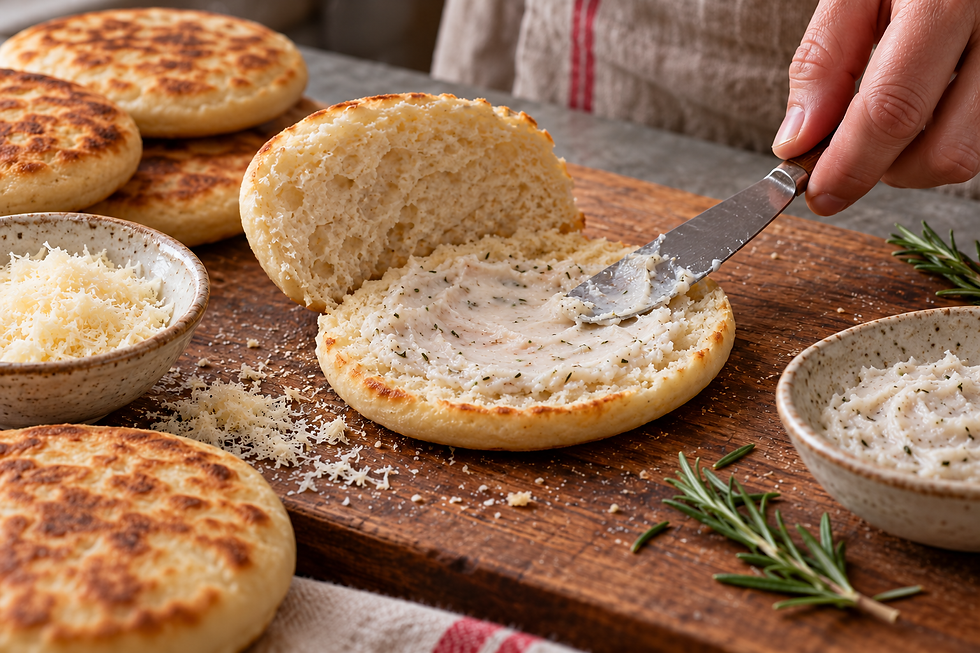
Fill and serve. Split each crescentina horizontally while still hot, using a serrated knife or your fingers, leaving it attached at one side. Spread about 1 tsp (5 g) of cunza on the inner face, sprinkle with grated Parmigiano Reggiano and close it. Serve at once, while the heat of the bread is still melting the lardo. In Modena each guest fills their own: you can also bring the crescentine to the table whole with the cunza and the Parmigiano in small bowls.
Plating
Serve the crescentine in a basket or on a wooden board lined with a cloth, stacked loosely so they stay warm without steaming. Arrange the filled ones slightly open, so the white cunza and the Parmigiano show at the edge. Place the bowl of cunza, softened, with a small butter knife, and the grated cheese beside the basket for the second round.
For a more formal antipasto, serve three crescentine per guest on a warm plate: one filled with cunza and grated Parmigiano, one with cunza and a few thin shavings of Parmigiano, and one left open with the cunza melting on its surface. Add a few rosemary needles on the plate. The guest eats them with the hands, immediately.
Professional Technique
The key number is the hydration. This dough uses about 280 ml of liquid for 500 g of flour, roughly 56 percent, with the lard adding tenderness. That is drier than a pizza dough, and it is what lets you roll it and cut it cleanly. A wetter dough sticks to the tigelliera and spreads; a drier one gives a dense, hard crescentina.
The hidden variable is the final rise. Crescentine cooked too early are flat and heavy, and those left too long collapse when pressed in the tigelliera. Use the finger test: a light press should leave a dent that springs back slowly and only partly. The rise also depends on the temperature of the kitchen, so watch the dough, not the clock.
The doneness test is sound and weight. A well-cooked crescentina feels light for its size and sounds hollow when tapped on the bottom. Break the first one of each batch: the crumb should be moist and fully set, with no sticky streak at the center. If it is still raw inside but brown outside, lower the heat and cook a minute longer on each side.
Heat and Dough Control
The tigelliera is a small oven that works by contact. Too little heat and the crescentine dry out before they brown; too much and they burn outside while staying raw inside. Medium heat, with the pan turned over every few minutes so both faces stay equally hot, is the rule. Gas gives the most control; on an electric or induction burner, use a heavy cast iron skillet and a second preheated pan as a lid.
Roll the dough evenly. A difference of a few millimeters between one crescentina and the next means different cooking times in the same batch. Use guides or check with a ruler: 1/4 inch (6 mm) before the final rise, and about twice that thickness after it.
Keep the cunza cool and the bread hot. Lardo melts at a low temperature, which is exactly why it is spread on hot bread, but if the cunza itself is warm it turns oily and separates. Keep it chilled until 30 minutes before serving, and work it with a knife if it has become too firm.
Professional Mise en Place
The dough is made the day before, and the cooking is done at the last moment, in batches. The cunza can be made up to two days ahead.
Equipment and tools
Large bowl or stand mixer, oiled container with lid
Rolling pin, ruler, 3 inch (7.5 cm) plain cutter
Tigelliera, or a cast iron skillet and a second heavy pan
Heavy knife or mezzaluna, or a marble mortar, for the cunza
Prepared ahead
Dough mixed and fermenting in the refrigerator, 12 to 24 hours
Cunza made, packed and refrigerated, up to 2 days ahead
Parmigiano Reggiano grated, covered
Rounds cut and rising on a dusted tray, 45 to 60 minutes before service
Service setup
Tigelliera preheated for 5 to 6 minutes
Basket lined with a cloth to keep cooked crescentine warm
Cunza softened at room temperature for 30 minutes
Small bowls of cunza and cheese, butter knives, serrated knife
Chef Tips
Use sourdough if you have it. A small amount of active starter in place of the yeast gives a slower rise and a more complex, slightly tangy crumb, closer to the crescentine of the old farmhouses. Allow 2 to 3 hours of extra rising time.
Season the cunza after tasting the lardo. Cured lardo is already salted, and different producers salt it differently. Add salt only if it tastes flat, and remember the Parmigiano will add more.
Freeze cooked crescentine. Cool them completely, freeze them in a bag and reheat them directly from frozen in the hot tigelliera or in the oven. They are almost as good as fresh, and this is a practical way to serve them for a party.
Offer the classic Modenese accompaniments alongside the cunza: thin slices of prosciutto, mortadella or salame, soft fresh cheeses and a few drops of Aceto Balsamico Tradizionale di Modena DOP on a shaving of Parmigiano. The cunza remains the first and the most traditional filling.
Common Mistakes
Rushing the fermentation. A dough risen quickly in a warm place tastes of yeast and gives a dry crescentina. Ferment it slowly in the refrigerator.
Rolling too thin. Thin rounds turn into crackers in the tigelliera. Roll them to 1/4 inch (6 mm) and let them rise until puffy.
A cold tigelliera. A pan that is not fully hot dries the dough before it browns. Preheat it for at least 5 minutes on both sides.
Too much heat. Crescentine that brown in a minute are raw inside. Cook them over medium heat, 3 to 4 minutes per side.
Too much garlic in the cunza. Raw garlic overwhelms the sweet lardo and the rosemary. Use one small clove, without its green germ.
Spreading cunza on cold bread. The lardo does not melt and stays waxy in the mouth. Fill the crescentine as soon as they come off the heat.
Stacking them in a closed container. Steam softens the crust and makes them soggy. Keep them in a cloth-lined basket, loosely covered.
Wine Pairing
Lambrusco di Sorbara DOC: The Lambrusco of the plain north of Modena, pale ruby, sparkling and very fresh, with notes of violets and red currant. Its bubbles and sharp acidity cut straight through the lardo and the Parmigiano, the classic way the Modenese drink with crescentine. Serve it chilled, at about 50 to 54°F (10 to 12°C).
Lambrusco Grasparossa di Castelvetro DOC: From the hills south of Modena, a deeper, more structured Lambrusco with dark fruit and a light tannic grip. It has the body to match the cunza and stands up to salumi served alongside. Serve at about 54°F (12°C).
Romagna Sangiovese DOC: The still red of the other half of the region, with cherry fruit, fresh acidity and moderate tannins. A good choice when the crescentine are the main dish of a meal. Serve at about 60°F (16°C).
Bonarda dell'Oltrepò Pavese DOC: From the hills of Lombardy just across the Po, usually made in a lightly sparkling style from Croatina. Soft, fruity and fresh, it shares Lambrusco's ability to clean the palate after pork fat and aged cheese. Serve at about 54 to 57°F (12 to 14°C).
Storage & Reheating
Refrigerator: the raw dough keeps for up to 48 hours from mixing. Cooked crescentine are best eaten the same day; keep them in a closed bag at room temperature for up to 1 day. The cunza keeps, covered and refrigerated, for up to 5 days. Freezer: cooked, unfilled crescentine freeze well for up to 1 month; the cunza can be frozen for up to 1 month, wrapped tightly.
Reheat unfilled crescentine in a preheated tigelliera or skillet over medium heat for 1 to 2 minutes per side, or wrapped in foil in a 350°F (175°C) oven for 8 to 10 minutes, 15 minutes from frozen. Fill them only once they are hot again.
Nutrition
Per serving, based on 8 servings of 3 crescentine:
Calories: 485 kcal
Total Fat: 27 g
Saturated Fat: 11 g
Trans Fat: 0 g
Unsaturated Fat: 15 g
Cholesterol: 30 mg
Sodium: 740 mg
Total Carbohydrates: 48 g
Fiber: 2 g
Total Sugars: 1 g
Added Sugars: 0 g
Protein: 11 g
Lactose: less than 1 g
Principal micronutrients: calcium, phosphorus, selenium, thiamin, folate
These figures are estimates, calculated on the quantities listed and rounded to the nearest whole number, with all the cunza and grated cheese eaten. They vary with the lardo, its salt content and the flour used.


Comments