

Italian Saffron Risotto Croquettes with a Molten Mozzarella Center | Crocchette di Risotto allo Zafferano con Cuore di Mozzarella
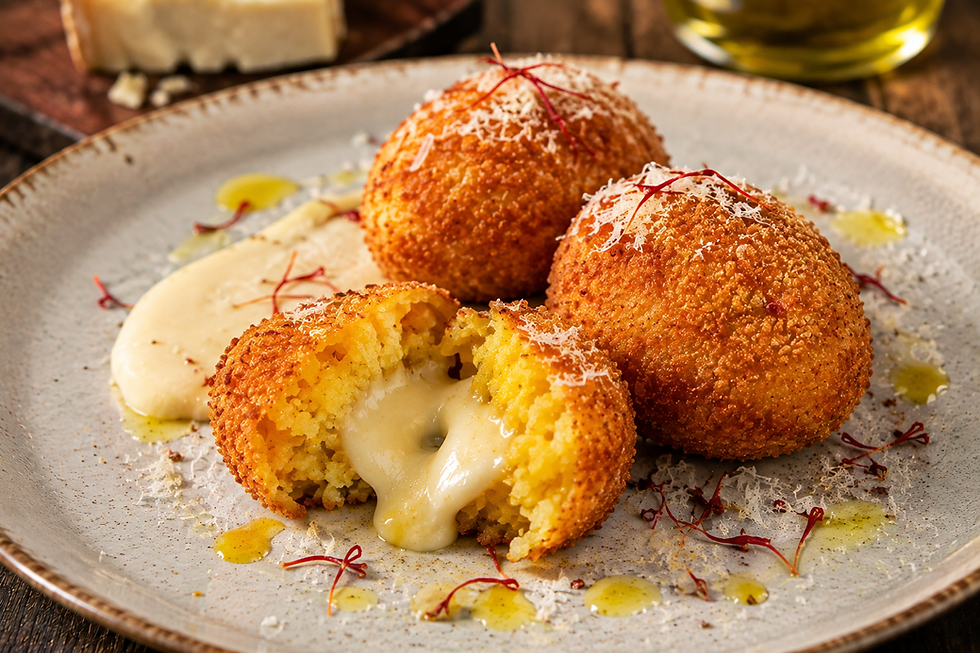
A croquette made from saffron risotto is judged on one thing: whether the inside still looks like risotto when you break it open. Collapsed grains, a leaked filling, a shell gone soft over a wet interior, all of these are failures of moisture rather than of flavour. Get it right and the cut face shows separate yellow grains in a creamy bind, a white thread of molten mozzarella through the middle and a shell thin enough to shatter.
Everything in this recipe is arranged around that cross section. The risotto is cooked drier than one destined for a plate, cooled flat so it firms evenly, and shaped cold. The mozzarella is dried before it goes in, because the water it holds is the single most common cause of a burst croquette. The breading is done in three passes and rested, and the oil is held in a narrow window that dries the shell before the cheese has time to escape.
Yield: 12 croquettes, 4 servings of 3. Prep: 40 minutes. Cook: 40 minutes. Chill: 6 hours. Total: about 7 hours 30 minutes. Difficulty: intermediate. Course: antipasto or fritto. Region: Lombardy, with a nod to Rome and Sicily.
The Story
Italy fries leftover rice in at least three dialects, and they are not the same dish. The Roman supplì al telefono is built on rice cooked in tomato and meat sugo, shaped into an oval, and named for the string of mozzarella that stretches like a telephone cord when it is pulled apart. The Sicilian arancino starts from rice boiled and coloured with saffron, wrapped around ragu or ham and cheese and shaped into a cone or a sphere depending on which side of the island you stand. The Lombard version, the one here, starts from actual risotto: rice cooked in stock, mounted with butter and Parmigiano, then chilled.
That difference in starting point is the whole story. Boiled rice has to be given a binder; risotto arrives with its own. Milanese cooks have exploited this for as long as there has been risotto to spare, most famously in risotto al salto, where day old risotto is pressed into a pan and crisped into a flat cake. The croquette is the same instinct with a different geometry and cheese in the middle. It belongs to cucina di recupero, which in the rice belt of the Lomellina was never a poverty of ideas but simply how a kitchen worked.
Saffron arrived in that kitchen by way of money rather than agriculture. Lombardy grows rice, not crocus, and the threads came through Milanese trade at prices that made them a statement of wealth. What matters here is what the spice does rather than what it cost. Frying concentrates it: the shell tastes toasted and nutty while the interior keeps the floral note of a proper bloom, so one croquette delivers saffron twice, in two registers.
Ingredients
For the saffron risotto
Carnaroli rice, 1 1/2 cups (300 g)
Chicken or vegetable stock, hot, 4 cups (960 ml)
Saffron threads, 1/3 tsp, about 0.2 g
Shallot, very finely minced, 1 medium
Unsalted butter, 3 tbsp (42 g), divided
Dry white wine, 1/3 cup (80 ml)
Parmigiano Reggiano, finely grated, 2/3 cup (60 g)
Fine sea salt, 3/4 tsp (4.5 g)
Freshly ground white pepper, to taste
For the filling
Low moisture mozzarella, in a block, 5 oz (140 g), cut into 12 batons
Flat leaf parsley, finely chopped, 1 tbsp (3 g)
For the breading
All purpose flour, 3/4 cup (95 g)
Large eggs, 3
Whole milk, 1 tbsp (15 ml)
Fine dry breadcrumbs, 2 cups (200 g)
Fine sea salt, 1/2 tsp (3 g)
For frying
Sunflower or peanut oil, 6 cups (1.4 l)
Flaky sea salt, for finishing
For finishing
Lemon, cut into wedges, 1
Parmigiano Reggiano, shaved, a small handful
Freshly ground black pepper, to taste
Preparation
Bloom the saffron and cook the risotto dry
Crush the threads into 4 tablespoons of hot stock and leave them 15 minutes, until the liquid is dark orange. Sweat the shallot in 2 tablespoons of butter over low heat for 6 minutes without colour, add the rice and toast it for 2 minutes until the grains squeak against the spoon. Pour in the wine and let it disappear. Add stock a ladle at a time for 16 to 17 minutes, stirring often, and stop while the rice is just cooked but the pan is visibly drier than it would be for the table. Stir in the saffron liquid for the last 2 minutes.
Finish it tight and spread it flat
Off the heat, beat in the remaining butter, the Parmigiano, the salt and the white pepper, working the spoon firmly so the rice turns thick and holds a line when you draw the spoon through it. Spread it onto a parchment lined tray about 1 inch (2.5 cm) deep, cover the surface directly with cling film so no skin forms, and refrigerate at least 6 hours, preferably overnight. Warm risotto cannot be shaped: the starch has to set cold before it will hold a wall.
Dry the mozzarella
Cut the block into 12 batons roughly 1 1/2 inches (4 cm) long and lay them on a double layer of paper towel in the refrigerator for at least 2 hours, turning once. Even low moisture mozzarella carries free water, and that water turns to steam in the fryer, builds pressure and splits the croquette from inside. The step looks fussy and it is the difference between twelve intact croquettes and four.
Shape around the cheese
Fold the parsley through the cold risotto. Wet your hands, take about 1/4 cup (60 g) of rice and flatten it on your palm into a disc roughly 1/3 inch (8 mm) thick. Set a dried baton in the centre, fold the rice up around it and roll it into a smooth cylinder with rounded ends, sealing any crack. The cheese must be fully enclosed with an even wall: a thin patch is where the leak starts. Chill the shaped croquettes for 30 minutes.
Bread in three passes
Set out three shallow dishes: flour, the eggs beaten with the milk and salt, and the breadcrumbs. Roll each croquette in flour and tap off the surplus, turn it in the egg until fully coated, then press it into the crumbs so the layer is even and nothing shows through. For the safest result pass them a second time through egg and crumbs. Rest them on a rack in the refrigerator for 20 minutes so the coating tightens onto the rice.
Fry in small batches
Bring the oil to 340°F (170°C) and keep a thermometer in it. Lower in four croquettes at a time and fry for 4 to 5 minutes, turning them gently, until the crust is deep gold and the surface has stopped bubbling hard. That temperature is a compromise: hotter and the shell browns before the cheese melts, cooler and the rice drinks oil. Lift them onto a wire rack, salt at once and let them stand 2 minutes before serving.
Plating
Serve them hot but not straight from the oil. Two minutes on the rack evens out the interior temperature, so the cheese stays molten instead of scalding and the shell finishes drying rather than steaming itself soft from below. Never rest a fried croquette on paper: the underside goes flabby within a minute.
Use a small warmed plate or a wooden board and set three croquettes at slight angles rather than in a row, so they read as a handful rather than a formation. A wedge of lemon goes on the side, never squeezed over them in the kitchen, since the juice softens the crust on contact. A few shavings of Parmigiano and a turn of pepper finish them.
If you are serving them as part of a fritto misto or on a larger board, cut one croquette in half and lay it cut face up among the whole ones. The yellow interior and the thread of cheese are the entire argument for the dish, and there is no reason to make a guest discover it by accident.
Professional Technique
The governing technique here is deliberate underhydration of the risotto. A risotto for the plate is finished all onda, loose enough to move when you tilt the pan, because the sauce is part of the eating. Chilled, that same rice is far too soft to shape. Stopping the stock two ladles early and beating the mantecatura hard gives a rice still creamy on the tongue that sets firm when cold, because the released starch binds the grains as it cools rather than sitting around them as liquid.
The second is the double breading, which is not belt and braces but a different structure altogether. A single crumb layer is porous, and molten cheese under pressure finds the gaps. Flour, egg, crumb, egg again, crumb again builds two bonded shells with a protein layer between them, and that holds pressure for the four minutes in the oil. Resting them cold lets the egg set against the crumb, which is why the coating stays on instead of sliding off.
The third is the temperature window. Frying is a drying process: water leaves the surface as steam, and while it is leaving, oil cannot enter. At 340°F (170°C) that outward flow is strong enough to keep oil out yet gentle enough that the crumb does not burn before the centre reaches the melting point of mozzarella, around 130°F (55°C). Below 320°F (160°C) the croquette absorbs fat; above 365°F (185°C) the shell is dark while the middle is cold.
Texture and Moisture Control
There are three reservoirs of water in a croquette and each is managed separately. The rice holds the most, which is why it is cooked drier and chilled under film long enough to firm all the way through. A tray given only two hours is set at the edges and soft in the middle, and the soft middle is where shaping fails.
The cheese holds the second, and it is the one most people ignore. Mozzarella sold in brine can carry more than half its weight in water, and inside a sealed croquette that water has nowhere to go but outward through the wall. Draining a low moisture block on paper for two hours changes the outcome entirely. Fresh fior di latte, however good, does not work here.
The third is the crust, and it is a race. The shell is crisp only while it is drier than the rice behind it, so every minute after frying moves it closer to soft. Draining on a rack rather than on paper, salting while the surface is hot and serving within ten minutes are what keep the shatter. Croquettes that must wait are held uncovered in a 250°F (120°C) oven, never under foil.
Professional Mise en Place
This is a preparation with a long idle period and a short violent finish. The risotto and the shaping belong to the day before, the frying belongs to the last ten minutes, and nothing useful happens in between.
Equipment and tools
Wide heavy saucepan for the risotto and a ladle
Rimmed tray, parchment and cling film for the chilled rice
Three shallow dishes for the breading line, set left to right
Deep pan or fryer with a probe thermometer and a spider
Wire cooling rack set over a tray
Prepared ahead
Saffron risotto cooked, spread and chilled, the day before
Mozzarella cut and drained on paper, at least 2 hours ahead
Croquettes shaped and breaded, up to 1 day ahead, on a rack in the refrigerator
Breadcrumbs and flour measured, eggs beaten with the milk at the last moment
Service setup
Oil at 340°F (170°C), thermometer in the pan, monitored between batches
Croquettes straight from the refrigerator to the oil, never at room temperature
Rack and flaky salt within reach of the fryer
Lemon wedges and Parmigiano cut, plates warm but not hot
Chef Tips
Make the risotto the day before and make a little more than you need. Rice that has spent a full night in the refrigerator shapes better than rice chilled in a hurry, and the extra gives you the material to repair a croquette that cracks while you are rolling it.
Keep one hand dry and one hand wet through the breading. The classic wet hand and dry hand method stops your fingers turning into a lump of egg and crumb, which is what ruins the evenness of the coating halfway through a batch.
Fry a single test croquette before committing the tray. It tells you whether the seal holds, whether the oil is right and whether the centre is molten in four minutes, and one sacrificed croquette is a cheap price for knowing.
If the mozzarella leaks anyway, do not increase the breading further. Go back a step: the rice wall was too thin somewhere, or the cheese was still damp. Thicker crumb on a weak wall simply moves the failure rather than fixing it.
Common Mistakes
Using fresh mozzarella in brine. It carries too much water, which turns to steam in the fryer and forces its way out through the rice wall. Use a firm low moisture block and dry it on paper for at least 2 hours before shaping.
Shaping warm or barely chilled risotto. The starch has not set, so the rice slumps on your palm and the wall around the cheese ends up uneven. Give the tray a minimum of 6 hours in the refrigerator, and overnight if you can.
Skipping the second breading. One layer of crumb is porous and melted cheese finds the weak point. Two passes through egg and crumb, with a cold rest afterwards, is what holds the pressure for the full frying time.
Frying too cold. Below about 320°F (160°C) the steam pressure at the surface drops and oil moves inward, giving a heavy greasy croquette with a pale shell. Keep a thermometer in the oil and wait for it to recover between batches.
Crowding the pan. Four at a time in a domestic pan is the limit. More than that drops the temperature sharply, and the croquettes also knock into each other and crack their coating while they are at their most fragile.
Wine Pairing
Oltrepò Pavese Metodo Classico DOCG: Lombardy makes serious traditional method sparkling wine from Pinot Nero in the Oltrepò, and fried food is exactly what it is for. The mousse scrubs fat from the palate between bites, the acidity resets it, and the autolytic bread and brioche notes sit alongside the toasted crumb. Serve it at 46°F (8°C) and pour it first at the table.
Frascati Superiore DOCG: The Roman answer, and the bottle that has been drunk with supplì in the hills above the city for a century. Malvasia and Trebbiano give a dry white with a soft almond bitterness and enough weight to meet melted cheese without being smothered. Its gentle aromatic lift also picks up the saffron, which more neutral whites ignore completely.
Grillo Sicilia DOC: A nod to the arancino, and a genuinely good match. Grillo is broad and slightly waxy with grapefruit and green herb aromatics and a saline finish, so it has the body for the richness while the salinity keeps things moving. Choose a stainless steel bottling rather than an oaked one, since wood muddies both the saffron and the crumb.
Bonarda dell'Oltrepò Pavese DOC: For anyone who wants a red with fried food, this is the local and correct one: Croatina, dry, often faintly frizzante, with dark berry fruit and a bitter almond finish. The light carbon dioxide does the same cutting work as a sparkling white and the modest tannin never collides with the cheese. Serve it at 57°F (14°C) and treat it as a refresher rather than a centrepiece.
Storage & Reheating
Raw stores better than cooked. Shaped and breaded croquettes keep uncovered on a rack in the refrigerator for 24 hours and freeze very well: open freeze them until solid, bag them for up to 2 months and fry from frozen at 325°F (165°C) for 6 to 7 minutes, cooler and longer so the centre catches up with the shell.
The chilled risotto tray on its own keeps refrigerated for 2 days under film and can also be frozen, though it needs a full night in the refrigerator to thaw and should be beaten briefly with a spoon before shaping to bring the texture back together.
Fried croquettes are worse on the second day but not lost. Keep them refrigerated in an airtight container for up to 2 days and reheat on a rack in a 375°F (190°C) oven for 8 to 10 minutes, which drives off the absorbed moisture and brings the cheese back to molten. Never use a microwave: it steams the shell into cardboard.
Nutrition
Per serving, based on 4 servings of 3 croquettes each:
Calories: 610 kcal
Total Fat: 29 g
Saturated Fat: 12 g
Trans Fat: 0.3 g
Unsaturated Fat: 16 g
Cholesterol: 175 mg
Sodium: 890 mg
Total Carbohydrates: 65 g
Fiber: 3 g
Total Sugars: 3 g
Added Sugars: 0 g
Protein: 24 g
Lactose: 2.5 g
Principal micronutrients: calcium, phosphorus, vitamin A, vitamin B12, selenium, zinc
These are estimates. Fried food absorbs a variable amount of oil, and the figure above assumes a correctly heated fryer and roughly 2 teaspoons taken up per croquette.


Comments