
Italian Apple Tart | Crostata di Mele
Updated: Sep 15

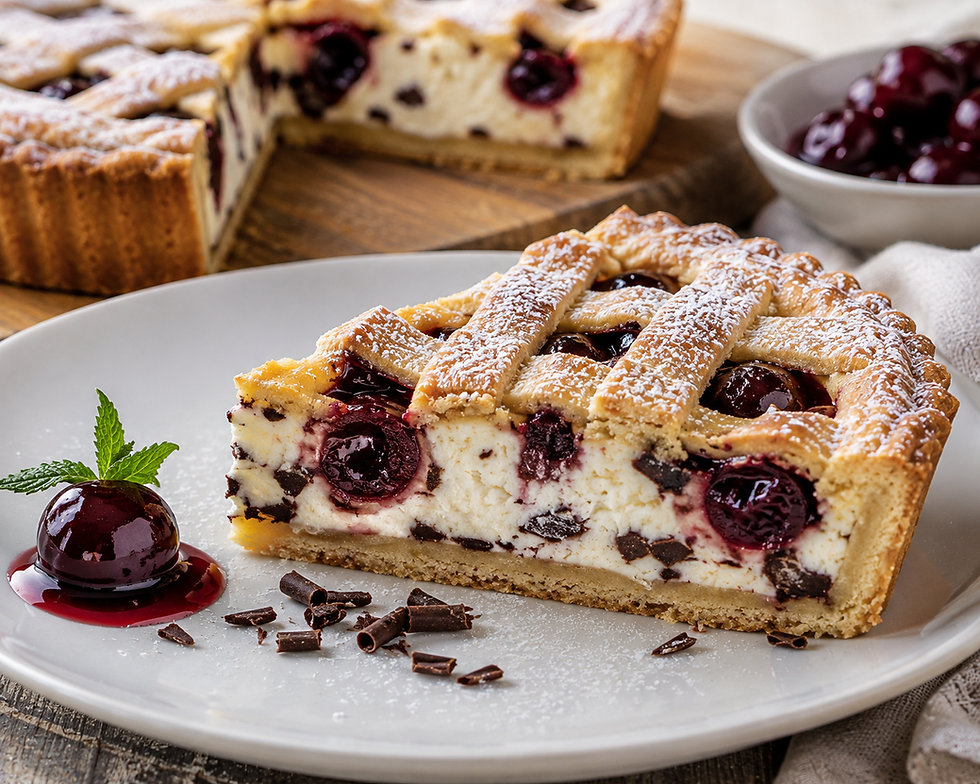
Crostata di mele is the apple tart Italian families actually make, and it has almost nothing to do with the deep double crust apple pie of the American table. There is one shell of pasta frolla, Italy's sweet short pastry, a layer of apples cut into slices rather than chunks, a thin protective coating of apricot preserves, and a lattice of pastry strips across the top. Nothing is thickened with starch, nothing is spiced heavily, and the apple is allowed to taste of apple.
The whole difficulty of the tart lives in two places: the pastry must stay friabile, tender and crumbling rather than chewy, and the fruit must not flood the base. Both problems are solved before the tart ever goes into the oven, by handling the frolla as little as possible and by drawing water out of the sliced apples in advance. Everything after that is assembly and an honest bake, long enough for the underside of the shell to colour properly.
Yield: 8 to 10 servings. Prep: 40 minutes. Rest: 2 hours. Bake: 50 minutes. Cool: 2 hours. Total: about 5 hours 30 minutes. Difficulty: intermediate. Course: dessert. Pan: 9 inch tart pan with a removable base.
The Story
The crostata is one of the oldest continuous shapes in Italian baking. Pasta frolla appears under that name in Italian pastry writing by the seventeenth century, and by the time Pellegrino Artusi published his household manual in 1891 the crostata was already treated as a fixed domestic form: a single sheet of sweet pastry, a filling of preserves or fruit, and strips of the same pastry laid over the top. Artusi gives the frolla in several ratios and remarks, as every Italian cook since has repeated, that the less you work it the better it will be.
Apples enter that form from the north. The Val di Non in Trentino and the Val Venosta in Alto Adige have grown apples commercially since the nineteenth century and remain the heart of Italian production, and the whole arc of the Alps from Piedmont through Friuli has an apple baking tradition that sits alongside, and sometimes overlaps with, the Austrian strudel. Further south the apple tart is a domestic dessert rather than a regional specialty, made in autumn when the fruit arrives and made plainly, because a crostata has always been the thing you bake with what is in the house.
Ingredients
For the pasta frolla
All purpose flour, 2 1/4 cups (280 g)
Unsalted butter, cool, cut into small cubes, 3/4 cup (170 g)
Granulated sugar, 2/3 cup (135 g)
Whole egg, large, 1
Egg yolks, large, 2
Finely grated lemon zest, from 1 lemon
Pure vanilla extract, 1 tsp (5 ml)
Fine sea salt, 1/4 tsp (1.5 g)
For the apple filling
Firm baking apples, Granny Smith or Braeburn, 1 1/4 lb (570 g) after peeling and coring
Aromatic sweet apples, Golden Delicious or Honeycrisp, 3/4 lb (340 g) after peeling and coring
Granulated sugar, 1/4 cup (50 g), adjusted to the fruit
Fresh lemon juice, 2 tbsp (30 ml)
Finely grated lemon zest, from 1/2 lemon
Ground cinnamon, 1/2 tsp (1 g), optional
Unsalted butter, 1 tbsp (14 g)
For the base and the glaze
Apricot preserves, good quality, 3 tbsp (60 g), for the protective layer
Fine dry breadcrumbs or finely ground almonds, 2 tbsp (15 g)
Apricot preserves, warmed and sieved, 2 tbsp (40 g), for the finishing glaze
For finishing
Egg yolk beaten with 1 tsp (5 ml) whole milk, for the lattice
Powdered sugar, for dusting, optional
Semolina or flour, for the work surface
Preparation
Mixing the pasta frolla
Put the flour, sugar and salt in a wide bowl or directly on a cool work surface and add the cubed butter. Rub the butter into the dry ingredients with your fingertips until the mixture looks like coarse damp sand with no visible lumps of butter left. Work quickly and lift your hands high so the mixture stays cool.
Bringing the dough together
Make a well in the sandy mixture and add the whole egg, the two yolks, the lemon zest and the vanilla. Draw the dry ingredients in with a fork, then press the mass together with the heel of your hand just two or three times, until it holds. Stop the moment it is cohesive, even if the surface still looks slightly marbled. Kneading frolla like bread dough develops gluten, and gluten is what makes a tart shell shrink in the pan and chew instead of crumble.
Resting the dough
Divide the dough roughly two thirds and one third, flatten each piece into a disk about 1 inch thick, wrap them tightly and refrigerate for at least 2 hours and up to 24. The rest does three separate jobs: the butter firms so the dough rolls without tearing, the flour finishes hydrating, and the gluten you did develop relaxes so the shell holds its shape.
Preparing and drying the apples
Peel, quarter and core all the apples and cut them into slices a scant 1/4 inch (5 mm) thick. Toss everything with the lemon juice, zest, sugar and the cinnamon if you are using it. Melt the butter in a wide pan over medium high heat, add the apples and cook for 4 to 5 minutes, turning them gently, only until the edges soften and a visible pool of liquid has formed. Tip the whole contents into a sieve set over a bowl and let the apples drain and cool completely, at least 30 minutes. Keep the drained juice.
Reducing the apple juice
Pour the collected juice into a small pan and simmer it down over medium heat until about 2 tablespoons of syrup remain and it coats the back of a spoon. This is the flavour you removed from the fruit, concentrated, and it goes back into the tart at assembly. Let it cool to room temperature.
Lining the tart pan
Roll the larger disk on a lightly floured surface to a round about 1/8 inch (3 mm) thick and 12 inches across. Lift it on the rolling pin into a 9 inch tart pan with a removable base and ease it into the corners without stretching it, pressing it gently against the fluted sides. Trim the overhang, patch any tears with scraps, prick the base lightly with a fork and refrigerate the lined pan for 20 minutes. Roll the smaller disk into a rectangle and cut ten strips 3/4 inch wide, then chill those on a tray as well.
Assembling the tart
Heat the oven to 350°F (175°C) with a rack in the lower third and a heavy baking sheet on it. Spread the 3 tablespoons of apricot preserves in a thin film across the chilled base, then scatter the breadcrumbs or ground almonds over it. Arrange the apple slices in overlapping concentric rings, firm apples and sweet apples mixed, pressing them down so the surface is level rather than domed. Spoon the reduced syrup evenly over the fruit.
Laying the lattice and baking
Lay five strips across the tart at even intervals, turn the pan and lay the remaining five diagonally across them, pressing the ends firmly against the rim and trimming them flush. Brush the lattice with the yolk and milk wash, avoiding the fruit. Bake on the preheated sheet for 45 to 55 minutes, until the lattice is deep golden and, more importantly, the underside of the shell is browned when you lift the pan and look. A pale base is an undercooked base. Cool in the pan on a rack for 20 minutes, then unmould and cool completely before glazing with the warmed sieved apricot preserves.
Plating
Serve the crostata at room temperature, never straight from the refrigerator and never hot. Warm pastry has not finished setting and the slice will slump; cold pastry has firm butter in it and tastes muted and waxy. If the tart has been refrigerated, give it 45 minutes on the counter first, or 8 minutes in a 300°F (150°C) oven followed by 20 minutes of resting.
Professional Technique
The controlling technique here is the sablage, the rubbing of cool butter into flour before any liquid arrives. Coating the flour particles in fat physically blocks water from reaching the proteins that would otherwise link into gluten, which is why a frolla made this way crumbles cleanly while one made by creaming butter and sugar first and adding flour last comes out denser and chewier. The butter must be cool and pliable, around 60°F (15°C), because butter that is too cold stays in lumps and butter that is too warm smears into a paste and shortens the pastry unevenly.
The second technique is the moisture barrier, and it is the reason this tart does not have a wet base. Apricot preserves spread thin form a sugar rich film that fruit juice cannot penetrate quickly, and the breadcrumbs or ground almonds above them absorb whatever does get through. Neither layer is there for flavour, and both are invisible in the finished tart. Pastry chefs use the same pair of tricks under every fruit tart that goes into the oven with its filling in place.
Texture and Moisture Control
A finished crostata has to deliver three textures at once: a base that snaps under the fork, a lattice that is crisp on top and just tender underneath, and apple slices that are soft but still distinct. The base is the one most often lost. Baking in the lower third of the oven on a preheated heavy sheet drives conducted heat straight into the underside of the pan, and a metal tart pan with a removable base browns far better than ceramic or glass, which insulate the pastry and leave it pale and damp.
Temperature discipline runs through the whole process. Dough goes into the oven cold, from the refrigerator, so the butter melts slowly and the shell sets before it can slide down the sides. Apples go in completely cool, because warm fruit begins softening the butter in the base on contact. If the kitchen is hot and the dough turns sticky while you are rolling it, stop and chill it for ten minutes rather than adding more flour, which dries the pastry and makes it sandy in the mouth.
Professional Mise en Place
The frolla and the apples can both be done a day ahead, which turns baking day into rolling, assembling and waiting. Work in this order and nothing is ever rushed.
Equipment and tools
9 inch tart pan with a removable base, metal, not ceramic
Heavy baking sheet to preheat on the lower rack
Rolling pin, bench scraper, fluted pastry wheel or a plain knife for the strips
Fine mesh sieve for draining the apples and for the finishing glaze
Small saucepan for reducing the juice, pastry brush, cooling rack
Prepared ahead
Pasta frolla mixed, divided and wrapped, up to 24 hours ahead in the refrigerator or 1 month frozen
Apples cooked, drained and cooled, up to 1 day ahead, kept refrigerated and covered
Apple juice reduced to syrup and cooled, stored in a small covered container
Tart pan lined with dough and chilled, and lattice strips cut and chilled on a tray
Apricot preserves warmed and sieved for the glaze, ready in a small bowl
Service setup
Oven at 350°F (175°C) for at least 20 minutes with the baking sheet already inside
Egg wash beaten and a soft brush beside it
Cooling rack clear and ready, positioned away from any steam
Thin bladed knife and a jug of hot water for clean slicing at service
Plates at room temperature, powdered sugar in a fine shaker
Chef Tips
Use two apple varieties, never one. A single firm acidic apple gives you structure and no perfume, a single sweet apple gives you perfume and collapses. Roughly 60 percent Granny Smith or Braeburn with 40 percent Golden Delicious or Honeycrisp is the ratio I keep coming back to, and the sweet apple should go in the outer ring where the heat is strongest so the firm slices sit in the cooler centre.
Taste one raw apple slice after you have tossed the fruit with the sugar and lemon. Apples vary enormously in sweetness between varieties and across a season, and this is the only moment when adjusting is free. It should taste pleasantly tart, slightly less sweet than you want the finished tart to be, because baking concentrates it.
Common Mistakes
Kneading the frolla like bread dough. Two or three presses with the heel of the hand are all the dough needs. Anything more develops gluten, and the shell will shrink down the sides of the pan during baking and chew rather than crumble when you eat it.
Putting the apples in raw. Raw apples release their water into the shell during the bake and the base comes out soggy underneath a perfectly browned lattice. Cook them briefly, drain them, and reduce the juice separately.
Baking on the middle rack in a ceramic dish. Ceramic insulates and the middle rack browns the top before the bottom. Use a metal tart pan in the lower third of the oven on a preheated heavy sheet, and check the underside before you take it out.
Cutting the tart while it is warm. The pectin in the fruit and the structure of the pastry both need to set as they cool. Cut too early and the slice slumps and the filling runs. Give it two full hours.
Wine Pairing
Moscato d'Asti DOCG: The natural partner and the easiest one to get right. Its low alcohol and gentle frizzante lift keep it from weighing on a buttery pastry, while the peach and orange blossom aromatics run straight alongside the lemon zest in the frolla.
Vin Santo del Chianti Classico DOC: For a richer match, poured in a small glass. Years in sealed caratelli give it dried apricot, walnut and a faint caramel that meets the apricot glaze and the browned pastry directly rather than contrasting with them. Its acidity stays high enough to cut the butter.
Recioto di Soave DOCG: Garganega dried on racks before pressing, which concentrates sugar while keeping the variety's almond and yellow apple character. That apple note makes it unusually literal here, and the almond picks up the ground almonds under the fruit.
Ramandolo DOCG: The Friulian choice, from Verduzzo grapes left to shrivel on the vine. What sets it apart is a light grip of tannin, rare in a sweet white, which gives the pairing a dry finish and keeps the palate from coating after a second slice. Honey and quince aromas sit naturally with cooked apple.
Colli Orientali del Friuli Picolit DOCG: The most delicate option and the one for a special table. Picolit is rare because the vine sets fruit poorly, and the wine it makes is perfumed rather than heavy, with white flowers, candied citrus and a light sweetness.
Storage & Reheating
A finished crostata keeps at cool room temperature for 2 days, loosely covered with a clean cloth or a cake dome rather than plastic wrap, which traps moisture and softens the lattice. It is genuinely at its best on the day after baking, when the pastry has absorbed a little aroma from the fruit but has not yet begun to give up its snap.
Beyond 2 days, refrigerate it in an airtight container for up to 5 days, then bring each slice back to room temperature before serving or give it 8 minutes in a 300°F (150°C) oven and rest it for 20 minutes. Never use a microwave: it steams the pastry from the inside and the base turns to paste. The tart also freezes well whole and fully baked, wrapped first in parchment and then in foil, for up to 2 months. Thaw it overnight in the refrigerator, then refresh it for 12 minutes at 325°F (165°C).
Nutrition
Per serving, based on 10 slices from a 9 inch tart:
Calories: 385 kcal
Total Fat: 17 g
Saturated Fat: 10 g
Trans Fat: 0.5 g
Unsaturated Fat: 6 g
Cholesterol: 100 mg
Sodium: 85 mg
Total Carbohydrates: 54 g
Fiber: 2.5 g
Total Sugars: 28 g
Added Sugars: 20 g
Protein: 5 g
Lactose: 0.3 g
Principal micronutrients: vitamin A, vitamin C, potassium, selenium, folate
These figures are estimates. The largest variables are the sweetness of the apples, how much sugar you adjust in the filling, and whether the tart is finished with the apricot glaze or only a dusting of powdered sugar.




Comments