
Italian Roman Ricotta Tart | Crostata di Ricotta Romana
Updated: 2 days ago

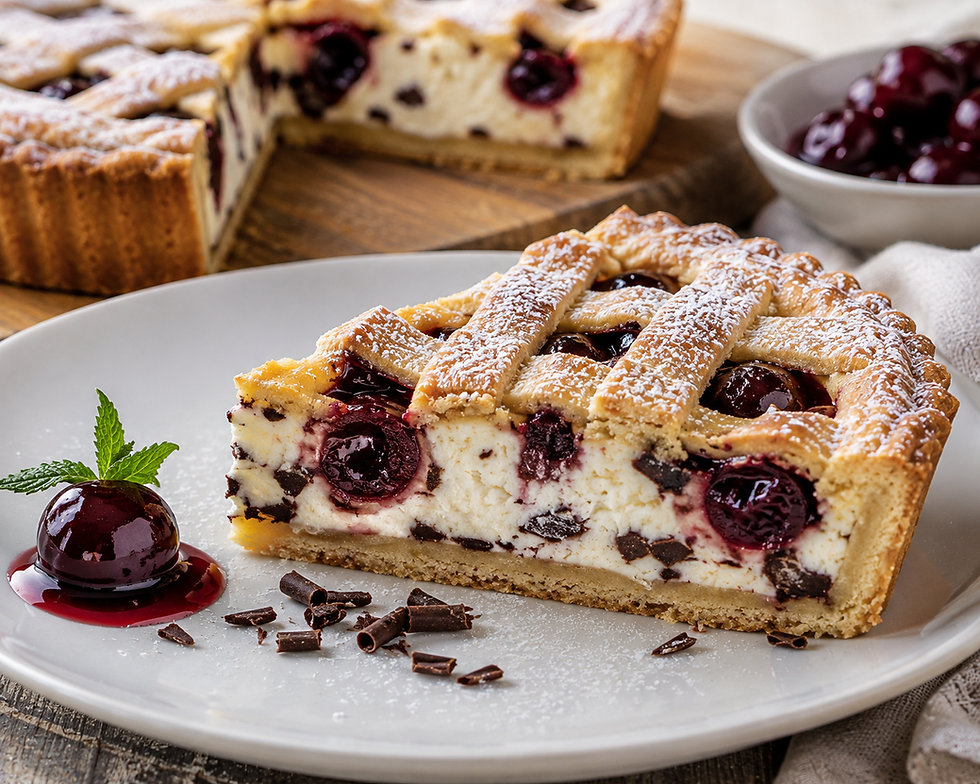
Crostata di ricotta is the tart Rome makes when it wants something sweet that is not really a cake. A short buttery pasta frolla holds drained ricotta, sugar, citrus zest and either sour cherry preserve or chopped dark chocolate, baked until the pastry is deep gold and the centre still moves as one soft mass. It is closer to a baked cheese than to a cheesecake, and that is the point.
The version that matters is Roman Jewish, from the few streets around the Portico d'Ottavia. There the ricotta is sheep milk, the sugar is restrained, the surface is often a closed lid rather than a lattice, and the top is taken to a colour most bakers would call too dark. It tastes savoury underneath the sweetness, which is what sheep milk ricotta should do.
Everything difficult happens before the oven. Ricotta carries a great deal of whey, and whey turns pastry to paste and filling to soup. Drain it, sieve it, fold it rather than beat it, and the rest is patience.
Yield: one 9 inch (23 cm) tart, 12 slices. Draining: 8 hours. Prep: 45 minutes. Chilling: 1 hour. Bake: 55 to 70 minutes at 350°F (175°C). Cooling: 2 hours, then 4 hours refrigerated. Difficulty: intermediate. Course: dessert. Region: Lazio, Rome.
The Story
The Roman ghetto was established by the papal bull Cum nimis absurdum in 1555, and for three centuries the blocks between the Portico d'Ottavia and the Tiber held a community cooking under two constraints: poverty, and the laws of kashrut that forbid meat and dairy in the same meal. A dessert built on cheese solved a real problem, since it could close a meal without meat, and ricotta was the cheapest cheese in the city. It came from the Agro Romano and the Castelli, the sour cherries came preserved because fresh visciole last days rather than weeks, and sugar was used sparingly because it was expensive. The tart that resulted, crostata di ricotta e visciole, is still sold at the Boccione bakery on Via del Portico d'Ottavia, its top baked almost black.
The closed lid separates the ghetto tart from the lattice crostate of the rest of Lazio. A sealed top traps steam and lets the filling set gently while the pastry above it darkens, and the story told in the quarter is that the lid also hid the ricotta from view, at a time when what a Jewish household ate was other people's business. The chocolate version is later and more Roman than Jewish, arriving once chocolate became affordable, and today Roman bakeries sell both. Neither is a cheesecake: the filling is never smoothed with cream or thickened with starch, so the tart depends entirely on the ricotta.
Ingredients
For the pasta frolla
All purpose flour, 2 1/2 cups (325 g)
Granulated sugar, 3/4 cup (150 g)
Cold unsalted butter, diced, 10 tbsp (140 g)
Egg yolks, large, 2 (36 g)
Whole egg, large, 1 (50 g without shell)
Finely grated lemon zest, 1 tsp (2 g)
Fine sea salt, 1/2 tsp (3 g)
Ice water, 1 to 2 tbsp (15 to 30 ml), only if needed
For the ricotta filling
Sheep milk ricotta, well drained, 2 lb (900 g)
Granulated sugar, 3/4 cup (150 g)
Whole eggs, large, 3 (150 g without shells)
All purpose flour, 1 tbsp (8 g)
Finely grated orange zest, 1 tbsp (6 g)
Pure vanilla extract, 1 tsp (5 ml)
Fine sea salt, 1 small pinch
For the filling accent, choose one
Sour cherry preserve, visciole, 3/4 cup (250 g), ghetto version
Dark chocolate at 70 percent, finely chopped, 4 oz (115 g), Roman version
For the pan and finishing
Unsalted butter for the pan, 1 tsp (5 g)
All purpose flour for the pan, 1 tbsp (8 g)
Egg yolk, 1, beaten with whole milk, 1 tsp (5 ml), for the lattice
Confectioners sugar, optional, for dusting at service
Preparation
Drain the ricotta
Line a fine mesh sieve with cheesecloth, set it over a bowl, tip in the ricotta and refrigerate for at least 8 hours. Sheep milk ricotta can give up 3 to 5 fl oz (90 to 150 ml) of whey in that time, and every drop would otherwise end up in the filling. Do not press or weight the cheese, which compacts it and makes the baked centre pasty. Weigh the ricotta after draining.
Make and chill the pasta frolla
Combine the flour, sugar, lemon zest and salt. Rub in the cold diced butter with your fingertips, or pulse it in a food processor, until the mixture looks like coarse crumbs with a few pieces the size of peas still visible. Add the yolks and the whole egg and work only until the dough begins to clump, adding ice water a teaspoon at a time if it refuses to hold. Press it into two flat discs, two thirds for the shell and one third for the lattice, wrap both and refrigerate for 45 minutes. Butter the tart pan and dust it with flour.
Line the tart pan
Roll the larger disc between two sheets of parchment to about 1/8 inch (3 mm) and lift it into the pan. Press it into the corner without stretching it, trim the rim flush and prick the base a few times with a fork. Chill the lined pan for 15 minutes. Heat the oven to 350°F (175°C) with a heavy sheet pan on the middle rack.
Mix the filling
Push the drained ricotta through a fine mesh sieve with a rubber spatula. This takes five minutes and it gives the baked filling its even, slightly grainy silk rather than a lumpy set. Fold in the sugar, then the eggs one at a time, then the flour, orange zest, vanilla and salt. A whisk or a mixer beats in air, and air makes the tart rise in the oven and crack as it falls.
Fill the shell and close the top
For the ghetto version, spread half the ricotta in the chilled shell, dot the sour cherry preserve over it in spoonfuls, then cover with the rest and level the surface. For the chocolate version, fold the chopped chocolate through the filling and pour it in at once. Leave 1/4 inch (6 mm) of clear pastry at the rim. Roll the smaller disc and cut strips about 3/4 inch (2 cm) wide, or leave it whole for a closed ghetto lid with two vents. Lay the strips in a loose lattice, pressing only at the rim, and brush with the yolk and milk wash.
Bake
Slide the tart onto the preheated sheet pan and bake for 55 to 70 minutes. The heat from below sets the base before the filling can soak into it. It is ready when the pastry is deep gold, the outer 2 inches (5 cm) of filling are set and the centre moves as one soft mass. If the lattice colours too early, lay foil loosely over the top for the last 15 minutes.
Cool, chill and slice
Cool the tart in its pan on a rack for 2 hours without touching it, then refrigerate for at least 4 hours, ideally overnight. Ricotta keeps setting as steam leaves the tart, and a warm slice slumps on the plate. Take it out 30 minutes before serving and cut with a thin knife warmed in hot water and wiped dry between slices.
Plating
Bring this tart to the table whole and cut it in front of people. The pastry is the frame and the filling is the colour, and portioning it in the kitchen loses both. Set it on a flat board or a plain white platter, nothing under it and nothing around it. Cut 12 slices and lift each with an offset spatula so the point stays intact, laying the slice flat rather than leaning it.
A light dusting of confectioners sugar suits the chocolate version and belongs at the table, since it dissolves into the surface within a minute. Resist a sauce: the visciole already supply the acidity a coulis would add, and the chocolate version carries its own bitterness. If you want something beside the slice, a spoonful of plain drained ricotta with orange zest is honest and Roman. Whipped cream is not.
Professional Technique
The controlling variable is the water held in the ricotta, managed in three operations that cooks tend to collapse into one. Draining removes the free whey that would migrate into the pastry base. Sieving breaks the curd into particles fine enough to set evenly, which is the difference between a filling that slices cleanly and one that weeps. The tablespoon of flour binds what moisture remains, without thickening the filling into a pastry cream. Skip any one of the three and the other two cannot compensate.
The second technique is thermal, and it is why the tart bakes on a preheated sheet pan. A shell filled with a cold wet mixture sets from the top down, which leaves the base soft for far too long and lets moisture soak into the pastry. Setting the pan on metal already at 350°F (175°C) drives heat into the base at once, so the bottom crust sets and begins to colour within ten minutes. The third technique is knowing when to stop: ricotta protein sets over a narrow range, and a filling baked firm in the middle is already overcooked, contracting as it cools and squeezing out whey. Take the tart out while the centre wobbles as one piece and let the refrigerator finish the job.
Texture and Moisture Control
Two textures have to arrive together: a friable pastry that shatters slightly under the fork, and a filling that is creamy but holds a clean edge. They fail for opposite reasons. The pastry turns tough if the dough is worked past the point where it holds, and hard and greasy if the butter warms and merges into the flour instead of staying in distinct pieces. Keep the butter cold, stop mixing early, chill the lined shell.
The filling fails through air and through water. Air beaten into ricotta expands in the oven, lifts the surface, then collapses and cracks it as the tart cools, which is why every stage is folded with a spatula. Water that was never drained separates as the tart chills, leaving a shallow pool under the pastry. If your ricotta is unusually wet, add a second tablespoon of flour rather than baking longer, because extra oven time dries the edges before it sets the centre.
Temperature at service is the last control. Straight from the refrigerator the butter is hard and the aromatics of ricotta and citrus are muted. Thirty minutes at room temperature softens the crumb and lets the orange and the sheep milk come forward, while the slices still hold their edge.
Professional Mise en Place
This tart is almost entirely advance work, which makes it excellent for service and unforgiving of a late start. The draining claims a night, the chilling after baking most of another, and nothing is done à la minute except the cutting.
Equipment and tools
9 inch (23 cm) tart pan with a removable base, plus a heavy sheet pan to preheat
Two fine mesh sieves and cheesecloth, one for draining, one for sieving
Rubber spatula and bowl scraper, never a whisk or a mixer for the filling
Rolling pin and parchment, so the frolla rolls without extra flour
Thin knife and hot water for wiping the blade between slices
Prepared ahead
Ricotta drained in the refrigerator, 8 hours to overnight
Pasta frolla made and divided into two discs, up to 2 days ahead
Shell lined and chilled in the buttered pan, up to 1 day ahead
Whole tart baked 1 day ahead, which genuinely improves it
Sour cherry preserve drained, or chocolate chopped and weighed
Service setup
Tart out of the refrigerator 30 minutes before cutting, still in its pan
Ring removed only once the tart is at cool room temperature
Hot water, a cloth and the knife beside the board
Confectioners sugar in a small sieve, at the table if at all
Plates cool, never warmed
Chef Tips
Buy the ricotta loose and by weight from a counter, not in a sealed tub. Tub ricotta is usually stabilised with gum or starch, which stops it draining properly and gives the baked filling a slippery set. If sheep milk ricotta is unavailable, use whole milk ricotta with a pinch more salt to recover some of the savoury edge.
Weigh the ricotta after draining, not before. Two pounds of a wet ricotta can lose 5 fl oz (150 ml) of whey, and a filling built on the undrained weight comes out short of cheese and long on sugar. Top up with more drained ricotta if you need to.
For the visciole version, drain the preserve of loose syrup first. Thin syrup runs through the filling during baking and leaves a wet channel down to the pastry. Add the fruit as whole cherries where possible, dotted rather than stirred through, so every slice shows them.
Bake the tart the day before you need it. The ricotta rounds out overnight, the citrus spreads through the filling instead of sitting in points, and the set is far more reliable than the same tart cut after four hours.
Common Mistakes
Using ricotta straight from the tub. Undrained ricotta releases whey into the filling and the base, giving a soggy bottom crust and a filling that separates in the refrigerator. Eight hours in a sieve is the single most important step in the recipe.
Beating the filling with a whisk or a mixer. Air worked into ricotta expands in the oven, then collapses into a cracked, sunken top as the tart cools. Fold with a spatula and stop as soon as each addition disappears.
Working the pasta frolla until it is smooth. Frolla should look barely held together when you wrap it. A dough kneaded until silky has developed gluten and bakes hard rather than friable, and no amount of butter brings the crumb back.
Baking until the centre is firm. A filling set in the middle in the oven is overcooked by the time it cools, and it turns grainy and weeps. Pull the tart while the centre moves as one soft mass and let the refrigerator finish the set. Cutting it warm has the same effect, since the slice slumps.
Serving it refrigerator cold. Cold butter and cold ricotta mute the citrus and the sheep milk almost completely. Thirty minutes at room temperature recovers the aroma without costing the clean edge of the slice.
Wine Pairing
Vin Santo del Chianti Classico DOC: Its dried fig and toasted almond character reads as a continuation of the baked frolla rather than a contrast, and the oxidative depth has the weight to sit beside sheep milk ricotta, which is more savoury than most tart fillings. Serve it around 54°F (12°C).
Recioto di Soave DOCG: Dried Garganega grapes give honey and candied orange peel that run alongside the zest in the filling, while the acidity underneath keeps a rich baked dairy centre from coating the palate. It is sweeter than the tart, which is the relationship a dessert wine needs.
Brachetto d'Acqui DOCG: The choice for the chocolate version. Light sweetness, low alcohol and rose and red berry aromatics meet the bitterness of chocolate at 70 percent without either hardening, and the gentle sparkle cuts the butter in the pastry.
Moscato d'Asti DOCG: The lightest option and the best after a long meal. Around 5 percent alcohol, faintly fizzy and full of white peach and orange blossom, it refreshes rather than adds richness and handles the sour cherry visciole better than any still white.
Storage & Reheating
The baked tart keeps in the refrigerator for up to 4 days. Cover it loosely with an inverted bowl or a cake dome rather than pressing film onto the surface, which sticks to the pastry and pulls the glaze off the lattice. Keep it whole for as long as you can, since a cut face dries and the exposed filling picks up refrigerator smells within a day.
Individual slices freeze for up to 1 month. Chill them first, wrap each in film and then foil, and freeze flat on a tray before stacking. Thaw overnight in the refrigerator, still wrapped, then bring to cool room temperature for 30 minutes. Do not freeze the tart whole, since a 9 inch (23 cm) tart thaws unevenly. There is no reheating step and there should not be one: a microwave drives whey out of the ricotta in seconds. If a slice has softened after several days, 6 to 8 minutes in a 300°F (150°C) oven crisps the pastry base, but let it cool completely before serving.
Nutrition
Per serving, based on 12 slices of the chocolate version:
Calories: 485 kcal
Total Fat: 26 g
Saturated Fat: 15 g
Trans Fat: 0.5 g
Unsaturated Fat: 9 g
Cholesterol: 110 mg
Sodium: 280 mg
Total Carbohydrates: 51 g
Fiber: 2 g
Total Sugars: 31 g
Added Sugars: 25 g
Protein: 14 g
Lactose: 3.5 g
Principal micronutrients: calcium, phosphorus, vitamin A, vitamin B2, vitamin B12, selenium, zinc
These figures are estimates. The visciole version runs higher in total sugars and lower in fat, and the values move with the fat content of the ricotta and how much whey came out during draining.


Comments