
Italian Amaretti and Apricot Frangipane Tart | Crostata Frangipane agli Amaretti e Albicocche

A frangipane crostata is two things baked together: a crisp pasta frolla shell and an almond cream that behaves like a cake batter. This one carries crushed amaretti through the cream and fresh apricot halves set into it, so the bitter almond perfume of the biscuit meets the acidity of the fruit in every slice.
It is a tart for the weeks when apricots are ripe enough to eat raw, and it is far less delicate than it looks, provided you respect one thing: the cream rises in the oven.
Yield: one 9 inch (23 cm) tart, 10 slices. Prep: 40 minutes. Rest: 1 hour. Bake: 50 minutes. Cool: 1 hour. Total: about 3 hours 30 minutes. Difficulty: intermediate. Course: dolce. Region: Lombardy for the amaretti, Campania and Liguria for the apricots.
The Story
Frangipane does not come from a village or a farmhouse. It carries the name of an Italian noble family, the Frangipani of Rome, and specifically of a marquis who served at the French court in the second half of the sixteenth century and gave his name to an almond scented glove perfume that became fashionable there. Pastry cooks of the period borrowed the scent, then the name, for a cream of ground almonds, butter, sugar and eggs, and within two generations the word had detached from the perfume completely. What survives in Italian pastry is the cream itself, used to fill tarts across the north and to carry whatever fruit the season hands over.
The crostata is older and entirely Italian. Shortcrust tarts filled with jam, ricotta or fruit appear in Italian recipe collections from the Renaissance onward, and the pasta frolla that holds them is one of the few doughs the whole peninsula makes in roughly the same way. The amaretti are Lombard by reputation: the hard brittle biscuits of Saronno are the ones sold worldwide in coloured paper, while Sassello in Liguria and Mombaruzzo in Piedmont make their own softer versions. Crushing them into a frangipane is a domestic habit rather than a pastry school technique, the way a household uses up the last biscuits in the tin, and it brings a toasted perfume that ground almonds alone never reach.
The apricots decide when this tart gets made. Italy grows them seriously in Campania, where the varieties on the volcanic slopes of Vesuvius are called crisommole and ripen through June and July, in Emilia Romagna along the Po plain, and in Liguria, where the Valleggia apricot near Savona is small, freckled and intensely scented. They share a short season and one quality that matters here: real acidity. An apricot that tastes only sweet disappears inside an almond cream, which is buttery and sweet by construction. One with a sour edge under the perfume holds its own, and that contrast is the whole reason the combination has been repeated for two centuries in Italian home baking.
Ingredients
For the pasta frolla
All purpose flour, 2 cups (250 g)
Cold unsalted butter, cubed, 9 tbsp (125 g)
Powdered sugar, 2/3 cup (80 g)
Egg yolks, large, 2
Fine sea salt, 1/4 tsp (1.5 g)
Finely grated lemon zest, from 1/2 lemon
Cold water, 1 to 2 tsp (5 to 10 ml), only if needed
For the amaretti frangipane
Soft unsalted butter, 9 tbsp (125 g)
Granulated sugar, 1/2 cup (100 g)
Eggs, large, 2
Almond flour, 1 1/4 cups (125 g)
Crisp amaretti biscuits, crushed, 3 oz (85 g)
All purpose flour, 2 tbsp (16 g)
Pure almond extract, 1/4 tsp (1.5 ml)
Finely grated orange zest, from 1/2 orange
Fine sea salt, 1 pinch
For the apricot layer
Ripe fresh apricots, 1 1/4 lb (570 g), about 9 or 10
Granulated sugar, 1 tbsp (12 g)
Lemon juice, 1 tsp (5 ml)
For finishing
Sliced almonds, 1/4 cup (25 g)
Crushed amaretti, 2 tbsp, reserved from above
Powdered sugar, for dusting
Preparation
Step 1
Rub the cold cubed butter into the flour, powdered sugar and salt with your fingertips until the mixture looks like coarse sand, then add the yolks and the lemon zest and bring it together quickly, adding a teaspoon of cold water only if the dough refuses to hold. Work it as little as you can: pasta frolla asks to be assembled, not kneaded. Flatten it into a disc, wrap it and refrigerate for at least 1 hour.
Step 2
Roll the chilled dough on a lightly floured surface to about 1/8 inch (3 mm) and line a 9 inch (23 cm) tart tin with a removable base, pressing it into the corner without stretching it. Trim the rim level and prick the base all over, then chill the lined tin for 20 minutes. Pastry that goes into the oven warm slumps down the sides and loses exactly the height this filling needs.
Step 3
Heat the oven to 350°F (175°C). Line the shell with parchment, fill it with baking beans and bake for 15 minutes, then lift out the beans and the paper and give it 5 minutes more, until the surface is dry and pale gold. The shell is not finished at this stage. It only needs to be set and sealed so that it stays crisp through the long bake still to come.
Step 4
Halve the apricots along their seam and twist out the stones. Leave them raw and leave the skin on: it holds each half in shape through the bake and carries much of the fruit's acidity. Toss the halves with the sugar and the lemon juice, then drain them in a sieve for 10 minutes and discard the liquid that collects, which would otherwise pool around each piece and thin the cream beside it.
Step 5
Beat the soft butter with the granulated sugar for 2 to 3 minutes, until pale and visibly aerated, then add the eggs one at a time and beat until each has disappeared before the next goes in. Fold in the almond flour, the crushed amaretti, the flour, the almond extract, the orange zest and the salt in one addition, with a spatula and few strokes. The cream should finish thick, glossy and only just droppable.
Step 6
Spread the frangipane in the cooled shell and stop at two thirds of its depth, levelling the surface with an offset spatula. Set the apricot halves cut side up over the cream and press each one gently down until the cream rises around its edge and grips it. Do not simply lay them on the surface. Scatter the sliced almonds between the fruit and around the rim.
Step 7
Bake at 350°F (175°C) for 40 to 50 minutes. The cream climbs during the first 20 minutes, browns from the outside inward and then sets. Test it by moving the tin gently: the edge firms up early, and the tart is ready only when the centre has stopped trembling and a skewer slid in beside a piece of fruit comes out clean. Cover the rim loosely with foil if it is colouring too fast.
Step 8
Leave the tart in its tin on a wire rack for 30 minutes, then lift off the ring and let it cool completely on the base. The cream is still soft while hot and firms as it cools, so cutting early tears it open. Dust with powdered sugar and scatter the reserved crushed amaretti over the top only just before serving, so both stay dry.
Plating
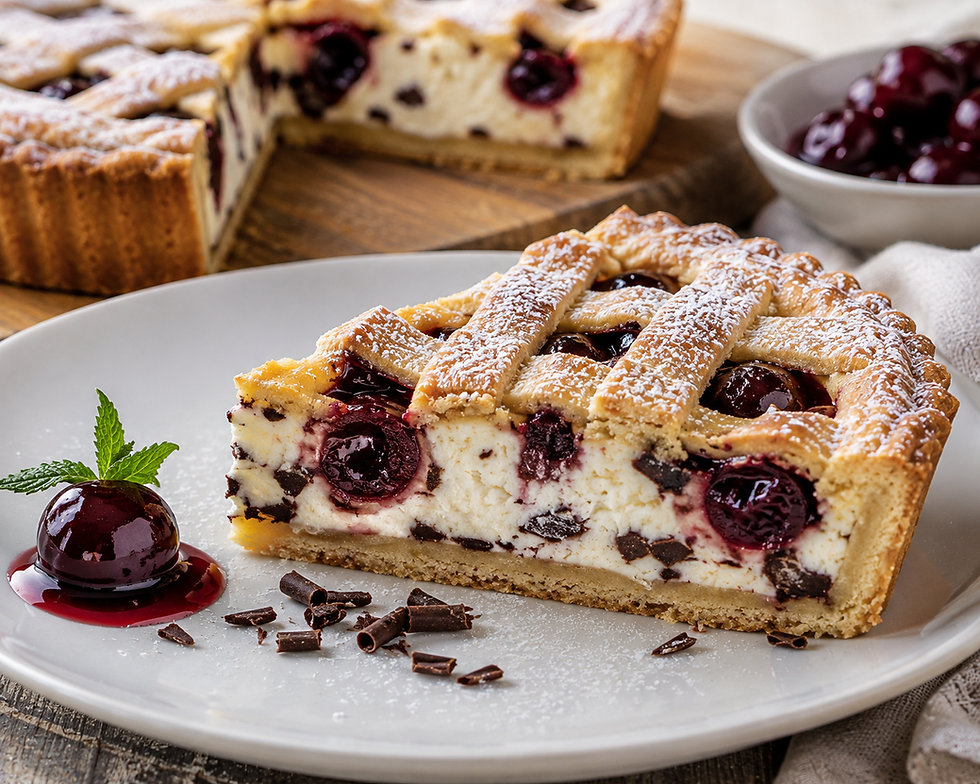
Serve the crostata at room temperature, never chilled and never straight from the oven. Cold mutes almond and butter and makes the frolla feel hard, while heat leaves the cream too soft to hold a clean edge. Cut with a thin bladed knife wiped between slices, pressing straight down through the fruit rather than dragging, so each slice keeps its apricot half whole at the centre.
Ten slices from a 9 inch (23 cm) tart is the right size for a dessert course. Plate each one on its own with the cut face turned towards the diner so the layers read, and keep whatever goes beside it restrained: a spoon of lightly whipped unsweetened cream, or a small quenelle of plain mascarpone. Nothing hot and nothing with chocolate, since both cover the almond instead of framing it.
Professional Technique
Frangipane is not a custard and it does not behave like one. It is a butter and egg batter, closer to a pound cake in miniature, and everything that happens in the oven follows from that. The air whipped into the butter and sugar expands, the water in the eggs and the butter turns to steam, and the mixture climbs before the proteins and the starch set it. A shell filled to the brim overflows within twenty minutes, runs down the outside of the tin and scorches there, and the tart arrives with a burnt collar and a sunken middle. Two thirds of the depth is the working number. It looks too shallow going in and it comes out level with the pastry rim.
The same rise governs the fruit. Apricot halves laid on the surface of the cream are carried upward and outward as it expands, and they finish sitting proud, dry at the edges and barely attached, sliding off the slice as soon as it is cut. Pressed down until the cream comes up around their sides, they are held from the first minute. The cream sets against them and the fruit ends embedded in the finished surface rather than perched on it. Press with a fingertip and stop when the cream reaches roughly half the height of each half, no deeper, or the fruit vanishes into the bake and the top loses its pattern.
Doneness is read from the centre and from nothing else. The outer ring of frangipane firms long before the middle does, so a tart that looks baked at the edge can still be raw at the core. Nudge the tin: a centre that shivers needs more time, a centre that stays still is done, and at that moment the skewer confirms it.
Texture and Moisture Control
Three sources of moisture meet in this tart: the butter in the shell, the water in the eggs and butter of the cream, and the juice of the fruit. The shell is blind baked first so its starch is already set and its surface dry before any of that arrives, which is what keeps the base crisp through a bake of nearly an hour. Draining the sugared apricots for ten minutes removes the free juice that would otherwise leave a wet ring in the cream around each half.
Butter temperature decides the texture of the frangipane. At around 65°F (18°C) it holds the air beaten into it and gives a cream that rises evenly and eats light. Colder than that and it will not aerate at all; warmer and it sheds the air within minutes and bakes dense and greasy. Add the eggs one at a time for the same reason: poured in together they split the mixture, and a split frangipane weeps butter in the oven.
The finished cream should be moist and slightly dense at the centre, never dry and crumbly. Five extra minutes in the oven crosses that line, one more reason to trust the centre test rather than the clock.
Professional Mise en Place
Almost everything here can be staged in advance. The only urgent stretch is between beating the frangipane and closing the oven door, because an aerated butter cream starts losing volume as it stands.
Equipment and tools
Tart tin, 9 inch (23 cm), with a removable base
Stand mixer or hand mixer with a paddle or beaters
Rolling pin, bench scraper and a flexible spatula
Parchment and baking beans or rice for the blind bake
Wire rack and a thin bladed slicing knife
Prepared ahead
Pasta frolla, up to 2 days refrigerated or 1 month frozen as a disc
Tart shell blind baked, up to 1 day ahead, kept dry and uncovered
Amaretti crushed and weighed, with the garnish spoonful set aside separately
Almond flour, flour and salt combined in one bowl
Butter cut and brought to 65°F (18°C) about an hour before mixing
Service setup
Tart completely cool before the ring comes off
Knife wiped clean between every slice
Powdered sugar and reserved amaretti added at the last moment
Whipped cream or mascarpone held cold and separate
Plates at room temperature, never warmed
Chef Tips
Buy the apricots three or four days before you bake and let them finish ripening on the counter. Fruit is picked hard for transport, and an apricot that is still firm against the stone tastes of nothing inside a rich cream, however good it looks on top of it.
Crush the amaretti by hand or under a rolling pin, not in a food processor. A blade reduces them to powder and you lose the small crisp fragments that give the cream its faint grain, which is half the reason for using biscuits in it at all.
Weigh the frangipane into the shell if you bake this often. For a 9 inch (23 cm) tin, around 1 lb 2 oz (510 g) of cream fills it to two thirds, and a scale removes the guesswork that spoils most first attempts.
If the apricot season has passed, ripe plums halved the same way behave almost identically, and quartered fresh figs work too. Pears and apples do not: they give up too little juice and too little acid, and they would need poaching first, which is another recipe.
Common Mistakes
Filling the shell to the rim. The cream rises by roughly a third in the oven, spills over the pastry edge and burns against the hot tin, and the centre sinks as it cools. Fill to two thirds and trust that it will climb.
Laying the fruit on the surface. Halves that are not pressed in get pushed up by the rising cream and finish loose on top, sliding off every slice. Press each one down until the cream comes up around its sides.
Cutting the tart while it is warm. Frangipane sets as it cools. A warm tart tears instead of slicing and the base stays glued to the tin, so give it a full hour before the knife goes anywhere near it.
Judging the bake by the edges. The outer ring is firm long before the middle is. Take the tart out when the centre no longer trembles, not when the rim has gone brown.
Wine Pairing
Vin Santo del Chianti Classico DOC: Grapes dried on the vine and long ageing in small barrels give it the roasted almond and apricot jam notes this tart already carries, so the match works by echo rather than contrast. The acidity survives the drying, and a sweet wine without it would sit heavily on a cream this buttery. Pour it cool in a small glass.
Recioto di Soave DOCG: Garganega raisined on mats gives a sweet white with a distinctly bitter almond finish, and that finish lands straight on the crushed amaretti. There is dried apricot on the nose and enough freshness behind the sugar to lift the butter in the frangipane instead of adding to it. Of the four bottles here it is the closest to the tart itself.
Ramandolo DOCG: Verduzzo Friulano left to overripen produces a golden wine with a light tannic grip, and that grip is what a fat almond cream needs. Honey and baked apricot on the palate, then a slightly dry finish that clears the butter before the next mouthful. Serve it at around 54°F (12°C) so the tannin stays in proportion.
Colli Orientali del Friuli Picolit DOCG: The most delicate bottle here, and the one to choose if your tart is less sweet than most. Picolit is aromatic rather than heavy, with white peach, acacia honey and a fine bitter almond edge, and it finishes lower in sugar than a passito. It flatters the fruit and the pastry without competing with the almond.
Storage & Reheating
The baked tart keeps for 2 days at cool room temperature under a dome or loosely covered with a cloth, and that is where it eats best. Refrigeration works for up to 4 days but it hardens the butter in both the frolla and the cream and dulls the almond, so bring any chilled slice back to room temperature for at least an hour before serving it.
Freeze the whole baked tart, cooled and without the powdered sugar, wrapped tightly, for up to 1 month, and thaw it overnight in the refrigerator and then an hour on the counter. Raw pasta frolla freezes better than the finished tart, so the dough is the smarter thing to keep ahead.
To revive a tart that has softened, give it 8 minutes at 300°F (150°C) and then let it cool completely again before cutting. Never use a microwave: the cream turns rubbery and the pastry goes limp within seconds.
Nutrition
Per slice, based on 10 slices:
Calories: 395 kcal
Total Fat: 25 g
Saturated Fat: 11 g
Trans Fat: 0 g
Unsaturated Fat: 13 g
Cholesterol: 90 mg
Sodium: 105 mg
Total Carbohydrates: 38 g
Fiber: 2.5 g
Total Sugars: 21 g
Added Sugars: 16 g
Protein: 7 g
Lactose: 0.4 g
Principal micronutrients: vitamin E, vitamin A, magnesium, calcium, phosphorus, potassium
These figures are estimates and move with the ripeness of the fruit and the sugar in the amaretti.




Comments