Italian Ricotta and Chocolate Chip Tart | Crostata di Ricotta e Gocce di Cioccolato
Updated: Oct 24

This is the plainest of the Roman ricotta tarts and the hardest one to get right, because nothing hides inside it. A short buttery pastry, sheep's milk ricotta sweetened and scented with lemon, and small dark chocolate chips that have to stay where you put them. Every technical decision in the recipe below exists for that last clause.
Yield: one 9 inch (23 cm) tart, 10 slices. Prep: 30 minutes. Chill: 1 hour 30 minutes. Bake: 50 minutes. Cool: 3 hours. Total: about 6 hours. Difficulty: intermediate. Course: dolce. Region: Lazio, Rome and the Agro Romano.
The Story
Rome bakes its ricotta tarts because Rome had ricotta before it had pastry cream. The Agro Romano, the open pasture that rings the city, fed sheep for centuries, and the pecorino made from their milk left behind a second harvest: the whey, reheated over a low fire to catch the last of its protein. That is what the word ricotta means, recooked. It came down from the pastures to the city markets cheap, fresh and highly perishable, worth nothing by the following week, and the pastry shell was simply the way a baker bought it another two days of life. Nearly every Roman dessert built on ricotta begins in that piece of arithmetic rather than in any pastry tradition.
The sheep's milk version is the one that matters here. Ricotta romana, now a protected designation, is grainier, drier and distinctly saltier than the cow's milk ricotta sold in most supermarkets, with a faint lanolin depth underneath that stands up to sugar instead of vanishing under it. That savoury undertow is the reason a Roman tart tastes of something and an industrial one tastes only sweet. Roman bakers still sell it by weight from the tray rather than by the slice, and in the pastry shops of Trastevere and the old Ghetto the trays sit in the window all morning at room temperature, never chilled, because cold flattens the flavour and firms the fat.
Chocolate came later and came from the south. Naples under Spanish rule was among the first Italian cities to work cacao seriously, and by the eighteenth century chopped chocolate was turning up in convent baking across the peninsula, scattered through ricotta fillings in Campania and in Sicily long before the habit reached Lazio. When it did arrive, the Roman version stayed characteristically restrained: no candied peel, no liqueur, no lattice of pastry strips laid over the top. Just the chips, the lemon and a bare surface that cracks very slightly as it cools. It is the kind of recipe that survives for two hundred years because there is nothing in it fashionable enough to go out of fashion.
Ingredients
For the pasta frolla
All purpose flour, 2 1/4 cups (280 g)
Cold unsalted butter, cubed, 9 tbsp (125 g)
Granulated sugar, 1/2 cup (100 g)
Egg yolks, large, 2
Whole egg, large, 1
Finely grated lemon zest, from 1/2 lemon
Fine sea salt, 1/4 tsp (1.5 g)
For the ricotta filling
Sheep's milk ricotta, well drained, 1 lb 5 oz (600 g)
Granulated sugar, 2/3 cup (130 g)
Whole eggs, large, 2
Egg yolk, large, 1
Cornstarch, 2 tbsp (16 g)
Finely grated lemon zest, from 1 lemon
Fine sea salt, 1 pinch
For the chocolate
Small dark chocolate chips, 60 to 70 percent cacao, 4 oz (115 g)
All purpose flour, taken from the 2 1/4 cups above, 1 tbsp (8 g)
For finishing
Softened butter and flour, for the tin
Egg wash, 1 yolk beaten with 1 tsp (5 ml) milk, optional
Powdered sugar, for dusting, 1 tsp (3 g)
Preparation
Make the pasta frolla
Rub the cold cubed butter into the flour, sugar, salt and lemon zest with your fingertips until the mixture looks like coarse damp sand with a few larger butter flakes still visible. Add the whole egg and the two yolks and press the dough together in as few movements as you can manage. Do not knead it. Flatten it into a disc, wrap it and refrigerate for at least 1 hour. Chilled frolla rolls without tearing and holds its edge in the oven; warm frolla slumps down the sides of the tin and thins out at the corner where it is needed most.
Drain and smooth the ricotta
Set the ricotta in a sieve over a bowl for 30 minutes if it is wet from the tub, then work it with a flexible spatula, pressing and folding rather than whisking, until it turns glossy and uniform. You want it smooth without beating air into it: air expands in the oven, lifts the surface and then collapses into a crater as the tart cools. Beat in the sugar, then the eggs and the extra yolk one at a time, then the lemon zest and the salt, and stop the moment it is homogeneous.
Thicken the filling with starch
Sift the cornstarch over the ricotta mixture and fold it through until no dry streaks remain. It is a small amount doing two jobs: it sets the custard so the filling slices cleanly, and it raises the viscosity of the raw mixture just enough to hold solid particles in place before the eggs have begun to set. Let the filling stand for 10 minutes, then check it. A teaspoon laid on the surface should sit for a second or two before it sinks. If it drops straight through, the ricotta was too wet.
Coat the chocolate chips
Put the chips in a small bowl, add the tablespoon of flour taken from the pastry weighing, and toss until every chip carries a dry dusty film. Tip them into a sieve and shake off the loose excess so you are not adding raw flour to the filling. The flour glues nothing: it roughens the slick cocoa butter surface, so the chip meets the filling with friction instead of sliding through it. Use small chips rather than chopped bars, since a chunk four times the mass falls four times as hard.
Line the tin and layer the tart
Roll the frolla to about 1/8 inch (3 mm) and line a buttered and floured 9 inch (23 cm) tart tin, pressing it well into the corner and trimming the rim flush. Chill the lined shell for 30 minutes. Now build in layers rather than stirring everything together: spread one third of the filling, scatter one third of the chips, repeat twice, and finish with a thin veil of plain filling. Level the surface with an offset spatula.
Bake and cool completely
Bake at 350°F (175°C) for 45 to 55 minutes, until the pastry edge is deep gold and the centre of the filling wobbles as one piece when you nudge the tin, with no liquid ripple. An instant read probe should show about 175°F (80°C) at the middle. Brush the pastry rim with egg wash at the halfway point if you want more colour. Cool the tart in the tin on a rack for at least 3 hours before unmoulding.
Plating
Serve this tart at room temperature, never straight from the refrigerator. Cold mutes the lemon, stiffens the cocoa butter into something waxy on the tongue, and makes the pastry taste of nothing at all. If the tart has been chilled, give it 40 minutes on the counter first.
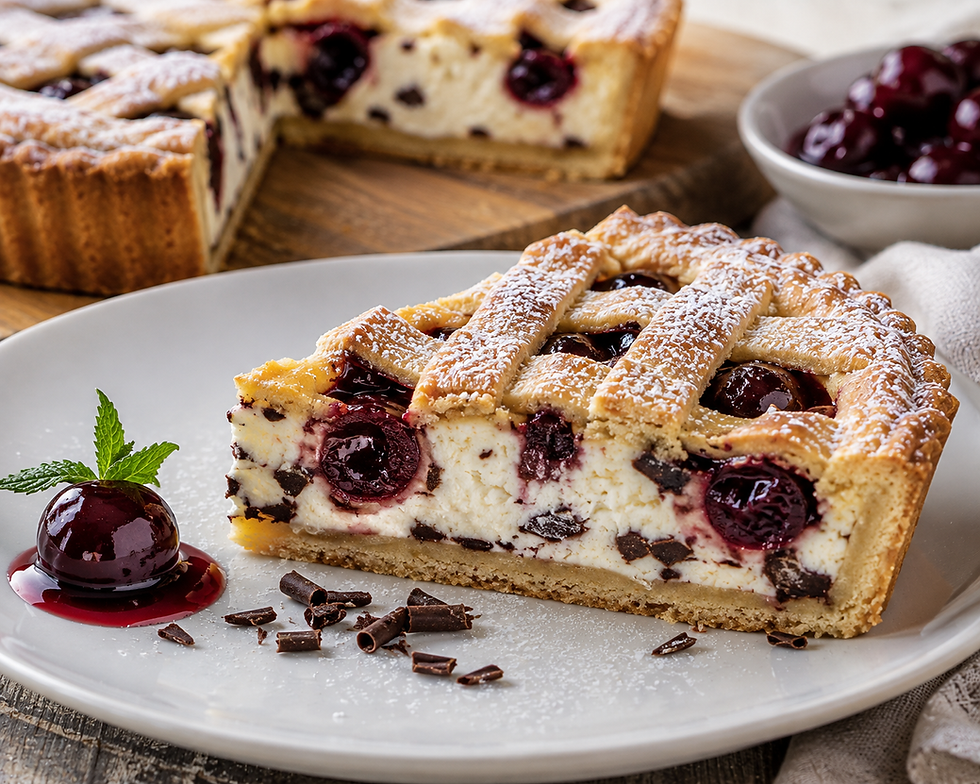
Cut with a thin bladed knife, wiped clean between slices, in one downward stroke rather than a sawing motion, so the chips are cut through instead of dragged. Ten slices from a 9 inch tin is right. Dust the slices with powdered sugar after cutting and not before, or the sugar dissolves into a grey film along the cut line. Serve on plain white plates with nothing beside it: no cream, no coulis, no mint. A slice should show an even scatter of dark points from the pastry base to the top edge, and that cross section is the whole point of the dish.
Professional Technique
The technical problem in this tart is sedimentation, and almost nobody names it. A chocolate chip is denser than a loose ricotta filling and completely unwetted by it, so from the moment it is stirred in it begins to fall. In the oven it gets worse before it gets better: the filling warms, thins and loses what little body it had, and for the first fifteen minutes the chips travel freely. By the time the egg proteins set at around 160°F (71°C) the chips are already sitting on the pastry, where they melt against the base and leave a dark greasy smear, while the top two thirds of the slice are plain white ricotta.
Three corrections work together and none is sufficient alone. The cornstarch gives the cold filling enough viscosity to slow the fall before the oven can thin it. The flour dusting takes the slip off the chip surface, so each one is held by the mixture around it rather than cutting a channel through it. Layering instead of mixing means no chip travels more than a third of the depth before it meets set filling above and below. Bakers who dust the chips and then stir them into the whole bowl are surprised that they still sink, and they should not be.
Verify it the first time you make the recipe. Cut a cold slice from the centre and look at the cut face against the light. A tart that worked shows chips through the full height of the filling, each in a clean dark pocket with white ricotta above it. A tart that failed shows a chocolate seam one chip thick pressed against the pastry, a stained base and a pale upper band.
Texture and Moisture Control
Two water problems run in opposite directions here. The filling holds a great deal of moisture and the pastry beneath it holds almost none, so the tart is a race between the custard setting and the frolla softening. Draining the ricotta and thickening it with starch shortens that race from the filling side. A cold shell going into a fully preheated oven shortens it from the pastry side, because the butter in chilled frolla sets the crumb structure before the wet filling has warmed enough to move into it.
Doneness is a texture judgement, not a clock reading. The filling should wobble as a single mass, like a set custard, with the very centre barely softer than the edge. Liquid movement under the surface means it needs longer. A dome that has risen and cracked across the middle means it went too far, and the eggs have overcooked and squeezed out water that will pool under the slice tomorrow. Pull the tart while the centre still looks slightly underdone and let carryover heat finish it in the tin.
The three hour cooling is not patience for its own sake. Starch gels continue to firm as they drop through room temperature, and the chocolate needs to resolidify before the tart is cut or the chips will smear along the blade and lose their definition entirely.
Professional Mise en Place
This is a make ahead dessert with two waiting periods built into it, so the work divides neatly across two days.
Equipment and tools
9 inch (23 cm) tart tin with a removable base, buttered and floured
Fine sieve for draining the ricotta and a second one for shaking flour off the chips
Flexible spatula and an offset spatula for levelling the surface
Instant read probe thermometer and a thin bladed slicing knife
Prepared ahead
Pasta frolla, wrapped and refrigerated, up to 2 days, or frozen up to 1 month
Ricotta drained and weighed, refrigerated overnight in a covered sieve
Lemons zested and the zest kept covered so it does not dry out
The whole tart baked a day ahead, which improves the slice
Service setup
Tart out of the refrigerator 40 minutes before service, still in the tin
Knife warmed under hot water and wiped dry between every cut
Powdered sugar in a small fine sieve, dusted onto plated slices only
Chef Tips
Buy sheep's milk ricotta if you possibly can, and taste it before you sweeten anything. Supermarket cow's milk ricotta is wetter, blander and often stabilised with gums that keep it loose no matter how long it drains, which is exactly the wrong property for this tart.
Weigh the ricotta after draining, not before. A wet tub can lose 3 oz (85 g) of whey in half an hour, and a filling built on the pre drained weight comes out short, shallow in the shell and loose in the centre.
Keep any frolla trimmings in the freezer rather than rerolling them onto the tart as decoration. Rerolled frolla is tougher, and this tart wants a bare top so you can see the surface set.
If your chips are large, chop them smaller rather than reaching for more starch. Particle size beats every other variable in this recipe, and thickening the filling further starts to make it taste pasty.
Common Mistakes
Stirring all the chips through the filling at once. Even dusted chips sink when they have the full depth of the tart to fall through. Layer them in thirds so every chip is trapped within a shallow band of filling.
Whipping the ricotta instead of working it. A whisk or a mixer beats in air, the tart domes in the oven and then sinks into a crater, and the surface cracks. Use a spatula and stop at smooth.
Cutting the tart before it is cold. Warm filling has not finished setting and warm chocolate is soft, so the slice slumps and the chips smear. Three hours in the tin, minimum.
Skipping the starch because the recipe looks traditional. Without it the cold filling is thin enough to let chips fall freely in the first minutes of baking, and the slice will never hold a clean edge.
Using milk chocolate chips. They are softer, sweeter and lower melting, so they liquefy early, bleed into the ricotta and disappear as distinct points in the slice.
Wine Pairing
Vin Santo del Chianti Classico DOC: The reference match. Dried on the vine and aged oxidatively, it brings walnut, dried apricot and a faintly bitter finish that reads as savoury against the sweet ricotta. Its acidity stays high while the sugar sits moderate, so it lifts the fat of the sheep's milk instead of layering sweetness on sweetness.
Moscato di Siracusa DOC: An aromatic Sicilian sweet wine whose orange blossom and candied citron run straight into the lemon zest in the filling. It is lower in alcohol than a fortified wine and lighter in body than a passito, which suits a tart with no cream and no liqueur in it. Serve it cold, around 46°F (8°C).
Malvasia delle Lipari DOC: From the Aeolian islands, with dried fig, raisin and a salty volcanic edge underneath. That saline thread is the reason to choose it: it echoes the savoury quality of sheep's milk ricotta, which most dessert wines cover up. Its light skin contact tannin also gives it grip against the pastry.
Recioto di Soave DOCG: Garganega dried on racks, giving candied almond, quince and yellow plum with a stony finish. It is the most delicate wine on this list and the one to pour if you want the tart to lead rather than the glass. Its almond character sits very close to the flavour of well baked frolla.
Moscato di Scanzo DOCG: The one red here, and the answer to the chocolate specifically. This tiny Lombard passito shows dried cherry, rose and warm spice with light silky tannin, and that tannin is what reaches the cocoa solids in the chips where an aromatic white cannot. Serve at 57°F (14°C) in a small glass.
Storage & Reheating
The baked tart keeps at cool room temperature under a cake dome for 24 hours and refrigerated, loosely covered, for up to 4 days. It genuinely improves on day two, when the starch has fully set and the lemon has spread through the filling. Do not seal it in an airtight box while any warmth remains, because the trapped steam condenses on the surface and softens the pastry rim.
Freeze it whole or in slices, wrapped first in parchment and then in foil, for up to 2 months. Thaw overnight in the refrigerator and then bring it to room temperature on the counter for an hour. There is no reheating step for this dessert. If the pastry has gone soft in storage, 6 minutes in a 300°F (150°C) oven with the tart still on its base will crisp the shell, but let it cool completely again before cutting.
Nutrition
Per slice, based on 10 slices:
Calories: 425 kcal
Total Fat: 24 g
Saturated Fat: 14 g
Trans Fat: 0 g
Unsaturated Fat: 9 g
Cholesterol: 125 mg
Sodium: 140 mg
Total Carbohydrates: 42 g
Fiber: 2 g
Total Sugars: 24 g
Added Sugars: 22 g
Protein: 11 g
Lactose: 2.5 g
Principal micronutrients: calcium, phosphorus, vitamin A, riboflavin, selenium, iron from the cacao
These figures are estimates and vary with the fat content of the ricotta and the cacao percentage of the chips.




Comments