

Italian Chocolate and Orange Gelato | Gelato al Cioccolato e Arancia
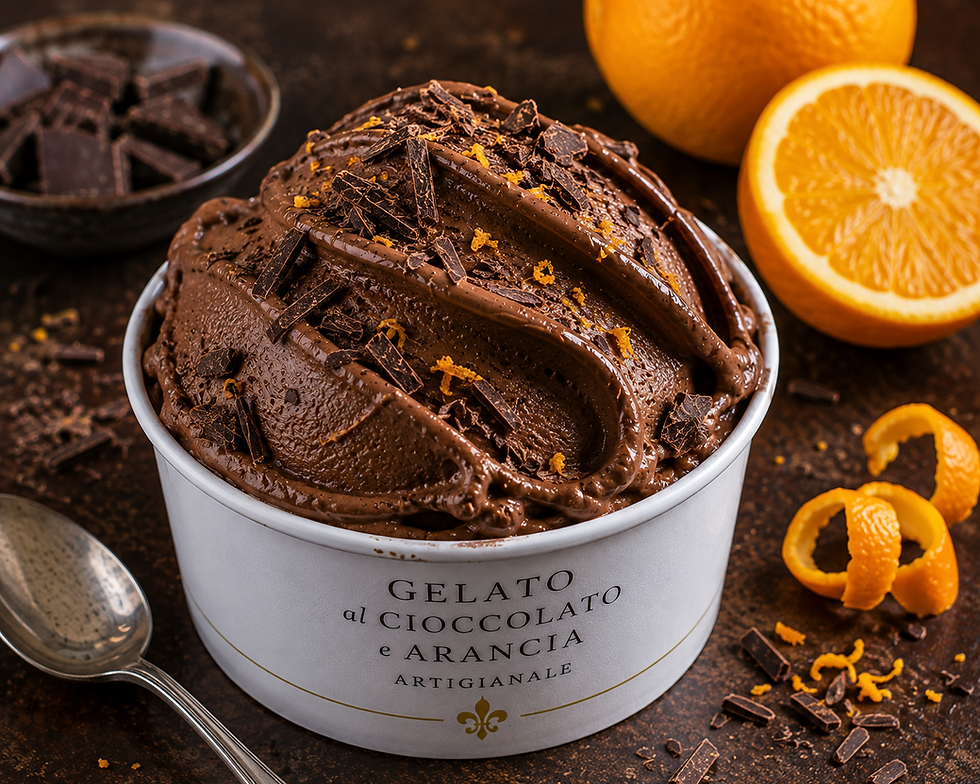
Chocolate and orange is one of the oldest pairings in Italian confectionery, and gelato is the hardest place to put it. Fresh fruit is the trap. Chopped segments or a handful of diced orange go into the base looking generous and come out of the freezer as hard little pebbles of ice that crack against the teeth and leave a wet patch behind them.
This version uses candied peel instead, cut small, dried and dusted before it goes in. It stays chewable at serving temperature, and the gelato around it stays smooth.
Yield: about 1 quart (1 litre), 6 servings. Prep: 30 minutes. Cook: 20 minutes. Aging: 6 to 12 hours. Churn and harden: 4 hours. Difficulty: intermediate. Course: dolce. Region: Sicily and Piedmont.
The Story
The marriage of cocoa and orange belongs to two Italian regions at once, and neither invented it alone. Sicily grew the fruit: the Tarocco and Moro blood oranges of the Catania plain, the navels of Ribera on the southern coast, and the bitter Seville types that the island's confectioners have candied since the Arab period brought both citrus and sugar cane to the same fields. Piedmont brought the chocolate. Turin has worked cocoa on an industrial scale since the seventeenth century, and by the eighteen hundreds its workshops were buying candied Sicilian peel by the crate to dip in couverture.
That product, the scorzetta candita ricoperta di cioccolato, is still sold from glass jars in pastry shops from Palermo to Alba, and it is the direct ancestor of this gelato. What the confectioner discovered by hand, the gelatiere inherited: candied peel behaves in a way fresh fruit does not. It keeps its shape, it keeps its perfume for months, and it does not weep liquid into whatever surrounds it. Sicilian gelaterie built their cioccolato all'arancia on exactly that, and the good ones still fold in peel they candied themselves in copper, cutting it by hand the morning they churn. The candying itself was for centuries a winter trade in towns like Bronte and Paternò, where the fruit came off the trees in December and the sugar came from the same island.
Gelato itself is older than either tradition. Florence claims Bernardo Buontalenti and his frozen creams for the Medici court in the late fifteen hundreds, and it was the Sicilian Francesco Procopio dei Coltelli who took the craft to Paris in 1686 and made it public. Cocoa gelato arrived later and stayed a southern speciality, denser and darker than the northern milk based flavours, closer to a frozen cream than to ice cream. The orange was never a decoration on it. In a gelateria in Catania it is the reason the chocolate tastes of anything at all.
Ingredients
Buy the candied peel rather than the sugar coated cubes sold for panettone, which are usually citron and taste of very little. You want translucent amber strips that are still soft in the middle. The chocolate should be a plain dark bar in the 65 to 70 percent range with no added flavour, and the cocoa should be Dutch process for colour and for a rounder taste than natural cocoa gives.
For the chocolate base
Whole milk, 2 1/2 cups (600 ml)
Heavy cream, 1/2 cup (120 ml)
Granulated sugar, 2/3 cup (135 g)
Dextrose, 3 tbsp (35 g)
Skim milk powder, 3 tbsp (20 g)
Dutch process cocoa powder, 1/3 cup (30 g)
Dark chocolate, 68 percent, finely chopped, 3 1/2 oz (100 g)
Egg yolks, large, 3
Fine sea salt, 1/4 tsp (1.5 g)
For the orange
Candied orange peel, soft and translucent, 3 1/2 oz (100 g)
Finely grated orange zest, from 2 untreated oranges
Fresh orange juice, strained, 1/4 cup (60 ml)
Unsweetened cocoa powder, 2 tsp (4 g), for dusting the diced peel
For finishing
Dark chocolate shavings, 1/2 oz (15 g)
Candied orange strips, 6, one per bowl
Flaky sea salt, a very small pinch per bowl
Preparation
Step 1: Cut and dry the candied peel
Cut the peel into dice of about 1/8 inch (3 mm), no larger. Spread them on a rack and leave them in a dry place for 20 to 30 minutes, until the cut faces stop looking wet and feel tacky rather than sticky. Toss them with the 2 teaspoons of cocoa powder until every piece is separately coated and no two are clinging together.
Step 2: Zest the oranges, then juice them
Grate the zest from two oranges on a fine rasp, taking the coloured layer only and stopping at the white pith, which is bitter and does not soften in a frozen base. Juice the oranges afterwards and strain the juice. Measure out 1/4 cup (60 ml) and refrigerate it. It goes in cold and late, never into a hot pan.
Step 3: Combine the dry ingredients
Whisk the granulated sugar, dextrose, skim milk powder, cocoa powder and salt together until the mixture is uniform and no cocoa lumps remain. Whisking the powders into each other first keeps the cocoa from balling up later, because every particle of it is separated by sugar crystals before any liquid arrives.
Step 4: Heat the dairy and steep the zest
Pour the milk and cream into a heavy saucepan, add the grated zest and bring it to about 170°F (77°C) over medium heat, stirring. Take the pan off the heat, cover it and leave it 15 minutes. Then whisk in the dry mixture in three additions, over low heat, stirring constantly until the liquid is glossy.
Step 5: Temper the yolks and cook the custard
Whisk the yolks, then ladle in about a cup of the hot chocolate milk in a slow stream while whisking hard, and return the loosened yolks to the pan. Cook over medium low heat, stirring in a figure of eight and scraping the corners, until the custard reaches 183°F (84°C) and coats the spatula. Do not let it simmer.
Step 6: Emulsify onto the chocolate, then add the juice
Put the chopped chocolate in a bowl and pour the hot custard over it through a fine mesh sieve, which catches the zest and any set yolk at once. Wait a minute, then stir from the centre outwards until the mixture shines. Cool it to 104°F (40°C) over an ice bath, whisk in the cold juice and blend smooth with a stick blender for 20 seconds.
Step 7: Age the base
Cover the surface with film touching the base and refrigerate at 39°F (4°C) for 6 to 12 hours. Overnight is ideal, 4 hours the minimum. During this rest the fat crystallises, the proteins and the milk powder finish taking up water, and the base thickens visibly. An aged base churns faster, holds more air and freezes with smaller crystals.
Step 8: Churn, fold in the peel and harden
Whisk the cold base smooth and churn it in a machine prechilled to its working temperature, 20 to 30 minutes, until it mounds on the paddle. Fold the cocoa dusted dice through by hand with a spatula, in two additions, distributing without deflating. Transfer to a shallow chilled metal container, press film to the surface and harden at 0°F (minus 18°C) for at least 4 hours.
Plating
Take the container out of the freezer 8 to 10 minutes before serving and let it stand on the counter. Gelato at 0°F (minus 18°C) is too cold to taste: the cocoa reads as dust and the orange disappears completely. The window you want is around 8°F (minus 13°C), where the spade still meets resistance but the surface gives.
Chill shallow ceramic bowls or small glass coupes, never warm ones, and shape two spades per serving rather than round scoops, so the surface shows the flecks of peel. Lay a single candied orange strip against the side of each portion, scatter a few chocolate shavings across the top and add the smallest pinch of flaky salt. Serve at once, with a teaspoon of hot espresso alongside for anyone who wants it.
Professional Technique
The technical heart of this gelato is that a candied dice and a fresh dice are two different materials in the freezer, and only one of them is edible at serving temperature. Water freezes solid at 32°F (0°C). Sugar dissolved in water does not: the more sugar the solution carries, the lower the temperature at which ice can form in it. The interior of a candied peel is a heavily concentrated sugar solution, so at 0°F (minus 18°C) a large part of it has still not frozen. That is exactly why it bends under the teeth instead of shattering.
Fresh orange is the opposite case. Its flesh is mostly water carrying a little sugar, so nearly all of it freezes, and it freezes into one connected mass of ice inside the membrane. That is the pebble. No churning technique and no serving temperature fixes it, because the problem sits inside the fruit and not in the gelato around it. This is why the juice here goes into the base as liquid, where the sugars of the whole mixture control its freezing, rather than into it as fruit.
The cut size follows from the same reasoning. At 1/8 inch (3 mm) the tooth meets the dice and the surrounding gelato at the same instant, so the two textures read as one. Cut at 1/4 inch (6 mm) or larger, the peel becomes a separate object in the mouth, sweeter and louder than everything around it. Small dice also distribute far more evenly, which matters because there is no second chance once the gelato is in the container.
Texture and Moisture Control
Drying the diced peel decides whether the pieces arrive in the bowl separately or in clumps. Freshly cut peel has an exposed syrupy face on every side, and syrup on syrup is glue. Twenty minutes in dry air sets those faces, and the cocoa dusting that follows gives each piece a mattress of dry powder that keeps it from finding its neighbour. Cocoa is used rather than starch because it disappears into a chocolate base without a trace, while starch leaves a chalky film.
The gelato itself depends on two numbers. The first is total sugar, split between sucrose and dextrose: dextrose lowers the freezing point more strongly for the same weight while tasting less sweet, and that pair keeps a cocoa heavy base scoopable instead of setting like a brick. The second is air. A proper gelato carries roughly 25 to 35 percent overrun, far less than commercial ice cream, and a domestic machine reaches it only if the base is cold and the bowl genuinely at temperature.
Crystal size is set in the first ten minutes of churning and cannot be improved afterwards. A base going in at 39°F (4°C) freezes fast and grows small crystals; one going in tepid grows large ones that no extra churning will break down. Hardening in a shallow metal container rather than a deep tub finishes the job, since the thinner the layer, the sooner the centre reaches temperature.
Professional Mise en Place
This is a two day preparation with almost nothing to do on the second day. The base must be made and aged the day before, and the peel can be cut and dusted while it rests.
Equipment and tools
Gelato machine with the bowl frozen for at least 24 hours
Digital probe thermometer reading to a single degree
Heavy saucepan, fine mesh sieve, stick blender, flexible spatula
Shallow metal container with a lid, prechilled in the freezer
Prepared ahead
Base cooked, blended and aged, 6 to 12 hours before churning
Candied peel diced, dried and dusted with cocoa, up to 1 day ahead in a sealed jar
Orange juice strained and refrigerated, on the day of churning
Chocolate shavings cut cold and kept in the refrigerator
Service setup
Bowls or coupes chilled in the freezer for 20 minutes
Gelato moved from freezer to counter 8 to 10 minutes before serving
Spade kept in hot water and wiped dry between portions
Candied strips, shavings and flaky salt lined up within reach
Chef Tips
Taste the candied peel before you commit to a jar of it. Cheap peel is often citron dyed orange, dried to leather and coated in crystallised sugar, and nothing done later brings back a perfume it never had. Good peel smells of the fruit through the sugar and yields when pressed.
If your peel has gone dry in the cupboard, revive it before cutting: cover it with warm water for two minutes, drain, then leave it in a little simple syrup for an hour. Dry the dice as usual afterwards. Peel that goes in dry turns woody in the freezer.
Weigh the cocoa rather than measuring it by volume. A third of a cup can vary by nearly a quarter in weight depending on how it was packed, and cocoa is the ingredient here with the most power to turn the texture dry and dense.
Churn the whole batch at once rather than in halves. A half batch meets the paddle wrongly, whips in too much air and finishes closer to ice cream, with a foamy body that carries the orange badly.
Common Mistakes
Using fresh orange instead of candied peel. The flesh freezes into solid ice inside its membrane, so the dice turn into pebbles that crack and leave a puddle. The fresh fruit belongs in the base as zest and juice.
Cutting the dice too large. Anything above 1/8 inch (3 mm) eats as a separate object. Cut small and the peel and the chocolate arrive in the mouth together.
Adding the dice without drying and dusting them. Wet cut faces stick on contact and the peel enters the machine as three or four lumps that never separate. Dry, dust with cocoa, then fold.
Overheating the custard. Past about 185°F (85°C) the yolk proteins set into grains no sieve can fully rescue. Hold at 183°F (84°C) and take it off.
Churning a base that has not been aged. Straight from the ice bath it is thinner, holds less air and freezes with coarse crystals, and the difference is obvious at the first spoonful.
Serving it straight from the freezer. At 0°F (minus 18°C) the cold shuts down the palate and both the cocoa and the orange go missing. Ten minutes on the counter is part of the recipe.
Wine Pairing
Recioto della Valpolicella DOCG: The most complete match on the list. Dried Corvina grapes give a sweet red with real tannin behind the sugar, and tannin is what a chocolate dessert needs: it meets the cocoa solids on their own terms instead of being swamped. The sour cherry and dried plum fruit sits beside the candied peel, and the acidity surviving the appassimento keeps the pairing from turning heavy.
Moscato di Scanzo DOCG: A tiny production red passito from Bergamo, and the aromatic opposite number to the Recioto. Its rose, dried fig and orange peel perfume lines up with the candied fruit almost exactly, while the sugar stays level with a gelato that is itself sweet. Tannin is lighter here, so choose it if you want the orange to lead and the chocolate to follow.
Marsala DOC: Choose a Superiore Dolce or a Vergine that has spent years in cask. Oxidative aging builds walnut, dried apricot and bitter orange marmalade notes that run straight into this dessert, and the fortified alcohol carries flavour across a chilled palate that a low alcohol sweet wine cannot reach. Serve at around 57°F (14°C) in a small glass.
Malvasia delle Lipari DOC: The Sicilian answer, from the volcanic soils of Salina, and the one that puts wine and peel in the same landscape. Gently sweet rather than syrupy, with candied citrus, apricot and a faintly saline finish, and that salinity cuts the fat of the cream and resets the palate between spoonfuls instead of layering sweetness onto sweetness.
Storage & Reheating
Gelato is never reheated, and never refrozen once it has gone soft. Keep the batch in the shallow metal container with film pressed onto the surface and the lid on top, at 0°F (minus 18°C), towards the back of the freezer where the door does not reach it. Within 5 days it is excellent, within 10 it is good, and after two weeks it has picked up freezer smells and lost its body.
The uncooked base keeps better than the frozen product. Aged and refrigerated in a sealed container it holds 3 days and churns perfectly on any of them, so making the base Friday and freezing a batch Sunday is a sound plan. Never churn a base twice.
If the surface softened during service, level it, press fresh film on and return it to the coldest part of the freezer at once. The crystals it grows on the way back down are larger than the originals, so serve that container first.
Nutrition
Per serving, based on 6 servings of about 5 oz (140 g):
Calories: 350 kcal
Total Fat: 15 g
Saturated Fat: 8 g
Trans Fat: 0 g
Unsaturated Fat: 6 g
Cholesterol: 120 mg
Sodium: 130 mg
Total Carbohydrates: 49 g
Fiber: 3 g
Total Sugars: 43 g
Added Sugars: 33 g
Protein: 7 g
Lactose: 8 g
Principal micronutrients: calcium, phosphorus, potassium, magnesium, iron, copper, vitamin A, vitamin C
These figures are estimates and move with the chocolate and the peel you use.


Comments