
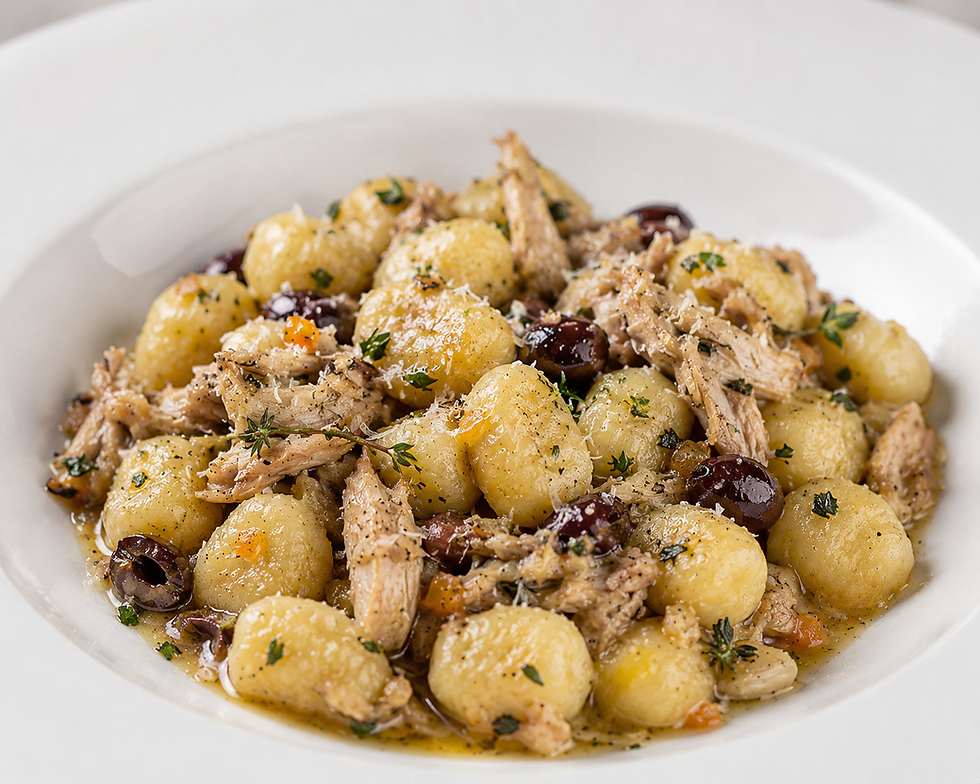
Italian Potato Gnocchi with Fontina | Gnocchi alla Fontina Valdostana

Valle d'Aosta is the smallest region in Italy and has the least farmland. What it has instead is altitude, cold, and pasture that works only a few months a year, and out of that it built a cuisine of cheese, butter, rye and cured meat. Gnocchi alla Fontina Valdostana is its plainest expression: potato, flour and one great cheese, from a kitchen where dinner had to be hot, filling and made from what was already in the larder.
The cheese is the point. Fontina DOP comes from Valdostana Pezzata Rossa cows, is made from raw milk still warm from the animal, and ripens at least three months in stone cellars and disused mine tunnels at close to ninety percent humidity. It melts as almost no other Italian cheese does, flowing rather than stringing, because its fat content and short ripening leave the protein structure loose enough to relax under gentle heat.
What follows is the classic house version: gnocchi folded through a fonduta and given a brief pass under the grill. The potatoes are baked rather than boiled, the one decision that keeps the dish from turning heavy. Everything else is patience, because the cheese is soaked and the fonduta is built off the boil.
Yield: 4 servings. Fontina soaking: 2 hours or overnight. Potato baking and cooling: 1 hour 15 minutes. Dough and shaping: 35 minutes. Fonduta and gratin: 20 minutes. Total: about 2 hours 15 minutes plus soaking. Difficulty: intermediate. Course: primo piatto. Region: Valle d'Aosta.
The Story
Fontina has been made in these valleys for a very long time. A cheese called fontine appears in the Challant family accounts in the fifteenth century, and a fresco at the Castello di Issogne painted around 1480 shows wheels of it on a market stall. The name probably comes from the alpine pasture of Fontin above Quart, though nobody has settled it. The consorzio was founded in 1952 and the DOP followed, fixing the breed, the milk and the altitude.
Fonduta is the older half of the recipe, and it is not Swiss fondue: no wine, no kirsch, no garlic. Fontina is soaked in milk, melted slowly with butter and thickened with egg yolks into something closer to a savoury custard, then eaten from a bowl with bread or poured over polenta. Pellegrino Artusi wrote it down in the 1890s and the method has not changed since.
Gnocchi came into the valley from Piedmont, its neighbour on the only easy side, and took on the local dressing rather than bringing its own. There is nothing ceremonial about it. A household with potatoes in the cellar and fontina on the shelf could feed six people in an hour, and where winter cut the passes for months, that arithmetic decided most of what got cooked.
Ingredients
For the gnocchi
Starchy baking potatoes, similar size, 2 1/4 lb (1 kg)
Coarse sea salt for the baking tray, 2 cups (500 g)
All purpose flour, 1 cup (130 g), plus more for dusting
Egg yolk, large, 1
Fine sea salt, 1 tsp (6 g)
Freshly grated nutmeg, 1 pinch
For the fonduta
Fontina Valle d'Aosta DOP, rind removed, thinly sliced, 10 oz (280 g)
Whole milk, 1 cup (240 ml)
Unsalted butter, 1 1/2 tbsp (20 g)
Egg yolks, large, 2
Freshly ground white pepper, to taste
Fine sea salt, only if needed
For finishing
Unsalted butter for the gratin dish, 1 tbsp (15 g)
Fontina Valle d'Aosta DOP, coarsely grated, 1 1/2 oz (40 g)
Reserved gnocchi cooking water, about 1/2 cup (120 ml)
Freshly grated nutmeg, 1 small pinch
Preparation
Soak the fontina in milk
Cut the rind away and slice the cheese thinly, then cover it with the cold milk and refrigerate it for at least 2 hours, or overnight. This first move is not optional. Soaking hydrates the paste so it melts at a lower temperature and in less time, which is why a valdostana fonduta pours instead of pulling into threads. Take it out 30 minutes before you cook.
Bake the potatoes on a bed of coarse salt
Heat the oven to 400°F (200°C). Spread the coarse salt over a baking tray, set the unpeeled potatoes on it and bake about 1 hour, until a skewer meets no resistance. Salt draws moisture out through the skin as the flesh cooks, so a baked potato is drier before you even open it, and drier flesh means less flour in the dough.
Rice them hot and cool the flesh
Split each potato as soon as you can handle it and scoop the flesh out, leaving the skins behind. Pass it through a ricer onto a cold tray in loose threads, spread them out, and leave it alone about 10 minutes while the steam lifts off. Do not cover it and do not heap it: trapped steam condenses back into the potato and the flour has to deal with it later.
Mix the dough quickly and keep it slack
Sprinkle the fine salt, the nutmeg and most of the flour over the cooled potato, drop in the egg yolk and cut everything together with a scraper until it just coheres. The dough should feel soft and slightly tacky rather than smooth; keep the last of the flour for the bench. A fontina sauce is heavy, so the gnocchi must be light enough to carry it, and that is decided here in about sixty seconds.
Shape them small and leave them plain
Roll the dough into ropes about 2/3 inch (1.5 cm) thick and cut short pieces. Leave them ungrooved: a fonduta coats every surface it touches, so ridges would only trap more sauce than the dish wants, and plain gnocchi gratin more evenly. Set them on a floured tray in one layer and keep them cool.
Build the fonduta off the boil
Melt the butter in a heavy saucepan over the lowest heat, tip in the fontina with all its milk and stir constantly with a wooden spoon. Let the cheese slump into the milk over 8 to 10 minutes, and never let it simmer: if it looks as though it will, lift the pan off and keep stirring. You want a thick glossy cream with no lumps in it.
Temper the yolks into the sauce
Take the pan off the heat and leave it a minute so the temperature drops. Beat the yolks in a small bowl, whisk in two spoonfuls of the hot cheese, then pour that back into the pan, stirring throughout. Return it to the lowest heat for 2 minutes only, until it thickens perceptibly. Above about 175°F (80°C) the yolks scramble, so watch it rather than time it.
Cook the gnocchi, fold and gratin
Boil the gnocchi in salted water in two batches and lift them out with a spider about 20 seconds after they surface. Fold them into the fonduta with a spoonful or two of cooking water, tilting the pan rather than stirring. Tip everything into a buttered gratin dish, scatter the grated fontina and the nutmeg over the top and grill for 2 to 3 minutes, until the surface blisters and turns pale gold.
Plating
This is served from the dish it was gratinated in. Use a shallow earthenware or cast iron dish rather than a deep one: a wide surface over a thin layer of gnocchi gives every portion both blistered top and soft interior, where a deep dish gives a pale middle and a burnt edge.
Bring it to the table within a minute of leaving the grill and serve onto hot plates, cutting through the crust with the edge of a spoon rather than scooping. Fonduta tightens as it cools, and a sauce that has sat five minutes is noticeably stiffer. Keep a small jug of hot milk beside you if it has to wait.
Finish each plate with white pepper from the mill and nothing else. No parsley, no chives, no oil. In the valley the only addition anyone makes is shaved white truffle in late autumn, which is a different and far more expensive dish. Bread is expected, since the last of the sauce gets wiped up.
Professional Technique
Everything technical here concerns heat control over a cheese unusually willing to melt and quick to break. Fontina carries around 45 percent fat in dry matter and ripens only three to four months, so its casein network is still soft. Warmed gently it relaxes and releases the fat as a stable emulsion; pushed past a simmer the proteins contract, squeeze the fat out and leave a rubbery mass in a pool of oil. The margin lives between about 150°F (65°C) and 175°F (80°C).
The milk soak widens that margin. Two hours of hydration lets water penetrate the paste, so the cheese softens sooner and needs less heat and less time in the pan. The soak also dilutes the casein slightly, which makes the finished fonduta pourable rather than elastic. Skipping it is the commonest reason a home version turns stringy.
The yolks are a liaison, not a thickener in the flour sense, and they behave like a custard. Tempering them with hot cheese before they go back raises their temperature slowly enough that the proteins set into a smooth gel instead of coagulating into threads. Two minutes over the lowest heat is enough. The gratin is separate: the grated fontina on top browns through Maillard reactions in dry heat, which is why it is scattered on rather than stirred in.
Texture and Moisture Control
The dish holds two opposite textures at once, a crust that crackles slightly under the spoon and a fonduta beneath that still flows. Timing keeps both. Two or three minutes under a fierce grill sets the top without heating the sauce enough to break it. Ten minutes in a moderate oven sounds gentler and is far worse, because the whole mass climbs past the temperature the emulsion survives.
Consistency is adjusted with gnocchi water, never with more milk. The starch in that water thickens the sauce as it cools and helps it cling instead of sliding off, whereas milk dilutes flavour and body at once. Add it a tablespoon at a time while folding, and stop while the sauce still moves slowly in a tilted pan.
Moisture in the gnocchi is controlled long before they meet the sauce, by baking the potatoes and letting the riced flesh steam off. The reward is a dough at roughly 130 g of flour per kilogram of raw potato. Lift them from the water promptly: every extra thirty seconds is water the fonduta has to absorb, and a watery fontina sauce cannot be rescued.
Professional Mise en Place
The soak and the potatoes are done long before service. What remains is about twelve minutes in which sauce, gnocchi and grill have to arrive together.
Equipment and tools
Potato ricer, bench scraper and a large cold tray
Heavy bottomed saucepan, ideally with a copper or thick steel base for even low heat
Wooden spoon and a small whisk for the yolk liaison
Shallow earthenware or cast iron gratin dish, wide rather than deep
Spider or slotted spoon, and an instant read thermometer
Prepared ahead
Fontina sliced and soaking in milk, refrigerated, up to 12 hours ahead
Potatoes baked, riced and cooled, up to 2 hours ahead on a covered tray
Gnocchi shaped up to 3 hours ahead, single layer on floured trays, refrigerated uncovered
Fontina for the top grated and kept cold and separate
Gratin dish buttered and standing ready beside the stove
Service setup
Grill preheated to its highest setting at least 10 minutes before service
Salted water at a gentle boil, wide pan, spider hanging on the rim
Cooking water reserved in a cup before anything is drained
Yolks beaten in a small bowl, whisk beside them
Plates hot, white pepper mill on the pass, bread cut and on the table
Chef Tips
Buy Fontina Valle d'Aosta DOP and check for the Matterhorn stamp on the rind. Fontina style cheese made elsewhere in Italy or in Scandinavia is a different product with a firmer paste and will not give a fonduta. Fontal from the same valleys is the nearest honest substitute, though it melts less generously.
Keep an instant read thermometer in the sauce. Fonduta is one of the few Italian preparations where the numbers beat instinct, and knowing you are at 165°F (74°C) rather than guessing is what separates a cook who makes this once from one who makes it every winter.
If the sauce breaks, take the pan off the heat and whisk in a tablespoon of cold milk with a few drops of lemon juice. It does not always come back, but often enough to try before starting again. What never works is more heat or more cheese.
Use the potato skins rather than throwing them out. Brush them with butter, season them and return them to the oven for 15 minutes while the gnocchi are shaped. They are the cook's share, eaten standing up, and in a valley where nothing edible was discarded they are entirely in the spirit of the dish.
Common Mistakes
Letting the fonduta simmer. A simmer contracts the casein, forces the fat out and leaves rubbery strands in an oily pool. Keep the pan on the lowest heat and lift it off whenever the surface looks as though it might move.
Skipping the milk soak. Unsoaked fontina needs more heat and more time to melt, which pushes the sauce straight into the temperature range where it breaks. Two hours in cold milk is the cheapest insurance in the recipe.
Adding the yolks straight to the hot pan. They coagulate on contact and the sauce fills with fine threads that no amount of whisking removes. Temper them with two spoonfuls of hot cheese first, then return the mixture off the boil.
Boiling the potatoes. Boiled flesh carries far more water, which has to be absorbed by extra flour, and the gnocchi end up dense under a sauce that is already rich. Bake them on coarse salt instead.
Gratinating too long. A slow bake heats the whole dish past the point where the emulsion holds, so the crust arrives and the sauce underneath has already split. Two to three minutes under a fierce grill does the job.
Thinning the sauce with milk. It dilutes both flavour and body at once. Use the starchy gnocchi water, a tablespoon at a time, which thickens as it cools and helps the sauce cling.
Wine Pairing
Valle d'Aosta Petite Arvine: The finest white grown in the valley and the most complete answer to this plate. Grapefruit and white flower aromatics sit over a saline, almost briny finish, and the acidity is high enough to cut a yolk thickened cheese sauce without stripping it. A slight bitterness at the end keeps the palate from tiring.
Valle d'Aosta Prié Blanc: Grown on ungrafted vines at Morgex and La Salle, close to 4,000 feet (1,200 m) and among the highest vineyards in Europe. It is taut, low in alcohol and sharply mineral, with green apple and mountain herb notes. That austerity is what a rich fonduta needs beside it, and it is the local pour.
Valle d'Aosta Donnas DOC: Nebbiolo grown on terraces at the mouth of the valley, lighter and more angular than its Piedmontese relatives because the site is colder. Dried rose, red cherry and a dusty tannin give grip against the fat without overwhelming the cheese. Serve it at about 59°F (15°C).
Valle d'Aosta Fumin: A native red almost lost by the 1970s and revived by a handful of growers, dark and peppery with black fruit and the smoky edge its name refers to. Firm tannin and a savoury finish stand up to the gratinated crust and the nutmeg, which makes it the choice when this dish is the centre of the meal.
Valle d'Aosta Enfer d'Arvier: From a natural amphitheatre of terraces so hot in summer that growers named it the inferno, planted mainly to Petit Rouge. It is medium bodied and gently spiced, with raspberry fruit and a dry herbal finish that refreshes rather than weighs. This is the bottle most families in the valley would actually open.
Storage & Reheating
The gratinated dish keeps covered in the refrigerator for up to 2 days, though it is better on the day. Do not freeze it once the fonduta is made: the emulsion separates on thawing and never returns. Raw shaped gnocchi freeze well on their tray and go into a bag for up to 1 month, cooked straight from frozen with 30 seconds added.
Reheat leftovers covered in a 300°F (150°C) oven for 12 to 15 minutes, with a tablespoon of milk stirred into the surface first. Gentle heat and a lid let the cheese soften back without breaking. A microwave heats unevenly and takes hot spots past saving, so use one only for a single portion, at half power, in thirty second bursts.
Fonduta made and not used keeps sealed in the refrigerator for 2 days. Rewarm it in a bowl over barely simmering water, stirring, loosening it with a splash of warm milk. Uncut fontina keeps for weeks wrapped in waxed paper in the vegetable drawer, but once the rind is opened use it within about a week.
Nutrition
Per serving, based on 4 servings:
Calories: 715 kcal
Total Fat: 36 g
Saturated Fat: 21 g
Trans Fat: 1 g
Unsaturated Fat: 12 g
Cholesterol: 240 mg
Sodium: 960 mg
Total Carbohydrates: 62 g
Fiber: 4 g
Total Sugars: 6 g
Added Sugars: 0 g
Protein: 33 g
Lactose: 3 g
Principal micronutrients: calcium, phosphorus, potassium, vitamin A, vitamin B12, vitamin D, zinc
These figures are estimates. Fontina is salty and the sodium moves considerably with the wheel, while the cholesterol reflects three egg yolks across four plates.



Comments