
Italian Trieste Beef Goulash | Goulash Triestino
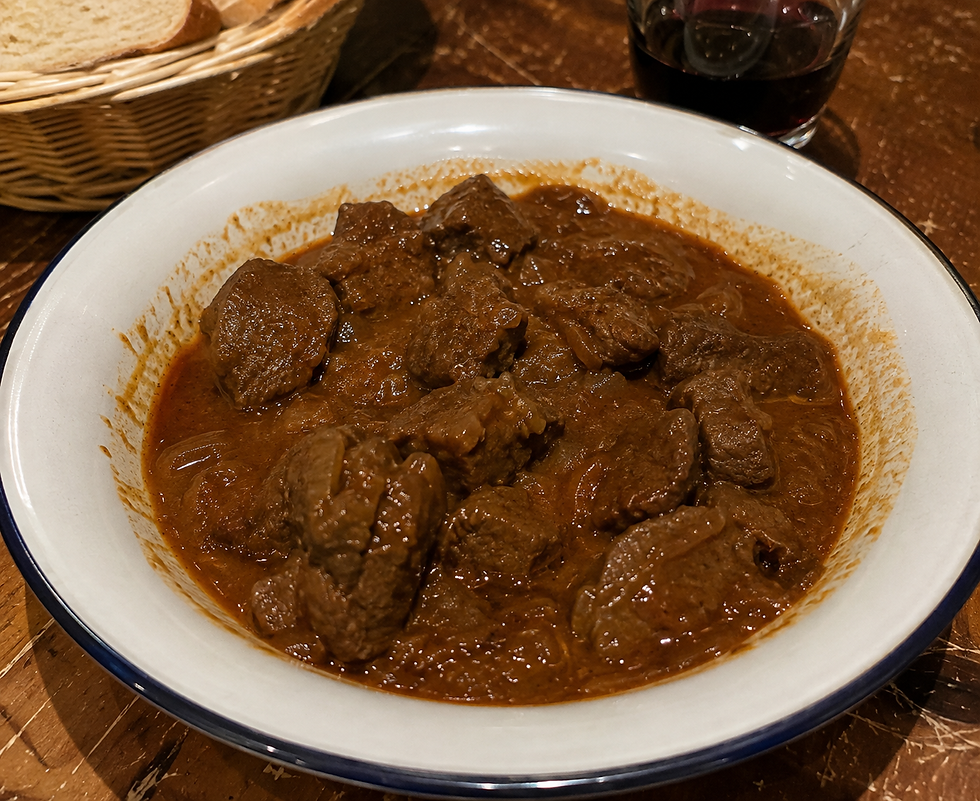
The quickest way to understand goulash in Trieste is to compare it with the dish it descends from. In Hungary, gulyas is a soup: thin enough to eat with a spoon, the beef sitting in a great deal of paprika stained broth with potato floating in it. Cross to the Italian side of the Karst and the same name means something else, a dense, almost dry stew whose sauce has been reduced until it clings to the meat.
That change is not an accident of translation. Hungarian gulyas is a one bowl meal that has to carry its own liquid. Triestine goulash is served over something, and that something is almost always bread gnocchi or soft polenta, both already moist and both ruined under a soup. The sauce is therefore concentrated on purpose, and a plate of goulash in a Trieste osteria arrives dark and glossy rather than brothy.
What stays constant is the engine of the dish: paprika and onion, in quantities that look implausible the first time you weigh them. There is as much onion as beef, and none of it appears as onion on the finished plate. It dissolves, and that dissolution is the whole technique.
Yield: 4 generous servings. Prep: 30 minutes. Cook: 3 hours. Rest: 20 minutes. Total: about 3 hours 50 minutes. Difficulty: intermediate. Course: secondo. Region: Friuli Venezia Giulia, Trieste and the Karst plateau.
The Story
Trieste learned this dish from the Hungarian half of the empire it belonged to and then changed it. The cooking of the city is layered, with Austrian, Slovenian, Hungarian, Venetian and Jewish kitchens all leaving something behind, and goulash arrived in the nineteenth century when soldiers, clerks and railway men moved freely between Budapest, Vienna and the port. The word comes from gulyas, Hungarian for herdsman, because the original was what cattle drovers cooked in a kettle while moving their animals across the plain.
A drover's kettle produces soup because a drover carries water and wants a meal in one vessel. A city kitchen has no such constraint, and Trieste already had its own starch traditions. The bread gnocchi of the Austrian and Slovenian tradition, made from stale bread rather than potato, and the yellow polenta of the Veneto were both on the table. Put a Hungarian soup over either and the result is unpleasant. Reduce it into a sauce instead and it becomes one of the most satisfying plates in the north east of Italy.
The other change is spice. Hungarian cooking uses paprika in many grades and often with a real chilli heat behind it. The Triestine version is warm rather than hot: sweet paprika does the work, a little smoked paprika adds depth, and cumin and marjoram carry the aroma. Those last two are the Slovenian and Austrian fingerprints, and they tell you a goulash was made on this side of the border.
Ingredients
For the beef
Beef shin or chuck, cut into 1 1/2 inch (4 cm) cubes, 2 1/4 lb (1 kg)
Fine sea salt, 2 tsp (12 g)
Freshly ground black pepper, 1/2 tsp (1 g)
All purpose flour, 2 tbsp (16 g), optional
Lard or clarified butter, 3 tbsp (45 g)
For the onion and spice base
Yellow onions, finely sliced, 2 1/4 lb (1 kg)
Lard or clarified butter, 2 tbsp (30 g)
Garlic cloves, finely chopped, 3
Sweet paprika, 3 tbsp (21 g)
Smoked or hot paprika, 1 tsp (2 g)
Cumin seeds, ground, 1 tsp (2 g)
Dried marjoram, 1 tsp (1 g)
Tomato paste, 1 tbsp (16 g)
Grated lemon zest, from 1/2 lemon
For the braise
Dry red wine, 1/2 cup (120 ml)
Red wine vinegar, 1 tbsp (15 ml)
Beef stock, hot, 2 cups (475 ml), plus more as needed
Bay leaves, 2
Fine sea salt, to taste
For serving
Bread gnocchi or soft polenta, 4 portions
Flat leaf parsley, chopped, 1 tbsp
Freshly ground black pepper, to taste
Preparation
Step 1
Cut, season and brown the beef. Trim the shin or chuck of heavy sinew, leaving the fine connective tissue inside the muscle, and cut it into cubes of about 1 1/2 inch (4 cm). A cube this size survives three hours of braising and still arrives as a recognisable piece of meat. Season, rest 20 minutes at room temperature, and toss in the flour if you want a thicker sauce. Heat the lard in a heavy casserole over medium high heat and brown the cubes in two or three batches, 6 to 8 minutes each, turning for a deep crust on at least three sides. Crowding the pan makes the meat steam instead of colour. Lift the cubes out and keep every scrap stuck to the base.
Step 2
Cook the onions down. Lower the heat to medium low, add the second measure of lard and all the sliced onion at once. It will fill the pot and look absurd. Season lightly, cover for 10 minutes so the onions release their water, then uncover and cook for 35 to 45 minutes, stirring often and scraping the base, until the volume has collapsed to about a quarter and the mass is deep gold and jammy. Add the garlic for the final 2 minutes.
Step 3
Bloom the spices off the heat. Pull the pot off the burner and let it cool for a minute. Add the sweet paprika, the smoked paprika, the cumin and the marjoram to the hot onions and stir hard for 30 seconds, then stir in the tomato paste and the lemon zest. Paprika is mostly sugar and scorches far below the temperature onions tolerate, turning irreversibly bitter in seconds. Taking the pot off the heat costs nothing and gives you a wide margin.
Step 4
Deglaze and return the beef. Set the pot back over medium heat, pour in the red wine and the vinegar and scrape the base clean while the liquid bubbles. Let it reduce by half, about 3 minutes. Return the beef and its juices, add the bay leaves and pour in enough hot stock to come two thirds of the way up the meat. It should not be submerged. Bring it to a bare simmer, with only occasional bubbles breaking the surface.
Step 5
Braise low and long. Cover with the lid slightly ajar and hold that bare simmer for 2 1/2 to 3 hours, or transfer the pot to an oven at 300°F (150°C), which holds temperature more evenly. Stir every 40 minutes and add a ladle of hot stock only if it threatens to go dry. The beef is ready when a fork meets no resistance but a cube still holds together when lifted. Correct the salt now, with the sauce near its final concentration.
Step 6
Reduce and rest. Uncover, raise the heat slightly and reduce for 15 to 20 minutes until the sauce coats the meat and a spoon drawn across the base leaves a channel that closes slowly. Remove the bay leaves, turn off the heat and let the pot stand for 20 minutes. The meat reabsorbs liquid and the sauce settles into the glossy, clinging consistency that separates a Triestine goulash from a Hungarian soup.
Plating
This is a plate without decoration, served hot on hot plates. Warm them to about 140°F (60°C), since a sauce this reduced sets and dulls quickly on cold china. Spoon the starch first, slightly off centre: four or five bread gnocchi, or a pool of soft polenta left to find its own level. Neither should be moulded.
Lay the beef beside the starch rather than on top of it, so the gnocchi keep their surface and do not go slack. Four or five cubes per person is right. Spoon the sauce over the meat and let it run down the side of the starch on its own, then stop. Flood the plate and you have made soup after all, which is what three hours of work was meant to avoid.
Chopped parsley and a turn of black pepper finish it. Nothing else belongs here: no cream, no herb sprigs, no drizzle of oil. In Trieste the accompaniment is a small dish of pickled vegetables or grated horseradish, served separately so it stays sharp and cold against the warm spice.
Professional Technique
The defining technique is the one to one ratio of onion to beef, and it is worth understanding rather than treating as a quirk. There is no flour thickening in a traditional goulash and no stock reduction rich enough to build body alone. The sauce is thickened by onion pectin and dissolved onion solids. A kilo of raw onion cooked down for 45 minutes loses three quarters of its volume and leaves a sweet, viscous mass that behaves like a natural liaison. Halve it and you get a thin, sharp sauce no reduction will fix.
The second technique is heat management around the paprika. Its colour compounds are fat soluble, so it must meet hot fat, but only briefly and never over a flame. A pot pulled from the burner gives roughly 30 seconds of ideal temperature: long enough for the fat to take colour and the aroma to open, not long enough for the sugars to caramelise into bitterness.
The third is the cut and the temperature it is held at. Beef shin carries more collagen than almost any other cut, and collagen converts to gelatin over hours between 160°F and 180°F (70°C and 82°C). A bare simmer sits inside that window; a rolling boil pushes past it. Slow here is not patience, it is temperature.
Texture and Moisture Control
Two textures have to arrive together: beef that gives to a fork while holding its shape, and a sauce dense enough to cling. They pull against each other, since the sauce reduces faster than the meat softens. Separate the two jobs in time. Braise covered with enough liquid for as long as the meat needs, then uncover and reduce hard only at the end. Doing both at once gives you either underdone meat in a tight sauce or good meat in a thin one.
Moisture inside the meat depends on holding the pot below a simmer. Muscle fibres contract and expel water sharply above roughly 180°F (82°C), and that water does not come back. Gelatin partly compensates by holding liquid between the fibres, which is why a properly braised shin tastes moist despite being far past well done.
The rest at the end does real work. During cooking the fibres are under tension; twenty minutes off the heat releases it and the cubes draw sauce back into their outer layer, while the gelatin in the sauce begins to set and produces the shine. Goulash reheated the next day is better still for the same reason.
Professional Mise en Place
Almost all of this dish is done in advance and the only service work is reheating and plating. In a restaurant it is cooked the day before as a matter of course.
Equipment and tools
Heavy cast iron or enamelled casserole with a lid, 6 quart (6 litre)
Wide wooden spoon or flat edged spatula for scraping the base
Sharp boning knife for trimming the shin
Instant read thermometer to keep the braise below a simmer
Prepared ahead
Beef trimmed, cubed and seasoned, up to 1 day ahead, kept cold
Onions sliced, up to 1 day ahead, covered and refrigerated
Spice mix weighed into one small bowl, ready for the 30 second bloom
The whole goulash cooked 1 or 2 days ahead and cooled, which improves it
Service setup
Goulash rewarmed slowly and held at about 160°F (70°C), covered
Hot stock beside the pot to loosen the sauce if it tightens
Plates in the warmer at about 140°F (60°C)
Pickles or horseradish portioned into small separate dishes
Chef Tips
Buy paprika in small quantities from a shop that sells a lot of it, and keep it in a sealed tin in a dark cupboard, not in a jar above the stove. Paprika loses its aroma to light and heat within months and old paprika tastes of dust. Since three tablespoons go into this pot, that one ingredient decides the dish more than the beef does.
Slice the onions with a mandoline or a very sharp knife to an even eighth of an inch (3 mm). Even slices collapse at the same rate, which lets the whole mass melt instead of leaving firm pieces in a smooth base. It is the easiest way to improve the finished sauce.
Taste for salt only in the last half hour. The sauce concentrates as it reduces, and a pot seasoned correctly at two hours will be too salty at the end. If the finished goulash tastes flat and heavy, a few drops of red wine vinegar stirred in off the heat will lift it.
Make it the day before if you can. The gelatin sets, the paprika distributes through the fat, and the onion sweetness stops reading as separate from the meat.
Common Mistakes
Adding paprika to a pot still over the flame. It scorches within seconds and turns permanently bitter, and nothing rescues it. Pull the pot off the heat, let it cool a minute, then stir the spices into the hot onions for 30 seconds.
Using half the onion. The full kilo looks like a mistake and is not. Onion is the only thickener in a traditional goulash, and cutting it gives a thin, harsh sauce that reduction cannot repair without overcooking the meat.
Cooking it like a Hungarian soup. Covering the meat entirely with stock gives you a decent soup and not a Triestine goulash. The liquid should come two thirds up the meat and the sauce should finish thick enough to cling.
Choosing a lean cut. Sirloin and round have little collagen and dry out over three hours. Shin, chuck and cheek carry the connective tissue that turns to gelatin, which is what makes the meat taste moist.
Boiling instead of simmering. A rolling boil drives the meat past the point at which fibres hold water, and the beef falls apart into dry threads. Keep the surface barely moving, or use a 300°F (150°C) oven.
Wine Pairing
Teroldego Rotaliano DOC: A dark, dry Trentino red with firm acidity and moderate tannin, and one of the most reliable matches for paprika. Its black cherry fruit sits beside the sweetness of the collapsed onion rather than fighting it, while the acidity cuts the lard and the reduced gelatin. Serve at about 61°F (16°C).
Alto Adige DOC Lagrein: More tannin and a dark chocolate and violet character, enough to stand up to the smoked paprika where a lighter red would be flattened. The tannin binds the rendered fat in the sauce and clears the palate between forkfuls. It comes from the same Alpine Austro Hungarian world as the dish.
Alto Adige Santa Maddalena DOC: The lighter choice, mostly Schiava, pale with low tannin and a fresh almond and red berry profile. The goulash is warm rather than genuinely hot, so it does not need a heavyweight partner. Serve it lightly chilled at around 57°F (14°C).
Valpolicella Ripasso DOC: Passed over the dried skins of Amarone, it has more weight and a faintly bitter cherry stone finish that suits the cumin and marjoram. The body matches a sauce reduced hard, and the bitterness keeps the onion sweetness in check. Choose a dry Ripasso, not a sweeter commercial style.
Alto Adige DOC Pinot Nero: For finesse rather than power. Alpine Pinot Nero has high acidity, light tannin and a savoury, almost smoky edge from the altitude that picks up the smoked paprika directly. It flatters the beef most and the sauce least, so it suits a lighter hand on the spice.
Storage & Reheating
Goulash keeps better than almost any other secondo and is demonstrably better on the second day. Cool it quickly in a wide shallow tray rather than leaving the casserole on the counter, then transfer it to an airtight container and refrigerate for up to 4 days. Keep the meat in its sauce: stored separately the cubes dry at the surface within hours.
It freezes for up to 3 months. Portion it into flat sealed bags and thaw overnight in the refrigerator. The gelatin protects the beef, though the sauce may look slightly separated and comes back together with gentle stirring over low heat.
Rewarm in a covered pan over low heat with a few tablespoons of hot stock until the centre of the meat reaches about 160°F (70°C). Never use a high flame or a microwave on full power: both boil the sauce and dry the meat in exactly the way the braise was designed to avoid. Bread gnocchi are always cooked fresh, and leftover polenta is best sliced and grilled.
Nutrition
Per serving, based on 4 servings, for the goulash alone without the bread gnocchi or polenta:
Calories: 620 kcal
Total Fat: 34 g
Saturated Fat: 14 g
Trans Fat: 0.5 g
Unsaturated Fat: 18 g
Cholesterol: 165 mg
Sodium: 980 mg
Total Carbohydrates: 24 g
Fiber: 5 g
Total Sugars: 12 g
Added Sugars: 0 g
Protein: 52 g
Lactose: 0 g
Principal micronutrients: iron, zinc, vitamin B12, niacin, selenium, vitamin A from the paprika, potassium
These figures are estimates. Fat varies considerably with the cut and with how much rendered fat you skim before serving.


Comments