

Italian Traditional Pantelleria Salad | Insalata Pantesca Tradizionale
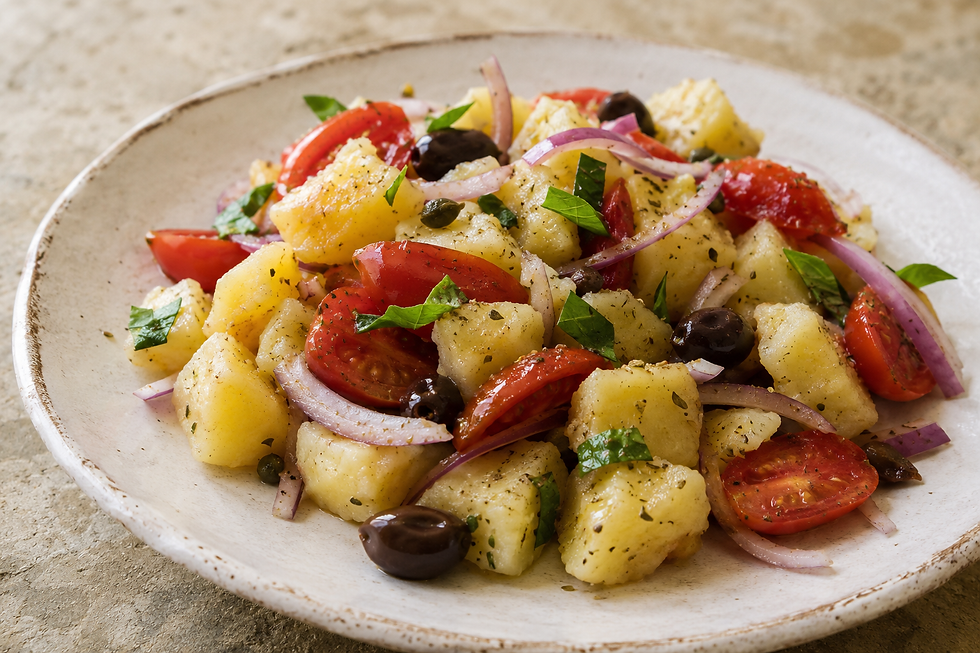
Insalata pantesca has six ingredients and no dressing in the usual sense. Boiled potatoes, ripe tomatoes, red onion, salted capers, olives and oregano are bound with nothing but very good olive oil, and the acidity comes entirely from the tomato while the salt comes entirely from the capers. There is no vinegar and no lemon in the traditional version, which is the single thing most recipes outside Pantelleria get wrong.
It is a warm climate salad built on preserved ingredients, which is why it works. The capers are packed in sea salt rather than brine, the olives are cured, the oregano is dried on the branch, and the potatoes are there to absorb everything and carry it. It is eaten at room temperature, never chilled, and it is better after an hour of resting than it is the moment it is assembled.
Yield: 4 servings as an antipasto or contorno, 2 as a light main. Prep: 20 minutes. Cook: 25 minutes. Rest: 1 hour. Total: about 1 hour 45 minutes. Difficulty: easy. Course: antipasto or contorno. Region: Sicily, the island of Pantelleria.
The Story
Pantelleria sits 62 miles (100 km) from Sicily and 44 miles (70 km) from Tunisia, closer to Africa than to the country that governs it, and the Arabs who held it from the ninth century left a name behind: Bent el Rhia, daughter of the wind. That wind is the reason the island cooks the way it does. Nothing grows upright here. The vines are trained into shallow hollows dug into the black volcanic soil, the caper bushes creep along dry stone walls, and the citrus trees are enclosed inside circular stone giardini panteschi built to break the wind and trap dew.
Capers are the island's defining crop, and Capperi di Pantelleria carry an IGP granted in 1996. They are harvested by hand between May and September, bud by bud, before dawn while the flowers are still closed, then layered with sea salt in barrels and turned repeatedly over several weeks. Salt curing rather than brining is what gives them their concentration, and it is the reason the salad below needs no seasoning of its own.
The salad itself is farmhouse and fisherman food. Potatoes were the cheap bulk that made a plate of tomatoes into a meal, and everything in it either grew within walking distance or came out of a jar on the shelf. In the dammusi, the low domed lava stone houses of the island, it was assembled in the morning and left on the table through the heat of the day. Tuna in oil appears in some versions and boiled eggs in others, but the six ingredient version is the original.
Ingredients
For the salad
Waxy potatoes, yellow fleshed, 1 1/4 lb (570 g)
Ripe vine tomatoes, 1 lb (450 g)
Red onion, preferably Tropea, 1 medium, about 5 oz (140 g)
Capers in sea salt, from Pantelleria if possible, 3 tbsp (30 g)
Black olives, Nocellara or Gaeta, pitted, 1/2 cup (70 g)
Dried oregano on the branch, 1 tsp (1 g)
Coarse sea salt for the potato water, 1 tbsp (18 g)
For dressing and finishing
Extra virgin olive oil, Sicilian, 5 tbsp (75 ml)
Fine sea salt, to taste and probably none
Freshly ground black pepper, to taste
Fresh basil leaves, 6 to 8, optional and only if very fresh
Preparation
Step 1
Rinse the salted capers. Put the capers in a bowl of cold water for 10 minutes, then drain and repeat once, rubbing them gently between your fingers to release the crystals trapped in the folds. Taste one. It should be sharply savoury and floral, not painful. Over rinsing is as bad as under rinsing, because the salt carries the aroma as well as the seasoning.
Step 2
Boil the potatoes whole and unpeeled. Cover them with cold water by an inch, add the coarse salt and bring to a simmer from cold. Starting cold lets the centre and the outside reach temperature at roughly the same rate, which stops the outer layer collapsing before the middle is done. Cook at a bare simmer for 20 to 25 minutes, until a thin knife goes in with slight resistance rather than sliding straight through.
Step 3
Peel and cut the potatoes warm. Drain and peel them while still hot enough to be uncomfortable, holding each one in a cloth. Warm skin lifts away in sheets and cold skin tears the flesh with it. Cut them into rough chunks of about 3/4 inch (2 cm) rather than neat cubes, spread them on a tray in a single layer and dress them with 2 tablespoons of the olive oil straight away, while warm.
Step 4
Prepare the tomatoes. Core them and cut them into wedges or thick irregular pieces, never thin slices, which collapse and flood the bowl. If they are very juicy, set the pieces in a sieve over a bowl for 10 minutes and keep the juice that drains out. That juice is the acid component of this salad and it goes back in at the end.
Step 5
Soften the onion. Slice the red onion as thinly as you can, put the slices in very cold water for 10 minutes and drain them thoroughly. This draws out the sulphur compounds responsible for the harsh burning edge while leaving the sweetness and the colour intact. It is worth doing whenever your onion is not a genuinely sweet variety.
Step 6
Combine and rest. Put the warm potatoes, tomatoes, drained onion, capers and olives in a wide bowl. Crumble the oregano between your palms directly over the top, which wakes the oils in a way that shaking it from a jar does not. Add the remaining 3 tablespoons of oil and the reserved tomato juice, then fold with two large spoons, lifting rather than stirring so the potato does not break into paste.
Step 7
Taste, then leave it alone. Season with black pepper and taste before reaching for salt, because between the capers, the olives and the potato water there is very often enough already. Cover the bowl and leave it at room temperature for at least 1 hour. Never refrigerate it during this rest.
Plating
Serve it in a wide shallow bowl or on a flat platter rather than heaped in a deep dish. Depth crushes the lower layers under the weight of everything above and the potato at the bottom turns to mash while the top stays intact. A single layer two or three pieces deep keeps every component recognisable, which is the whole point of a salad made of six things.
The plate and the salad should both be at room temperature, around 68°F (20°C). This is not a chilled dish and refrigeration is its enemy: cold mutes the tomato, stiffens the olive oil and does nothing at all for the potato. If it has been in the refrigerator because of the weather, take it out a full 45 minutes before it goes on the table.
Finish by spooning any oil and juice from the bottom of the mixing bowl back over the top, then add a last thread of raw olive oil and a few torn basil leaves if you are using them. Scatter a few whole capers across the surface so they are visible. Do not add vinegar, do not add lemon and do not add a crumbled cheese: each of those pushes the plate somewhere other than Pantelleria.
Professional Technique
The governing technique here is dressing starch while it is hot. A boiled potato at around 160°F (70°C) has gelatinised starch granules that are swollen and open, and oil and dissolved salt move into that structure readily. The same potato at room temperature has retrograded: the starch has recrystallised and closed, and anything poured over it now stays on the outside. This is why the first 2 tablespoons of oil go on within a minute of peeling, and it is also why this salad is assembled warm and eaten cool rather than made cold from the start.
The second is the salt budget, managed by subtraction rather than addition. Salt cured capers arrive at roughly 20 percent salt by weight, cured olives carry their own, and the potatoes have taken salt from their cooking water. The rinsing in step one is not cleaning, it is a measured removal, and how far you take it decides whether the finished bowl needs anything else.
The third is treating the tomato juice as a deliberate ingredient rather than an accident. Draining the cut tomatoes and returning their juice at the end gives control over when the acid arrives and how much there is. Left to run freely from the start it pools under everything and dilutes the oil into a watery liquid. Added at the folding stage it is absorbed by the warm potato and becomes the dressing.
Texture and Moisture Control
The potato is the component that decides whether this dish works. It needs to hold its shape under folding and still yield completely in the mouth, which means a waxy yellow fleshed variety with lower starch and firmer cell walls. A floury baking potato disintegrates into the oil and turns the whole bowl into a rough mash within twenty minutes. Test with a thin knife rather than a fork, and pull them off the heat while there is still the faintest resistance in the centre.
Water management runs through the rest of it. Onion slices are drained properly and patted dry after their soak, tomatoes give up their juice into a sieve rather than into the bowl, and the capers are shaken out rather than tipped in wet. Every unnecessary millilitre of water thins the oil and breaks the light emulsion that forms between oil, tomato juice and potato starch, which is the only sauce this salad has.
The hour of rest is a textural step, not just a flavour one. In that time the potato surface softens and takes on the tomato acid, the onion goes from crisp to pliable, and the oregano moves out of the leaf and into the oil. Much beyond three hours the tomatoes start to break down and release a second wave of water, so the window is real. Assemble one hour before service and no earlier.
Professional Mise en Place
This is a dish with almost no service pressure and a long useful window, which makes it valuable when a lot of plates have to go out at once. Everything can be staged hours ahead and only the folding is timed.
Equipment and tools
Wide low bowl for mixing, large enough to fold without compressing
Sieve for the tomato juice and a second one for the capers
Thin bladed knife for testing the potatoes, clean cloth for peeling them hot
Sheet tray for spreading and cooling the dressed potatoes
Flat platters or shallow bowls for service, kept at room temperature
Prepared ahead
Capers rinsed twice, drained and held in a covered container, same day
Olives pitted and left whole or halved, up to 1 day ahead
Potatoes boiled, peeled, cut and dressed with oil, up to 4 hours ahead
Onion sliced and soaked, drained and patted dry, up to 2 hours ahead
Tomatoes cut and draining in a sieve, juice reserved, up to 1 hour ahead
Service setup
Everything held at room temperature, nothing in the refrigerator
Salad folded together exactly 1 hour before the first plate goes out
Reserved tomato juice and finishing oil beside the bowl
Oregano crumbled by hand at the moment of folding, never earlier
Salt tasted for and added only at the very end, if at all
Chef Tips
Buy capers packed in sea salt, not in vinegar brine. Brined capers taste of the brine and nothing else, and they bring an acidity this salad is specifically built to avoid. If salted capers are genuinely unavailable, rinse brined ones thoroughly and then dry them on paper for an hour, and accept that the result is a different and lesser dish.
Use the biggest capers you can find, not the tiny nonpareils. Pantelleria grades its capers by size and the larger grades have more flesh relative to surface, so they stay recognisably a caper after rinsing instead of dissolving into the background.
Keep the olive oil raw and spend money on it. There is no cooking here and nothing to hide behind, so the oil is a third of what you taste. A grassy peppery Sicilian oil with a bitter finish is the right character, poured generously enough that a little collects at the bottom of the plate for bread.
If your tomatoes are out of season and flavourless, do not make this salad. There is no cooking step to concentrate them and no vinegar to compensate, so a pale winter tomato leaves a bowl of oily potato. Wait for real ones, or roast halved cherry tomatoes briefly at 300°F (150°C) as an honest substitute.
Common Mistakes
Adding vinegar or lemon. The acid in this dish is tomato and nothing else, and adding a second sharp element flattens the caper aroma and turns it into a generic potato salad. Leave both out and let the tomatoes do the work.
Using floury potatoes. A baking potato falls apart under folding and turns the bowl into mash. Choose a waxy yellow fleshed variety and stop cooking while a knife still meets a little resistance.
Dressing the potatoes cold. Once the starch has cooled and recrystallised, oil sits on the outside instead of being absorbed. Peel them hot and put the first oil on immediately.
Refrigerating the finished salad. Cold mutes the tomato, thickens the oil and hardens the potato. This is a room temperature dish from start to finish, and anything below 60°F (15°C) costs it most of its aroma.
Over rinsing the capers. The salt carries the floral aroma as well as the seasoning, and capers left soaking for an hour come out tasting of wet vegetable. Two changes of water for 10 minutes each, then taste.
Slicing the tomatoes thin. Thin slices collapse and release all their water into the bowl at once. Cut thick irregular wedges and drain them briefly before they go in.
Wine Pairing
Grillo Sicilia DOC: The most obvious Sicilian white and the one that handles the capers best. Grillo has a saline, almost briny edge with grapefruit and white peach behind it, and that salinity meets the salt cured capers and olives as a partner rather than being knocked flat by them. Its acidity is moderate, which matters here because a piercing wine would fight the tomato instead of joining it.
Etna Bianco DOC: Made mainly from carricante on volcanic soils, and the geological echo of Pantelleria is not just poetic. It carries a stony, almost flinty minerality and a high firm acidity that cuts straight through the olive oil, which is the one thing this plate has in quantity. Green apple and citrus keep it lean enough not to add weight to a dish that is meant to feel light.
Cerasuolo di Vittoria DOCG: The red to reach for first, and the frappato in the blend is why. It is pale, low in tannin, full of red cherry and dried herb, and it should be served lightly chilled at around 57°F (14°C). At that temperature it behaves almost like a white against the tomato while its herbal character runs directly alongside the oregano.
Faro DOC: A rare bottle from the hills above Messina, built on nerello mascalese and nerello cappuccio. It is light bodied with fine grained tannin and a savoury, slightly bitter finish that picks up the black olives without overwhelming the potato. Serve it cool. It has more structure than the Cerasuolo and suits the version of this salad that includes tuna.
Etna Rosso DOC: The choice for a generous hand with the olives and the oregano. Nerello mascalese grown high on the volcano gives red fruit, dried tomato leaf and a distinct ashy mineral note, with tannin fine enough not to clash with the raw onion. Keep to a younger unoaked bottling and serve it at around 59°F (15°C), well below room temperature.
Storage & Reheating
This salad is at its best between one and three hours after assembly and it does not improve overnight. If you must keep it, cover the bowl and refrigerate for up to 24 hours, then take it out and leave it at room temperature for a full 45 minutes before serving. The potato firms up in the cold and the oil solidifies around it, and neither reverses quickly.
There is no reheating step: warming this dish cooks the tomato and the raw onion and destroys it. If a refrigerated portion tastes dull, revive it with a fresh thread of raw olive oil, a pinch of oregano crumbled between the fingers and a few new caper buds. Do not freeze it, since potato and tomato both turn grainy and watery on thawing.
The components store better separately than assembled. Boiled and oiled potatoes keep 2 days refrigerated in a sealed container, rinsed capers keep a week submerged in olive oil, and cut tomatoes should be used the same day. Unopened salted capers keep for years in a cool dark cupboard and only improve.
Nutrition
Per serving, based on 4 antipasto portions:
Calories: 290 kcal
Total Fat: 19 g
Saturated Fat: 2.7 g
Trans Fat: 0 g
Unsaturated Fat: 16 g
Cholesterol: 0 mg
Sodium: 780 mg
Total Carbohydrates: 28 g
Fiber: 4 g
Total Sugars: 5 g
Added Sugars: 0 g
Protein: 4 g
Lactose: 0 g
Principal micronutrients: vitamin C, potassium, vitamin K, lycopene, vitamin B6, manganese
These figures are estimates. Sodium depends almost entirely on how thoroughly the capers and olives are rinsed and can vary by several hundred milligrams in either direction.


Comments