
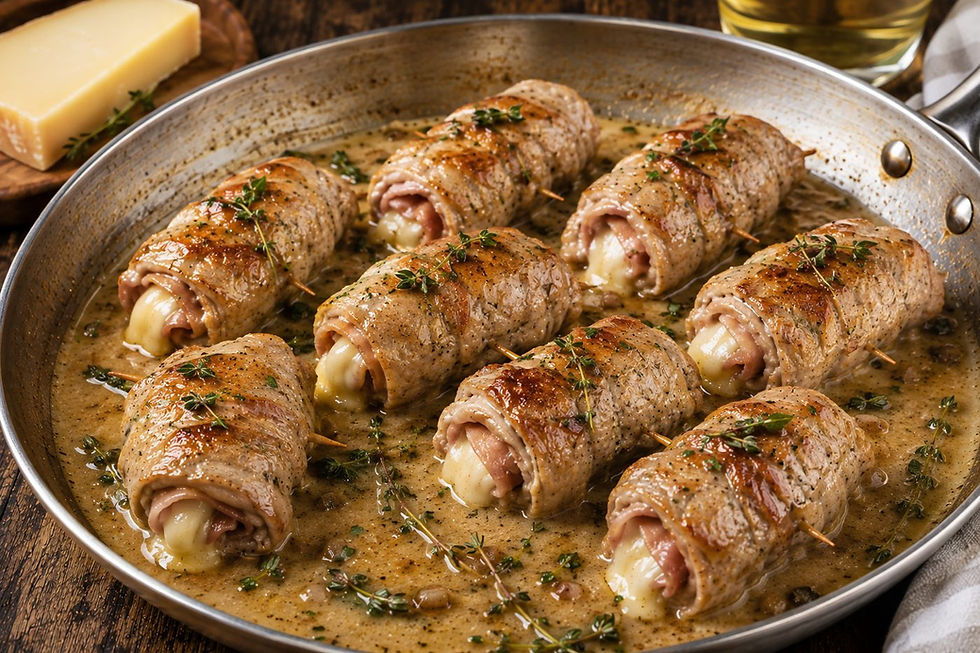
Italian Parma Veal Rolls | Involtini di Vitello alla Parmense con Prosciutto di Parma e Parmigiano Reggiano

These are the veal rolls of Parma, and they contain almost nothing: a thin slice of veal, a slice of Prosciutto di Parma, grated Parmigiano Reggiano, sage, butter, a splash of dry white wine. Four elements carry the dish and three of them are already salted before the pan is lit. That single fact governs everything that follows, from the moment the veal is seasoned, which it is not, to the moment the sauce is finished, which is the only place salt is ever added.
The involtino is a home preparation rather than a restaurant invention, built around the two products that made the province of Parma famous and around the offcuts of both. It cooks in under fifteen minutes and it fails in exactly one predictable way, too salty, because the cook seasoned it the way any other veal dish would be seasoned. What follows treats the salt as the real architecture of the recipe.
Yield: 4 servings, 2 rolls each. Prep: 30 minutes. Cook: 20 minutes. Rest: 10 minutes. Total: about 1 hour. Difficulty: intermediate. Course: secondo. Region: Emilia Romagna, province of Parma.
The Story
Parma was built on salt long before it was known for ham. The brine springs at Salsomaggiore, a short distance southwest of the city, were worked from Roman times onward, and by the medieval period the salt trade running out of that valley was one of the wealthiest activities in the Po plain. Salt was what allowed the surrounding countryside to preserve meat through the winter, and the pig was what there was to preserve. Prosciutto di Parma exists because of that geological accident: a salt source, a humid wind coming off the Apennines, and pigs fattened on the whey left over from cheesemaking.
The cheese came from the same landscape. Parmigiano Reggiano has been made in the provinces of Parma and Reggio Emilia since at least the twelfth century, in Cistercian and Benedictine abbeys first and then in the small village dairies that still dot the plain. The two products were never separate industries. The whey from the morning cheesemaking fed the pigs whose hind legs became prosciutto, and those pigs fertilised the fields that fed the cows.
The dish itself carries no grand pedigree, and that is the point. It belongs to the cucina di casa of the Parmense, alongside anolini and torta fritta, and it was above all a way to use what was left. The heel of a prosciutto, too dry and too salty to serve in slices, went inside a roll where its saltiness became an advantage. The dry outer edge of a wedge of Parmigiano, grated rather than shaved, did the same work. Veal was the extravagance, bought thin and stretched with a filling.
Alla parmense spread far beyond Parma and came to mean, loosely, anything finished with Parmigiano. In Parma it means something narrower: the prosciutto and the cheese of that province, used together, in quantities that assume the cook knows how salty both of them are. Old household versions carry no seasoning instructions at all, because none were thought necessary. The ingredients did the seasoning.
Ingredients
For the veal
Veal top round, sliced thin for scallopini, 1 1/2 lb (680 g), about 8 slices
Freshly ground black pepper, 1/2 tsp (1 g)
All purpose flour, 1 tbsp (8 g), for the lightest dusting
No salt at this stage, see Professional Technique
For the filling
Prosciutto di Parma, sliced thin, 5 oz (140 g), about 8 slices
Parmigiano Reggiano aged 24 months, freshly grated, 2 1/2 oz (70 g)
Fresh sage leaves, 16
Fine dry breadcrumbs, 2 tbsp (14 g)
Finely grated lemon zest, from 1/2 lemon
Freshly ground black pepper, to taste
For the pan and the sauce
Unsalted butter, 3 tbsp (45 g)
Extra virgin olive oil, 1 tbsp (15 ml)
Shallot, finely chopped, 1 small
Dry white wine, 2/3 cup (160 ml)
Unsalted veal or chicken stock, 1 cup (240 ml)
Cold unsalted butter, cubed, 1 tbsp (15 g), for finishing
Fine sea salt, to taste, added only at the very end
For finishing
Flat leaf parsley, chopped, 1 tbsp
Parmigiano Reggiano, shaved, 1/2 oz (15 g)
Freshly ground black pepper, to taste
Wooden picks, 16. Use unsalted stock without exception: a commercial salted stock, reduced by half in this recipe, takes the sauce past the point of correction.
Preparation
Bringing the veal to an even thickness
Work each slice between two sheets of parchment to an even 1/8 inch (3 mm) with the flat side of a mallet, so every roll cooks in the same time. Trim each slice to a rectangle of roughly 4 by 5 inches (10 by 13 cm) and keep the trimmings, chopped fine, for the filling. Grind black pepper over both faces. Add no salt to the meat, now or later.
Mixing the filling
Combine the grated Parmigiano Reggiano, the breadcrumbs, the lemon zest, the chopped veal trimmings and a grinding of black pepper. The breadcrumbs absorb the fat the cheese releases as it melts, so the filling stays inside the roll instead of running into the pan. Taste a pinch and register how salty it already is: that is the cheese alone, before the prosciutto joins it.
Rolling the involtini
Lay a slice of prosciutto over each piece of veal, trimmed to sit just inside the edges. Put two sage leaves down the centre, spoon a tablespoon of the cheese mixture along the near third, and roll from that edge, tucking the sides in. Secure each roll with two wooden picks pushed through at an angle. Dust very lightly with flour and tap off the excess.
Browning in butter
Heat 2 tablespoons of the butter with the olive oil in a heavy pan wide enough to hold the rolls without their sides touching. When the foam subsides, lay them in seam side down for 2 minutes, then turn them with tongs and brown the remaining sides, 5 to 6 minutes in all. Work in two batches: crowded rolls steam instead of colouring. Lift them onto a warm plate.
Building the pan sauce
Lower the heat, add the last tablespoon of butter and the shallot, and cook for 2 minutes until soft and translucent. Pour in the wine, raise the heat and scrape the base clean with a wooden spoon as it bubbles. Reduce until about a third remains and the raw alcohol smell has gone, roughly 3 minutes. Add the unsalted stock and return it to a simmer.
Finishing the rolls in the sauce
Return the involtini, cover partially and simmer gently for 8 to 10 minutes until a probe slides into the centre without resistance and reads about 145°F (63°C). Lift them onto a warm plate. Reduce what is left in the pan until it is slightly thinner than you think it should be, then stop. Off the heat, swirl in the cold butter a cube at a time until the sauce turns glossy, then taste it and add fine sea salt only if it needs any.
Resting before serving
Rest the rolls for a full 10 minutes in a warm place, loosely covered, with the sauce held warm separately. This is the window in which the salt from the prosciutto finishes moving into the veal, and it changes how the dish tastes. Remove the picks just before serving, counting them out.
Plating
Serve on warm plates, not hot ones. The sauce is a butter emulsion and a plate straight from the oven will break it within a minute. Two rolls per person, side by side rather than stacked, seams turned down.
Cut one of the two rolls across on a slight diagonal into three thick pieces and leave the second whole. The cut roll shows the spiral of prosciutto and the melted cheese core, which is the visual argument of the dish, while the whole one keeps its heat. Spoon about 2 tablespoons of sauce around and partly over the base, never enough to pool.
Finish with chopped parsley, a few shavings of Parmigiano Reggiano over the cut faces only, and black pepper. Mashed potato, buttered spinach or plain polenta belongs beside it, seasoned lightly, since it will be eaten in the same mouthful as the sauce.
Professional Technique
The technique that decides this dish is a salt budget. Take an inventory before cooking. Prosciutto di Parma carries roughly 5 percent salt by weight, which puts about 7 grams into the five ounces used here. Parmigiano Reggiano sits around 1.5 percent, adding another gram. The pan sauce then reduces by more than half, concentrating whatever has dissolved into it from both. Of the four elements on the plate only the veal arrives unsalted. This is why the meat is not salted, the filling is not salted, and the sauce is salted only at the end, after tasting.
The mechanism is diffusion. Salt moves down a concentration gradient, from where there is a lot of it to where there is little, and heat accelerates the movement. Once a slice of prosciutto at 5 percent salt is pressed flat against veal at effectively zero and the roll goes into hot butter, sodium and chloride ions migrate into the outer few millimetres of the meat. They do not stop when the pan comes off. The rest is a second and slower salting. An involtino cut open the instant it leaves the pan and one cut ten minutes later are two different dishes: the first tastes of salty ham around bland veal, the second tastes seasoned through.
The reduction is where most cooks lose the plate, because salt concentrates faster than flavour does. When water evaporates the salt stays behind and its concentration rises in direct proportion to the volume lost, while aroma and body build far more slowly and depend on dissolved solids that were present in modest amounts to begin with. So a reduction taken to the point where its texture finally looks right has almost always gone past the point where its salt is right. Stop it earlier than seems necessary, while it still looks slightly loose, and let the cold butter give it the body the reduction was not allowed to build.
Texture and Moisture Control
Veal at this thickness has almost no margin. The target is an internal 145°F (63°C), which leaves the meat pale, moist and yielding; ten degrees beyond that the fibres contract, expel their water and turn dry. Probe the centre of the thickest roll, not the end, and remember carryover adds a few degrees.
The filling controls moisture from the inside. Parmigiano Reggiano at 24 months is a low moisture cheese with high fat, and when it melts it releases that fat rather than turning stringy. The breadcrumbs absorb it and hold it as a soft paste. Without them the fat runs out through the seam and the sauce turns greasy.
The sauce is a butter emulsion. Cold butter added off the heat, a cube at a time, with the pan swirled rather than whisked hard, gives a gloss that holds for a whole service. Butter added over direct heat splits, and the surface goes oily within seconds. A teaspoon of cold stock and vigorous swirling usually brings it back once.
Professional Mise en Place
The rolls take twenty minutes from a cold pan, so the whole preparation happens beforehand and the cooking runs without interruption.
Equipment and tools
Heavy sauté pan, 12 inch (30 cm), wide enough for eight rolls with space between them
Meat mallet and parchment sheets
Instant read probe thermometer
Wooden picks, 16, counted out and counted back in
Tongs, wooden spoon, warm serving plate
Prepared ahead
Veal flattened, trimmed and peppered, up to 6 hours ahead, covered and refrigerated
Filling mixed, up to 1 day ahead, refrigerated in a sealed container
Rolls assembled and secured, up to 4 hours ahead, on a covered tray
Shallot chopped, wine and stock measured into separate jugs
Finishing butter cubed and kept cold until it is used
Service setup
Rolls out of the refrigerator 20 minutes before cooking, never fridge cold
Plates warm, never hot, side dish held separately
Salt and a tasting spoon beside the stove, used only after the sauce is finished
Rested rolls loosely covered in a warm place, sauce held off direct heat
Chef Tips
Buy the prosciutto cut to order and ask for slices from nearer the heel than the centre. They are drier, firmer, easier to roll and cheaper, and this is the one preparation where their extra saltiness is a feature.
Taste the sauce twice, before the cold butter goes in and again after. Fat mutes the perception of salt, so a sauce correctly seasoned before the butter tastes flat after it. Adjust at the second tasting only.
If the sauce comes out too salty, do not add water, which thins flavour along with salt. Add a tablespoon of unsalted stock and an extra cube of butter, and if it is badly out, drop in a few slices of raw potato for a minute and remove them.
Cook one roll ahead as a test if you do not know your prosciutto, and taste it after a full ten minute rest. That roll tells you how much salt the sauce will need.
Common Mistakes
Salting the veal out of habit. The prosciutto carries roughly 5 percent salt and seasons the meat from the inside during cooking and resting. Salt added to the meat arrives on top of that and cannot be removed.
Reducing the sauce until it looks right. By then its salt has concentrated past its flavour. Stop while it still looks slightly thin and let the cold butter finish the body.
Using commercial salted stock. Reduced by half it delivers more sodium than the prosciutto does, and no amount of butter corrects it. Use unsalted stock or water.
Tasting the involtino straight from the pan. Salt is still migrating into the veal, so it reads as ham around bland meat. Judge the seasoning after the full rest.
Crowding the pan. Rolls pressed together release moisture faster than it evaporates, so they poach instead of browning and leave no fond for the sauce. Brown in two batches.
Overcooking past 145°F (63°C). Veal this thin goes from moist to dry within a few degrees. Probe the thickest roll and let carryover heat finish it.
Wine Pairing
Colli Bolognesi Pignoletto DOCG: The most useful white here. Its high acidity and faintly bitter almond finish rinse the palate between mouthfuls, and because the wine is lean it adds no fat to a dish already carrying butter and cheese. Salt sharpens the perception of acidity, so serve it well chilled.
Lambrusco di Sorbara DOC: Choose the secco version and you have the local answer. The carbon dioxide scrubs the butter emulsion off the tongue, the sharp red fruit acidity stands up to the prosciutto, and the light tannin of the Sorbara skins registers against the veal without gripping.
Gutturnio dei Colli Piacentini DOC: A Barbera and Bonarda blend from the hills west of Parma, the closest red neighbour the dish has. The Barbera supplies the acidity that cuts the reduction, the Bonarda a soft plummy weight. Tannin stays moderate, which matters: a firmly tannic red turns metallic against this much salt.
Romagna Sangiovese DOC: The regional red for anyone wanting something drier and more savoury. Its sour cherry fruit and dusty tannin meet the browned surface directly, and its herbal edge picks up the sage. Keep to a young unoaked bottling at around 61°F (16°C): oak and salt sit badly together.
Franciacorta DOCG: The bottle for a more formal table. Metodo classico autolysis gives a bready depth alongside the aged Parmigiano, while the fine mousse and firm Chardonnay acidity lift the butter sauce off the palate. Ask for Brut rather than Extra Brut: a trace of residual sugar keeps the salt from reading as harsh.
Storage & Reheating
Keep the rolls and the sauce in separate airtight containers. The involtini hold for 3 days refrigerated, and they are noticeably saltier on the second day, since the salt keeps equalising through the meat. Account for that before adding anything to the reheated sauce.
Reheat the rolls covered at 300°F (150°C) for 10 to 12 minutes with a spoonful of unsalted stock in the dish. Never use a microwave, which drives water out of thin veal in seconds. Warm the sauce separately over the lowest heat, loosening it with a teaspoon of stock rather than reboiling.
The assembled uncooked rolls freeze for up to 1 month, wrapped individually, and thaw overnight in the refrigerator. Do not freeze the finished sauce, which separates irreversibly. The filling keeps 3 days refrigerated.
Nutrition
Per serving, based on 4 servings of 2 rolls each with sauce:
Calories: 560 kcal
Total Fat: 34 g
Saturated Fat: 17 g
Trans Fat: 0.7 g
Unsaturated Fat: 15 g
Cholesterol: 175 mg
Sodium: 1180 mg
Total Carbohydrates: 7 g
Fiber: 0.4 g
Total Sugars: 1 g
Added Sugars: 0 g
Protein: 52 g
Lactose: 0.2 g
Principal micronutrients: calcium, phosphorus, zinc, selenium, vitamin B12, niacin, vitamin A
These figures are estimates. Sodium is the value that varies most, since it depends almost entirely on the prosciutto and on how far the sauce is reduced, and it is the reason no salt is added before the final tasting.



Comments