
Italian Piedmont Veal Rolls | Involtini di Vitello alla Piemontese con Grissini Torinesi, Toma e Prosciutto
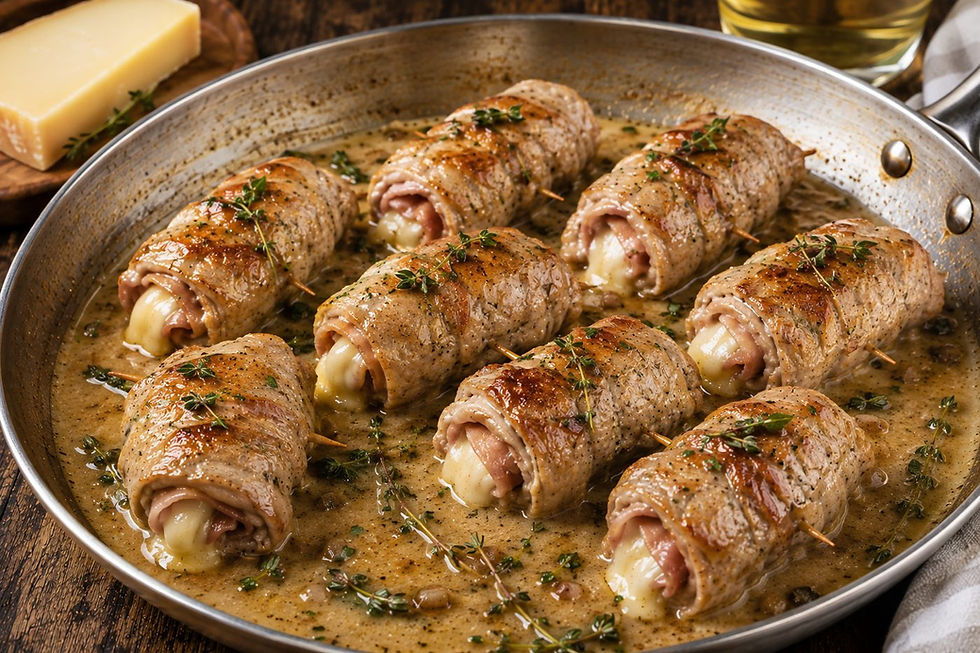
A grissino stirato is bread that was engineered to have almost no crumb, and that single fact is the reason it belongs inside these veal rolls while ordinary bread does not. Stretched by hand until it is thinner than a pencil and baked until it is dry the whole way through, it is very nearly all crust. Crust takes up water slowly. Crumb takes it up on contact.
So a filling built on hand broken grissini, young Toma Piemontese and prosciutto crudo reaches the table with something no breadcrumb stuffing can offer: audible texture that survives inside a rolled, browned, wine braised piece of veal. Every decision below exists to protect that, from how the sticks are broken to where in the roll they sit.
Yield: 4 servings, 8 rolls. Prep: 35 minutes. Cook: 30 minutes. Rest: 8 minutes. Total: about 1 hour 15 minutes. Difficulty: intermediate. Course: secondo. Region: Piedmont, Turin and the Cuneo valleys.
The Story
The grissino was invented as a medical object. Turin court records place its creation in 1679, when the baker Antonio Brunero was asked to make bread the sickly young Vittorio Amedeo II could keep down. The boy could not digest the soft interior of ordinary loaves, so Brunero removed the problem instead of treating it: he stretched the dough into thin cords and baked them until there was practically no interior left. The result was a bread made entirely of its own outside. Napoleon later had them carried from Turin to Paris and called them les petits batons de Turin. Nothing in that history has to do with cooking, and yet it produced the only Italian bread that can be sealed inside a moist filling and still be heard when the knife goes through.
The veal is the other half of the story. Piedmont keeps a cattle breed of its own, the razza Piemontese, prized for a lean double muscled hindquarter that slices into pale scaloppine with almost no marbling. The weekly market at Carru still sets the price for it. Lean meat this dry needs fat carried in from elsewhere, which is where Toma Piemontese DOP arrives, made in the Cuneo and Biella valleys and, in its young form, soft enough to melt without breaking. Prosciutto crudo di Cuneo DOP, salted in the dry mountain air of the Stura valley, supplies the salt that lean veal cannot supply itself.
Involtini like these were never restaurant food. They were a Monday solution in Turin households: the grissini left in the tin from Sunday, the end of a Toma, two slices of prosciutto too dry to serve alone, and cheap cuts pounded thin to go further. The cooks who put those things together were not thinking about texture engineering. They noticed that the grissini stayed crunchy where breadcrumbs went soft, and kept doing it that way. The version below changes nothing about that discovery. It only explains it and builds the roll so the effect is guaranteed rather than lucky.
Ingredients
For the veal
Veal top round, 8 thin slices, 1 1/2 lb (680 g) total
Fine sea salt, 3/4 tsp (4 g)
Freshly ground black pepper, to taste
For the grissini filling
Grissini stirati torinesi, 3 oz (85 g), about 8 sticks
Toma Piemontese DOP, young, coarsely grated, 4 oz (115 g)
Parmigiano Reggiano aged 24 months, grated, 1 1/2 oz (40 g)
Prosciutto crudo di Cuneo, thin slices, 3 oz (85 g)
Whole milk, 3 tbsp (45 ml)
Egg yolk, 1
Flat leaf parsley, chopped, 2 tbsp (6 g)
Fresh sage leaves, chopped, 4
Freshly grated nutmeg, 1/8 tsp
Freshly ground black pepper, to taste
For browning and the pan sauce
Unsalted butter, 3 tbsp (42 g)
Extra virgin olive oil, 1 tbsp (15 ml)
All purpose flour, 2 tbsp (16 g), for dusting
Dry white wine, Arneis or Erbaluce, 3/4 cup (180 ml)
Light veal or chicken stock, 1 cup (240 ml)
Whole sage leaves, 4
Garlic clove, lightly crushed, 1
For finishing
Cold unsalted butter, 1 tbsp (14 g), diced
Grissini, 1 stick, broken for the garnish
Flat leaf parsley, chopped, 1 tsp
Cotton kitchen twine
Flaked salt, a small pinch per plate
Preparation
Step 1
Break the grissini by hand. Snap the sticks into pieces the length of your thumbnail, between 1/2 and 3/4 inch (12 to 18 mm), letting them fracture where they want to. No processor, no rolling pin, no bag and mallet. Uneven shards are the point. Keep the coarsest pieces separate for the centre of each roll, and leave the garnish stick whole.
Step 2
Season the grissini, do not soak them. Toss the broken pieces with the nutmeg, pepper, parsley and chopped sage. Sprinkle the milk over them from a spoon, half a tablespoon at a time, tossing between additions, and stop at 3 tablespoons. They should be barely damp outside and still rigid at the core. A piece that bends rather than snaps has gone too far.
Step 3
Build the two part filling. Work the grated Toma, the Parmigiano and the egg yolk into a thick paste with a fork. This paste is binder and waterproofing at once. Fold in two thirds of the seasoned grissini and hold back the coarsest third. Do not salt: the prosciutto, the Parmigiano and the veal seasoning already carry the dish.
Step 4
Flatten and season the veal. Pound each slice between parchment sheets to an even 1/8 inch (3 mm), working from the centre outward rather than straight down so the fibres spread instead of tearing. Trim to a rough rectangle of about 5 by 3 inches (13 by 8 cm). Season the upward face only.
Step 5
Roll with a protected core. Lay a slice of prosciutto on each piece of veal, leaving a clear half inch (12 mm) border. Spread a tablespoon of cheese paste over it, press the reserved coarse grissini into one narrow band down the middle, then cover that band with more paste so no shard touches the outer edge. Fold the long sides in, roll up firmly from the short end, tie with two turns of twine.
Step 6
Flour and brown without crowding. Dust the rolls lightly with flour and pat off the excess; a heavy coat gums the sauce. Heat the butter and oil in a wide saute pan over medium high heat until the foam subsides, then lay the rolls in seam side down with space between them. Brown 2 minutes on each of the four faces, 8 minutes total, to a deep gold.
Step 7
Deglaze and reduce hard. Lift the rolls onto a warm plate. Drop to medium heat, add the garlic and whole sage, and pour in the white wine. Scrape the base clean and reduce by two thirds, about 3 minutes, until no smell of alcohol remains. This reduction must finish before the rolls go back, because every minute in thin liquid is a minute of water moving toward the grissini.
Step 8
Braise briefly, then rest. Return the rolls seam side up, add stock to a depth of no more than 1/2 inch (12 mm) so they sit in liquid rather than swim, cover and simmer gently 10 minutes, turning once. Internal temperature should read 145°F (63°C). Lift them out, cut off the twine and rest 8 minutes on a warm plate while you reduce the sauce to a light gloss and swirl in the cold butter off the heat.
Plating
Warm the plates to about 120°F (50°C), no hotter. Veal this lean tightens on a genuinely hot plate, and the melted Toma inside will keep flowing where it should be setting. Slice each roll crosswise into three thick rounds with a very sharp knife, cutting in one stroke and not sawing, so the grissini band shows in section as pale shards suspended in cheese rather than as a smear.
Set two sliced rolls per plate, six rounds, cut faces turned toward the diner. Spoon the reduced sauce around the base and never over the cut faces, which would wet the exposed grissini within seconds. Scatter the broken garnish grissini and the chopped parsley, add a pinch of flaked salt on the veal, and serve at once. Buttered spinach or a few roasted potatoes belong beside this; a starch that steams under the rolls does not.
Professional Technique
The whole technique of this dish is the management of one property: a grissino stirato is almost pure crust. In a soft roll the ratio of crumb to crust is perhaps eight to one; in a stretched grissino it is close to nothing to one. Crumb is an open foam of thin starch walls that wicks liquid by capillary action almost instantly, which is why a breadcrumb filling turns to paste in minutes. Crust is a dense, partly caramelised, low porosity layer, and water has to work through it rather than run into it. That is why a grissini filling is still crunchy after a braise while every other bread has surrendered.
Two handling rules follow from that, and both are counterintuitive. The first is that the grissini must be broken by hand into large irregular pieces and never ground. Grinding destroys the property you came for: it multiplies surface area, exposes the fractured interior of every piece, and turns the grissino straight back into breadcrumb, at which point you have paid for Turin bread to get the behaviour of a stale loaf. The second is that the quantity stays low, 3 oz (85 g) for eight rolls. Grissini absorb very little, so they are not a binder and cannot serve as one; the cheese and the yolk do that work, and the grissini are there purely as structure.
The third element is geometry. When an involtino finishes in liquid, water arrives from outside as well as from the filling, and any shard sitting near the seam is reached first and gives up its crunch. So the coarse grissini go into a single narrow band down the centre of the roll, sealed above and below by the Toma and Parmigiano paste. Melted cheese fat is hydrophobic, so that band becomes a real barrier rather than a decorative layer, and the shards at the core stay hard even once the outer millimetres of filling have gone soft.
Texture and Moisture Control
Three separate moisture fronts move toward the grissini, and each has its own countermeasure. The milk and yolk in the filling are the first, which is why the milk is limited to 3 tablespoons and sprinkled rather than poured. The melting Toma is the second, and because cheese fat repels water it turns from a threat into the shield described above. The braising liquid is the third and the strongest, and it is held off by keeping the stock at 1/2 inch (12 mm) and the braise at 10 minutes rather than 25.
The veal has to be watched in the opposite direction. Piedmontese top round is very lean and carries little collagen, so it gains nothing from long cooking the way a shin or a cheek does; past about 150°F (65°C) the muscle fibres contract and press their water out, and the roll goes dry and grainy. Pull it at 145°F (63°C) and rest it 8 minutes so juice is reabsorbed. The rest is also when the melted Toma cools enough to hold a clean slice instead of running out of the cut.
Professional Mise en Place
The filling can be built ahead but the grissini cannot sit in it, so the mise en place splits into a wet side and a dry side that meet only at rolling time.
Equipment and tools
Wide heavy saute pan with a lid, large enough to hold 8 rolls apart
Meat mallet and parchment sheets for pounding
Instant read thermometer, cotton kitchen twine, sharp slicing knife
Two mixing bowls, one for the dry grissini and one for the cheese paste
Prepared ahead
Veal pounded, trimmed and stacked between parchment, refrigerated up to 8 hours
Cheese and yolk paste mixed, refrigerated up to 8 hours
Grissini broken by hand and kept dry in a sealed tin, up to 2 days
Stock reduced and strained, sage and garlic portioned, on the day
Service setup
Grissini seasoned with milk no more than 10 minutes before rolling
Rolls tied and held on a rack, uncovered, cold, up to 1 hour
Plates warm at 120°F (50°C), sauce holding just below a simmer
Garnish grissini broken at the last moment and kept away from steam
Chef Tips
Buy grissini stirati, the hand stretched knobbly ones, not the smooth extruded rubatà or the industrial sticks in cellophane. Extruded grissini are denser and more uniform, and they soften in a filling far faster than a hand stretched stick.
Test one stick first. It should break with a clean dry crack and no bend at all. A grissino that flexes has already taken up humidity from the room and will be soft inside the roll. Refresh a doubtful batch 4 minutes at 300°F (150°C) and cool it completely.
Use young Toma, sold at around 60 days, not the aged version. Young Toma melts into a smooth flowing layer, while Toma matured past four months breaks and releases oil, which floods the grissini band with the liquid you spent the whole recipe keeping away from it.
Tie with twine rather than toothpicks. Twine holds even pressure along the roll and keeps the seam sealed during browning, where a toothpick leaves a gap that lets stock into the filling.
Common Mistakes
Grinding the grissini. A processor turns them into breadcrumb and cancels the only reason they are in the dish. Break them by hand into pieces of 1/2 to 3/4 inch (12 to 18 mm).
Soaking the grissini in milk. They are not a panade and need no hydration to work. Three tablespoons sprinkled over them is the ceiling; more than that and they arrive as wet bread.
Using grissini as the binder. They absorb too little to hold a filling together, so doubling the quantity gives a crumbling centre. The cheese and the yolk do the binding.
Scattering the shards through the filling. Pieces near the seam meet the braising liquid first and soften within minutes. Concentrate them in one central band sealed by the paste.
Braising too long or too deep. Twenty five minutes in stock halfway up the roll reaches the core whatever you do, and overcooks lean veal. Ten minutes in 1/2 inch (12 mm) is the limit.
Spooning sauce over the cut faces. It destroys the section in seconds, wetting the exposed grissini in front of the diner. Sauce goes around the base of the rolls only.
Wine Pairing
Nebbiolo d'Alba DOC: The most complete answer on the list. It has the fine grained tannin of Nebbiolo without the weight of Barolo, and that tannin scrubs the melted Toma and the butter mounted sauce off the palate. The rose and tar aromatics run alongside the sage, and the high acidity keeps lean veal from tasting dry.
Barbera d'Asti DOCG: Chosen for acidity rather than tannin, which suits a dish carrying more cheese fat than meat fat. Bright sour cherry and very low tannin cut the Parmigiano and the prosciutto salt without adding astringency to a delicate filling. Look for a young unoaked bottling.
Dolcetto d'Alba DOC: The everyday Piedmont red and the easiest match here. Soft tannin, dark plum fruit and a faintly bitter almond finish sit against the browned crust, and the modest structure never overwhelms veal. Serve it cool, around 60°F (16°C).
Roero Arneis DOCG: The white to pour if the same wine goes into the pan. Arneis has real body and a stony pear and almond profile with only moderate acidity, enough for the Toma without stripping the dish. It also picks up the toasted note of the grissini, which no red here does.
Alta Langa DOCG: The Piedmontese metodo classico, and the one choice that addresses texture rather than flavour. Its fine persistent bead and firm acidity reset the palate after each fat coated bite, and the lees derived bread crust character sits precisely on the grissini.
Storage & Reheating
Eat this the day it is made, because the one thing that cannot be stored is the crunch. Cooked rolls keep refrigerated in an airtight container up to 2 days, but the grissini band will be soft by the next morning and no reheating brings it back. Keep the sauce separate, in its own container, up to 3 days.
Reheat the rolls whole and never sliced, covered, in a 300°F (150°C) oven with a spoonful of stock in the dish, 10 to 12 minutes. Slice only after they come out. Avoid the microwave, which drives the cheese fat out and leaves the veal rubbery. Uncooked tied rolls freeze up to 1 month; cook from frozen with 5 minutes added to the braise. Never freeze them cooked.
Nutrition
Per serving, based on 4 servings of 2 rolls each:
Calories: 610 kcal
Total Fat: 36 g
Saturated Fat: 18 g
Trans Fat: 0.7 g
Unsaturated Fat: 16 g
Cholesterol: 195 mg
Sodium: 1150 mg
Total Carbohydrates: 21 g
Fiber: 1 g
Total Sugars: 3 g
Added Sugars: 0 g
Protein: 48 g
Lactose: 2 g
Principal micronutrients: calcium, phosphorus, zinc, selenium, vitamin B12, niacin
These figures are estimates. Sodium depends heavily on the prosciutto and the stock, and much of the wine cooks away before serving.




Comments