
Italian Tuscan Veal Rolls with Pecorino and Herbs | Involtini di Vitello alla Toscana con Pecorino ed Erbe

Tuscan involtini are a cheese dish wearing a meat costume. Thin veal from the top round, prosciutto, sage, rosemary and Pecorino Toscano go into the pan together, and what the diner remembers afterwards is the cheese. Which is why the decision that settles this recipe is made at the cheese counter rather than at the stove.
Pecorino Toscano DOP is sold at two ages that share one name and behave like two different ingredients. The young wheel melts. The aged wheel does not, or not in the same way. Both belong in these rolls, and the recipe below uses them together in a measured ratio rather than treating pecorino as one thing.
Everything else is Tuscan restraint: olive oil, a glass of white wine, a little stock, no cream, no tomato, no breadcrumbs. The rolls brown in one pan, the pan makes the sauce, and the dish is on the table in under an hour.
Yield: 4 servings, 8 rolls. Prep: 25 minutes. Cook: 20 minutes. Rest: 5 minutes. Total: about 50 minutes. Difficulty: intermediate. Course: secondo. Region: Tuscany.
The Story
Involtini exist because Tuscan veal is lean to the point of difficulty. The Chianina of the Val di Chiana and the Vitellone Bianco dell'Appennino Centrale give a pale, fine grained meat with almost no marbling inside the muscle, and a thin slice cut from the top round of a young animal goes from raw to dry in under two minutes over direct heat. The traditional answer was never a sauce poured on afterwards. It was to wrap the meat around fat and salt so that the fat cooks from the inside out, and the slice is protected by what it is holding.
The filling reads as a map of the province. Pecorino Toscano DOP carries two histories at once: the old sheep flocks of the Val d'Orcia and the hills around Pienza, and the Sardinian shepherd families who moved north into the Maremma and the Crete Senesi through the twentieth century and took over much of the milk and much of the making. The consortium recognises the two ages of the cheese separately, which is an official admission of what every Tuscan cook already knows, that they are not interchangeable. Prosciutto Toscano is the other regional marker, cured with garlic, juniper and a heavy hand of pepper, drier and considerably more assertive than the Parma style.
Sage and rosemary complete it, and neither is a garnish here. Sage grows against farmhouse walls across the region and its slightly bitter, resinous quality is the traditional partner to veal in central Italy. Rosemary does the same work with more perfume. The dish itself belongs to the weekday table rather than to the feast, the sort of secondo a family cooks in one pan on a Tuesday, and it survives in trattorie from Siena to Grosseto precisely because it is cheap, fast and built out of things a Tuscan kitchen already has in it. There is no single authoritative version. What is constant across the valleys is the shape, the pecorino and the glass of white wine that goes in once the rolls are brown.
Ingredients
For the veal
Veal top round, cut into 8 thin slices, 1 1/2 lb (680 g)
Fine sea salt, 1/2 tsp (3 g)
Freshly ground black pepper, to taste
For the filling
Pecorino Toscano DOP fresco, coarsely grated, 4 oz (115 g)
Pecorino Toscano DOP stagionato, finely grated, 4 oz (115 g)
Prosciutto Toscano, thin slices, 8, about 3 oz (85 g)
Fresh sage leaves, 16
Rosemary needles, finely chopped, 1 tbsp (3 g)
Flat leaf parsley, finely chopped, 2 tbsp (8 g)
Garlic clove, minced, 1
Finely grated lemon zest, from 1/2 lemon
Freshly ground black pepper, to taste
For the pan
Extra virgin olive oil, Tuscan, 3 tbsp (45 ml)
Dry white wine, 1/2 cup (120 ml)
Veal or light chicken stock, 3/4 cup (180 ml)
Garlic clove, whole and lightly crushed, 1
Rosemary sprig, 1
For finishing
Extra virgin olive oil, 1 tbsp (15 ml)
Flat leaf parsley, chopped, 1 tsp
Wooden toothpicks, 16
Flaky sea salt, a small pinch per plate
Preparation
Preparing the veal slices
Ask for the veal in one piece from the top round and slice it across the grain into eight slices of roughly equal thickness. Lay each between two sheets of parchment and work it out gently with the flat of a mallet until it is about 1/8 inch (3 mm) thick and roughly rectangular. Trim any silverskin at the edges, since it shrinks faster than the muscle and pulls the roll out of shape. Season on one side only and keep the slices cold on a rack.
Mixing the two pecorini
Grate the fresco on the large holes of a box grater and the stagionato finely, almost to a powder, on the fine holes. Combine them with the rosemary, parsley, garlic, lemon zest and plenty of black pepper, turning the mixture with your fingertips so the coarse shreds stay intact. Do not add salt: the stagionato and the prosciutto already carry enough, and salt draws water out of the fresco while the rolls wait.
Filling and rolling
Lay a slice of veal seasoned side up, cover two thirds of it with prosciutto and set two sage leaves on top. Spread about 2 tablespoons of the cheese mixture in an even layer, leaving a clear border of at least 1/2 inch (1 cm) all round. Fold the two long edges in over the filling, then roll the slice up from the short end, firmly enough that no air is trapped inside but not so tight that the cheese is pushed towards the ends. Close each roll with two toothpicks set at an angle through the seam.
Browning the rolls
Heat the 3 tablespoons of olive oil in a heavy sauté pan over medium high heat with the crushed garlic and the rosemary sprig until the oil is fragrant, then take the garlic out before it colours. Put in the rolls seam side down, spaced apart, and leave them alone for about 2 minutes. Turn them with tongs and brown all four sides, 6 to 7 minutes in total, until the surface is evenly the colour of a hazelnut shell. Never cover or crowd the pan here: trapped steam turns the rolls grey and later cooking never recovers the surface.
Deglazing and reducing
Pour in the white wine and let it bubble hard for about a minute, scraping the base of the pan so the browned residue dissolves into the liquid. Add the stock, lower the heat to a bare simmer and cook the rolls for a further 6 to 8 minutes, turning them once and spooning the liquid over them. The centre of a roll should reach about 145°F (63°C). The cheese inside will be soft by then and the sauce reduced to a scant 1/2 cup.
Resting and finishing the sauce
Move the rolls to a warm plate and let them rest for 5 full minutes. Meanwhile raise the heat and reduce the liquid until it just coats the back of a spoon and turns glossy, take the pan off the heat, then stir in the tablespoon of raw olive oil and any juices released on the plate. Pull the toothpicks out only after the rest, counting them so none reaches the table, and slice each roll on a slight diagonal.
Plating
Use warm plates for this one. The filling is a cheese emulsion held at the edge of setting and a cold plate stiffens it within a minute. Slice the rolls only once the plates are out and the sauce is finished, since a cut roll loses its interior heat immediately.
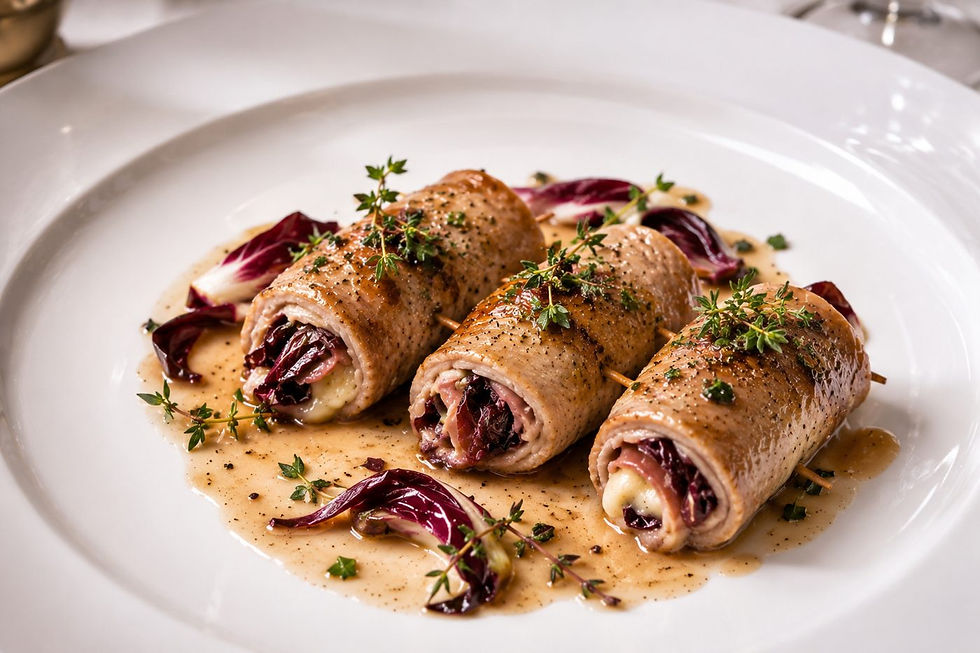
Set two rolls per plate, cut faces angled towards the diner so the spiral of prosciutto, sage and melted pecorino shows. That cross section is the whole visual argument of the dish and it disappears if the pieces lie flat. Spoon the sauce around the base rather than over the top, which would dull both the colour and the crust.
Finish with a pinch of flaky salt on the cut face and a little chopped parsley on the sauce. A Tuscan table would set white beans dressed in oil, or wet cooked chard, alongside. Nothing sweet, nothing with tomato, no grated cheese on top.
Professional Technique
Pecorino Toscano DOP is one name covering two cheeses, and the behaviour of this filling depends on understanding that they are not the same ingredient. The fresco is released at twenty days of ageing. It holds close to fifty per cent water, tastes gently lactic and sweet, and inside a hot involtino it melts smoothly and homogeneously into a cream that stays where you put it. The stagionato has four months of ageing behind it, sometimes considerably more. Much of that water has gone, the flavour has turned sharp and piquant, and the paste has become dense, so that heated inside a roll it does not flow: it breaks into grains and releases its fat, which runs out of the seam.
So the two ages are two tools. Use the fresco alone when the point is a creamy filling that binds the prosciutto and the herbs and stretches slightly when the roll is cut. Use the stagionato alone when the point is savoury depth and you want the filling to stay in place, seasoning the veal without becoming a liquid centre that escapes. Used in equal parts, as this recipe does, they give both at once: the fresco supplies the melt and the body, the stagionato supplies the salt, the sharpness and the length, and the small amount of fat the stagionato releases is caught and held by the fresco instead of running out.
There is one rule that follows from this and is not negotiable. The stagionato must be grated, and grated fine, never sliced. A slice of aged pecorino inside a roll never softens evenly: the outside of the slice goes oily while the core stays firm, and the diner meets a hard salty streak in the middle of a soft filling. Grated fine, the same cheese disperses through the fresco and melts as part of it. The fresco can go on the coarse holes, or even be diced, since everything about it wants to melt anyway.
Texture and Moisture Control
Veal top round holds almost no intramuscular fat and very little connective tissue, so there is nothing in the meat to keep it juicy and nothing that turns into gelatin if you cook it longer. Take the centre of the roll to about 145°F (63°C) and stop. Past roughly 155°F (68°C) the proteins tighten and force out the water they were holding, and the slice goes grey and fibrous within two minutes.
The filling has its own window: hot enough to have melted and cohered, cool enough not to be liquid. That is why the five minute rest matters twice. A roll cut straight out of the pan empties itself onto the plate, while the same roll rested holds a filling that is soft and sliceable. The sauce is the third element, and it should be reduced to the point where it coats a spoon and no further, because it carries the fat the stagionato gave up and driven too hard that fat separates.
Professional Mise en Place
Equipment and tools
Heavy sauté pan, wide enough for 8 rolls without touching, plus tongs
Box grater with both coarse and fine faces, and a meat mallet
Instant read thermometer, parchment sheets, wooden toothpicks
Prepared ahead
Cheese mixture, up to 6 hours ahead, covered and refrigerated, unsalted
Veal sliced and pounded, up to 4 hours ahead, kept cold on a rack between parchment
Rolls filled and closed, up to 2 hours ahead, refrigerated and brought out 20 minutes before cooking
Stock measured and warm, wine measured, garlic and rosemary ready beside the pan
Service setup
Plates warming, since the filling sets on a cold plate
Rolls at cool room temperature, not fridge cold, so the centres heat through before the outside overcooks
Thermometer, tongs and a small dish for the used toothpicks within reach
Finishing olive oil, flaky salt and parsley in front of you, sauce reduced last
Chef Tips
Ask the cheese counter for the two ages by name, Pecorino Toscano DOP fresco and stagionato, and taste both. A generic pecorino sold with no age stated is usually a Roman or Sardinian style, saltier and drier than either. If that is all you can find, use two thirds of the stated stagionato.
Buy the veal as a whole piece and slice it at home. Ready cut scaloppine are almost always thicker at one end, so half the roll is overcooked by the time the other half is done.
Weigh the filling for the first roll and use it as a visual reference for the other seven. Two tablespoons looks like nothing in the bowl and like far too much on the veal, and even distribution matters more than generosity.
If cheese does leak, do not fish it out. Let it brown against the base of the pan and dissolve it into the wine when you deglaze: it gives the sauce more body than the stock alone.
Common Mistakes
Filling with aged pecorino alone. The stagionato does not melt into a cream, it breaks into grains and releases fat, so the filling leaks while the veal is still browning. Cut it with an equal weight of fresco.
Slicing the stagionato instead of grating it. A slice of aged pecorino never softens evenly: the diner finds an oily edge and a hard salty core. Grate it fine instead.
Salting the cheese mixture. The stagionato and the prosciutto carry all the salt the filling needs, and added salt pulls water out of the fresco while the rolls stand.
Overfilling and rolling to the edge. Cheese pushed to the borders has nowhere to go but out of the seam. Leave a clear 1/2 inch (1 cm) margin all round.
Covering the pan while browning. A lid traps steam against the rolls, the surface goes grey instead of brown, and no residue is left to build a sauce on.
Cooking the veal to well done. Top round has no fat and no collagen to fall back on. Past about 155°F (68°C) it squeezes out its water, and no sauce corrects that.
Wine Pairing
Chianti Rufina DOCG: The most precise match on the list. Rufina sits higher and cooler than the other Chianti subzones, so its Sangiovese keeps a nervous acidity and a fine grained tannin that lifts the fat of the melted pecorino without bullying a lean meat. Its sour cherry and dried herb edge runs alongside the sage.
Carmignano DOCG: Sangiovese with a legally sanctioned share of Cabernet, which gives it a fuller mid palate than straight Chianti. That extra flesh stands up to the peppery, juniper cured Prosciutto Toscano inside the roll, while the tannin stays supple enough not to dry the veal out.
Rosso di Montalcino DOC: Younger Sangiovese from the Montalcino vineyards, bottled without the long ageing of its senior. Bright red cherry, moderate tannin and a savoury finish give it the right weight for a dish cooked in twenty minutes rather than braised for three hours.
Vino Nobile di Montepulciano DOCG: Prugnolo Gentile grown a short drive from the Val d'Orcia pastures that produce the cheese. Its tannin is rounder and its fruit darker than Chianti, and its savoury, almost salty finish meets the sharpness of the aged pecorino head on. Serve at 61°F (16°C).
Vernaccia di San Gimignano DOCG: The white option, and a serious one. It has more structure than most Italian whites and finishes on a bitter almond note that picks up the lactic sweetness of the fresco. High acidity cuts the cheese fat cleanly and a saline edge echoes the prosciutto.
Storage & Reheating
Cooked rolls keep refrigerated in an airtight container for up to 2 days, whole and unsliced, with the sauce in a separate jar. Left sitting in the liquid the veal takes up salt and the browned surface goes soft. Bring them to room temperature for 20 minutes before reheating.
Reheat gently, never in a hot pan or a high oven. Put the rolls in a small pan with 2 tablespoons of the sauce, cover, and set over the lowest heat for 6 to 8 minutes, turning once, until the centre is warm rather than hot. Microwaving drives the cheese out of the seam.
The uncooked filled rolls freeze better than the cooked ones: wrap them individually, freeze for up to 1 month, thaw overnight in the refrigerator and cook as written. Do not freeze after cooking, since the melted pecorino separates on thawing.
Nutrition
Per serving, based on 4 servings of 2 rolls each:
Calories: 520 kcal
Total Fat: 33 g
Saturated Fat: 14 g
Trans Fat: 0 g
Unsaturated Fat: 17 g
Cholesterol: 165 mg
Sodium: 1120 mg
Total Carbohydrates: 2 g
Fiber: 0 g
Total Sugars: 1 g
Added Sugars: 0 g
Protein: 50 g
Lactose: 0.6 g
Principal micronutrients: calcium, phosphorus, zinc, selenium, vitamin B12, niacin, vitamin A
These figures are estimates. Sodium is the variable to watch, since it depends almost entirely on how salty your stagionato and your prosciutto are, and much of the liquid in the pan evaporates rather than reaching the plate.




Comments