
Italian Umbrian Veal Rolls | Involtini di Vitello alla Umbra

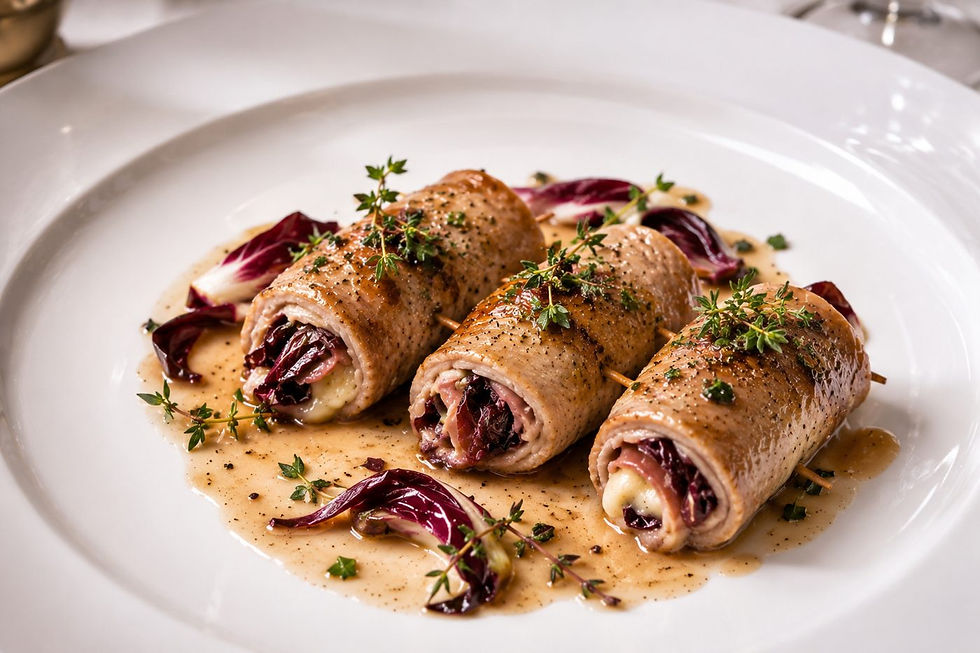
Involtini di vitello alla umbra are thin slices of veal rolled around a filling of chopped guanciale, celery, parsley and lemon zest, browned in oil and sage, then finished slowly in white wine and stock until the jus reduces to a glaze. They belong to the everyday cooking of the Umbrian interior, where cured pork is the standard seasoning.
The dish turns on one decision that is easy to get wrong. A filling has no pan of its own, no soffritto, no moment where aromatics sweat in fat before anything else happens. There is only the inside of a roll, thirty minutes of gentle heat, and whatever you put in there. So the savoury base has to be built raw, inside the veal, from something that releases fat as it cooks. Chopped guanciale and finely cut celery do exactly that.
What follows is the version I cook and teach: no cheese, very little added salt, and a filling that seasons itself from within.
Yield: 4 servings, 8 rolls. Prep: 35 minutes. Cook: 45 minutes. Rest: 5 minutes. Total: about 1 hour 25 minutes. Difficulty: intermediate. Course: secondo. Region: Umbria, the Norcia and Spoleto interior.
The Story
Umbria is the one Italian region with no coastline, and its cooking reads like it. There is no fish tradition to fall back on and, until recently, almost no agriculture beyond olives, lentils, farro and pigs. What the region has instead is Norcia, a small town in the Valnerina whose butchers gave their name to the entire Italian trade of pork curing: norcino still means a pork butcher anywhere in the country. In a place like that, cured pork is not a luxury added for interest, it is the salt, the fat and the seasoning at once.
That is the context these rolls come from. Veal was expensive and eaten in small quantities, cut into thin slices and made to go further by wrapping it around something. In the Umbrian version that something is pork: guanciale, prosciutto di Norcia, often both. Cheese appears in the Roman and Neapolitan cousins of this dish, but across much of Umbria it is absent, and the filling is built on cured pork, celery from the garden, parsley and a little bread. The cheap ingredient is doing the work of seasoning the expensive one.
Celery matters more here than it looks as though it should. Umbrian cooking uses it constantly, not as a vegetable in its own right but as the aromatic backbone of everything from lentil soup to the sauces served over strangozzi, and it is the one aromatic almost every household had to hand. Putting it inside a veal roll rather than under one, in a pan, is a thoroughly Umbrian answer to the question of where the flavour comes from.
Sage and white wine finish the dish, and both are habits rather than decisions. Sage grows wild on the limestone slopes, and white wine, historically the everyday bottle of the Trasimeno and Orvieto areas, was what was in the house.
Ingredients
For the veal
Veal top round, cut into 8 thin slices, 1 1/2 lb (680 g)
Prosciutto di Norcia, thin slices, 4 oz (115 g)
Freshly ground black pepper, to taste
For the filling
Guanciale, chopped by hand, 5 oz (140 g)
Celery, inner pale stalks only, cut very fine, 3 oz (85 g)
Flat leaf parsley, chopped, 1/4 cup (10 g)
Garlic clove, minced, 1
Fresh breadcrumbs, 1/3 cup (25 g)
Finely grated lemon zest, from 1 lemon
Freshly ground black pepper, 1/2 tsp (1 g)
For the pan
Extra virgin olive oil, 3 tbsp (45 ml)
Unsalted butter, 1 tbsp (14 g)
Fresh sage leaves, 6
Bay leaf, 1
Dry white wine, 3/4 cup (180 ml)
Veal or light chicken stock, 1 cup (240 ml)
For finishing
Cold unsalted butter, 1 tbsp (14 g)
Flat leaf parsley, chopped, 1 tbsp (4 g)
Extra virgin olive oil, a few drops per plate
Fine sea salt, only if the jus needs it after tasting
Note on salt: there is none in the filling and none on the veal. The guanciale and the prosciutto carry enough between them, and the jus concentrates as it reduces. Salt goes in at the very end, after tasting, and often not at all.
Preparation
Chopping the guanciale
Chill the guanciale in the freezer for 15 minutes so the fat firms up, then chop it by hand with a heavy knife into pieces around 1/8 inch (3 mm). Resist the food processor and the mincer entirely. You want visible cubes of fat and lean, not a paste.
Cutting the celery
Take only the pale inner stalks, peel off any stringy fibre with a small knife, and cut them lengthwise into thin strips before cutting across into pieces no larger than 1/16 inch (2 mm). This is finer than feels necessary and it is the most important cut in the recipe. Larger pieces stay raw and squeaky.
Mixing the filling
Combine the guanciale, celery, parsley, garlic, breadcrumbs, lemon zest and black pepper in a bowl and work them together with your fingers for a minute, pressing rather than stirring, so the fat begins to coat everything else. No salt, no cheese, no egg. Keep the bowl cold until you fill the rolls.
Laying out the veal
Lay the slices flat between two sheets of plastic and flatten them gently and evenly to about 1/8 inch (3 mm), then trim each one to a rough rectangle. Lay a slice of prosciutto over each piece, leaving a clear border of about 1/2 inch (1 cm) all round so the filling does not escape at the seams. Grind a little pepper over the top.
Filling and rolling
Divide the filling between the eight slices, about 2 tablespoons each, spread in a line across the narrower end rather than over the whole surface. Fold the two long sides in over the filling, then roll from the filled end into a cylinder. Secure each roll with two toothpicks pushed through at an angle, or with a single loose turn of kitchen twine.
Browning the rolls
Heat the olive oil and butter in a wide saute pan over medium high heat until the butter stops foaming. Add the sage leaves, then the rolls, seam side down, in a single layer with space between them. Brown about 2 minutes a side, turning so all four faces take colour, 7 to 8 minutes in total. Two batches are better than a pan that steams.
Deglazing and covering
Add the bay leaf, pour in the white wine and let it bubble hard for a minute, scraping the base of the pan. Lower the heat until the liquid is barely moving, add half the stock, cover and cook 30 minutes, turning the rolls every 10 minutes and adding the rest of the stock in two additions as the level drops. The pan should stay just wet, never swimming.
Reducing and resting
Lift the rolls onto a warm plate and cover loosely. Raise the heat, remove the sage and bay, and reduce until the liquid coats the back of a spoon, 3 to 4 minutes. Off the heat, swirl in the cold butter and the parsley, and taste for salt now, not earlier. Rest the rolls 5 minutes, remove the toothpicks, and return them briefly to the jus to coat.
Plating
Serve on warm plates, around 130F (55C), because the jus is thickened with butter and a cold plate sets it into a film. Two rolls per person. Cut the first roll of each pair in half on a slight diagonal and leave the second whole, so the plate shows both the browned outside and the cross section.
Spoon the jus over and around the rolls rather than under them, and use less than you think you need: perhaps 1/4 cup (60 ml) for four plates, and it is a glaze, not a sauce. Finish with a few drops of olive oil and a little chopped parsley.
The Umbrian accompaniments are lentils from Castelluccio, braised chicory, or roast potatoes with rosemary, always served beside the rolls rather than underneath them so the jus stays on the meat.
Professional Technique
The technique that defines this dish is building a savoury base inside the roll rather than in a pan. Every braise starts the same way: fat goes into a pan, aromatics go into the fat, and they sweat until their flavour dissolves into it. A rolled involtino has none of that. Once the veal is closed the filling is sealed inside for thirty minutes and whatever happens in there happens on its own. Chopped raw guanciale and finely cut celery supply both halves of that missing soffritto.
The guanciale fat begins to render at around 110F (43C), well before the veal is anywhere near done, and because the roll is closed it cannot escape. It pools among the celery and the breadcrumbs and becomes the liquid medium the aromatics need. The celery then does in that fat exactly what it would do in a pan: it softens, releases its water, and gives up the compounds that read as sweet and green. By the time the rolls come out there has been a soffritto, it simply happened inside the meat.
This is why the guanciale is chopped by hand and never minced. Mincing ruptures the fat cells before cooking, so the fat renders out completely in the first ten minutes and leaves grease below and dry shreds of lean pork above. Hand cut cubes render gradually across the full thirty minutes, so fat is still arriving when the celery is at its most receptive. The same logic explains the celery cut: gentle heat in fat will soften 2 mm dice and nothing larger.
The consequence is that the filling seasons itself. Guanciale is cured at roughly 3 percent salt, and 5 oz (140 g) of it releases enough into the filling and then into the jus that added salt becomes risky rather than merely unnecessary. It is also why the Umbrian version so often carries no cheese: the salt and fat pecorino would bring are already there, and better distributed.
Texture and Moisture Control
Three textures have to arrive together: veal that is tender rather than firm, a filling that is moist and cohesive, and an outer surface that has kept its colour. They pull in different directions, since browning wants high heat and a dry surface while the veal wants low heat. The method resolves it by browning fast and early, then dropping the temperature.
Moisture inside the roll comes from the rendering guanciale fat and the water the celery releases. The breadcrumbs hold both in place, which is why the quantity is small. Too much bread absorbs everything and the filling turns dry; too little and the fat runs out at the seams.
In the pan, keep the liquid at a bare tremble and the lid on. A visible simmer contracts the veal and squeezes moisture out of the slices, and the rolls tighten and turn rubbery. Five minutes of rest before slicing lets the juices inside settle so the cross section holds together rather than spilling.
Professional Mise en Place
The filling and the rolling are the slow part and both can be done well ahead. The cooking is 45 minutes of largely unattended pan time.
Equipment and tools
Heavy chef knife and a small paring knife for the celery fibre
Wide saute pan with a tight lid, large enough for 8 rolls in one layer
Meat mallet or a small heavy pan, and two sheets of plastic
Wooden toothpicks or kitchen twine, tongs, a fine sieve for a clear jus
Prepared ahead
Guanciale chopped and celery cut, up to 1 day ahead, kept separate and refrigerated
Filling mixed, up to 4 hours ahead, kept cold and covered
Rolls filled, secured and refrigerated on a tray, up to 6 hours ahead
Stock measured and warm, wine measured, sage and bay picked over
Service setup
Rolls out of the refrigerator 20 minutes before they meet the pan
Plates warming at 130F (55C), cold butter and parsley within reach
Contorno finished and held separately, never under the rolls
Chef Tips
Buy guanciale in a piece and never sliced. Sliced guanciale is too thin to chop into cubes and renders out in minutes, which destroys the point of the filling. Ask for a wedge from the thick end where lean and fat alternate.
Taste a little of the raw filling on the tip of a knife before you fill anything. It should already taste seasoned. If it tastes flat, add a little more guanciale, but do not reach for the salt: the jus has not reduced yet.
If your celery is coarse or the stalks are dark green, blanch the cut pieces for 30 seconds and drain them dry before mixing. Outer stalks have fibre that thirty minutes inside a roll will not break down.
Turn the rolls with tongs and never with a fork. A fork pierces the veal, the rendered fat runs into the pan and the filling loses the medium it needs. For the same reason, leave the toothpicks in until after the rest.
Common Mistakes
Mincing or processing the guanciale. Ruptured fat cells render out in the first ten minutes, so the filling floods with grease early and then has nothing left to give. Chop by hand into 3 mm pieces.
Cutting the celery too coarsely. Anything larger than about 2 mm stays raw and crunchy through thirty minutes of gentle cooking, and a hard piece of celery in a soft filling reads as a fault.
Salting the veal or the filling. Between the guanciale, the prosciutto and a jus that reduces to a quarter of its volume, the dish is already seasoned. Taste at the end and salt then, if at all.
Simmering instead of barely trembling. A visible simmer contracts the veal and pushes moisture out, and the rolls come out tight and rubbery with pale patches where the browning has washed off.
Overfilling the rolls. About 2 tablespoons per slice is the limit. More than that and the seams open during browning, so the internal base ends up as fat in the pan.
Adding all the stock at once. A full pan poaches rather than braises, the colour leaves the meat and the jus never reduces to a glaze.
Wine Pairing
Torgiano Rosso Riserva DOCG: The Umbrian bottle this dish belongs beside, Sangiovese led and grown on the hills above the Tiber. Its tannin is present but fine grained, enough to cut the rendered guanciale fat without overwhelming veal, and its acidity picks up the white wine still audible in the jus. Bottle age brings a dried herb note that runs with the sage.
Orvieto Classico DOC: The Umbrian white answer, and the more surprising of the two. Grechetto and Procanico give firm citrus acidity with a faintly bitter almond finish, and that bitterness is what makes it work: it meets the green edge of the celery head on rather than covering it.
Rosso di Montalcino DOC: A Tuscan neighbour, and the right weight when you want Sangiovese without the structure of a Riserva. Brighter and younger, it brings sour cherry fruit and high acidity that lifts the butter finished jus, while its lighter tannin leaves the delicacy of the veal intact.
Cerasuolo d'Abruzzo DOC: For a warm day, or for anyone who finds a red too heavy against veal. Montepulciano made as a deep rosato has real extract and an almost saline finish, so it stands up to cured pork while its acidity handles the fat the way a white would. It also copes with the lemon zest better than the reds here.
Cesanese del Piglio DOCG: From the hills of southern Lazio, close enough to share the same cooking, and a good match for pork fat inside meat. Cesanese is aromatic, faintly peppery and moderately tannic, with spiced dark fruit that sits alongside the black pepper in the filling instead of competing with it.
Storage & Reheating
Store the rolls and the jus separately in airtight containers, refrigerated, for up to 3 days. Keeping them apart matters: left sitting in the jus the browned surface softens overnight. Uncooked filled rolls keep for 24 hours and are better made ahead than cooked ahead.
To reheat, warm the jus in a small pan with 1 tablespoon of water, add the rolls whole, cover and hold over low heat for 6 to 8 minutes, turning once. Never use a microwave and never slice before reheating, since a cut roll loses its internal fat at once. The dish is good the second day, when the celery is noticeably sweeter.
Cooked rolls freeze acceptably for up to 2 months, whole in their jus, thawed overnight in the refrigerator. The filling survives freezing better than the veal, which loses a little tenderness.
Nutrition
Per serving, based on 4 servings of 2 rolls each:
Calories: 590 kcal
Total Fat: 39 g
Saturated Fat: 14 g
Trans Fat: 0.4 g
Unsaturated Fat: 23 g
Cholesterol: 175 mg
Sodium: 980 mg
Total Carbohydrates: 7 g
Fiber: 1 g
Total Sugars: 2 g
Added Sugars: 0 g
Protein: 48 g
Lactose: 0.2 g
Principal micronutrients: vitamin B12, zinc, selenium, niacin, iron, phosphorus, potassium
These figures are estimates. Sodium moves most, since it depends on how salty the guanciale and prosciutto are and how far the jus is reduced.




Comments