
Italian Tuscan Veal Rolls | Involtini di Vitello alla Toscana
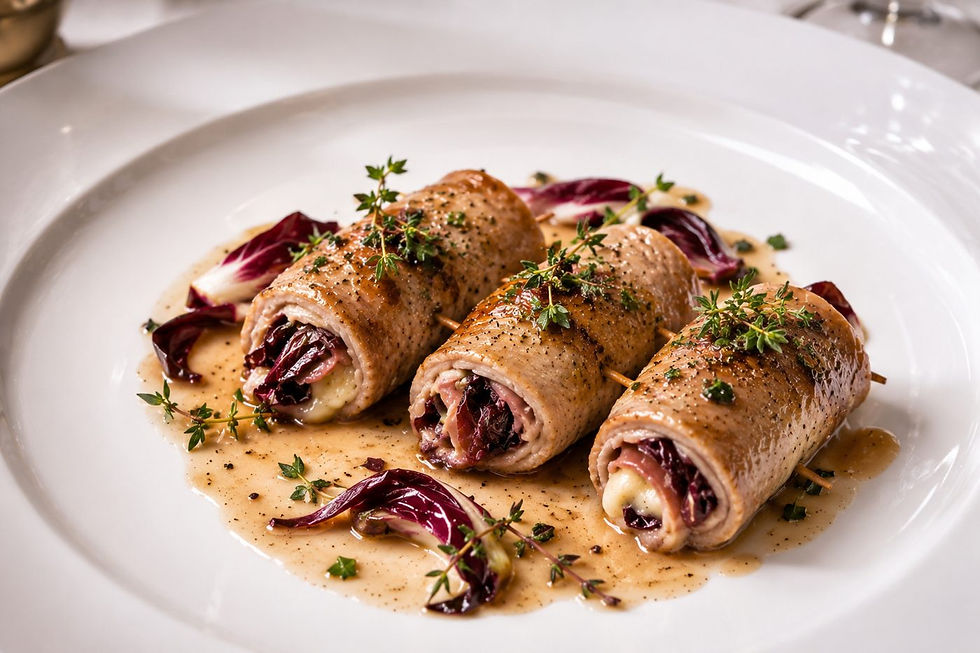
Involtini di vitello alla toscana are thin veal scallops rolled around prosciutto toscano and a whole sage leaf, browned in a pan and finished with red wine. There is nothing difficult about the rolls. What separates the trattoria plate from the dining room plate is not the meat or the filling: it is what happens in the pan in the two minutes after the rolls come out.
That liquid is not a sauce yet. It is a thin watery solution carrying gelatin dissolved out of the veal, salt from the prosciutto, wine acids and the browned compounds lifted off the base of the pan. Reduce it and you get something more concentrated but still thin and sharp. Work cold butter into it off the heat and you get an emulsion with gloss, body and a rounded finish that reduction alone cannot produce. This recipe is built around that step.
Butter is not the Tuscan pantry. Tuscany cooks in olive oil and a farmhouse version of this dish would simply be spooned with its pan juices. The butter finish arrives from restaurant practice, and it is the one addition a Tuscan cook would not recognise. Everything else stays where it belongs: the veal, the prosciutto, the sage, the household red wine.
Yield: 4 main course servings, 8 rolls. Prep: 30 minutes. Cook: 25 minutes. Total: about 55 minutes. Difficulty: intermediate. Course: secondo. Region: Tuscany, the Val di Chiana and the Chianti countryside.
The Story
Tuscany is cattle country before it is anything else in the kitchen. The Val di Chiana, the broad valley running south from Arezzo, gave its name to the Chianina, the white giant behind the bistecca fiorentina, and the same farms sold the small cuts no restaurant wanted. The involtino exists because of those cuts. One thin slice of veal, opened out and rolled around something salty, feeds a person who would otherwise eat half a portion, and it cooks on top of the stove rather than in a bread oven nobody lit on a weekday.
The filling is the local charcuterie. Prosciutto Toscano DOP is cured with a heavier hand than the hams of Parma or San Daniele: the salt is coarser, the surface is rubbed with pepper and a mix of garlic, juniper and rosemary, and the minimum ageing runs to ten months. The result is markedly savoury and openly aromatic, which is exactly what a piece of veal needs, because veal on its own is mild to the point of blandness. One thin slice of that ham inside a roll seasons the whole thing from the inside out, and the cook adds almost no salt afterwards.
Sage is the third element and it is not decoration. It grows as a woody shrub across the region, survives the summer without water, and is the herb Tuscans reach for with pork, beans and veal the way other regions reach for basil. Put whole into the roll, it perfumes the meat from within during cooking. The wine in the pan is whatever red the house drinks, which in practice means Sangiovese, and its acidity does real work against the fat of the ham.
The dish has no canonical version and never did. It travels between Arezzo, Siena and the Florentine hills gaining and shedding details: a strip of lardo, a spoon of tomato, a bed of onion. What holds across all of them is the shape, the ham, the sage and the pan.
Ingredients
For the rolls
Veal top round or leg, cut into 8 thin scallops, 1 1/2 lb (680 g) total
Prosciutto Toscano DOP, thinly sliced, 8 slices, about 3 oz (85 g)
Fresh sage leaves, large, 8
Garlic clove, peeled and halved, 1
Fine sea salt, 1/4 tsp (1.5 g), for the outside of the rolls only
Freshly ground black pepper, to taste
All purpose flour, 2 tbsp (16 g), for dusting
For the pan
Extra virgin olive oil, 2 tbsp (30 ml)
Unsalted butter, 1 tbsp (14 g), for the browning stage
Fresh sage leaves, extra, 4
Dry red Sangiovese, Chianti or Rosso di Montalcino, 3/4 cup (180 ml)
Light veal or chicken stock, unsalted, 3/4 cup (180 ml)
For finishing the sauce
Cold unsalted butter, cut into 1/2 inch (1 cm) cubes, 4 tbsp (57 g)
Fine sea salt, to taste
Freshly ground black pepper, to taste
Lemon zest, finely grated, a small pinch, optional
For serving
Cannellini beans, cooked and warm, 1 1/2 cups (255 g), optional
Extra virgin olive oil, a few drops per plate
Flat leaf parsley or small sage leaves, to garnish
Preparation
Open out and season the veal
Lay each scallop between two sheets of parchment and press it out with the flat of a mallet to an even 1/8 inch (3 mm), working from the centre outward. Even thickness matters more than thinness: a roll thick at one end and thin at the other is either underdone or dry. Rub the cut garlic once over each surface and discard it. Grind black pepper over the veal and leave the salt for the outside, since the prosciutto seasons from within.
Fill and roll
Lay a slice of prosciutto on each scallop, leaving a border of about 1/2 inch (1 cm) all round so it cannot escape and scorch. Press a whole sage leaf onto the ham. Roll from the narrow end, firm but not compressed, and fix each roll with one wooden toothpick. Dust very lightly with flour and tap off everything not clinging: that trace helps the surface brown and gives the sauce body, it is not a coating.
Brown the rolls
Heat the olive oil and the tablespoon of butter in a heavy skillet wide enough for all eight rolls without touching, over medium high heat. When the foam subsides, add the rolls seam side down and leave them 2 minutes. Turn with tongs and brown the remaining sides, roughly 6 minutes in all, adding the extra sage for the last minute. Season the outside with the salt and lift the rolls onto a warm plate. The pan should be deep golden with no black patches: burned residue turns the sauce bitter.
Deglaze and cook briefly
Pour off excess fat, keep the pan on medium heat and add the wine. It boils hard at once. Scrape the base with a wooden spoon until everything stuck has dissolved, then reduce the wine by half, about 2 to 3 minutes, which also takes off its raw alcoholic edge. Add the stock, return the rolls, drop to a bare simmer and cover loosely for 8 to 10 minutes, turning once.
Reduce the cooking liquid
Lift the rolls out again and keep them warm and covered. Raise the heat and reduce what is left to about 1/3 cup (80 ml), a shallow glossy film that streaks the pan when you tilt it. Taste it now: intense, savoury, sharp, still thin in the mouth. That is correct. It is also the last moment to adjust the salt, because once the butter goes in the seasoning is fixed. Strain for a cleaner finish.
Mount the sauce with cold butter
Take the pan completely off the heat and wait 20 seconds. Add two cubes of cold butter and move the pan in a continuous circle so they travel through the liquid and melt against the moving surface. As they almost disappear add two more, and continue until all 4 tablespoons (57 g) are in and the sauce is pale, opaque and visibly thicker. Never put the pan back over the flame. Pull the toothpicks, return the rolls briefly to coat, and plate.
Plating
Warm the plates, but not much. Around 120°F (50°C) is right: hot enough that the veal does not chill on contact, cool enough that the emulsion is not sitting on a surface that breaks it. A plate straight from a hot cupboard thins the sauce into a pool of oil within a minute.
Set two rolls per plate, slightly overlapping and angled rather than lined up. With the cannellini beans, spoon them warm to one side and lean the rolls against them. Beans are the Tuscan companion for a practical reason: they take up the sauce and add no competing flavour.
Spoon the sauce over the rolls at once, about 1 1/2 tablespoons per plate, letting it run down rather than flooding the plate. The gloss lasts four or five minutes, so plates go out as soon as they are dressed. Finish with one small sage leaf and nothing else. If the rolls are large, slice one on a diagonal to show the ham and sage.
Professional Technique
The technique that defines this plate is mounting the pan sauce with cold butter, and it is worth knowing what actually happens. After the rolls come out, the liquid is an aqueous solution: water carrying gelatin drawn out of the veal, salt from the prosciutto, acids from the wine and aromatic compounds lifted off the browned base. Butter is roughly four parts fat to one part water, with milk proteins and phospholipids sitting at the boundary between them. When cold butter is worked into that hot solution the fat does not dissolve. It breaks into microscopic globules that stay dispersed in the water phase, held apart by those milk proteins and by the gelatin already present. Light scatters off the globules, which is why the sauce turns pale and opaque, and the globules are what the tongue reads as body and roundness.
Three conditions decide whether it works. The butter must be cold and in pieces, because a cold cube melts gradually and releases its fat in amounts the liquid can take up, while melted butter arrives as bulk fat and floats. The pan must be off the heat and the liquid must stay below about 140°F (60°C): above that the proteins holding the interface fail, the globules coalesce, and the sauce splits with visible fat on top. And the pan is moved, not whisked, since swirling disperses the butter without shearing the emulsion or beating in air that dulls the gloss.
This is a temporary emulsion, not a stable one. It does not survive refrigeration, reheating or standing, and nothing rescues it once it breaks. That is why it is made at the moment of service, with the meat cooked and the plates warm, and served within minutes.
Texture and Moisture Control
Two things carry texture here and they pull against each other. Veal at 1/8 inch (3 mm) is lean, almost free of connective tissue and cooked through in minutes, so every extra minute squeezes water out of fibres with nothing to replace it. The sauce is the counterweight: a roll that has lost moisture passes under a glossy emulsion and reads as dry under thin pan juices.
The reduction sets viscosity before any butter goes in. At roughly 1/3 cup (80 ml) the gelatin is concentrated enough to coat a spoon on its own. Stop short and the sauce stays loose however much butter you add, since butter gives richness rather than structure. Reduce too far and the salt from the prosciutto passes the point where butter can round it.
Once mounted, the sauce holds only while it stays warm and undisturbed, and setting the pan back over a low flame is the commonest way it is lost. If service is slow, hold the reduced liquid alone and mount the butter as the plates go out.
Professional Mise en Place
The rolls can be built hours ahead and the dish then runs in twenty minutes, with only the last two needing full attention. Organise for that shape: everything ready, nothing mounted until the plates are out.
Equipment and tools
Heavy skillet wide enough for 8 rolls in a single layer
Meat mallet and parchment sheets
Tongs, wooden spoon, small fine mesh sieve
Wooden toothpicks, 8
Warm covered tray for holding the rolls
Prepared ahead
Rolls filled, secured and refrigerated on a rack, up to 8 hours
Butter cut into cubes and returned to the refrigerator, never left out
Stock measured and warm, wine measured
Cannellini beans cooked and held warm in their liquid
Plates set aside to warm gently, not heated hard
Service setup
Rolls out of the refrigerator 20 minutes before the pan
Reduced pan liquid held warm off direct heat
Cold butter cubes within reach of the stove, in a small bowl
Garnishes and finishing oil lined up beside the plates
Sauce mounted last, plates out immediately
Chef Tips
Buy the veal in one piece and slice it yourself against the grain. Ready cut scallops are usually thicker at one end, and thickness that varies across one scallop is the one fault no technique corrects later.
Weigh the butter rather than guessing. The working ratio is about 4 tablespoons (57 g) to 1/3 cup (80 ml) of reduced liquid. Less and the sauce stays sharp and thin, more and it loses the savoury edge the wine and the prosciutto put there.
Keep a tablespoon of warm stock aside. If the emulsion tightens or separates at the edges, a teaspoon of it and a firmer swirl usually bring the sauce back, provided the pan stayed off the flame.
If Prosciutto Toscano is unavailable, use another well aged dry cured ham and raise the pepper rather than the salt. Do not use cooked ham or speck: one brings water, the other smoke.
Common Mistakes
Adding the butter over the flame. The pan holds heat well past the moment the burner goes off. Take it off, count twenty seconds, then start. Above 140°F (60°C) the emulsion breaks and fat floats up.
Using melted or softened butter. Butter already liquid releases its fat at once and the sauce cannot take it up. Cut it cold, keep it cold, add it in two or three batches.
Whisking hard instead of swirling. A whisk shears the emulsion and beats in air, leaving the sauce foamy and dull. Move the pan in a circle instead.
Not reducing far enough first. Butter adds richness, not structure. Left at 1/2 cup or more the sauce stays thin. Reduce to about 1/3 cup (80 ml) and check it films the pan.
Overcooking the veal. Eight to ten minutes at a bare simmer is the whole cooking time. Veal this thin has no fat to protect it, and no sauce hides a roll cooked for twenty.
Making the sauce ahead. This emulsion cannot be held, chilled or reheated, and cannot be repaired once split. Hold the reduced liquid and mount it at the plate.
Wine Pairing
Chianti Classico DOCG: The default and the correct one. Sangiovese acidity cuts straight through a butter emulsion, and its firm but fine tannin meets the savoury cure of the prosciutto without hardening against the mild veal. The sour cherry and dried herb register picks up the sage directly.
Chianti Rufina DOCG: Grown at higher altitude east of Florence, so it arrives leaner, more mineral and sharper than Classico. Choose it when the sauce has gone rich: the extra acidity resets the palate between mouthfuls, and its lighter body sits under veal where a heavier red buries the meat.
Carmignano DOCG: Sangiovese with a required proportion of Cabernet, which brings darker fruit and a rounder tannic frame. That roundness meets the butter better than pure Sangiovese does, and there is still acid enough for the salt of the ham. A good choice when beans are on the plate.
Rosso di Montalcino DOC: Younger and less extracted than Brunello, with softer tannin and generous red fruit. The softness is why it works: veal gives hard tannin nothing to bind to, so a gentler red leaves the meat intact while its acidity lifts the fat in the sauce.
Vernaccia di San Gimignano DOCG: The Tuscan white, for anyone who prefers one with veal. Firmer than most Italian whites, it finishes on a bitter almond note that echoes the browned surface of the rolls, and its acidity and texture carry the butter where a lighter white cannot.
Storage & Reheating
Sauce and rolls store on different terms. The mounted sauce does not store at all: it separates in the refrigerator and cannot be brought back, so make only what goes on the plates. The reduced liquid, before any butter, keeps refrigerated for 3 days and freezes for 2 months.
Cooked rolls keep refrigerated in an airtight container for 2 days. Reheat them covered at 300°F (150°C) with a spoonful of stock in the dish, about 10 minutes, or in a covered pan over low heat. Never microwave them. Filled rolls freeze raw for 1 month.
To serve leftovers, warm the reduced liquid, take it off the heat and mount fresh cold butter exactly as on the first day. The dish comes back almost intact, which is never true when the butter went in before storage.
Nutrition
Per serving, based on 4 main course portions of 2 rolls each, without the beans:
Calories: 485 kcal
Total Fat: 33 g
Saturated Fat: 15 g
Trans Fat: 0.7 g
Unsaturated Fat: 16 g
Cholesterol: 175 mg
Sodium: 690 mg
Total Carbohydrates: 5 g
Fiber: 0.3 g
Total Sugars: 1 g
Added Sugars: 0 g
Protein: 40 g
Lactose: 0.1 g
Principal micronutrients: vitamin B12, niacin, zinc, selenium, phosphorus, iron
These figures are estimates. Adding the cannellini beans contributes roughly 130 kcal, 7 g of protein and 6 g of fibre per portion, and the sodium depends almost entirely on the ham.


Comments