
Italian Fresh Spaghetti alla Chitarra alla Nerano with Pea Cream | Spaghetti alla Chitarra Freschi alla Nerano con Crema di Piselli
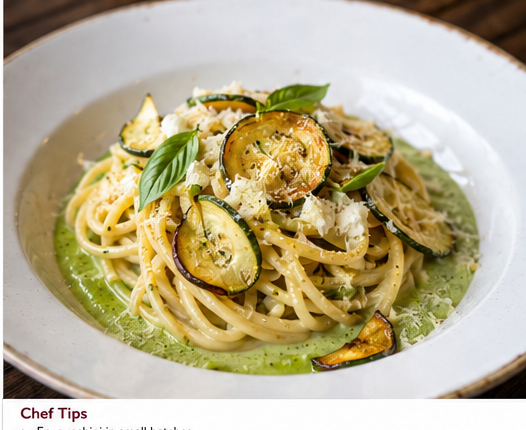
Spaghetti alla Nerano is a dish of four ingredients that behaves like a dish of forty. Zucchini, oil, Provolone del Monaco and basil, and yet every cook who has tried it knows the two ways it fails: the cheese seizes into rubbery threads at the bottom of the pan, or the sauce breaks and leaves a slick of oil around dry pasta. Everything here exists to prevent those two failures.
Two things change from the version served on the Sorrento coast. The pasta is spaghetti alla chitarra, cut fresh on the Abruzzese wire frame, so the strands are square in section with a porous surface that holds a cheese emulsion far better than smooth extruded spaghetti. And a cream of green peas goes under the pasta rather than into it, cutting the fried richness above without ever mixing into the Nerano sauce.
Yield: 4 servings. Dough: 30 minutes plus 45 minutes rest. Zucchini: 40 minutes plus overnight maceration. Pea cream: 20 minutes. Service: 6 minutes. Difficulty: intermediate. Course: primo piatto. Region: Campania and Abruzzo.
The Story
Spaghetti alla Nerano was born in a single restaurant in a single cove. Nerano is a hamlet of Massa Lubrense at the tip of the Sorrento peninsula, and the dish was created around 1952 at the trattoria of Maria Grazia in Marina del Cantone, the pebble beach below the village. She fried the zucchini from her own garden and finished the pasta with local Provolone del Monaco, and the recipe stayed a house secret for decades while the beach filled with boats down from Capri.
The cheese is what makes it local rather than generic. Provolone del Monaco DOP is a stretched curd cow milk cheese from the Lattari mountains behind Sorrento, aged at least six months, with a butter and hay flavour and a slight piquancy at the finish. The name comes from the dairymen who crossed the bay to Naples on the night boat wrapped in heavy cloaks and looked like monks. A supermarket provolone gives a different dish: sharper, saltier, without the sweetness that makes Nerano work.
The chitarra belongs to a different coast. It is an Abruzzese tool, a beechwood frame strung with steel wires over which a thick sheet of egg and semola dough is pressed with a rolling pin, in use around Chieti and Teramo since at least the nineteenth century. Putting a Campanian sauce on Abruzzese pasta is not tradition and this recipe does not pretend otherwise. The reason is mechanical: the square edge and rough surface hold an emulsified cheese sauce in a way round industrial spaghetti cannot.
Ingredients
For the fresh spaghetti alla chitarra
Semola rimacinata di grano duro, 1 3/4 cups (280 g)
Italian 00 flour, 1/2 cup (65 g)
Large eggs, 3
Egg yolk, 1
Fine sea salt, 1/2 tsp (3 g)
Semola for dusting the wires, 1/3 cup (50 g)
For the fried zucchini
Small dark green zucchini, firm, 1 1/2 lb (680 g)
Sunflower oil for frying, 4 cups (950 ml)
Fine sea salt, 1 tsp (6 g)
Fresh basil leaves, torn, 12
For the pea cream
Shelled fresh peas or frozen petits pois, 10 oz (285 g)
Spring onion, white part only, 1
Extra virgin olive oil, 2 tbsp (30 ml)
Light vegetable stock or water, 3/4 cup (180 ml)
Fine sea salt, 1/2 tsp (3 g)
Ice water, for chilling the peas
For finishing
Provolone del Monaco DOP, aged 8 months, finely grated, 4 oz (115 g)
Parmigiano Reggiano, finely grated, 1 oz (30 g)
Unsalted butter, cold and diced, 1 tbsp (14 g)
Coarse sea salt for the pasta water, 2 tbsp (30 g) for 4 quarts (3.8 l)
Small basil leaves, 12
Freshly ground black pepper, to taste
Extra virgin olive oil, a few drops per plate
Preparation
Mix and knead the chitarra dough
Mound the semola and the 00 flour on a board, make a well and add the eggs, the yolk and the salt. Break the eggs into the flour with a fork until a shaggy mass forms, then work it with the heels of your hands for a full 10 minutes. Semola dough resists at first and softens under pressure: if a stretched corner tears, keep kneading rather than adding water. Wrap tightly and rest 45 minutes.
Roll the sheet and cut it on the chitarra
Roll the rested dough to about 1/8 in (3 mm), far thicker than a tagliatelle sheet and not a mistake: the wires need depth to cut a square strand. Cut it into rectangles the length of the frame, dust sheet and wires with semola, and press each one through with a single firm pass of the rolling pin. Strum the frame, toss the strands in semola and coil them into loose nests, uncovered, for 20 minutes.
Fry the zucchini in two stages
Slice the washed and dried zucchini into even rounds about 1/8 in (3 mm) thick. Heat the sunflower oil to 340°F (170°C) and fry in small batches, never crowding, for about 3 minutes, until the edges are pale gold and the centre still soft. Lift onto absorbent paper. Raise the oil to 355°F (180°C) and give one third of the rounds a second fry of 40 seconds, until deep gold: those carry the toasted flavour that defines the dish.
Macerate the zucchini with basil
Layer the drained rounds in a wide dish while still warm, salting each layer lightly and scattering torn basil between them. Cover, leave 2 hours at room temperature, then refrigerate overnight. This is the step most home versions skip. The zucchini soften, weep a little sweet liquid and take the basil perfume all the way through. Return them to room temperature before service and keep every drop of that liquid.
Build the pea cream
Sweat the thinly sliced spring onion in the olive oil over low heat for 4 minutes without colour. Add the peas and the stock, bring to a boil and cook 3 minutes for fresh peas or 2 for frozen. Drain, keeping the liquid, and plunge the peas into ice water for 1 minute to lock the colour. Blend with enough reserved liquid to give a thick pourable purée, season and pass through a fine mesh sieve. Chill over ice, then hold at cool room temperature.
Salt the water and cook the pasta
Bring 4 quarts (3.8 l) of water to a rolling boil and salt it with 2 tablespoons (30 g) of coarse salt, no more. Fresh egg and semola pasta sheds a great deal of starch and that water binds the sauce, so it must stay concentrated: never reach for a bigger pot. Shake the semola off the nests and drop them in. Chitarra at this thickness takes 2 to 3 minutes; bite a strand at 2 minutes and look for a firm core. Reserve 1 1/2 cups (360 ml) before draining.
Mantecare the pasta with the cheese
Take the sauté pan off the heat entirely and let it lose its fierceness for 20 seconds. Add two thirds of the zucchini with their liquid, a ladle of pasta water and the drained pasta, and toss. Scatter in the grated Provolone del Monaco and Parmigiano Reggiano a handful at a time, shaking the pan and stirring hard between additions, loosening with pasta water as you go. Keep the pan below 150°F (65°C). This is the whole dish: 45 seconds of continuous agitation while starch and fat come together.
Check the emulsion and correct it
Stop and look. The sauce should be glossy and pale green gold, coating each square strand and moving as one mass when you tilt the pan. If it looks tight and dull, add pasta water a tablespoon at a time and keep stirring. If free oil shows at the edge it has gone too warm: pull the pan further off, add cold pasta water and the cold diced butter and stir hard until it comes back. Finish with pepper, and taste before salting.
Plating
Warm the bowls to no more than hand hot. A scorching plate carries the cheese emulsion past the temperature at which it holds, and the sauce breaks between kitchen and table. Wide shallow bowls with a flat base are right, because the pea cream needs somewhere to sit without running up the sides.
Spoon about 3 tablespoons of pea cream into each bowl and spread it into a smooth disc. Lift a portion of pasta with a carving fork and a ladle, twist it into a tall nest and set it in the centre of the green, leaving a rim of cream visible. Do not stir the two together: the contrast between cool sweet purée underneath and hot savoury pasta above is the point of the dish. Finish with the reserved zucchini rounds, the darker ones placed where they will be seen, a few small basil leaves, black pepper and three drops of olive oil around the cream. No extra cheese at the table, which would only tighten the sauce.
Professional Technique
The controlling technique is a cheese emulsion built below the melting point of a stretched curd cheese. Provolone del Monaco is pasta filata: its casein network was stretched in hot whey when the cheese was made, and reheating above roughly 160°F (70°C) sends it back to that state, contracting into elastic strings and squeezing the butterfat out as free oil. The defence is starch. Gelatinised amylose from pasta water coats the fat droplets and holds them suspended, but only if the fat is released slowly: low heat, small additions, hard agitation rather than time.
The second technique is the double fry. The first pass at 340°F (170°C) drives water out of the flesh and sets the slices without browning them. The shorter pass at 355°F (180°C) on a third of the batch pushes those rounds into Maillard territory, so the plate carries two zucchini flavours, one sweet and vegetal, one toasted and almost nutty. Frying everything hot from the start gives the second and nothing else; frying everything cool gives a pale, oily result.
The third is the pea cream held separately, a plating decision with a technical reason. Blended peas are full of free water and would thin the cheese emulsion instantly in the pan. Kept underneath, sieved and cool, the purée gives sweetness to each forkful without touching the sauce chemistry above it.
Texture and Moisture Control
Three water contents pull in different directions. Zucchini are about 94 percent water, and both the frying and the overnight maceration exist to remove and then control it: fried properly they lose enough to concentrate, and the little they weep during maceration is sweet and belongs in the pan. Pasta water carries the starch that binds everything. The pea cream holds its own water and stays out of the pan.
The pasta is the moisture reserve. Fresh chitarra at 1/8 in (3 mm) absorbs fast in its outer layer and slowly at the core, so it keeps drinking for a minute after it leaves the pot. That is why it is drained just short of al dente and why the sauce should look slightly loose when you stop stirring: it tightens on the way to the table. A sauce that looks perfect in the pan will be dry in the bowl. Aim for pasta at around 145°F (63°C) as it is plated, with the bowls warm rather than hot and the pea cream at cool room temperature rather than refrigerator cold.
Professional Mise en Place
This dish is won the day before and lost in the final minute. The service window is 6 minutes, from dropping the pasta to setting down the bowls.
Equipment and tools
Chitarra frame and a long wooden rolling pin, or a square cut chitarra attachment
Deep heavy pot for frying, probe thermometer, spider skimmer
Wide sauté pan, 12 in (30 cm), with sloping sides
Blender and a fine mesh conical sieve
Carving fork and ladle for twisting the nests
Prepared ahead
Zucchini fried, salted, layered with basil, macerated up to 24 hours
Pea cream blended, sieved and chilled, up to 2 days refrigerated
Pasta cut and nested on semola, up to 4 hours at cool room temperature
Both cheeses grated fine and kept covered, on the day
Bowls stacked where they will warm gently, never in a hot oven
Service setup
Pasta water at a rolling boil, salted at 2 tbsp (30 g) per 4 quarts (3.8 l)
Zucchini and their liquid at room temperature beside the stove
Grated cheeses in an open bowl, cold butter diced
Pea cream spooned into the bowls before the pasta goes in the water
Basil picked at the last moment so it does not blacken
Chef Tips
Buy the smallest zucchini the market has. Large ones are mostly seed and water, collapse in the fryer and taste of nothing, while small firm dark green ones hold their shape and have real sweetness.
Grate the provolone on the fine side of the grater, never the coarse one. Coarse shreds need more heat and more time to melt, and both are exactly what breaks the sauce. Fine grating dissolves into the starchy water almost on contact.
Fry in sunflower oil rather than olive oil. This is not an economy: olive oil at 340°F (170°C) is close to its smoke point and turns bitter, and that bitterness carries into the finished dish. Save the good oil for the pea cream and the drops at the table.
If Provolone del Monaco is unavailable, use two parts aged caciocavallo silano to one part Parmigiano Reggiano. Avoid provolone dolce, which is young and rubbery, and mozzarella or scamorza, which string uncontrollably.
Common Mistakes
Adding the cheese over the flame. This is the single failure that ruins the dish, and it is irreversible once the casein has contracted. The pan must be off the heat and below 150°F (65°C) before the first handful of provolone goes in, and stay there for the whole mantecatura.
Skipping the overnight maceration. Zucchini fried and used at once taste of frying and little else. The rest with salt and basil turns them from a garnish into the flavour base of the sauce, and extra basil at the end is no substitute.
Blending the peas into the sauce. It destroys both elements: the free water thins the cheese emulsion until it splits, and the pea flavour disappears under the provolone. Keep the cream underneath, where it stays sweet and green.
Overcooking the chitarra. Fresh square cut pasta at this thickness goes from firm to slack in about 40 seconds. Drain while the core still bites, because it keeps cooking and absorbing through the whole mantecatura.
Wine Pairing
Fiano di Avellino DOCG: The most complete match here. Fiano has a waxy, almost oily texture that meets the fried zucchini and the melted provolone on equal terms rather than being flattened by them, and under it runs a firm line of acidity that resets the palate. Its hazelnut and pear character sits beside the toasted rounds from the second fry.
Greco di Tufo DOCG: Sharper and more mineral than Fiano, with a sulphurous volcanic note from the tuff soils and a bitter citrus grip on the finish. That grip is the reason to choose it: this is a fatty dish and Greco scrubs rather than soothes. Serve at 50°F (10°C) and give it a few minutes in the glass.
Falanghina del Sannio DOC: The everyday bottle of inland Campania and the easiest to drink with a full plate of pasta. Green apple and white flower aromatics, moderate alcohol and a brisk finish that handles the salt of the provolone without adding weight. It also picks up the sweetness of the pea cream.
Lacryma Christi del Vesuvio DOC: The bottle from the volcano itself, grown on the same bay as Nerano. In its white form it is built on Coda di Volpe and Verdeca, with a saline smoky edge and a broad soft middle that flatters the cheese emulsion. Choose a recent vintage: it loses its lift after three or four years.
Vermentino di Gallura DOCG: The alternative when nothing Campanian is at hand. Grown on decomposed granite in northern Sardinia, it brings a saline bite and a firm citrus attack and finishes on a faintly bitter almond note that echoes the basil. It carries enough weight to sit under a rich pasta without disappearing.
Storage & Reheating
The finished dish does not store. A cheese emulsion built on starch and pasta water survives perhaps 10 minutes in a bowl and nothing at all in a refrigerator, where it sets into a block that cannot be brought back. If you must serve two sittings, do the mantecatura twice with half the ingredients each time.
The components are a different matter. Fried zucchini keep refrigerated in a sealed container with their basil and liquid for 3 days and are better on day two. The pea cream keeps 2 days refrigerated and freezes for up to 2 months, losing some brightness and needing a fresh blend on thawing. Uncooked chitarra nests hold 24 hours on a semola dusted tray, or freeze on the tray and go into a bag once solid, then cook straight from frozen with 1 extra minute. Leftover cooked pasta is best treated as a frittata: press it into a small pan with a beaten egg and cook slowly on both sides until crisp.
Nutrition
Per serving, based on 4 servings:
Calories: 760 kcal
Total Fat: 34 g
Saturated Fat: 14 g
Trans Fat: 0 g
Unsaturated Fat: 18 g
Cholesterol: 205 mg
Sodium: 890 mg
Total Carbohydrates: 82 g
Fiber: 7 g
Total Sugars: 8 g
Added Sugars: 0 g
Protein: 31 g
Lactose: 1 g
Principal micronutrients: calcium, phosphorus, vitamin A, vitamin C, vitamin K, folate, selenium
These figures are estimates. Most of the frying oil is drained away rather than eaten, and the real fat content depends on how well the zucchini were blotted.




Comments