
Italian Fresh Spaghetti alla Chitarra with Goat Ricotta and Saffron Cream | Spaghetti alla Chitarra Freschi con Ricotta di Capra e Zafferano
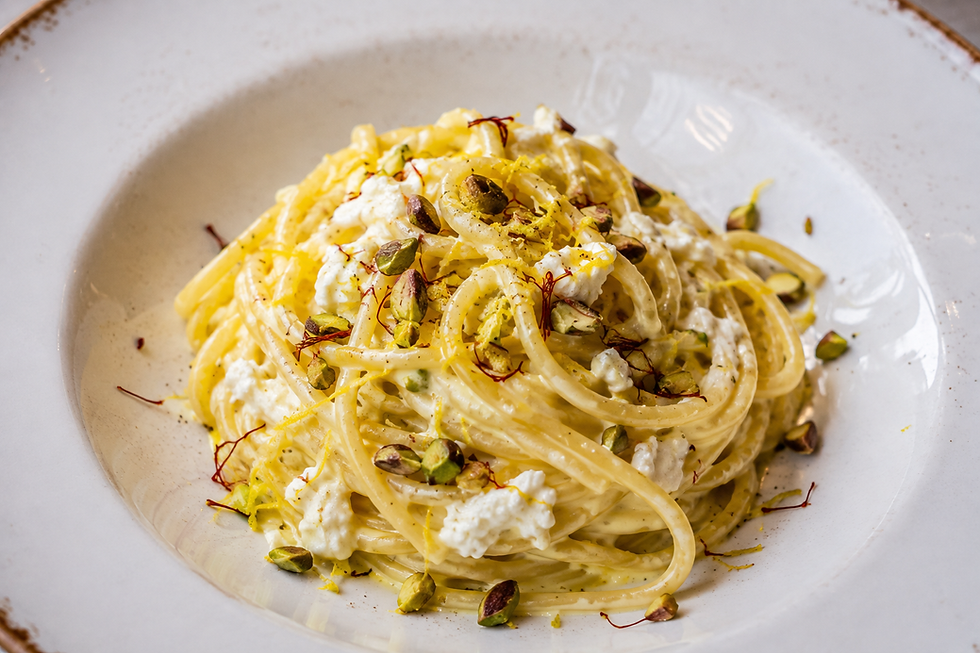
This is an Abruzzo plate that rarely leaves the province of L'Aquila, built from three things the high plains produce. Egg and semola dough is cut on the chitarra into strands square in section rather than round, fresh goat ricotta is loosened into a cold cream, and saffron threads are steeped in warm milk until the liquid turns deep amber. The three meet in a pan already taken off the flame.
What makes it worth the effort is the refusal to cook the sauce. Goat ricotta is a fragile fresh cheese, and heated past about 150°F (65°C) its proteins tighten and the cream turns to grains. The whole method is arranged backwards from that limit: the heat lives in the pasta and its starchy water, and the ricotta arrives last, warmed only by what is already in the pan.
Saffron is the other discipline. It gives colour instantly and flavour slowly, so it is ground with salt and steeped for hours rather than thrown into the pan at the end. Done properly the dish tastes of honey, hay and goat milk in that order, with the faint bitterness of real saffron underneath.
Yield: 4 first course servings. Prep: 45 minutes. Rest: 45 minutes. Saffron infusion: 2 hours. Cook: 10 minutes. Total: about 3 hours 30 minutes. Difficulty: intermediate. Course: primo piatto. Region: Abruzzo, the Aterno valley and the Navelli plain.
The Story
The chitarra is joinery before it is a kitchen tool: a beechwood box roughly 18 inches long strung with steel wires a few millimetres apart, one face set wider for a fatter strand. Abruzzese households have kept one since the early nineteenth century, when it appears in accounts from the Chieti countryside under the dialect name carrature. A rolled sheet of dough is laid across the wires and driven through with a rolling pin, and the strands fall into the tray below with the sound that renamed the tool after a guitar.
The saffron comes from Navelli, a wind scoured plain at about 2,300 feet southeast of L'Aquila where crocus sativus has grown since a Dominican friar carried the corms back from Spain in the thirteenth century. The flowers open for a single morning in late October and are picked before the sun reaches them, the three red stigmas pulled by hand and dried over oak embers the same day. Roughly 200 flowers make one gram, which explains both the price and the Aquilano habit of restraint.
Goat ricotta belongs to the same landscape through the tratturi, the grass droving roads that carried Abruzzese flocks down to the Tavoliere in Puglia each autumn and back in June. Ricotta was made at the sheepfold from the whey left after cheesemaking, and goat whey gives a ricotta looser, whiter and distinctly lactic where sheep ricotta is sweet. Pairing that tang with saffron is old mountain economy: one ingredient cost nothing, the other was the only luxury anyone had.
Ingredients
For the chitarra pasta
Durum wheat semola rimacinata, 1 1/2 cups (250 g)
Tipo 00 flour, 1/2 cup (60 g)
Whole eggs, large, at room temperature, 3
Fine sea salt, 1/4 tsp (1.5 g)
Extra semola for dusting, about 1/4 cup (40 g)
For the saffron infusion
Saffron threads, Zafferano dell'Aquila DOP if you can get it, 0.15 g, a generous pinch
Whole milk, 1/4 cup (60 ml)
Fine sea salt, 1 pinch, for grinding with the threads
For the goat ricotta cream
Fresh goat ricotta, well drained, 7 oz (200 g)
Unsalted butter, cold, 2 tbsp (28 g)
Aged pecorino, finely grated, 1/3 cup (30 g)
Extra virgin olive oil, 2 tsp (10 ml)
Freshly ground white pepper, to taste
Fine sea salt, to taste
For finishing
Coarse sea salt for the pasta water, 2 tbsp (30 g)
Finely grated lemon zest, from 1/2 lemon
Chives, thinly sliced, 1 tbsp (3 g)
Saffron threads for the plate, 8 to 12
Extra virgin olive oil, a few drops per bowl
Preparation
Step 1
Steep the saffron. Do this first, because it is the only step that cannot be hurried. Grind the threads in a small mortar with a pinch of fine salt until they break into a coarse red powder; the salt acts as an abrasive and releases far more colour than crushing alone. Warm the milk to about 140°F (60°C), no hotter, pour it over the powder and leave it covered at room temperature for 2 hours, or refrigerated overnight. The liquid should finish deep amber.
Step 2
Make the dough. Combine the semola and the tipo 00 on a board, build a wide crater, break in the eggs and add the fine salt. Beat the eggs with a fork, drawing flour from the inner wall until the centre is a thick paste, then push the rest in with a bench scraper. It will look dry and ragged, which is correct for a dough that has to hold a square edge. Knead a full 10 minutes until smooth and elastic, wrap tightly and rest at room temperature for 45 minutes.
Step 3
Roll the sheet to the thickness of the wires. Cut the dough into four pieces and keep three covered. Roll the first out on a lightly dusted board, or take it down the pasta machine to the second thickest setting, until it is a shade under 1/8 inch (3 mm). Thickness is not a matter of taste here: a sheet thinner than the gap between the wires sags through uncut, and one only slightly thinner gives flat ribbons instead of square strands. Trim the sheet to the width of the frame.
Step 4
Cut on the chitarra. Lay the sheet squarely over the wires, press it down with one firm pass of the rolling pin, then work the pin back and forth with real weight until the strands drop into the tray underneath. Lift the frame and pluck the wires once to release anything still hanging. Toss the strands immediately with semola, never with flour, and gather them into loose nests. Fresh chitarra can sit uncovered for an hour; beyond that, refrigerate it.
Step 5
Loosen the ricotta into a cream. Push the goat ricotta through a fine mesh sieve into a wide bowl, which takes a minute and removes the graininess every fresh ricotta has. Whisk in the saffron milk a spoonful at a time, then the olive oil, until you have a smooth pourable cream the colour of buttercup. Season with white pepper and a little salt and taste it now, while you can still correct it. Leave it at room temperature and never put this bowl over heat.
Step 6
Cook the pasta and mind the water. Bring 4 quarts (3.8 litres) of water to a rolling boil and add the 2 tablespoons of coarse salt, enough to season fresh pasta without competing with the pecorino. Drop the nests in, stir them apart at once, and cook 2 to 3 minutes only. Fresh chitarra is done when the strand still resists slightly at the centre of its square section. Reserve a full cup of the cooking water, thick with semola starch, and drain without rinsing.
Step 7
Mantecare off the heat. Take a wide sauté pan off the flame entirely. Add the cold butter and about 1/3 cup (80 ml) of the reserved water and swirl until they emulsify into a glossy liquid, then tip in the drained pasta and toss hard for 20 seconds. Only now pour in the goat ricotta cream, still with the pan off the stove, and add the pecorino in two additions while tossing. The residual heat of the pasta and the pan is all the warmth the cheese ever gets. Loosen with more cooking water until the sauce falls slowly from a lifted strand, and serve immediately.
Plating
Warm the bowls, but only just: about 120°F (50°C), hot enough to stop the sauce seizing on contact and cool enough not to carry on cooking the ricotta. A wide shallow bowl beats a deep one, because the strands should sit in a single low nest rather than pile up and trap steam.
Lift a quarter of the pasta with a carving fork and a ladle, twist it against the ladle into a compact nest and set it just off centre so a little of the pale gold sauce shows at the edge. Scrape the sauce left in the pan over the top. Finish each bowl with a few drops of olive oil, a dusting of lemon zest, the sliced chives and two or three whole saffron threads laid on the pasta. Send the bowls out at once, with extra pecorino on the table rather than on the plate.
Professional Technique
The controlling technique here is cold extraction of saffron followed by a heatless emulsion. Crocin, the pigment, is water soluble and leaves the threads readily; picrocrocin and safranal, which carry the bitterness and the aroma, come out slowly and are destroyed by direct heat. Grinding with salt fractures the thread walls, and a long steep below 140°F (60°C) pulls all three out intact. Saffron dropped into a hot pan gives colour and almost no perfume, which is why so many saffron pastas look right and taste of nothing.
The second technique is the reverse mantecatura. Normally the fat is worked into starchy water over gentle heat; here the fat is a fresh goat cheese whose caseins coagulate far below the point aged cheese does, so the pan comes off the flame before the cream appears. Building a butter and water emulsion first gives the ricotta something stable to join, and the pasta supplies the heat. The result clings without a single grain in it, and there is no cream anywhere in the recipe.
Texture and Moisture Control
The square section of chitarra is not decorative. Four flat faces and four edges give roughly a quarter more surface than a round spaghetto of the same weight, and the cut faces are rough rather than extruded, so a light cream holds on instead of sliding into a pool. That is why the dish needs no cream or egg yolk as a binder, and why dried round spaghetti leaves you with a puddle.
Fresh pasta releases far more starch than dried, so the water after 3 minutes is already thick enough to act as the emulsifier. Reserve more than you think you need and add it in small amounts, tossing between each, because goat ricotta tightens as it sits and a sauce that was perfect at the stove can be stiff at the table. Judge it by how the sauce falls from a lifted strand: it should run for a second and then stop.
Temperature is the whole moisture story. Above roughly 150°F (65°C) the ricotta breaks and no amount of water brings it back, while below about 100°F (38°C) the butter emulsion dulls and the sauce turns pasty. Working off the flame keeps the pan between those two.
Professional Mise en Place
Everything here is done before service except the last 3 minutes, which are unforgiving. Set the infusion going in the morning and the rest is simple.
Equipment and tools
Chitarra frame, or a fine mesh guitar cutter attachment, plus a heavy rolling pin
Small mortar and pestle for the saffron threads
Fine mesh sieve for the ricotta and a balloon whisk
Wide sauté pan, large enough to toss the pasta without crowding
Carving fork and ladle for twisting the nests
Prepared ahead
Saffron milk infused, covered, up to 24 hours ahead in the refrigerator
Pasta dough kneaded and rested, up to 4 hours ahead
Chitarra strands cut, dusted with semola, on a tray up to 3 hours ahead
Goat ricotta drained overnight in a sieve if it looks wet
Pecorino grated, lemon zested, chives sliced within the hour
Service setup
Salted water at a rolling boil, lid off, with a ladle beside it
Ricotta cream at room temperature within arm's reach of the stove
Cold butter portioned, reserved water in a warm jug
Bowls warmed to 120°F (50°C), never hotter
Garnishes in small dishes, ready to finish four bowls in under a minute
Chef Tips
Buy saffron in threads, never in sachets of powder, which is routinely cut with turmeric or safflower. Real threads are trumpet shaped, deep red with a paler yellow style at one end, and they colour water slowly over several minutes rather than instantly.
Taste the goat ricotta on its own before you commit. Its acidity varies with the season and the dairy: a very tangy one needs an extra teaspoon of butter and less lemon zest, while a mild one takes all the zest you planned and more white pepper.
If the strands stick together on the tray, you dusted with flour instead of semola. Semola stays granular on the surface; soft flour hydrates and glues. Toss the nests with a generous handful of semola, shake the tray, and cook them within the hour.
Keep a small jug of the reserved water beside the plates, not just beside the stove. The sauce tightens in the warm bowls, and a teaspoon of starchy water stirred in at the pass rescues a serving that has gone dry between pan and table.
Common Mistakes
Adding the ricotta over the flame. Goat ricotta is a fresh acid set cheese and it curdles well below a simmer, turning the sauce into pale grains. The pan must be off the heat before the cream goes in, and it never goes back on.
Throwing the saffron threads straight into the pan. You get a yellow plate with no aroma, because the perfume compounds need a long steep in warm liquid and are driven off by direct heat.
Rolling the sheet too thin. A sheet thinner than the gap between the wires sags through uncut, and one slightly thinner gives flat ribbons rather than square strands. Stop at just under 1/8 inch (3 mm).
Dusting the cut strands with flour. Soft flour absorbs surface moisture and sets into a paste that welds the nests together. Use semola only, and more of it than feels necessary.
Cooking fresh chitarra like dried spaghetti. Two to three minutes is the whole window. At 5 minutes the strands have lost their edge and their bite, and the starch they shed turns the water gluey rather than useful.
Draining the pasta without keeping water. There is no cream in this sauce, so the starchy water is the only thing holding butter, cheese and ricotta together. Keep a full cup.
Wine Pairing
Offida Pecorino DOCG: The closest thing to a local white, grown just over the Marche border on hills facing the same Adriatic wind. Pecorino has unusually high acidity for a southern grape and a stony, faintly aniseed finish that cuts the goat ricotta without stripping it, while its ripe yellow fruit meets the honeyed side of the saffron head on.
Cerasuolo d'Abruzzo DOC: The Abruzzese answer, a rosato with far more grip than its colour suggests. Made from Montepulciano bled off after a few hours on the skins, it carries sour cherry fruit, a light tannic edge and real acidity, so it handles the lactic tang of goat cheese better than most whites. Serve it at 54°F (12°C).
Verdicchio di Matelica DOC: Grown in a cold inland valley rather than near the sea, this is the tauter of the two Verdicchios and the better one for a delicate plate. Green almond and citrus peel run against the richness of the butter emulsion, and the salty mineral length keeps the palate clear between forkfuls without the wine vanishing under the pecorino.
Greco di Tufo DOCG: Choose this when the ricotta is rich and the plate needs weight rather than cut. Grown on volcanic tuff in Irpinia, it is broad and slightly smoky with a sulphurous mineral note that flatters saffron as no neutral white can. Firm acidity stops the pairing turning heavy, but this is the fullest option here.
Fiano di Avellino DOCG: The most aromatic match, and the one to pour if the lemon zest and chives are generous. Fiano brings pear, hazelnut and a waxy texture that echoes how the sauce coats the strands, while its moderate acidity leaves the goat tang audible instead of scrubbing it away. A bottle with two or three years on it beats a brand new vintage.
Storage & Reheating
The finished dish does not keep, but every component does. Uncooked chitarra strands hold on a semola dusted tray, loosely covered, for 24 hours in the refrigerator, and freeze well: open freeze the nests, bag them once solid, keep up to 2 months and cook from frozen with an extra 30 seconds. The saffron milk keeps 3 days refrigerated in a sealed jar and only improves. The ricotta cream keeps 24 hours in an airtight container.
Refrigerate dressed leftovers for no more than a day in a sealed container and reheat in a wide pan over low heat with 2 tablespoons of water or milk per portion, tossing constantly and stopping while it is barely warm. Never use a microwave and never let the pan reach a simmer, because ricotta that survived the first service will break on the second. Do not freeze the finished pasta or the ricotta cream, which separates on thawing.
Nutrition
Per serving, based on 4 first course portions:
Calories: 620 kcal
Total Fat: 26 g
Saturated Fat: 13 g
Trans Fat: 0 g
Unsaturated Fat: 11 g
Cholesterol: 195 mg
Sodium: 520 mg
Total Carbohydrates: 68 g
Fiber: 3 g
Total Sugars: 4 g
Added Sugars: 0 g
Protein: 27 g
Lactose: 2.6 g
Principal micronutrients: calcium, phosphorus, selenium, riboflavin, vitamin B12, vitamin A
These figures are estimates. Most of the salt in the pasta water is poured away, and the final sodium depends mainly on how heavily the pecorino is grated over the bowls.


Comments