Italian Perfect Risotto Method | Risotto Italiano Perfetto
Updated: Oct 24

Most people who cannot make risotto already know the steps. They toast the rice, they add the brodo, they stir. What they cannot do is look at the pan at minute 12 and say what is going wrong, which is why the same failure repeats for years. This piece is written the other way round: the method is here in full, but every stage is paired with the fault it produces and the sign that tells you it is happening.
Italian kitchens have names for these failures, which is proof of how common they are. Risotto slegato is unbound, rice sitting in thin liquid. Risotto collato is glued, a single stiff mass. Riso scotto is overcooked, the grain blown open. A mantecatura impazzita is a split finish, butter floating on the surface. Four faults, four causes, and none of them is fixed by stirring harder.
The base used throughout is risotto bianco alla parmigiana, the plainest version there is, because nothing hides behind it. Rice, brodo, butter and Parmigiano Reggiano. If it works with this, it works with anything you add to it.
Yield: 4 servings. Prep: 15 minutes. Cook: 25 minutes. Total: about 40 minutes. Difficulty: intermediate. Course: primo. Region: the Po valley rice belt, Lombardy, Piedmont and eastern Veneto.
The Story
Rice reached the Po valley in the fifteenth century, planted on land that flooded badly and grew little else, and by the eighteenth century the plain between Vercelli, Novara and Pavia was the largest rice growing area in Europe. It still is. That geography explains why risotto is a northern dish in a country whose staple grain is wheat: in Lombardy and Piedmont rice was what the fields produced.
The technique was codified surprisingly late. Giovanni Felice Luraschi printed a risotto alla milanese in 1829, and Pellegrino Artusi included three risotti in La scienza in cucina in 1891, but both describe results rather than controls: they say what the dish should be like, not what to do when it is not. The vocabulary of failure came from professional kitchens, where cooks needed short words for what went wrong during service, and those words are still the fastest diagnostic tool available.
The modern standard is stricter. Gualtiero Marchesi and the Milanese cooks around him fixed all onda as the benchmark, a risotto loose enough to ripple when the plate is knocked, and in doing so made the faults easier to name. A risotto that would have passed in a home kitchen in 1950 fails that test today, which is not snobbery but precision: onda is a visible, testable state, and a cook who can see it can correct towards it.
Ingredients
For the brodo
Light vegetable brodo, 6 cups (1.4 L), lightly salted
Yellow onion, halved, 1 small
Carrot, 1 small
Celery stalk, 1
Parsley stems, 4
For the risotto
Carnaroli rice, 1 1/2 cups (320 g)
Shallot or white onion, very finely minced, 2 oz (55 g)
Unsalted butter for the soffritto, 1 1/2 tbsp (21 g)
Dry white wine, at room temperature, 1/2 cup (120 ml)
Fine sea salt, about 1 tsp (6 g), adjusted to the brodo
For the mantecatura
Cold unsalted butter, cubed, 3 1/2 tbsp (50 g)
Parmigiano Reggiano, aged 24 months, finely grated, 3/4 cup (70 g)
Freshly ground white pepper, to taste
Preparation
Season the brodo first, and keep it at 190°F
Simmer the vegetables for 20 minutes, strain, then salt the brodo until it tastes pleasant but slightly under seasoned as a soup. Hold it at about 190°F (88°C) beside the risotto pan. Two faults start here. Brodo that is too salty gives a risotto nobody can eat, because the rice absorbs four times its volume and concentrates every gram. Cold brodo stalls the cooking and gives a chalky core.
Choose a pan that is wide and heavy
Use a pan about 11 inches (28 cm) across with a thick base, so the rice sits no deeper than an inch. A narrow deep pot is the commonest piece of bad equipment in a home kitchen: the bottom overcooks while the top is raw and the grains cannot rub against each other. If a tall pot is your only option, halve the quantity rather than double the depth.
Sweat the shallot without colour
Melt the butter over low heat, add the minced shallot with a pinch of salt and cook 4 to 5 minutes until translucent and soft. It must take no colour at all. Browned onion in a white risotto reads as a sweet toasted note, and a plain parmigiana has nothing to hide behind. Mince it finely enough that it disappears into the rice.
Toast the rice until it clicks and the edge goes glassy
Raise the heat to medium, add the Carnaroli dry and stir for 2 to 3 minutes. Three things tell you it is done: the grains click, the outer edge turns translucent while the centre stays chalk white, and the rice smells faintly of toasted bread. Undertoasted rice gives risotto collato, because the starch floods out at once. Overtoasted rice stays hard at the core.
Deglaze and drive the wine off completely
Pour in the white wine and stir until the pan is nearly dry, about 2 minutes. The test is smell: if any sharp alcohol note is left, it is not ready. Wine chased with brodo too early leaves a raw acidity that is unmistakable in the finished plate. Use wine at room temperature, since a cold splash drops the pan temperature sharply.
Add brodo in small amounts and keep the rice moving
Add hot brodo one ladle at a time, just enough to cover, stirring steadily so the grains rub against each other. Wait until each addition is nearly gone before the next. Flooding the pan boils the rice instead of cooking it in friction, and the result is slegato: cooked grains in cloudy water, with no body. The surface should look damp, not submerged.
Taste from minute 14 and stop at al dente al centro
Carnaroli takes 17 to 18 minutes from the first ladle. Bite a grain at 14 minutes and every minute after. You want a grain that yields softly outside and still shows a fine white line at the centre. One minute past that the line disappears and the risotto is scotto, and no amount of butter brings back the bite. Take the pan off while it still looks slightly too loose.
Rest one minute, then mantecare off the flame
Let the pan stand off the heat for 1 minute. Most home cooks skip this, and it prevents a split finish: butter added above about 175°F (80°C) melts and separates instead of emulsifying. Add the cold butter and the Parmigiano, then beat hard for 30 to 40 seconds, or shake the pan sharply back towards yourself. It should loosen and gloss. Check the salt and serve.
Plating
Warm the plates to around 140°F (60°C) and use wide flat plates, not bowls. The plate is part of the test: onda only shows on a flat surface, and a deep bowl hides both the texture and the fault.
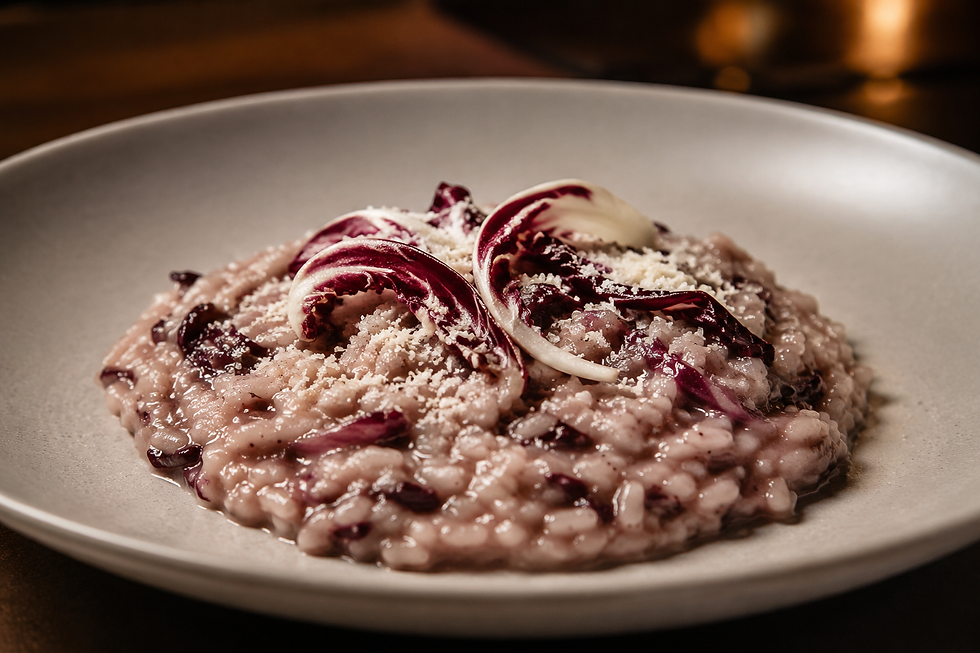
Spoon a ladle into the centre and knock the rim once against the heel of your hand. Three outcomes, three verdicts. It spreads into an even layer that stops short of the rim and ripples for a second: correct. It sits in a dome and refuses to move: too tight, beat in a spoonful of hot brodo. It runs to the rim and leaves a ring of liquid: too loose, so serve it fast and take less brodo next time.
Finish with a turn of white pepper and nothing else. A plain parmigiana takes no garnish, no parsley, no oil, no cheese at the table. Anything added now disguises the surface, and the surface is the point. Serve within 60 seconds of leaving the pan.
Professional Technique
The controlling technique is starch management, and it explains all four faults. Carnaroli carries two starches: amylopectin, which sits in the outer layers and dissolves to give creaminess, and amylose, which lives deeper and sets firm as it cools. Correct risotto releases most of the first and little of the second. Collato is amylose that has escaped, from undertoasted rice or grains broken by violent stirring. Slegato is amylopectin that never came out, because there was too much liquid and not enough friction.
The tostatura is what makes the separation possible. Heating dry rice in fat until the grains click partly gelatinises the surface starch and forms a firm outer shell. That shell acts as a valve: it lets amylopectin leach out slowly over 18 minutes while holding the amylose inside. This is why toasting cannot be shortened and why rinsing rice before a risotto, a habit imported from other rice traditions, destroys the dish before it starts.
The mantecatura is a genuine emulsion and obeys the same rules as any other. The starch suspended in the liquid is the stabiliser, cold butter supplies the fat in pieces small enough to disperse before they pool, and hard mechanical action off the heat brings them together. Warm butter, a pan on the flame or a lazy stir all give fat that separates and floats. Once it has split, more cheese only thickens the mess.
Texture and Moisture Control
Onda is a measurable state, not a feeling. A risotto at the right consistency spreads across a knocked plate in about 2 seconds and then stops, the surface still moving faintly. A spoon drawn through it leaves a channel that closes slowly rather than staying open or collapsing. Learn those two tests and you stop guessing.
The liquid ratio is the lever. Carnaroli absorbs roughly three and a half to four times its weight, but a risotto is finished by judgement rather than measurement, because evaporation changes with the pan and the heat. The working rule is to stop adding brodo about 2 minutes before the rice is ready, since the pan thickens during the rest and the mantecatura loosens it again. Finishing tight and correcting loose is easier than the reverse.
Heat is the other lever and it runs both ways. Too gentle and the grains never move enough to release starch, so the risotto ends slegato even with the right liquid. Too hard and the outside of each grain boils before the centre hydrates, giving rice that is mushy and raw at once. Hold a steady lively simmer, active enough that the surface breaks constantly but never a rolling boil.
Professional Mise en Place
Risotto punishes disorganisation more than any other primo, because the 18 minutes of cooking allow no time to fetch anything. Set the station before the rice goes in the pan.
Equipment and tools
Wide heavy pan, about 11 inches (28 cm)
Second saucepan holding the brodo at about 190°F (88°C)
Ladle sized to about 1/2 cup (120 ml), so additions stay consistent
Flat wooden spoon, and a thermometer while you learn the rest point
Warm flat plates, never bowls
Prepared ahead
Brodo made, strained and seasoned, up to 3 days ahead
Shallot minced very finely, up to 4 hours ahead, kept covered and cold
Parmigiano grated on the day, never in advance, since it dries and clumps
Butter cubed and refrigerated so it goes in genuinely cold
Wine measured and standing at room temperature beside the pan
Service setup
Brodo simmering on the burner next to the rice, ladle resting in it
Cold butter and cheese within arm's reach for the mantecatura
Plates warmed before the rice reaches minute 15
A clean spoon for tasting, changed each time
Nothing else cooking in that window, because risotto cannot be held
Chef Tips
Use Carnaroli rather than Arborio while you are learning to read the pan. Its higher amylose content and firmer structure give a window of about 2 minutes between al dente and overcooked. Arborio gives perhaps 40 seconds, and Vialone Nano is faster still and better suited to the looser Veneto risotti.
Buy Parmigiano Reggiano aged 24 months and grate it yourself. Pregrated cheese carries anticaking agents that interfere with the emulsion, and cheese past 36 months has lost so much moisture that it goes grainy instead of melting. It is one of four ingredients here, so it shows.
If the rice is about to overcook and the table is not ready, take the pan off the heat and spread the risotto thin on a cold tray, so the residual heat stops working on the grain. You can bring it back with hot brodo and finish the mantecatura fresh. It is not quite the same dish, and it is far better than scotto rice.
Learn to hear the pan as well as watch it. Rice toasting correctly makes a dry click. A risotto at the right simmer makes a steady low bubbling, one with too much liquid sounds like boiling water, one that is catching sounds sharp and dry. Cooks who make risotto daily listen as much as they look.
Common Mistakes
Rinsing the rice before cooking. Washing away the surface starch removes exactly what makes risotto creamy, and no stirring afterwards replaces it. Rice for risotto goes into the pan dry and unwashed.
Using a tall narrow pot. Depth makes the bottom overcook while the top stays raw and stops the grains rubbing. A wide heavy pan with the rice no deeper than an inch solves half the faults in this list.
Flooding the pan with brodo. All the liquid at once boils the rice instead of cooking it in friction, and the starch never comes out. The result is slegato. Add one ladle at a time and wait until it is nearly absorbed.
Adding the butter over the flame. Above about 175°F (80°C) butter melts and separates instead of emulsifying, which is a mantecatura impazzita. Rest the pan off the heat for a full minute first, then beat in cold butter and cheese fast.
Cooking to the packet time. Packet times ignore your pan, your heat and how much liquid the rice has taken. Start tasting at 14 minutes and trust the grain, not the clock. One minute too long gives riso scotto and there is no recovery.
Adding cream to correct the texture. Cream masks a slegato risotto rather than fixing it, and flattens the brodo and the cheese. If it is thin, cook it longer and beat the mantecatura harder.
Wine Pairing
Erbaluce di Caluso DOCG: A Piedmontese white with unusually high natural acidity, grown not far from the rice fields themselves. That acidity is what a plain parmigiana needs, since the dish is butter and hard cheese and dulls the palate quickly. It has a stony finish and very little aromatic noise, so it refreshes without adding a competing flavour.
Bianco di Custoza DOC: A blend from the moraine hills south of Lake Garda, soft in outline but with a firm core and a faint bitter almond close. It has more texture than most light Italian whites, so it sits alongside the emulsion rather than under it. Its white flower and pear aromatics never overwhelm a risotto of four ingredients.
Verdicchio di Matelica DOC: The inland Verdicchio, from a cool valley in the Marche, tighter and more saline than the coastal version. Its acidity is high and its finish bitter in the way good Verdicchio always is, which cuts straight through the butter. Choose a young unoaked bottle: wood adds a second creamy element the dish does not need.
Valpolicella Classico DOC: The light red option, made from Corvina and served cool at around 57°F (14°C). Tannin is very low, which matters because tannin binds to dairy protein and strips the emulsion off the palate. What it brings instead is sour cherry acidity and a bitter almond finish that cut the richness.
Trentino Marzemino DOC: A soft alpine red with dark plum and violet aromatics, modest alcohol and almost no grip, from the Vallagarina south of Trento. It is the winter bottle, when a white can feel thin against a hot rich plate. Serve it lightly chilled, and keep it for the plain parmigiana rather than any version with fish.
Storage & Reheating
A finished risotto cannot be stored and then restored. Once it cools the starch retrogrades, the emulsion breaks and the grain firms, and nothing brings back onda. Leftovers keep in an airtight container in the refrigerator for up to 2 days, spread thin on a cold tray first, since a hot covered mass keeps cooking and waters itself down.
To reheat, warm it in a wide pan with about 3 tablespoons of hot brodo per portion over medium low heat, stirring gently for 3 minutes, then finish with a knob of cold butter off the heat. Never use a microwave: it gives paste outside and a cold centre. The brodo keeps 3 days refrigerated and freezes for 3 months, which is the part worth making in quantity.
The traditional answer in Lombardy is riso al salto, and it is better than reheating. Press the cold risotto into a thin disc, fry it in butter over medium heat for 4 to 5 minutes a side without moving it, and turn it out when a deep crust has formed. Do not freeze finished risotto: it thaws grainy and separated.
Nutrition
Per serving, based on 4 servings:
Calories: 585 kcal
Total Fat: 24 g
Saturated Fat: 15 g
Trans Fat: 0.7 g
Unsaturated Fat: 7 g
Cholesterol: 65 mg
Sodium: 780 mg
Total Carbohydrates: 70 g
Fiber: 1.5 g
Total Sugars: 2 g
Added Sugars: 0 g
Protein: 16 g
Lactose: 0.7 g
Principal micronutrients: calcium, phosphorus, selenium, zinc, vitamin A, vitamin B12, riboflavin
These figures are estimates. Almost all the calcium and much of the protein come from the Parmigiano Reggiano, and the sodium depends on how the brodo was seasoned, since the rice absorbs nearly all of it.




Comments