Vegan Barley Orzotto with Treviso Radicchio, Reinterpreted | Orzotto al Radicchio Trevigiano Vegano Rivisitato

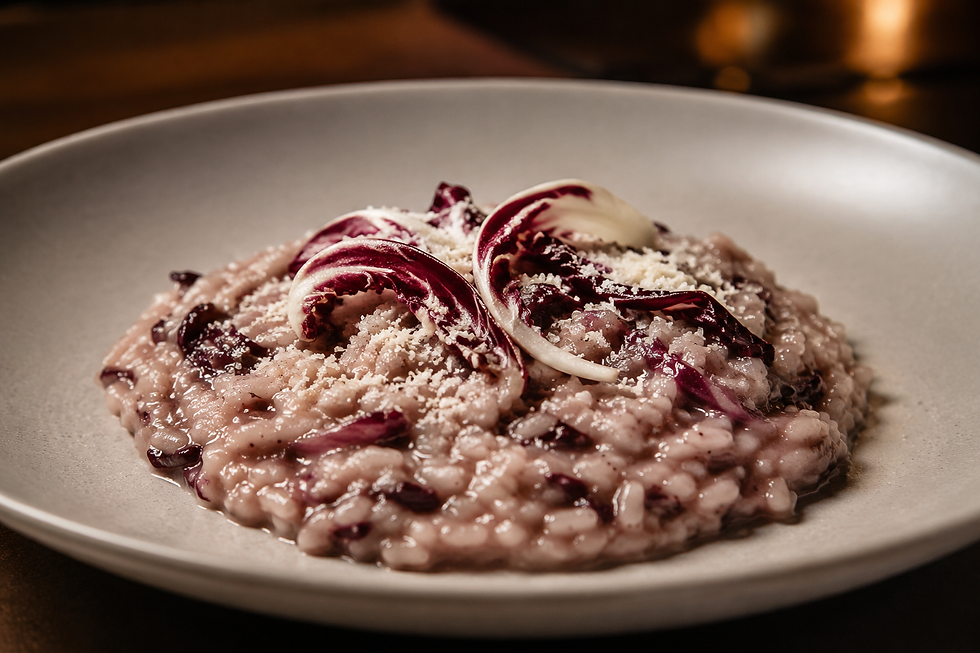
Orzotto is barley cooked with the method of risotto: toasted in fat, moistened with wine, fed with hot broth a ladle at a time and finished with a creamy mantecatura. In the Veneto it meets one of the great winter vegetables of Italy, the red radicchio of Treviso, whose bitterness turns gentle and almost sweet in the pan. The classic is finished with butter and Grana Padano or Parmigiano Reggiano; this vegan recipe is a reinterpretation that keeps the structure of the northern dish and replaces them with a cashew cream and cold extra virgin olive oil, so every grain stays distinct, chewy and glossy. The result is a deep crimson primo with a clean bitter edge, a nutty body and a long, savory finish.
Yield: 4 servings. Prep: 25 minutes, plus 4 hours soaking for the cashews. Cook: 50 minutes. Rest: 2 minutes. Course: primo piatto. Region: Veneto.
The Story
Barley is one of the oldest cultivated cereals in the world, grown in the Near East thousands of years before it reached the Italian peninsula. In the Alps and the foothills of the northeast it remained a staple long after wheat and rice became common elsewhere, because it tolerates short summers, cold nights and thin mountain soils. Barley soups are still part of the everyday cooking of Trentino, Friuli and the mountain valleys of the Veneto, and orzotto grew out of that same kitchen: the grain of the poor treated with the care normally given to rice.
The name is simple. Orzo is the Italian word for barley, and orzotto joins it to the ending of risotto, announcing the method rather than an ancient recipe. It is a dish of the modern northeastern table, cooked in homes and trattorie from the Dolomites to the plain, where it changes with the seasons: asparagus in spring, mushrooms in autumn, and radicchio in the cold months, when the fields around Treviso turn red.
The Radicchio Rosso di Treviso is protected as an IGP in two types. The early one, precoce, has compact elongated heads. The late one, tardivo, is the more prized: after harvest the plants are kept with their roots in tanks of running spring water, in the dark, until the new inner leaves grow white ribs and deep red tips, crisp and only lightly bitter. This forcing, called imbianchimento, is slow manual work and the reason tardivo arrives in markets only from late autumn. Around Treviso the same radicchio goes into risotto, onto the grill and into the pan, and it suits barley just as well.
Traditional orzotto is finished with butter and Grana Padano or Parmigiano Reggiano, and the classic risotto al radicchio of Treviso often adds both. This version is entirely plant based. Raw cashews soaked and blended with lemon give the creamy fat and the gentle acidity the cheese once provided, cold olive oil replaces the butter in the final stirring, and toasted walnuts add the depth that aged cheese brings. The method, the grain and the radicchio stay exactly as the tradition wants them.
Ingredients
Choose pearl barley with plump, pale, uniform grains and no dust in the bag: broken grains release too much starch too fast and turn the orzotto gluey. Look for firm radicchio heads with bright, tightly packed leaves and white ribs that snap; tardivo is ideal in winter, precoce or a long Chioggia-type head works at other times. Use raw, unsalted cashews for the cream, a dry white wine you would drink, and a delicate extra virgin olive oil from the Veneto, such as the Veneto Valpolicella DOP or Garda DOP, for finishing.
For the vegetable broth
Cold water, 2 1/2 quarts (2.4 l)
Yellow onion, 1 medium, halved, skin on
Carrot, 1 large, cut in thirds
Celery, 2 stalks, cut in thirds
Leek greens, from 1 leek, washed
Bay leaf, 1
Black peppercorns, 6
Fine sea salt, 2 tsp (12 g)
For the cashew cream
Raw cashews, 1/2 cup (70 g), soaked in water for 4 hours
Fresh lemon juice, 2 tsp (10 ml)
Fine sea salt, 1 pinch
Cold water, 1/3 cup (80 ml)
For the orzotto
Pearl barley, 1 1/2 cups (300 g)
Radicchio Rosso di Treviso, 14 oz (400 g), about 3 heads
Extra virgin olive oil, 3 tbsp (45 ml)
Shallots, 2, finely chopped, about 3 oz (80 g)
Dry white wine, 1/2 cup (120 ml)
Red wine vinegar, 1 tsp (5 ml)
Fine sea salt and freshly ground black pepper, to taste
For the finish and the garnish
Extra virgin olive oil, delicate, cold, 2 tbsp (30 ml)
Walnut halves, 1/3 cup (35 g), toasted
Fresh thyme leaves, 1 tsp (1 g)
Flaky sea salt, 1 pinch
Preparation
Step 1

Make the vegetable broth. Put all the broth ingredients in a large pot, bring them slowly to a simmer over medium heat and cook gently, uncovered, for 45 minutes. Strain the broth into a clean saucepan, discarding the vegetables, and keep it at a bare simmer next to the stove. You need about 6 cups (1.4 l). The onion skin gives the broth a golden color, and the slow simmer extracts sweetness from the vegetables without the cloudy, cabbage-like taste a hard boil produces. A light, clean broth matters here, because radicchio and barley have delicate flavors that a strong stock would cover.
Step 2

Blend the cashew cream. Drain and rinse the soaked cashews, put them in a blender with the lemon juice, a pinch of salt and the cold water, and blend for 2 minutes, until perfectly smooth and as thick as a yogurt. Taste it: it should be mildly tangy and clean. Keep it in the refrigerator until the end. Soaking softens the cashews so they break down completely into an emulsion of fat and water, which behaves in the pan very much like the butter and cheese of a classic mantecatura, thickening the liquid around the grains without making it heavy.
Step 3

Prepare the radicchio. Separate the radicchio leaves, wash them in cold water and dry them well. Set aside the 8 most attractive inner leaves for the garnish. Cut the rest crosswise into strips about 1/2 inch (1 cm) wide, keeping the white ribs and the red leaf together. Divide the strips into two parts, two thirds for cooking with the barley and one third to add at the end. The radicchio cooked from the start colors the orzotto and softens its bitterness, while the portion added in the last minutes keeps a fresh crunch and a cleaner bitter note.
Step 4

Toast the barley. Warm 3 tbsp (45 ml) of olive oil in a wide, heavy pan over medium low heat, add the shallots with a pinch of salt and cook them for 5 minutes, until soft and translucent, without color. Raise the heat to medium, add the pearl barley and stir continuously for 3 to 4 minutes, until the grains are hot to the touch, slightly opaque and smell of toasted bread. Pour in the white wine and stir until it has completely evaporated and the sharp smell of alcohol is gone, about 2 minutes. Toasting dries the surface of each grain and seals it slightly, so the barley absorbs broth evenly and keeps its bite.
Step 5

Cook the barley with the radicchio. Add two thirds of the radicchio strips and stir for 2 minutes, until they wilt and turn a dark garnet color. Add hot broth until it just covers the barley, about 2 cups (475 ml), and keep the heat at a lively simmer. Stir every minute or two and add more broth, a ladle at a time, whenever the surface looks dry. Pearl barley needs 30 to 35 minutes, longer than rice, and it releases its starch more slowly, so you do not need to stir it continuously as for a risotto; regular stirring is enough to rub the starch off the grains and build the creamy base.
Step 6

Add the second radicchio and the vinegar. After about 28 minutes, taste a grain: it should be almost tender with a firm, chewy center. Add the remaining radicchio and the teaspoon of red wine vinegar, stir for 2 minutes and add a last ladle of broth so the orzotto stays fluid. The vinegar brightens the color of the radicchio, because its red pigments are more vivid in a slightly acidic environment, and it lifts the flavor of the dish the way a dry white wine does at the end of a risotto. Season with salt and pepper.
Step 7

Finish with the mantecatura. Take the pan off the heat when the barley is tender but still springy, and the liquid around it is loose and abundant. Add the cold cashew cream and the 2 tbsp (30 ml) of cold olive oil and beat the orzotto vigorously with a wooden spoon for 1 minute, shaking the pan back and forth. Cover and leave it to rest for 2 minutes. The cold fat, beaten into the hot starchy liquid, forms a glossy emulsion that binds the grains together; if the orzotto looks tight, loosen it with a splash of hot broth. It should spread slowly on a plate, all'onda, never standing in a heap.
Plating
Warm shallow plates to about 140°F (60°C). Spoon about 1 1/4 cups (300 g) of orzotto into the center of each plate and tap the bottom of the plate on a folded towel so it spreads into a flat, even disc with a glossy surface. The color should be a deep, even crimson, with the paler ribs of the fresh radicchio visible.
Place two raw inner radicchio leaves upright on one side of each portion, scatter the toasted walnuts, roughly broken, over the surface, and finish with a few thyme leaves, a turn of black pepper and a pinch of flaky salt. A thin thread of olive oil around the edge adds shine. The guest eats it with a fork or a spoon, alternating the soft, creamy grains with the crunch of walnuts and raw leaves.
Professional Technique
The key number is the liquid. Pearl barley absorbs about three and a half to four times its weight in broth: for 1 1/2 cups (300 g) of barley, plan for 5 to 6 cups (1.2 to 1.4 l) of hot broth, added over 30 to 35 minutes. Keep at least 1 cup (240 ml) aside for the end, because the mantecatura and the rest both tighten the orzotto and you will almost always need a last splash.
The hidden variable is the barley itself. Pearl barley has lost its husk and most of its bran, but how much has been polished away varies from brand to brand. A heavily pearled barley is white and cooks in 25 minutes; a lightly pearled one is beige and may need 40. Taste from the 25th minute onward and judge by the grain, not by the clock. Never use hulled whole barley for orzotto: its bran prevents the starch from escaping and the dish stays dry.
The doneness test is the bite. Press a grain between your teeth: it should be tender all the way through but spring back, with a pleasant chew that rice never has. The liquid around the grains should be creamy and loose, and a spoonful dropped on a plate should spread slowly in a wave.
Bitterness and Color Control
Radicchio is bitter because of natural compounds concentrated in its leaves, and the bitterness is the point of the dish, but it must be balanced. Heat softens it, salt reduces how strongly we perceive it, fat rounds it and a little acid sharpens the fruit behind it. That is why the radicchio is cooked in two moments: the long-cooked part gives a mellow, almost sweet depth, the fresh part keeps the clean bitter note that wakes up the palate.
The color is fragile. The red pigments of radicchio, the same family found in red cabbage, are vivid in acidic conditions and turn dull and brownish in neutral or alkaline ones, and they fade with long cooking. The white wine at the start and the teaspoon of vinegar near the end keep the pan slightly acidic and the orzotto crimson. Adding the radicchio too early, or cooking it hard over high heat, gives a gray dish however good it tastes.
The cashew cream also affects the color, because it lightens the red as it binds. Use only the quantity in the recipe: enough to make the orzotto creamy and to round the bitterness, not so much that it turns pink and loses its edge. If your radicchio is especially bitter, add a little more cream rather than sugar, which would flatten the flavor.
Professional Mise en Place
Orzotto rewards preparation: the broth, the cashew cream and the cut radicchio can all be ready an hour before service, so that the last 35 minutes are only toasting, stirring and finishing.
Equipment and tools
Large pot and fine strainer for the broth, saucepan to keep it simmering
Wide, heavy pan with low sides, about 11 inches (28 cm)
Wooden spoon with a flat edge, ladle, chef's knife, salad spinner
High-speed blender for the cashew cream, small dry pan for the walnuts
Prepared ahead
Vegetable broth strained, up to 3 days ahead, refrigerated
Cashews soaked and blended, up to 2 days ahead, refrigerated
Radicchio washed, dried and cut, garnish leaves kept apart, within 2 hours of service
Walnuts toasted at 325°F (165°C) for 8 minutes and cooled
Service setup
Broth simmering next to the pan, ladle in it
Cashew cream and finishing oil cold, measured and ready
Plates warmed to about 140°F (60°C)
Walnuts, thyme, pepper mill and flaky salt on the pass
Chef Tips
Rinse the pearl barley briefly in a sieve under cold water and dry it well on a towel before toasting. This removes the loose starch dust left by the polishing, which would otherwise make the first minutes of cooking cloudy and sticky. Do not rinse it for long or soak it, or the grains lose the surface starch you need for the creamy base.
If you find tardivo, use it raw in the garnish and in the final addition, and use precoce for the long cooking: precoce is cheaper, more bitter and holds up better in the pan, while the crisp, sweeter tardivo shows its best qualities when barely cooked.
Make a quick radicchio oil with the trimmings. Blend the outer leaves you would discard with 1/4 cup (60 ml) of olive oil, warm the mixture to 140°F (60°C) for 2 minutes, then strain it through a coffee filter. A few drops on the plate give a ruby color and a concentrated bitter aroma.
For a deeper, toasted flavor, roast half of the walnuts until dark golden and blend them into the cashew cream. The walnut skins bring a tannic note that echoes the radicchio and replaces the savory depth of aged cheese.
Common Mistakes
Using hulled or quick-cooking barley. Hulled barley keeps its bran and never becomes creamy; quick-cooking barley is precooked and turns to mush. Use true pearl barley.
Skipping the toasting. Untoasted barley absorbs broth unevenly and cooks soft outside and hard inside. Toast it until hot, opaque and fragrant.
Adding cold broth. Cold liquid stops the cooking and makes the starch set around the grains. Keep the broth at a bare simmer beside the pan.
Cooking all the radicchio from the start. Long-cooked radicchio loses its color and its fresh bitterness. Cook two thirds with the barley and add the rest at the end.
Browning the shallots. Browned shallots bring a burnt sweetness that clashes with the radicchio. Cook them gently until translucent.
Finishing on the heat. The cashew cream can split and turn grainy if it boils. Take the pan off the heat before the mantecatura.
Serving it stiff. Orzotto thickens as it rests. Leave it loose, all'onda, and serve it at once on warm plates.
Wine Pairing
Valpolicella Classico DOC: A light, fragrant red from the hills north of Verona, made mainly from Corvina, with sour cherry fruit, a hint of almond and gentle tannins. Its freshness meets the bitterness of the radicchio and its fruit softens it. Serve it slightly cool, at about 60°F (16°C).
Soave Superiore DOCG: A white of the Veneto from the Garganega grape on volcanic and limestone hills east of Verona, with almond, white flowers and a mineral finish. Its almond note echoes the cashew cream and its acidity refreshes the palate. Serve it at about 50°F (10°C).
Bardolino DOC: A pale, delicate red from the eastern shore of Lake Garda, with red berries and a light peppery spice. It has the lightness the dish needs and enough structure for the walnuts and the nutty barley. Serve it at about 57°F (14°C).
Collio Friulano DOC: From neighboring Friuli, where orzotto is also part of the everyday table, a white with a full, round body, notes of pear and a typical bitter almond finish that suits the radicchio perfectly. Serve it at about 52°F (11°C).
Storage & Reheating
Refrigerator: keep leftover orzotto in an airtight container for up to 3 days. Barley holds its shape far better than rice, so it reheats well, though it absorbs the remaining liquid and turns firm when cold. Freezer: possible for up to 2 months, but the radicchio darkens and softens; the broth and the cashew cream freeze better on their own, for up to 3 months. Cool the orzotto within 1 hour before refrigerating.
Reheat in a pan over medium low heat with about 1/4 cup (60 ml) of hot broth or water per portion, stirring gently until creamy and steaming, about 5 minutes. In the microwave, add the same liquid, cover and heat at 70 percent power for 2 minutes, stir, then heat 1 minute more. Finish with a thread of cold olive oil and a few fresh walnuts to restore shine and crunch.
Nutrition
Per serving, based on 4 servings:
Calories: 560 kcal
Total Fat: 25 g
Saturated Fat: 4 g
Trans Fat: 0 g
Unsaturated Fat: 21 g
Cholesterol: 0 mg
Sodium: 680 mg
Total Carbohydrates: 70 g
Fiber: 14 g
Total Sugars: 5 g
Added Sugars: 0 g
Protein: 13 g
Principal micronutrients: manganese, selenium, magnesium, copper, vitamin K, folate
These figures are estimates, calculated on the quantities listed and rounded to the nearest whole number, assuming that about 5 cups (1.2 l) of broth are absorbed. They vary with the type of barley, the size of the radicchio and the amount of broth used.


Comments