
Italian Braised Veal Ossobuco with Sardinian Fregola | Ossobuco Brasato con Fregola Sarda
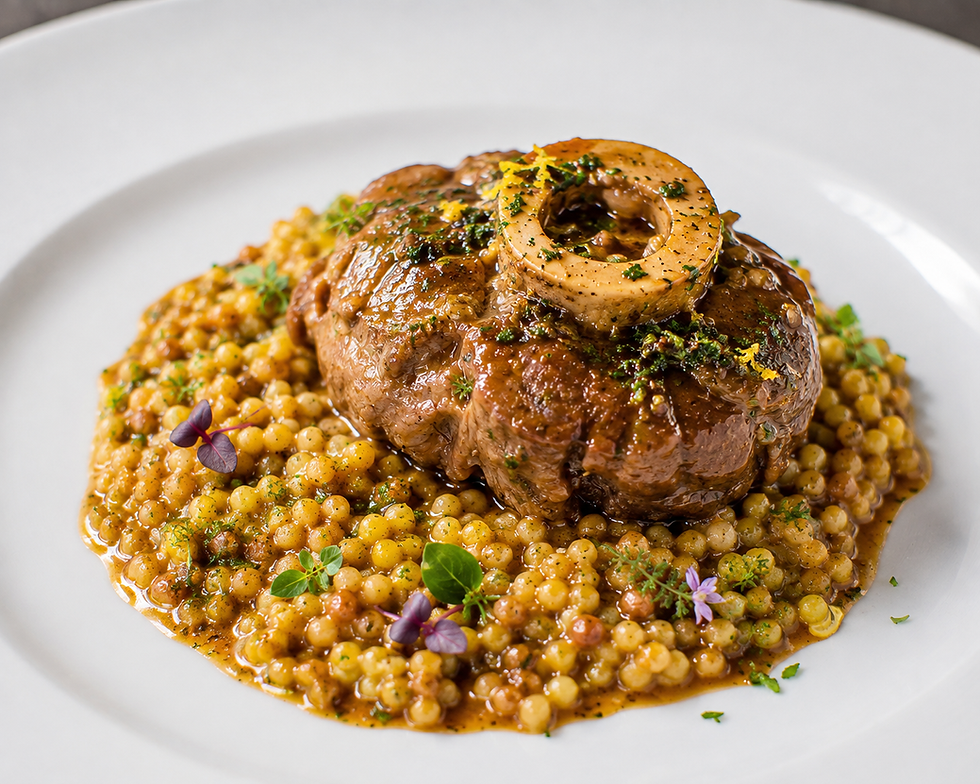
Fregola sarda is the only Italian pasta toasted in an oven before it is ever cooked, and that single fact is what this dish is built on. The semolina is rolled by hand into irregular pearls, dried, then roasted on trays until the surface sets and partly caramelises. A sealed exterior releases starch slowly instead of dumping all of it in the first three minutes, which means fregola can be cooked by absorption, fed with hot liquid in stages, exactly the way you would build a risotto.
So the braising liquid from a veal shank is not reduced into a sauce here. It is strained, split and used as the cooking medium for the pasta, which drinks it, takes its colour and arrives tasting of the same meat sitting beside it. The marrow lifted out of the bone replaces butter in the final mantecatura, and Sardinian saffron infused gently in warm liquid carries the perfume through both halves of the plate.
Yield: 4 servings. Prep: 40 minutes. Cook: 3 hours. Rest: 15 minutes. Total: about 3 hours 55 minutes. Difficulty: advanced. Course: primo piatto. Region: Sardinia, from the Campidano plain to Oristano.
The Story
Fregola comes from the Campidano, the fertile plain that runs from Cagliari towards Oristano, and it is among the oldest documented pastas in the Mediterranean. Notarial records describe it in the fourteenth century, and a Cagliari statute of the period regulated when it could be made, because producing it consumed both semolina and firewood. The method has barely moved. Coarse durum semolina is scattered into a wide earthenware basin called a scivedda, sprinkled with warm salted water and rubbed in slow circles with the flat of the palm until the grains gather into spheres. The pearls are then sieved into grades, dried and toasted in a cooling bread oven.
Toasting is why fregola exists in this form. Sardinia is a dry island whose rural economy had to store food for months, and a toasted pasta keeps far better because surface moisture is driven out and the starch is stabilised. Island cooks almost never boiled and drained it. Saffron belongs to the same landscape: Crocus sativus has been grown around San Gavino Monreale and Turri since the Middle Ages, and for centuries the island shipped it north to the trading cities of Lombardy. The shank is the other half of the story, the humblest cut on the animal, worth nothing until time and gentle heat turn its collagen into gelatine. Milan made it famous; here the liquid it gives up is handed to the pasta instead of being thickened into a gravy.
Ingredients
For the braised shanks
Veal shanks cut crosswise 1 1/2 inches (4 cm) thick, 4 pieces of about 12 oz (340 g) each
All purpose flour for dusting, 1/4 cup (30 g)
Extra virgin olive oil, 3 tbsp (45 ml)
Butter, 2 tbsp (28 g)
Yellow onion, finely diced, 1 medium, about 5 oz (140 g)
Carrot, finely diced, 1 medium, about 3 oz (85 g)
Celery, finely diced, 1 stalk, about 2 oz (55 g)
Garlic cloves, peeled and lightly crushed, 3
Tomato paste, 1 tbsp (16 g)
Vermentino, dry and unoaked, 1 cup (240 ml)
Veal stock, unsalted and well reduced, 3 cups (720 ml)
Fresh myrtle sprigs, 2, or dried myrtle berries, 1 tsp
Thyme sprigs, 2, and bay leaf, 1
Wild fennel seeds, lightly crushed, 1/2 tsp (1 g)
Aged white wine vinegar, 1 tsp (5 ml)
Fine sea salt and freshly ground black pepper, to taste
For the fregola
Sardinian fregola, medium grade and well toasted, 12 oz (340 g)
Butter, 2 tbsp (28 g)
Shallot, finely chopped, 1 large, about 1 1/2 oz (40 g)
Sardinian saffron threads, 1/2 tsp (about 0.4 g)
Bone marrow lifted from the braised shanks, about 2 oz (55 g)
Pecorino Sardo DOP, aged 8 months and finely grated, 1/4 cup (25 g)
For finishing
Sardinian extra virgin olive oil, 2 tsp (10 ml)
Pecorino Sardo shaved into thin curls, 1/2 oz (15 g)
Dry toasted fregola pearls for scattering, 1 tbsp (10 g)
Maldon sea salt flakes, 1/2 tsp
Wild fennel fronds, a few small sprigs
Preparation
Tying, Seasoning and Browning the Shanks
Bring the shanks out of the refrigerator forty minutes ahead. Tie each slice once around its circumference with butcher's twine, firm but not throttling: the muscle bundles that ring the tibia separate as soon as the collagen between them dissolves, and an untied shank collapses and loses the marrow canal. Season both faces, dust them lightly with flour, then slap off everything that does not cling. Heat the olive oil and the first butter until the foam subsides, then brown the shanks two at a time, four to five minutes a face, without moving them.
Building the Soffritto and Deglazing with Vermentino
Park the browned pieces upright on a tray so gravity keeps the marrow in place. Drop the heat to medium and add the onion, carrot, celery and crushed garlic to the same fat. Cook them ten to twelve minutes, scraping the base as their moisture dissolves the fond. When the vegetables are soft, push them aside, drop the tomato paste onto the bare metal and cook it a minute until it darkens from red to brick. Pour in the Vermentino, scrape everything loose and reduce by half. Add the crushed fennel seeds, myrtle, thyme and bay.
Braising the Shanks and Splitting the Liquid
Return the shanks in one layer, marrow side up, and pour the veal stock around them until it reaches two thirds of the way up the meat and no further. A submerged shank poaches instead of braising, and the exposed face is exactly what concentrates and glazes. Bring the surface to the barest tremble, cover tightly and slide the pan into an oven at 325°F (165°C) for 2 1/2 to 3 hours, basting every forty minutes. Lift the shanks out with a wide flat spatula supported from underneath, then strain the liquid through a fine mesh chinois, let it settle ten minutes and skim the fat.
Infusing the Saffron and Toasting the Fregola
Split the strained liquid at once: hold 2 cups (480 ml) at a gentle simmer for the pasta and reduce the rest until it coats a spoon, whisking in the vinegar off the heat. Ladle 1/4 cup (60 ml) of the hot liquid into a bowl, let it fall to about 150°F (65°C), add the saffron and infuse twenty minutes. Push the marrow out of the bones, chop it and keep it cold. Sweat the shallot in the second butter for three minutes with no colour, add the fregola dry and toast it three minutes, stirring, then pour in the infusion, threads and all.
Cooking by Absorption and Mounting with Marrow
Now build it like a risotto. Add the hot braising liquid two or three ladles at a time, waiting each time until the previous addition has almost vanished, holding a moderate simmer and stirring often so the starch keeps coming out. Fregola takes 12 to 14 minutes, but taste from minute ten. When a pearl is tender outside with a small firm centre, pull the pan off the heat and wait thirty seconds for the bubbling to stop. Only then fold in the cold marrow and the grated Pecorino Sardo, in wide slow circles. Salt at the very end, because the braise and the pecorino have both been seasoning it all along.
Plating
Use wide shallow bowls with a genuinely flat base, warmed but not hot. Spoon the fregola slightly off centre and give the bowl two short shakes so it settles into a soft oval about six inches across. It should move slowly and then stop by itself; if it locks into a dome the instant it lands it wants another spoonful of hot braising liquid before it leaves the pass.
Snip the twine, lay a shank half on the pasta and half on the bare bowl, marrow canal turned towards the guest, and brush it with the warm reduction in several thin coats so it shines instead of pooling. Shave pecorino over the pasta only, scatter a pinch of the reserved dry pearls, add three drops of Sardinian olive oil and a pinch of Maldon on the meat. Leave the outer third of the bowl bare, and carry the plates out the moment they are built.
Professional Technique
The governing technique is cooking fregola by absorption in the strained braise, and it works only because of the oven toasting the pearls received before packaging. A toasted surface behaves like a slow release membrane: water has to work past a set, partly dextrinised outer layer before it reaches the raw semolina core, so starch leaves the pearl gradually across twelve to fourteen minutes instead of flooding out at the start. That gradual release lets the gelatine from the shank and the starch from the pasta build a bound, glossy sauce with no cream and no flour. It also means the pan must never run dry, because once the exterior starch sets against hot metal the pearls seize for good.
The second half of the technique is the marrow mantecatura. Marrow is close to ninety percent lipid and begins to melt around 104°F (40°C), far below a simmering pan, so over direct heat it liquefies instantly and separates into a slick that stirring will not recover. Off the flame, with the pan near 175°F (80°C), it melts slowly enough for the pasta starch and the casein in the Pecorino Sardo to hold it in suspension. It is the physics of mounting a sauce with cold butter, applied to a fat that came out of the bone on the plate.
Texture and Moisture Control
Fregola holds more liquid inside each pearl than a rice grain does, so it keeps absorbing after it leaves the heat and tightens noticeably in the ninety seconds between pan and table. Cook it looser than you believe is correct and pull it the moment a bitten pearl shows a small pale core. The check is the shake rather than the spoon: move the bowl sideways and the surface should ripple and settle flat within two seconds. A tablespoon of hot liquid stirred in at the bowl rescues a portion that stiffened during service.
Keep the reserve saucepan genuinely hot, since cold additions stop the simmer dead, and if you run short extend with hot water rather than stock, otherwise the salt climbs beyond what the pecorino can sit on. On the meat side the window opens once collagen has converted to gelatine, near two and a half hours at 325°F (165°C), and closes when the fibres begin to shred. Hold ready shanks in the thin liquid off the heat, never in a warming oven, where the exposed face dries and the glaze turns tacky.
Professional Mise en Place
The recipe divides into a long unattended phase and a short intense one. Everything slow can be done the day before, leaving about twenty minutes of real work at service, and nothing should need chopping, grating or measuring once the pasta is in the pan.
Equipment and tools
Heavy braising pan with a tight lid, wide enough to hold four shanks in one layer
Fine mesh chinois and a ladle for skimming the strained liquid
Wide shallow pan for the fregola, plus a saucepan to hold the hot liquid
Butcher's twine, a wide flat fish spatula and a pastry brush for the glaze
Instant read thermometer for the saffron infusion and the mantecatura
Prepared ahead
Braise the shanks a day ahead and cool them in their unstrained liquid, then lift the set fat off in a single sheet
Strain and split the liquid while it is warm, refrigerating the thin and the glazing portions separately
Push the marrow out of the cold bones, chop it and keep it covered and cold up to 24 hours
Weigh the fregola, grate the pecorino and set out the saffron on the morning of service
Service setup
Saffron infusion started twenty minutes before the pasta goes in
Thin braising liquid at a gentle simmer, never below it, with a ladle standing in the pan
Reduction warm and fluid, with the brush beside it
Shanks reheating covered in a little thin liquid, bowls warmed but not hot
Marrow and pecorino cold and within reach of the pan for the final mantecatura
Chef Tips
Buy fregola media rather than fine, and look for pearls of uneven amber colour. Patchy toasting is the signature of a properly oven dried product, and the larger grade keeps its firm centre through fourteen minutes of absorption where the fine grade goes to paste.
Braise the day before without exception. Chilled veal slices cleanly, and the cold liquid tells you whether the stock was strong enough: if it does not set to a soft jelly, reduce it further before it ever meets the fregola.
Check the infusion with a probe rather than by eye. At 150°F (65°C) the surface barely steams, and most cooks overshoot by thirty degrees because it looks far too cool to be working.
If the marrow breaks and the pasta turns oily, take the pan off the heat, add two tablespoons of cold braising liquid and stir hard in one direction only until the emulsion returns. Adding pecorino at that point makes it worse.
Common Mistakes
Boiling the fregola in water and draining it. This removes the entire reason for the recipe, sending the surface starch down the sink and washing out the toasted aroma you paid for. Cook the pearls from raw in the strained braising liquid and let the starch build the sauce.
Crushing the saffron straight into the hot pan. You get colour and almost no perfume, because safranal is volatile and breaks down under sustained heat, while crocin needs time in water rather than a blast of it. Infuse twenty minutes at about 150°F (65°C), then pour it in with the threads.
Folding the marrow in while the pan is still on the flame. It separates instantly at simmering temperature and leaves a film that stirring cannot recover. Pull the pan off the heat, wait until the bubbling has stopped, then add the cold marrow and the pecorino.
Covering the shanks entirely with stock. Submerged veal poaches, the upper surface never concentrates, and the meat tastes washed out however long it cooks. Keep the liquid at two thirds the height of the shanks and baste the exposed faces every forty minutes.
Leaving the shanks untied. The rings of muscle around the bone separate as soon as the collagen between them melts, and a shank that has fallen open cannot be plated or brushed with glaze. One firm turn of twine per slice holds it together through three hours.
Wine Pairing
The plate carries real fat from marrow, butter and aged pecorino over a gelatinous braise, yet its dominant flavours are aromatic rather than heavy, so it wants acidity, supple tannin and a scrub character of its own.
Cannonau di Sardegna DOC: The island red that fits this plate most completely. Ripe red cherry fruit and the warm scrub notes of myrtle and dried rosemary run straight into the saffron and the fennel seed, while tannin that is supple rather than gripping keeps the marrow from coating the palate. Choose a fresh bottling around 14 percent rather than an oaked riserva, because oak tannin sits badly against Pecorino Sardo.
Vermentino di Gallura DOCG: The white answer, and a serious one. Grown on decomposed granite in the north east of the island, it carries a bitter almond edge and a saline cut that slices through the marrow emulsion in a way no red can manage, and it echoes the Vermentino used to deglaze the braise. Serve it at 50°F (10°C).
Nuragus di Cagliari DOC: The quiet local white from the same plain that produced the fregola and the saffron. Light in alcohol, high in acidity and gently citrus scented, it refreshes the palate between forkfuls of a very rich pasta without ever competing with the aroma of the threads. Pour it young and cold.
Alghero DOC: The Catalan corner of Sardinia, and the choice when you want something with more flesh than Cannonau but less weight than a mainland red. Its Cagnulari and Torbato bottlings show dark berry fruit over a savoury herbal frame with moderate tannin, which tracks the gelatine in the braise and keeps the myrtle from being drowned. Decant a young bottle for twenty minutes.
Storage & Reheating
The braise improves overnight and works as a make ahead component. Cool the shanks in their unstrained liquid, transfer them to an airtight container and refrigerate up to 3 days, where the fat sets into a cap that seals the meat. Reheat them covered in a little thin liquid at 300°F (150°C) for about 25 minutes, never uncovered, where the exposed face dries out, and never in a microwave, which contracts the fibres and squeezes the gelatine straight out of them.
The strained liquid freezes 3 months in portioned containers and the reduced glaze keeps 5 days refrigerated, setting firm and needing a moment over low heat to run again. Cooked fregola does not keep at all, since it carries on absorbing and the marrow emulsion breaks on cooling, so cook only what goes on the plate. Raw fregola keeps a year in a sealed jar away from light.
Nutrition
Per serving, based on 4 servings of one shank with a quarter of the finished fregola:
Calories: 890 kcal
Total Fat: 44 g
Saturated Fat: 19 g
Trans Fat: 0.8 g
Unsaturated Fat: 22 g
Cholesterol: 235 mg
Sodium: 780 mg
Total Carbohydrates: 70 g
Fiber: 4 g
Total Sugars: 6 g
Added Sugars: 0 g
Protein: 58 g
Lactose: about 1 g
Principal micronutrients: iron 6 mg, zinc 9 mg, vitamin B12 3 mcg, calcium 180 mg, potassium 950 mg
Allergens: wheat semolina and milk, so the dish contains gluten and lactose. These figures are estimates and shift with the size of the shanks and how far the stock was reduced before it met the pasta.


Comments