Vegan Neapolitan Eggplant Parmigiana, Reinterpreted | Parmigiana di Melanzane Vegana alla Napoletana Rivisitata

Parmigiana di melanzane is the great Sunday dish of Naples: slices of fried eggplant layered with a slow tomato sauce, fresh basil and melting cheese, baked until the edges caramelize and the layers fuse into one tender block. The Neapolitan original is made with fior di latte or smoked provola and grated Parmigiano Reggiano; this vegan version is a reinterpretation that keeps the Neapolitan method, from the salting of the eggplant to the long rest after baking, and replaces the dairy with two plant elements made from scratch: a stretchy cashew mozzarella that melts and browns in the oven, and a toasted almond crumb that gives the savory, salty finish of the grated cheese. The result slices cleanly, holds its layers and tastes of Campania.
Yield: 8 servings. Prep: 1 hour 15 minutes, plus 1 hour salting and 8 hours soaking the cashews. Cook: 1 hour 30 minutes. Rest: 1 hour. Course: secondo piatto or piatto unico. Region: Campania.
The Story
Few dishes are claimed by as many places as the parmigiana. Campania, Sicily and Emilia all defend their right to it, and the name itself has three competing explanations. One traces it to the city of Parma and the Parmigiano Reggiano of the original recipe. Another points to the Sicilian word parmiciana, the overlapping wooden slats of a window shutter, which the layers of eggplant resemble. A third simply reads "alla parmigiana" as an old kitchen term for any vegetable baked in layers with grated cheese. Historians have not settled the question, and a serious cook does not need to: what matters is that Naples gave the dish the form most of the world knows today.
The eggplant reached southern Italy through the Arab presence in Sicily during the Middle Ages, and for centuries it was treated with suspicion in the north, where it was considered a poor and even unhealthy food. In the south it found its ideal climate. Campania grows long, dark eggplants with few seeds and firm flesh, perfect for slicing lengthwise and frying, and the volcanic plain around Vesuvius gives the San Marzano tomato, now protected as San Marzano dell'Agro Sarnese-Nocerino DOP, with its thick walls, low acidity and few seeds.
The first printed recipe that resembles the modern Neapolitan parmigiana is often attributed to Ippolito Cavalcanti, Duke of Buonvicino, whose cookbook Cucina teorico-pratica was published in Naples in the nineteenth century. His eggplants are fried, layered with cheese, basil and tomato sauce, and baked: the same architecture that Neapolitan families still follow. In the traditional home version the slices are fried, the cheese is fior di latte or smoked provola, and Parmigiano Reggiano is grated between every layer.
In Naples the parmigiana belongs to summer, when eggplants are at their best, and to the Sunday lunch, when it is made in large pans and eaten warm or at room temperature, often the day after. This vegan recipe follows that tradition step by step. It replaces the fior di latte with a cashew mozzarella thickened with tapioca starch, which stretches and browns like the original, and the grated Parmigiano Reggiano with a crumb of toasted almonds, nutritional yeast and sea salt. The dish is honestly different from the dairy original, and it is built to deliver the same structure, the same richness and the same deep tomato flavor.
Ingredients
Choose eggplants that feel heavy for their size, with tight, glossy skin and a green, fresh stem: light eggplants are spongy and drink oil. Long, dark Neapolitan or globe eggplants both work; avoid very large ones, which carry more seeds and bitterness. For the sauce, use whole peeled San Marzano tomatoes from a reliable producer and pass them through a food mill rather than blending them, so the seeds do not break and turn the sauce bitter. Use raw, unsalted cashews for the mozzarella and a neutral, high smoke point oil such as peanut or high oleic sunflower for frying.
For the eggplant
Eggplants, firm, 4 1/2 lb (2 kg), about 4 large
Coarse sea salt, for drawing out water, 3 tbsp (45 g)
All-purpose flour, for dusting, 1 cup (125 g)
Peanut or high oleic sunflower oil, for frying, 6 cups (1.4 l)
For the San Marzano sauce
Whole peeled San Marzano tomatoes, 2 cans of 28 oz (800 g) each
Extra virgin olive oil, 1/4 cup (60 ml)
Garlic, 2 cloves, peeled and lightly crushed
Yellow onion, small, finely chopped, 1/2 cup (70 g)
Fresh basil, 1 large bunch, about 1 oz (30 g)
Fine sea salt, 1 1/2 tsp (9 g)
Sugar, only if the tomatoes are sharp, 1/2 tsp (2 g)
For the cashew mozzarella
Raw cashews, soaked 8 hours, 1 cup (140 g) before soaking
Cold water, 1 1/2 cups (360 ml)
Tapioca starch, 1/4 cup (32 g)
Plain unsweetened plant yogurt, 2 tbsp (30 g)
Fresh lemon juice, 2 tsp (10 ml)
Refined coconut oil, melted, 1 tbsp (15 ml)
Fine sea salt, 1 tsp (6 g)
For the almond crumb
Blanched almonds, 3/4 cup (100 g)
Nutritional yeast flakes, 1/4 cup (15 g)
Fine sea salt, 3/4 tsp (4 g)
Garlic powder, 1/4 tsp (1 g)
Extra virgin olive oil, 1 tbsp (15 ml)
Preparation
Step 1

Salt and press the eggplant. Trim the eggplants and cut them lengthwise into slices 3/8 inch (1 cm) thick, leaving the skin on. Layer them in a colander, sprinkling coarse salt between the layers, cover with a plate and a weight of about 4 lb (2 kg), and leave them for 1 hour. The salt draws water out of the cells by osmosis, and the pressure squeezes it away: drier flesh absorbs far less oil during frying and holds its shape during baking. Rinse the slices quickly under cold water, then dry them thoroughly between clean kitchen towels, pressing firmly. Any water left on the surface will spatter in the oil and make the slices steam instead of fry.
Step 2

Make the cashew mozzarella. Drain and rinse the soaked cashews and blend them with the cold water, tapioca starch, plant yogurt, lemon juice, coconut oil and salt for 2 minutes, until perfectly smooth with no grit between the fingers. Pour the mixture into a nonstick saucepan and cook over medium low heat, stirring constantly with a silicone spatula. After 3 to 4 minutes it thickens suddenly, then turns glossy, elastic and stretchy, pulling away from the sides in one mass. Cook 1 minute more and spread it on a parchment lined tray to cool. Tapioca starch gelatinizes at about 150°F (65°C): its long chains of amylopectin give the stretch and the melt, while the cashew fat gives body and the yogurt and lemon give the mild lactic tang of fresh mozzarella.
Step 3
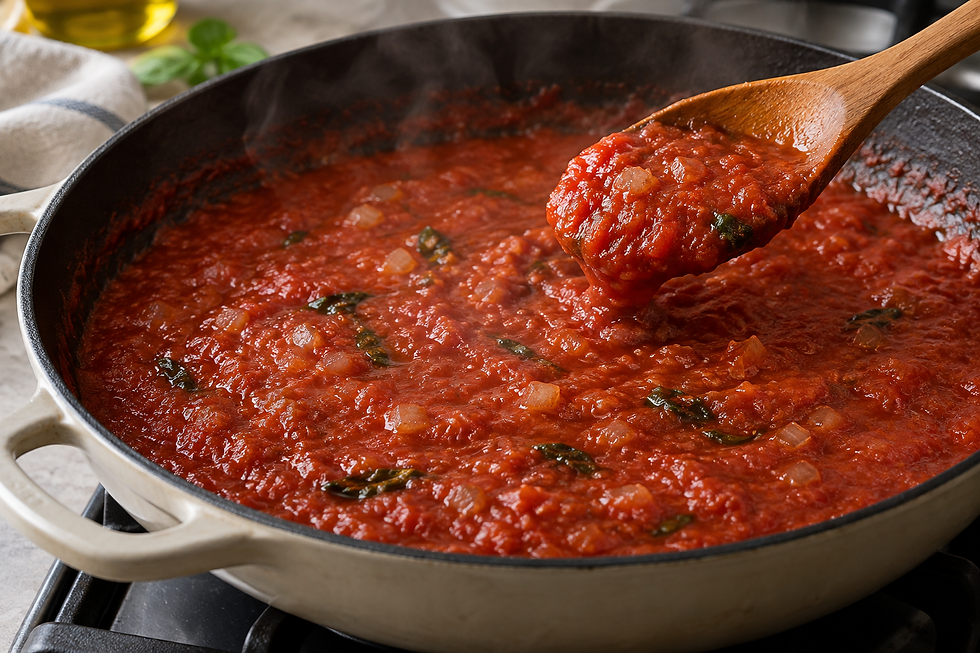
Cook the sauce. Pass the tomatoes and their juice through a food mill. In a wide pan, warm the olive oil over medium low heat with the garlic and the onion and cook for 8 minutes, until the onion is soft and translucent but not colored; remove the garlic. Add the passed tomatoes, the salt and half of the basil leaves, torn by hand, and simmer uncovered for 40 to 45 minutes, stirring now and then, until the sauce has reduced by about one third and coats a spoon in an even layer. Taste it: if it is sharp, add the sugar. A parmigiana sauce must be denser than a pasta sauce, because the eggplant releases more liquid in the oven; a thin sauce makes a watery dish.
Step 4

Fry the eggplant. Heat the frying oil in a deep, heavy pot to 340°F (170°C). Dust each slice lightly in flour and shake off the excess, then fry 3 or 4 slices at a time for 2 to 3 minutes per side, until deep golden and soft right through when pressed with tongs. Drain them on a rack set over a tray and then blot them with paper towels. Keep the oil between 335 and 350°F (168 and 177°C): colder oil soaks into the flesh and leaves the slices greasy, hotter oil burns the flour before the eggplant is cooked. The thin flour coating seals the surface, creating a crust that limits oil absorption and gives the layers a slight structure.
Step 5

Toast the almond crumb. Heat the oven to 350°F (175°C). Pulse the blanched almonds in a food processor until they look like coarse sand, then mix them with the nutritional yeast, salt, garlic powder and olive oil. Spread the crumb on a tray and toast it for 8 to 10 minutes, stirring halfway, until pale gold and fragrant. Let it cool completely. Nutritional yeast brings glutamates, the same savory molecules that make aged cheese taste deep and round, while toasted almonds add fat and a fine grainy texture that melts into the sauce like grated cheese.
Step 6

Assemble the parmigiana. Raise the oven to 375°F (190°C). Spread 3/4 cup (180 ml) of sauce over the bottom of a 9 by 13 inch (23 by 33 cm) baking dish. Lay a layer of eggplant slices, slightly overlapping, then spoon over a thin layer of sauce, scatter small pieces of cashew mozzarella, a few torn basil leaves and 2 tbsp of almond crumb. Repeat for four or five layers, pressing each one gently with your palm. Finish with sauce, the remaining mozzarella and a generous layer of almond crumb. Pressing removes air pockets, so the layers bake into one compact block that slices cleanly.
Step 7

Bake and rest. Bake the parmigiana for 40 to 45 minutes, until the sauce bubbles at the edges, the top is browned in spots and a knife slides through the center without resistance. If the top colors too quickly, cover it loosely with foil for the last 15 minutes. Take it out and leave it to rest for at least 1 hour before cutting. The rest is not optional: as the dish cools to about 120°F (50°C), the starches of the mozzarella and the pectin of the eggplant set, the sauce is reabsorbed and the layers bind. Cut too early, the parmigiana collapses into a stew on the plate.
Plating
Serve the parmigiana warm, not hot, at about 120 to 130°F (50 to 55°C), the temperature at which Neapolitans prefer it and the flavors are most open. Cut it into neat squares with a sharp, thin knife, wiping the blade between cuts, and lift each portion with a wide spatula onto a warm plate, turning it slightly so the guest sees the layers on the side.
Spoon a little warm sauce beside the portion, never on top, so the browned surface stays crisp. Finish with a small leaf of fresh basil, a thin thread of extra virgin olive oil and a pinch of almond crumb. The guest eats it with a fork alone: each cut should carry eggplant, sauce and melted mozzarella together, with the browned edges giving a slightly chewy, caramelized note.
Professional Technique
The key number is the oil temperature: 340°F (170°C). At this point the water inside the eggplant turns to steam fast enough to push outward and keep the oil from soaking in, while the flour colors in the time the flesh needs to soften. Fry fewer slices than the pot seems to allow, because every slice lowers the temperature, and give the oil 1 minute to recover between batches. Well fried slices weigh only slightly more than raw ones; greasy slices can weigh a third more.
The hidden variable is the water in the eggplant. Salting and pressing remove a large part of it before frying, the dense sauce prevents more from being added, and the long rest lets the remaining moisture redistribute. Skip any of the three and the dish releases liquid on the plate. If your eggplants are very fresh and young, 45 minutes of salting is enough; late season eggplants need the full hour.
The doneness test is the knife and the edges. A thin knife pushed into the center must meet no resistance from any layer, the sauce must bubble thickly at the sides of the dish, and the top must show browned spots of mozzarella and gold almond crumb. Then wait: the true test of a parmigiana is a clean cut after the rest.
Layer and Moisture Control
A parmigiana is an architecture of moisture. Each layer of eggplant should be covered by just enough sauce to coat it, about 3 tablespoons per layer for a dish of this size, never a pool. Too much sauce between the layers turns into steam in the oven and separates them; too little leaves dry, leathery eggplant. Spreading the sauce with the back of a spoon in a thin, even film gives the best balance.
The cashew mozzarella helps control moisture too. Because it is set with tapioca starch, it melts into a creamy, cohesive layer that binds the eggplant above and below, instead of releasing whey as fresh dairy mozzarella often does. Tear it into small pieces, about 3/4 inch (2 cm), and scatter them evenly: large pieces form pockets of soft filling, small ones melt into a continuous layer.
The almond crumb is the last moisture regulator. Scattered between the layers it absorbs excess juice, and on top it forms a dry, toasted crust that protects the surface during baking. Keep it fully cooled and dry before using it; a warm crumb clumps and loses its fine texture.
Professional Mise en Place
The parmigiana is a dish of preparation: almost all the work happens before the oven. Organize the components so that the frying, the most demanding step, is done in one calm session with everything else ready.
Equipment and tools
Large colander, plate and weight for pressing, clean kitchen towels
Food mill for the tomatoes, wide pan for the sauce
High speed blender, nonstick saucepan and silicone spatula for the mozzarella
Deep heavy pot, frying thermometer, tongs, wire rack over a tray
Food processor, baking tray, 9 by 13 inch (23 by 33 cm) baking dish, thin sharp knife, wide spatula
Prepared ahead
Cashews soaked for 8 hours, drained and rinsed
Sauce cooked and reduced, up to 2 days ahead, refrigerated
Cashew mozzarella made and cooled, up to 3 days ahead, covered in the refrigerator
Almond crumb toasted and cooled, up to 1 week ahead, in an airtight jar
Service setup
Parmigiana rested at least 1 hour, cut into portions at the pass
Warm plates at about 140°F (60°C) and a small pan of warm sauce
Fresh basil leaves, extra virgin olive oil and almond crumb for the finish
Chef Tips
Make the parmigiana a day ahead. Like many layered dishes, it improves overnight: the flavors of the basil and tomato spread into the eggplant and the layers set firmly. Cool it completely, cover it and refrigerate it, then reheat it whole at 325°F (165°C) for about 35 minutes and rest it 15 minutes before cutting.
For a lighter version, brush the salted, dried slices with olive oil and roast them at 425°F (220°C) for 20 to 25 minutes, turning once, instead of frying them. The parmigiana will be less rich and slightly firmer than the classic fried version, but still excellent.
Add a smoky note in place of the smoked provola used in many Neapolitan homes: stir 1/4 tsp of smoked sweet paprika into half of the cashew mozzarella before cooking it, and use that half in the top two layers.
Keep a few slices of the best fried eggplant aside for the top layer. Choosing the most even, golden slices for the surface makes the cut portion look neat and professional.
Common Mistakes
Skipping the salting. Unsalted eggplant holds its water, absorbs oil like a sponge and releases liquid in the oven. Salt and press the slices for a full hour and dry them well.
Frying in cold oil. Below 330°F (165°C) the slices soak up oil and turn heavy and gray. Use a thermometer and fry in small batches.
Using a thin sauce. A pasta-style sauce makes the dish watery. Reduce it by a third, until it coats a spoon.
Blending the tomatoes. A blender breaks the seeds and gives a bitter, pale sauce. Pass the tomatoes through a food mill.
Undercooking the cashew mozzarella. If it is taken off the heat before it turns glossy and elastic, it stays pasty and will not melt. Cook it until it pulls away from the pan in one mass.
Too much sauce between the layers. Excess sauce turns to steam and makes the layers slide apart. Spread a thin, even film.
Cutting it hot. A parmigiana cut straight from the oven collapses. Rest it at least 1 hour.
Wine Pairing
Lacryma Christi del Vesuvio DOC: The red from the slopes of Vesuvius, mainly Piedirosso, has bright red fruit, a volcanic minerality and soft tannins. It grows in the same soils as the San Marzano tomato and matches the sweetness and acidity of the sauce perfectly. Serve it at about 60°F (16°C).
Aglianico del Taburno DOCG: From the province of Benevento, a structured red with dark cherry, spice and firm tannins. Its grip balances the richness of the fried eggplant and the cashew mozzarella. Serve it at about 62 to 64°F (17 to 18°C), after 30 minutes in a decanter.
Falanghina del Sannio DOC: A fresh Campanian white with notes of citrus, white flowers and a saline finish. Its acidity cleans the palate after each bite of fried eggplant and lifts the basil. Serve it at about 50°F (10°C).
Greco di Tufo DOCG: From the hills of Irpinia, a white with body, notes of pear and almond and a mineral backbone. Its almond character echoes the almond crumb, and its structure stands up to the tomato. Serve it at about 52°F (11°C).
Storage & Reheating
Refrigerator: keep the parmigiana covered in its dish, or in portions in airtight containers, for up to 4 days. It firms up when cold and slices even more cleanly. Freezer: it freezes well for up to 2 months, whole or in portions, wrapped tightly; the eggplant becomes slightly softer after thawing but the dish stays very good. Thaw it overnight in the refrigerator. Cool it at room temperature for no more than 2 hours before refrigerating.
Reheat portions in the oven at 325°F (165°C), covered with foil, for 20 to 25 minutes, then uncover for the last 5 minutes to crisp the top. In the microwave, heat a portion at 60 percent power for 2 to 3 minutes, then let it stand for 2 minutes so the heat reaches the center evenly. Avoid high power, which makes the edges rubbery and the center cold.
Nutrition
Per serving, based on 8 servings:
Calories: 430 kcal
Total Fat: 30 g
Saturated Fat: 5 g
Trans Fat: 0 g
Unsaturated Fat: 24 g
Cholesterol: 0 mg
Sodium: 820 mg
Total Carbohydrates: 33 g
Fiber: 9 g
Total Sugars: 12 g
Added Sugars: 0 g
Protein: 10 g
Principal micronutrients: vitamin E, manganese, potassium, magnesium, vitamin B6, B vitamins from nutritional yeast
These figures are estimates, calculated on the quantities listed and rounded to the nearest whole number, assuming that the fried eggplant retains about one tenth of the frying oil and that most of the salting salt is rinsed away. They vary with the size of the eggplants and the frying temperature.


Comments