
Italian Anna Potatoes | Patate Anna al Burro e Timo

Pommes Anna is French, documented, and it belongs to Paris in the Second Empire. The Italian title here describes how it is cooked, not where it was invented: the same three ingredients, the same heavy covered pan, the same architecture of paper thin slices welded together by their own starch, with fresh thyme through the layers.
There is very little to it, and that is why it is difficult. Potato, clarified butter, salt and pepper, with no binder except the starch the potato gives up on its own. A gratin hides a badly cut potato under cream. This hides nothing, and the distance between a cake that turns out whole and a heap of greasy slices is a few decisions made before the pan reaches the oven.
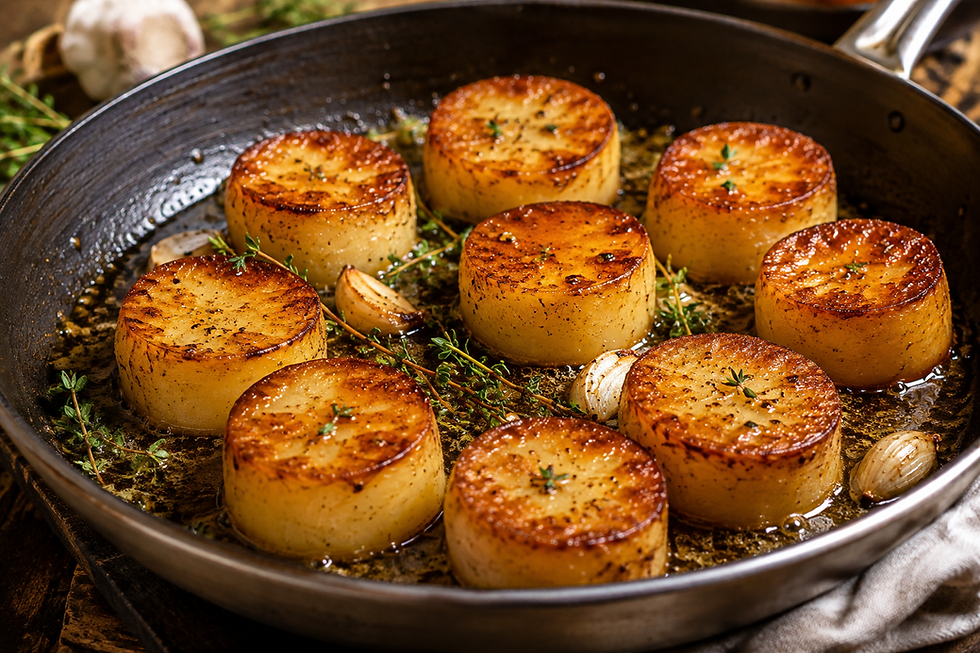
You are aiming for a compact disc about 2 inches (5 cm) tall, dark gold and crisp on both faces, the rings of the top layer intact and the interior fused into something you can cut in wedges. It should smell of browned butter and thyme, and never weep fat onto the plate.
Yield: 6 to 8 side servings. Prep: 30 minutes. Cook: 55 minutes. Rest: 10 minutes. Total: about 1 hour 35 minutes. Difficulty: intermediate. Course: contorno, side dish. Serve hot.
The Story
The dish is attributed to Adolphe Duglere, who took over the Cafe Anglais on the boulevard des Italiens in 1866. Duglere had trained under Careme, which shows in the thinking: a construction dish, built from one humble ingredient and a great deal of butter, that reaches the table looking far more expensive than it is. He named it for a demimondaine of the rooms upstairs, said to be Anna Deslions.
The pan came with the recipe. The classic cocotte a pommes Anna is a two part copper vessel, a straight sided base with a deep lid that doubles as a second pan, so the cake can be turned without being handled. You do not need one. Any heavy ovenproof pan with straight sides does the same work, which means cast iron of about 9 or 10 inches (23 to 25 cm).
Italy took the dish up through the hotel kitchens and culinary schools of the north, and the Italian version is recognisable by its restraint with the butter and its use of herbs. Thyme, timo, grows wild across the Italian hills and belonged to the vocabulary of potatoes in Liguria, Tuscany and Sardinia long before anybody thought about Paris. A few leaves between the layers keep the richness from cloying.
Ingredients
For the potato cake
Yukon Gold potatoes, 3 lb (1.36 kg), about 6 medium, uniform in size
Unsalted butter, 8 tbsp (115 g), clarified, yielding about 6 tbsp (90 ml) of butterfat
Fine sea salt, 1 1/2 tsp (8 g)
Freshly ground black pepper, 1/2 tsp (1 g)
Fresh thyme leaves, stripped from the stems, 2 tsp (2 g)
Garlic clove, small, finely grated, 1, optional
For finishing
Flaky sea salt, a small pinch per portion
Fresh thyme sprigs, 3 or 4, for the plate
Unsalted butter, 1 tsp (5 g), optional, brushed over the crust at serving
On the potato. A very starchy baking potato gives a fine crust and a floury interior that crumbles when cut. A waxy salad potato holds together and browns poorly, having less free starch to caramelise and to glue the layers. Yukon Gold sits between the two, as does a good Patata di Bologna.
On the butter. It must be clarified. Whole butter is roughly 16 percent water and 2 percent milk solids: the water steams the potato instead of frying it, and the solids burn before the cake is cooked. Clarifying removes both and raises the smoke point to about 450°F (230°C).
Preparation
Step 1. Clarify the butter and keep it warm.
Melt the butter slowly over low heat without stirring. Three layers form: foam on top, clear golden fat in the middle, milk solids below. Skim the foam, pour off the clear fat and stop the moment the sediment moves. Expect about 6 tablespoons (90 ml) from 8 tablespoons (115 g). Keep it warm, since cold clarified butter sets hard.
Step 2. Slice the potatoes and do not rinse them.
Peel and slice on a mandoline to 1/16 inch (1.5 mm). Uniformity matters more than thinness, since uneven slices cook at different rates and leave soft patches. Never rinse the slices or hold them in water: the free starch on the cut surface is the only binder here. Pat them dry, removing surface water but not starch.
Step 3. Season the slices in a bowl, briefly.
Put the slices in a large bowl, pour over half the warm butter, and add the salt, pepper, thyme and the grated garlic if you use it. Turn them gently until every slice carries a film of fat. Work within three minutes, because salt draws water out of raw potato and a bowl left standing will sit in a pool.
Step 4. Build the top layer with care.
Brush the base of a cold 9 or 10 inch (23 to 25 cm) cast iron pan generously with butter. This first layer becomes the top of the cake once inverted, so it is the only one anyone sees. Arrange the best slices in tight overlapping circles, from the outside in, each covering half of the last.
Step 5. Fill the pan in layers, pressing as you go.
Add the rest in overlapping circles, alternating the overlap so the structure locks rather than slides. Brush butter over every second layer and press firmly with the base of a smaller pan every three or four layers. Fill until the potato stands about 1 inch (2.5 cm) above the rim: it loses a third of its height.
Step 6. Set the crust on the stovetop first.
Put the pan over medium heat for 8 to 10 minutes without moving it. You are listening rather than looking. A steady sizzle means the butter is frying the bottom layer, silence means the heat is too low, a crackle means it is too high. Lift an edge with a palette knife to check the colour.
Step 7. Weight the cake and bake it covered.
Lay a round of parchment on the surface, set a lid or second pan on top and press hard, then transfer to an oven at 425°F (220°C). Keep it covered and weighted 30 minutes. The weight holds the layers in contact while the starch granules swell, gelatinise and fuse the slices into one mass.
Step 8. Uncover and finish.
Take off the lid and the parchment and return the pan to the oven 15 to 20 minutes, until the top is deep gold and the edges have pulled away from the sides. Test with a thin knife through the centre: it should meet no resistance. If it drags, give it another 5 minutes.
Step 9. Rest, drain and turn out.
Let the pan stand 10 minutes off the heat. The cake is soft at full temperature and firms as it cools, and turning it out at once is how most break. Tilt the pan over a bowl and pour off free butter. Run the knife around the edge, set a flat plate over the pan, and turn it in one movement.
Plating
Bring the whole cake to the table once before you cut it, because the rings of the top layer are the entire visual argument of the dish and they disappear the instant a knife goes in. Set it on a warmed board or flat plate, never on anything with a raised rim, where steam collects and softens the crust.
Cut it in wedges with a sharp thin bladed knife, pressing straight down rather than sawing, which tears the layers. Six or eight wedges from a 10 inch (25 cm) cake is the right scale. Wipe the blade between cuts, since a loaded blade drags.
Finish with a small pinch of flaky salt, a thyme sprig laid beside rather than on top, and if you like a teaspoon of butter brushed over the surface as it goes out. Nothing else belongs on the plate: no cream, no parsley, no cheese, each of which wets the crust. This is a side for roast lamb, chicken or beef.
Professional Technique
The technical heart of this dish is starch gelatinisation used as an adhesive. Raw potato starch sits in tight semicrystalline granules inside the cells. Between roughly 136°F and 158°F (58°C and 70°C), with water present, those granules swell and burst, releasing amylose and amylopectin chains that form a sticky gel. On one cut surface pressed against another, that gel glues slice to slice. The potato makes its own paste, which is why the slices are never rinsed and why trapped steam matters.
The second technique is the split of the bake into two phases with opposite aims. The first 30 minutes are covered and weighted, for a humid environment where the interior fuses without the surface drying. The last 15 to 20 are uncovered, driving off surface moisture so the top browns. Reverse the order and you get a hard dry lid over a chalky middle.
The clarified butter does three jobs: frying medium at 425°F (220°C) without smoking, moisture barrier between the layers, and release agent that lets a 3 lb (1.36 kg) cake invert cleanly. The last piece is the weight. Pressure excludes the insulating air between slices, so heat conducts evenly into the centre, and holds the gelatinising surfaces in contact while the gel sets.
Texture and Moisture Control
Potato is around 79 percent water and the recipe is a negotiation with it. The water has to stay in long enough to gelatinise the starch, then leave from the two faces so they can brown. The covered phase keeps it in, the uncovered phase lets it out, and the 10 minute rest lets what remains redistribute.
The moment of greatest risk is the seasoned bowl. Salt on raw potato starts osmotic drainage immediately, and slices left salted twenty minutes sit in a pool of starchy water. Every millilitre going into the pan is liquid the butter must boil off before frying begins. Season, toss and start building within three minutes, and if a pool has formed, drain the slices.
Contrast is the point of the finished object and it is fragile. The crust should crack slightly under a knife, the interior should be creamy and dense, closer to a firm gratin than a roast potato. The enemy of both is trapped steam, so never cover a finished cake: within ten minutes the crust goes leathery. Serve above 150°F (65°C). If it must wait, hold it uncovered at 200°F (95°C) for 20 minutes at most.
Professional Mise en Place
This dish has almost no service window and a long unattended cooking time. The one thing that cannot be done ahead is the slicing, because sliced potato oxidises and cannot be held in water.
Equipment and tools
Cast iron pan, 9 or 10 inches (23 to 25 cm), straight sided and ovenproof
A lid or second pan that fits inside the rim, to weight the cake
Mandoline with a guard, set to 1/16 inch (1.5 mm)
Small saucepan and a warm bowl for the butter
Pastry brush, thin palette knife, and a parchment round cut to the pan
Flat plate wide enough to invert onto, and a towel
Prepared ahead
Butter clarified and strained, up to 1 week ahead, refrigerated
Thyme stripped from the stems and the garlic grated, up to 1 day ahead
Parchment round cut and the pan brushed, before you start slicing
Oven at a true 425°F (220°C), checked with a thermometer
Potatoes peeled and held whole in cold water, dried before slicing
Service setup
Cake rested 10 minutes and turned out onto a warm board, uncovered
Plates warmed, since a cold plate dulls the butter in seconds
Thin bladed knife and a cloth for wiping it between cuts
Flaky salt, thyme sprigs and soft butter in reach of the pass
Nothing wet near the crust, and no sauce over it
Chef Tips
Use the mandoline and use the guard. A knife cut cake is possible and never as good, because the hand cannot hold 1.5 mm over three hundred slices.
Fill the pan far higher than looks sensible. A raw stack standing an inch above the rim finishes at or just below it. Filling level with the rim gives a thin cake with plenty of crust and no creamy interior, losing the contrast the recipe is built around.
Trust your ears at the stovetop stage. Lifting the cake to look will break the crust you are trying to form. A steady even sizzle for 8 to 10 minutes is the sound of a crust setting. If it goes quiet, raise the heat. If it spits, lower it, because butter that aggressive is close to burning even after clarifying.
Practise the inversion. Set the plate over the pan, hold both with a towel and both thumbs on top, and turn in one continuous movement. Hesitation breaks cakes, not speed. If it comes apart, cut the pieces into rough wedges, call it a rustica and serve it anyway.
Common Mistakes
Rinsing or soaking the sliced potatoes. The most common way to ruin the dish, and it comes from habit, since rinsing is right for chips and many gratins. Here the surface starch is the only thing holding the cake together, and washing it off leaves loose buttered slices.
Using whole butter instead of clarified. The water steams the bottom layer instead of frying it, so the crust never forms, and the milk solids scorch long before the 50 minute mark, leaving bitter specks through the base.
Not pressing hard enough. Pressure removes the insulating air between slices and holds the gelatinising surfaces in contact while the gel sets. An unpressed cake bakes unevenly and collapses into loose slices on the plate.
Turning it out straight from the oven. At full temperature the gel is still soft and the cake has little strength, while ten minutes of resting firms it considerably. Inverting at once is how most broken cakes happen.
Adding cream, stock or cheese. Each turns this into a gratin, which is a good dish and a different one. Extra liquid prevents the crust forming and cheese burns at 425°F (220°C) long before the potato is cooked. The austerity is the recipe, not an omission.
Wine Pairing
Franciacorta DOCG: The most reliable answer to a plate this rich. Bottle fermented in Lombardy with real lees ageing, it brings a fine persistent bead and a bready hazelnut character that runs alongside browned butter. The carbonation and high acidity together scour the fat from the palate between bites.
Roero Arneis DOCG: The white of Piedmont, a neighbour to this cooking in spirit as well as geography. Arneis gives white pear, chamomile and a faintly bitter almond finish, with moderate acidity on a body that sits under butterfat without being erased. Chamomile is what meets the thyme.
Collio Friulano DOC: From the hills on the Slovenian border, and the choice when the thyme is prominent. Friulano is savoury, with green almond, field herbs and a saline mineral edge, plus a phenolic grip on the finish that most Italian whites lack. That grip stops the pairing turning soft.
Alto Adige DOC Pinot Nero: The red to pour when the potatoes go beside roast chicken or lamb. Grown at altitude, it keeps high acidity and very fine tannin, the combination that lets a red work against butter at all, and its cherry fruit sits with thyme comfortably. Serve it slightly cool, around 60°F (16°C).
Dolcetto d'Alba DOC: The everyday Piedmontese red and an honest match. Its tannin is soft and its fruit is dark, plum and black cherry with an almond bitterness, and the moderate alcohol keeps it from weighing on a dish that is already rich. Less acidity than the Pinot Nero, so it suits a plate where the potatoes are the main event.
Storage & Reheating
Eat it the day it is made, because the crust is most of the pleasure and does not survive storage. Leftovers keep refrigerated up to 3 days, cooled completely and uncovered on a rack first, then wrapped loosely in parchment in an airtight container. Wrapping it warm traps steam and the surface goes soft overnight.
It freezes acceptably, provided you freeze it cooked. Cool completely, cut into wedges, freeze them in a single layer until solid, then bag them with parchment between the pieces for up to 2 months. Never freeze it raw: ice crystals rupture the cell walls and the slices thaw into a watery mush that will not bind.
Reheating is about driving surface moisture off again. A dry ovenproof pan over medium heat for 3 or 4 minutes a side is best for wedges and restores the crust. In the oven, lay the pieces on a rack over a tray, no foil, at 400°F (200°C) for 12 to 15 minutes, or 20 to 25 from frozen. An air fryer at 375°F (190°C) for 8 minutes also works. Never microwave it.
Nutrition
Per serving, based on 6 servings as a side dish:
Calories: 285 kcal
Total Fat: 15 g
Saturated Fat: 9 g
Trans Fat: 0.5 g
Unsaturated Fat: 5 g
Cholesterol: 40 mg
Sodium: 490 mg
Total Carbohydrates: 35 g
Fiber: 4 g
Total Sugars: 2 g
Added Sugars: 0 g
Protein: 4 g
Lactose: under 0.1 g, since clarifying removes almost all the milk sugar
Principal micronutrients: potassium, vitamin C, vitamin B6, vitamin A, manganese, iron
These figures are estimates. The fat number assumes the butter poured off after resting is discarded, typically 1 to 2 tablespoons (15 to 30 ml) across the cake. Serving it in 8 portions instead of 6 brings each to roughly 215 calories.


Comments