
Italian Confit Potatoes | Patate Confit all'Aglio e Timo

Confit is a cooking method before it is a dish. A potato submerged in olive oil and held far below frying temperature will never brown, never absorb water and never go grainy. It simply softens from the outside in until the whole piece has the density of set custard. Garlic and thyme sit in the oil the entire time and hand their perfume to the fat, which hands it to the potato.
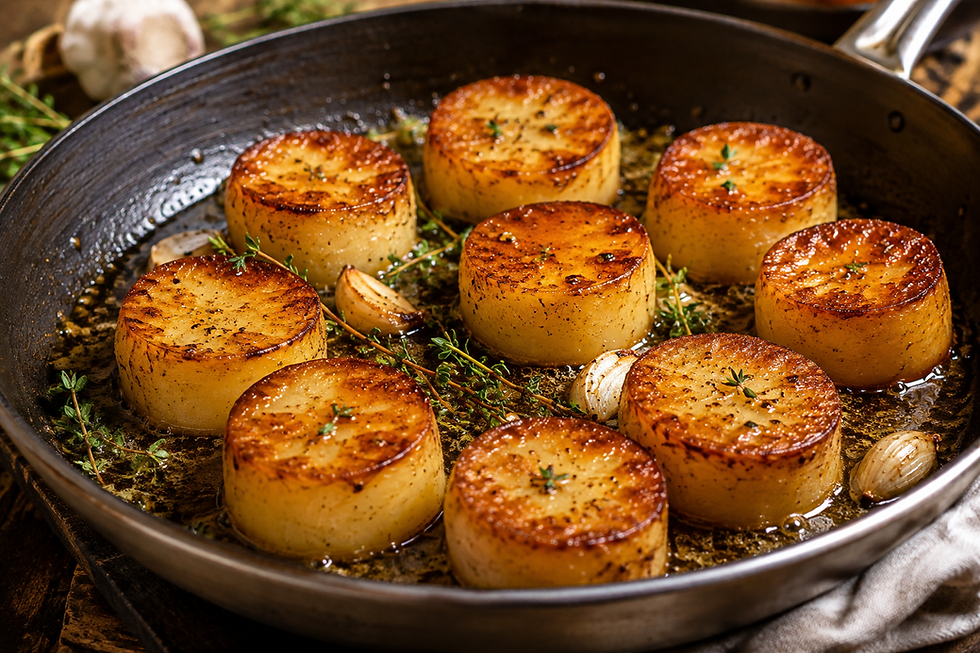
What comes out of that oil is not finished. Confit potatoes reach the table only after they have been chilled firm and seared hard on two cut faces, so the plate gives a thin brittle crust and, immediately under it, an interior that collapses on the tongue. Roasting cannot deliver that contrast, because it drives moisture out of the middle while it builds the crust.
This version stays inside the Italian pantry: no duck fat and no butter, only extra virgin olive oil, whole garlic cloves, thyme, rosemary and a bay leaf. The oil is not consumed, it is a medium you strain and reuse, and the potatoes carry perhaps two tablespoons of it between six servings.
Yield: 6 side servings. Prep: 25 minutes. Cook: 1 hour 20 minutes. Chill: 2 hours. Sear: 10 minutes. Total: about 4 hours including the rest. Difficulty: intermediate. Course: contorno.
The Story
The word confit belongs to Gascony, where geese and ducks were cooked in their own fat and buried in it through the winter, but the principle belongs to the whole Mediterranean and to Italy in particular. Conserva sott'olio, food held under oil, is one of the oldest preservation habits on the peninsula: artichokes, mushrooms, peppers, aubergines and tuna have all been kept this way for centuries, sealed from the air by a layer of olive oil in a glass jar in a cool cellar. The logic is identical. Fat excludes oxygen, fat excludes water, and what sits in it keeps.
The potato arrived in Italy late and unloved. Brought from the Andes through Spain in the sixteenth century, it was fed to animals for two hundred years and reached Italian tables properly only after the famines of the late eighteenth century. It took root fastest in the Sila, in the Fucino basin and on the volcanic soils of the Viterbese, all places that now grow potatoes with protected status.
Cooking them under oil rather than in water is a modern professional move, but it answers a very old Italian complaint about boiled potatoes, which is that they drink. A potato boiled in salted water takes on liquid, loses flavour into the pot and arrives slightly hollow. Held under oil at low temperature it gives nothing away and takes nothing on, and the garlic and thyme in the fat go into it rather than down the drain.
Ingredients
For the confit
Yukon Gold potatoes, even sized, 3 lb (1.36 kg)
Extra virgin olive oil, mild and fruity, 3 cups (710 ml), or enough to submerge
Garlic cloves, unpeeled and lightly crushed, 8
Fresh thyme sprigs, 10
Fresh rosemary sprig, 1
Bay leaf, 1
Black peppercorns, whole, 1 tsp (3 g)
Fine sea salt, 2 tsp (12 g)
For the sear and finishing
Reserved confit oil, 2 tbsp (30 ml)
Garlic clove, whole and unpeeled, 1
Fresh thyme sprigs, 3
Flaky sea salt, 1 tsp (4 g)
Freshly ground black pepper, to taste
Finely grated lemon zest, from 1/2 lemon
Preparation
Step 1
Shape the potatoes for an even cook. Peel them and cut each one into a squat block about 2 in (5 cm) across and 1 1/2 in (4 cm) tall, so every piece has two flat parallel faces and the same height as its neighbours. The flat faces meet the pan later, and the matched height stops half the dish turning to mush while the rest is still firm.
Step 2
Rinse and dry them completely. Hold the cut pieces under cold running water for about a minute, until the water runs clear, to wash off the free starch released by the knife. Drain and dry every surface with a towel. Water left on the potatoes sits under the oil and boils there, which pits the underside of the pieces.
Step 3
Infuse the oil first. Pour the olive oil into a small saucepan with the crushed garlic, thyme, rosemary, bay leaf and peppercorns and bring it to 160°F (70°C) over low heat. Hold it there for 10 minutes, with a fine stream of small bubbles rising off the garlic and nothing more violent. Infuse before the potatoes go in, because once they are submerged the aromatics are trapped under them and give up much less.
Step 4
Submerge and set the oven. Heat the oven to 275°F (135°C). Stand the potatoes on a cut face in a single layer in a deep baking dish, close but not touching. Season with the fine sea salt, then pour the warm infused oil and all the aromatics over the top. The oil must cover them by at least 1/4 in (6 mm). If it does not, move to a narrower dish rather than adding more oil.
Step 5
Cook low and slow, and check by feel. Cook uncovered for 70 to 90 minutes. The oil should never simmer properly: a lazy bubble every few seconds at the edge of the dish is right, and anything faster means the oven is running hot. The potatoes are ready when a paring knife enters the centre with no resistance and slides out without lifting the piece. Underdone confit stays chalky and searing will not rescue it.
Step 6
Cool them in the oil, then chill. Leave the dish on the counter until the oil is no longer hot, about 45 minutes. Lift the potatoes onto a rack over a tray and refrigerate them uncovered for at least 2 hours and up to 2 days. This rest is not optional: straight from the oil the pieces fall apart in the pan. Strain the oil and keep it.
Step 7
Sear the cut faces hard. Heat a heavy skillet over medium high heat with 2 tablespoons of the reserved confit oil until it shimmers. Lay the potatoes flat face down, add the whole garlic clove and the thyme sprigs at the side of the pan and leave them alone for 3 to 4 minutes, until a deep even gold crust has formed. Turn onto the second flat face for another 2 to 3 minutes, working in batches.
Step 8
Season at the last second. Lift the potatoes onto absorbent paper for a few seconds, then season the crust with flaky sea salt and black pepper while it is hot enough to take it, and grate the lemon zest over the top. Salting earlier draws moisture to the surface and softens the crust you have just built.
Plating
Confit potatoes are served hot, on hot plates, and immediately. The crust has a working life of perhaps four minutes before moisture from inside softens it, so this is the last thing to leave the stove and the first to reach the table.
Stand the pieces upright on a seared face so the gold crust faces the room. On a shared platter, set them in a single layer with a finger of space between them, never stacked or piled into a bowl, because trapped steam undoes the crust of both pieces within a minute. Spoon over the garlic and thyme from the pan.
As a contorno this belongs beside roast lamb, braised beef or guinea fowl, anything with a sauce the potato can sit next to rather than swim in. Do not pour sauce over the crust.
Professional Technique
The technique that defines this dish is temperature control inside a fat bath, and the number that matters is 275°F (135°C) in the oven, which puts the oil between 200°F (93°C) and 215°F (102°C). That band is deliberate. It is hot enough to break down the pectin holding the potato cells together and to gelatinize the starch fully, and far too cool for any browning to begin. The result is a piece cooked through to one uniform texture, with no gradient from edge to centre.
The oil is there to move heat evenly and to keep water out, not to add fat. It conducts heat far more gently than boiling water, so the potato is spared the violent surface cooking that leaves boiled edges ragged, and because the piece is sealed under oil its own moisture cannot escape as steam. Weigh a batch before and after if you doubt it.
The chilling stage is the third technique and the one most cooks skip. As the potato cools, the gelatinized starch retrogrades: the amylose chains that went loose in the heat reassociate into a firmer network. A piece at 40°F (4°C) throughout can take three minutes against hot metal without disintegrating, and that is the only way to build a real crust on something this soft.
Texture and Moisture Control
Everything here protects the interior water of the potato while removing water from its surface, and those two jobs happen at opposite ends of the process. Inside, the potato keeps essentially all the moisture it started with, and that retained water is what makes the centre creamy instead of floury. Outside, the surface must be bone dry twice: before it goes under the oil, so the dish does not steam from below, and before it hits the skillet, so the crust forms by browning rather than evaporation.
The variety supports the same aim. Yukon Gold sits in the middle of the starch range, around 18 percent dry matter, high enough to turn creamy and low enough to hold its shape through 90 minutes. A floury Russet crumbles at the edges as soon as it is moved; a very waxy potato holds together but never reaches that melting interior. Patata della Sila and Patata del Fucino are both excellent here.
Rinsing the cut faces is a small step with a visible payoff. The knife ruptures cells and releases free starch onto the surface, and that loose starch scorches and goes bitter long before the potato underneath has browned. Between the confit and the sear, keep the pieces uncovered in the refrigerator so the surface dries further.
Professional Mise en Place
This is a dish with a long passive stage and a very short active one. Everything up to the sear can be done the day before.
Equipment and tools
Deep baking dish that fits the potatoes in one layer
Small saucepan for infusing the oil and an instant read thermometer
Heavy skillet, cast iron or carbon steel, for the final sear
Fine mesh sieve for the oil and a wire rack set over a tray
Slotted spoon, fish spatula, sharp paring knife
Prepared ahead
Potatoes cut, rinsed and dried, up to 6 hours ahead, held in cold water and dried again
Oil infused with garlic and herbs, up to 3 days ahead, kept covered and cold
The confit cooked, cooled and chilled on a rack, up to 2 days ahead
Confit oil strained into a clean jar for the sear and for future batches
Service setup
Potatoes out of the refrigerator and uncovered, surfaces dry, 15 minutes before searing
Serving platter warming in a low oven
Skillet preheating while the rest of the meal is plated, sear as the last action
Two batches planned rather than one crowded pan, the first held in the oven
Salt, pepper and zest within reach of the stove
Chef Tips
Use the cheapest decent extra virgin olive oil you are happy to cook with, not your finishing bottle, and buy the large tin. Three cups sounds extravagant until you understand that you are not eating it: strain it, keep it cold and it will confit three or four more batches.
Choose potatoes already close to the same size in the shop. Uniformity does more work here than any other factor, and a mixed bag gives you chalky pieces beside pieces that have gone to puree.
Leave the garlic unpeeled and whole. The skin slows extraction enough that the cloves perfume the oil across the full cooking time instead of dumping everything in the first twenty minutes, and it stops them turning bitter. The soft cloves at the end are excellent crushed onto bread.
If the crust is not forming after three minutes, do not turn the heat up. Lift a piece and look at the pan: nine times out of ten there is moisture on the metal, from a potato that was not dry or a crowded pan. Move to a clean hot skillet instead.
Common Mistakes
Letting the oil simmer. If the surface bubbles steadily the oil has passed about 230°F (110°C) and you are slow frying, not confiting. The outsides toughen and colour while the centres stay behind. Drop the oven by 25°F (15°C).
Searing the potatoes while they are still warm. Warm confit potatoes have no structural strength and break under the spatula, leaving skin stuck to the pan. The refrigerator stage of at least 2 hours is what makes the sear possible at all.
Not using enough oil to cover. Any part of a potato standing above the oil is roasting in hot air while the rest confits, and it finishes dry and leathery. Change to a narrower and deeper dish.
Salting the crust too early. Salt applied before or during the sear draws water to the surface and dissolves into it, and the crust goes from brittle to leathery within a minute. Season the moment the pieces leave the pan.
Crowding the skillet. Pieces touching each other trap steam, the pan temperature falls and the potatoes end up pale and slightly stewed. Leave a finger of space around each one and sear in two batches.
Wine Pairing
Riviera Ligure di Ponente Pigato DOC: The natural partner for anything cooked in a serious quantity of Ligurian olive oil, because it grew up beside it. Pigato has an oily weight of its own and a herbal, almost resinous top note that meets the thyme and rosemary head on rather than cutting through them. Its salinity is high, and that saltiness refreshes the palate between one rich piece and the next.
Vermentino di Gallura DOCG: Grown on decomposed granite in northern Sardinia, this is the more chiselled choice, with firmer citrus acidity and a mineral bite. It works on the garlic, which leaves a sweet heaviness that a softer white only reinforces. The faint bitter almond finish lifts the seared crust, and at 50°F (10°C) it stays clean against the fat.
Offida Pecorino DOCG: From the Marche, and the most structured white here. Pecorino carries real body and a savoury sage and hay character that reads as a continuation of the herbs in the oil. That weight matters when the potatoes sit alongside roast meat, where a thin wine vanishes between the two. High natural acidity keeps it from feeling heavy.
Greco di Tufo DOCG: Campanian, volcanic and slightly smoky, with a texture closer to a light red than to most whites. Its stony sulphurous edge matches the browned crust, picking up the roasted note instead of contrasting with it, and there is enough tannic grip in a good Greco to scrub the mouth clean of olive oil.
Cerasuolo d'Abruzzo DOC: The rosato option, and a strong one when the potatoes sit beside lamb or a braise. Deeply coloured and genuinely dry, it has red cherry fruit and a light tannic frame that stands up to roast meat while its acidity handles the potatoes. Serve it at 54°F (12°C).
Storage & Reheating
Store the potatoes confited but not seared, which is how professional kitchens hold them and the only version that reheats properly. Drained on a rack in a covered container they keep refrigerated for 3 days. Submerged in their strained oil in a sealed jar they keep for 5 days, though they soften and need draining and drying for twenty minutes before searing.
To bring them back, take them out an hour before service so the chill comes off the centre, dry the faces and sear them exactly as the recipe describes. This is not reheating, it is finishing a dish deliberately left unfinished, and the result is indistinguishable from the first day. Never microwave them: the steam inside collapses any crust at once.
Already seared potatoes are less forgiving. Hold them on a rack at 300°F (150°C) for up to 25 minutes, never under foil, and accept a softer crust. They freeze well unseared: open freeze on a tray, bag for up to 2 months, then sear from frozen with 2 extra minutes per side. The strained oil keeps refrigerated for 2 months.
Nutrition
Per serving, based on 6 side servings, counting only the oil retained by the potatoes and not the bath:
Calories: 265 kcal
Total Fat: 13 g
Saturated Fat: 1.9 g
Trans Fat: 0 g
Unsaturated Fat: 11 g
Cholesterol: 0 mg
Sodium: 480 mg
Total Carbohydrates: 34 g
Fiber: 3.5 g
Total Sugars: 1.8 g
Added Sugars: 0 g
Protein: 4 g
Lactose: 0 g
Principal micronutrients: potassium, vitamin C, vitamin B6, manganese, copper, vitamin E from the olive oil
These figures are estimates. Retained oil moves them most, and that depends on draining: potatoes lifted straight from the bath onto a rack carry roughly half the fat of potatoes left sitting in oil overnight.


Comments