
Italian Fondant Potatoes with Butter and Thyme | Patate Fondenti al Burro e Timo
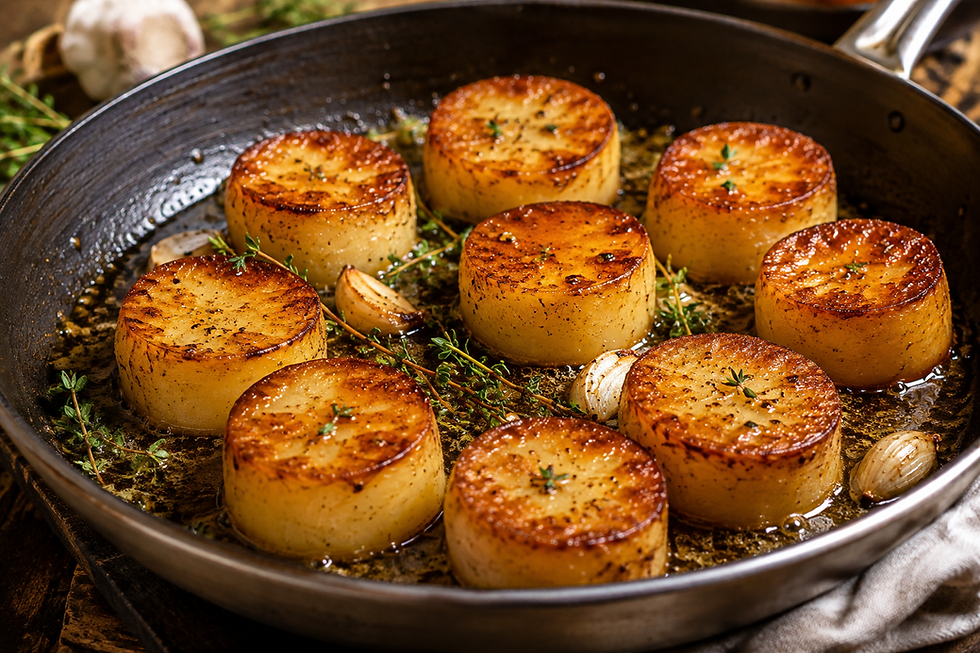
A fondant potato is not a roast potato and it is not trying to be one. There is no shattering crust, no shaken pan, no rough edges catching in hot fat. What defines it is absorption: a thick cylinder of potato is browned on its two flat faces in foaming butter, then set in a shallow pool of stock and cooked until the pool is gone, taken up into the potato. Fondente means melting, and the finished interior yields under a spoon.
That idea governs every decision here. The cylinder is thick because a thin slice absorbs its liquid before the centre softens. The stock reaches only a third of the way up because the sides must steam while the base stays on the pan. The butter goes in twice, once for colour and once for gloss, because butter left in a hot oven for half an hour browns past the point where it tastes of cream.
Thyme and garlic are the only aromatics, and they perfume the stock rather than the potato directly. Everything else is discipline: even cylinders, an uncrowded pan, a stock seasoned before it goes in, and the patience to leave the potatoes alone.
Yield: 6 side servings. Prep: 25 minutes. Cook: 50 minutes. Rest: 5 minutes. Difficulty: intermediate. Course: contorno. Register: Italian restaurant cooking of the butter north.
The Story
The technique is French by birth. Pommes fondantes belong to the classical repertoire codified around Escoffier, where a cylindrical potato was browned in clarified butter and finished in stock until the liquid vanished. It sat on menus beside pommes chateau and pommes cocotte as a standard garnish any brigade could produce without thinking. It survived when other turned potato preparations died out because it is genuinely better, not merely neater.
It entered Italian kitchens through the same door as most classical French method, the professional brigade, and it settled in the north. Piedmont, Lombardy, Valle d'Aosta and Alto Adige are the Italian butter regions, where the fat on the stove has historically been burro rather than olive oil, and where a potato finished in butter and broth reads as local. In a Turin or Bolzano dining room, patate fondenti never looked borrowed.
The potato itself reached Italy from Spain in the sixteenth century and was treated as a curiosity or as livestock feed for two hundred years. It became food after the famines that followed 1816, when the alpine valleys planted it because nothing else grew at altitude. Those mountains still give the best Italian potatoes, alongside the Patata di Bologna DOP on the plain. Thyme grows wild on the same hillsides, which is why it, and not rosemary, belongs in this pan.
Ingredients
For the potatoes
Large waxy or all purpose potatoes, 3 lb (1.35 kg)
Unsalted butter, 4 tbsp (57 g), for the sear
Neutral oil, 1 tbsp (15 ml)
Fine sea salt, 1 tsp (6 g)
Freshly ground black pepper, to taste
For the braise
Light chicken or vegetable stock, hot, 1 1/4 cups (300 ml)
Garlic cloves, unpeeled and lightly crushed, 4
Fresh thyme sprigs, 6
Bay leaf, 1
For finishing
Unsalted butter, cold and cubed, 2 tbsp (28 g)
Fresh thyme leaves, 1 tsp
Flaky sea salt, to taste
Preparation
Step 1

Peel the potatoes and trim each into a neat cylinder about 2 inches (5 cm) tall, squaring the top and bottom so both faces are flat and parallel. A round cutter of 2 to 2 1/2 inches (5 to 6 cm) makes this fast, but a knife is fine. Aim for six cylinders of the same height. Uneven heights leave some potatoes raw in the middle and others collapsing, because the braise cooks them on a fixed clock.
Step 2

Rinse the trimmed cylinders under cold water for 30 seconds to wash surface starch off the cut faces, then stand them on a towel and dry them completely. Season the faces with the fine sea salt and a little pepper. Surface starch and surface water both stop browning: the first burns before the potato colours, the second has to boil off before the pan reaches browning temperature.
Step 3

Put a heavy ovenproof pan just wide enough to hold the six cylinders with a finger of space between them over medium high heat. Heat the oil, add 4 tablespoons (57 g) of butter and let it foam. When the foam subsides and the butter smells nutty, stand the cylinders on one flat face and do not move them for 6 to 8 minutes. Lift one only when the visible edge has gone deep gold, not pale tan.
Step 4

Turn the cylinders onto their second flat face and cook another 6 to 8 minutes, lowering the heat if the butter darkens faster than the potato colours. Both faces should end the same deep even gold. Do not brown the curved sides: they must stay open so the potato can take up stock, and a sealed side stops the absorption this dish depends on. Heat the oven to 400°F (200°C) now.
Step 5

Tuck the crushed garlic, the thyme sprigs and the bay leaf into the gaps between the cylinders and warm them for 30 seconds so the oils release into the butter. Keep them at the edges rather than under the potatoes, where they would scorch against the hot base and turn bitter. The garlic stays unpeeled on purpose: the skin slows it and keeps it sweet through the braise.
Step 6

Pour the hot stock down the side of the pan, never over the potatoes, so the browned faces are not washed. It should come one third of the way up the cylinders and no further, about 1 1/4 cups (300 ml) in a pan this size. Bring it to a simmer, then move the pan uncovered to the oven. Cold stock drops the pan temperature and stalls the cooking.
Step 7

Cook 25 to 30 minutes, until a thin skewer slides into the centre with no resistance and the stock has reduced to a glossy film on the base. Take the pan out, add the cold cubed butter and tilt it so the butter emulsifies into the last of the stock, then spoon that over the potatoes two or three times. Rest 5 minutes, which lets the centres firm just enough to lift cleanly.
Plating
Fondant potatoes are served hot and they cool fast, because a cylinder has a lot of exposed surface and no crust to insulate it. Warm the plates to about 140°F (60°C) before anything leaves the pan. A cold plate is noticeable here within a minute.
Lift each cylinder with a spoon rather than tongs, sliding it under the base so the browned face stays intact. Stand them upright with the better face on top, spaced rather than stacked, and never on their sides: the point of the shape is a gold disc above a pale column.
Spoon the emulsified pan sauce over each one and let it run down the sides. Scatter the thyme leaves and a little flaky salt, and stop there. These go beside roast meat, braised beef or a plate of mushrooms, and they are rich enough that a sharp chicory salad alongside does the plate more good than another sauce would.
Professional Technique
The whole method rests on one principle: a browned face seals, an unbrowned side absorbs. The two flat faces are seared hard so they build a Maillard crust that holds the cylinder together and supplies the roasted flavour. The curved sides are left pale because they are the surface through which stock, butter and aromatics travel into the potato. Brown the sides too and you get a well coloured potato that has absorbed nothing.
The stock depth is the second control, and one third of the way up is not an approximation. Below that, the liquid reduces to nothing before the centre is cooked and the bases scorch. Above it, the potatoes poach, the seared faces soften back into the liquid, and a concentrated glaze finishes as thin broth. Pan width matters for the same reason: too wide and the stock evaporates early, too narrow and the cylinders steam each other.
Splitting the butter into two additions is the third. Butter added at the start is for the sear, and its milk solids give the crust its colour and nutty flavour, but those same solids are burnt after half an hour at 400°F (200°C). The cold butter added off the heat is a classic monter au beurre: it emulsifies into the reduced stock and returns the dairy sweetness the oven cooked out.
Texture and Moisture Control
The interior you want is uniformly soft and slightly translucent, giving under a spoon without falling apart. That comes from cooking a thick piece slowly in a small amount of liquid, so heat and moisture move inward together. Waxy and all purpose potatoes hold their shape while this happens. A very floury variety reaches the right softness and then disintegrates as it is lifted.
Moisture at the start is the enemy and moisture at the end is the goal, and that reversal is what trips people up. Before the sear, the flat faces must be bone dry and free of surface starch, because a wet face steams and refuses to brown until the water has gone. Once the stock is in, the same potato needs to take up as much liquid as it can.
The finish is judged by the pan, not the clock. When the stock has gone from a pool to a glossy film that coats the base and drags behind a spoon, the absorption is complete. Left another five minutes, that film dries to a scorched residue and the bases turn bitter. The rest afterwards lets the saturated centres firm, which is the difference between lifting a whole cylinder and most of one.
Professional Mise en Place
This is a dish with one long unattended stretch and two short active ones, so the planning is about the pan and the stock rather than about many components.
Equipment and tools
Heavy ovenproof sauté pan or cast iron skillet that holds 6 cylinders without crowding
Round cutter of 2 to 2 1/2 inches (5 to 6 cm), or a sharp paring knife
Tongs for turning and a large spoon for lifting and basting
Small saucepan to keep the stock hot
A thin metal skewer to test the centres
Prepared ahead
Potatoes trimmed into cylinders up to 4 hours ahead, held in cold water
Stock made or opened and seasoned ahead, held hot
Garlic crushed and thyme picked over, kept dry at the stove
Finishing butter cubed and kept cold until the last moment
Service setup
Oven at 400°F (200°C) and fully preheated before the sear begins
Cylinders drained and dried, since they cannot go wet into butter
Plates warming to about 140°F (60°C)
Pan sauce emulsified only once the potatoes are out of the oven
Chef Tips
Buy bigger potatoes than you think you need. A 3 lb (1.35 kg) bag of medium potatoes will not yield six cylinders 2 inches (5 cm) tall and wide, because trimming loses so much. Keep the trimmings for soup or a potato cake, and choose the largest, most regular potatoes in the shop.
Season the stock before it goes into the pan, not after. Once it is reducing there is no way to correct it without diluting the glaze or oversalting at the end, and the potato draws seasoning from the stock for the whole braise. It should taste properly seasoned as a broth, since it will concentrate several times over.
If the pan is too wide for six cylinders, do not spread them out. Use a smaller pan or a ring of crumpled foil to reduce the working area, because stock spread thin across an empty pan evaporates long before the potatoes are cooked.
Test with a thin skewer rather than a knife tip, and test the centre rather than the edge. A knife widens the hole and lets the potato leak into the pan. The skewer should meet no resistance in the middle: any slight catch means another 5 minutes.
Common Mistakes
Cutting the cylinders too short. A potato under about 1 1/2 inches (4 cm) tall absorbs its stock and overcooks before a melting centre develops. Trim to a full 2 inches (5 cm) and keep all six the same height.
Browning the curved sides as well. It looks thorough and it ruins the dish. The sides are the absorption surface, and sealing them means the stock reduces in the pan instead of entering the potato.
Putting wet potatoes into the butter. Water on the flat faces has to boil off before the pan reaches browning temperature, which costs contact time and usually means the butter burns before the crust forms.
Using too much stock. Liquid above a third of the way up poaches the potatoes, softens the seared faces and leaves a thin broth rather than a glaze. Add more only if the pan runs dry before the centres are done.
Adding all the butter at the start. Butter that spends half an hour in a hot oven browns past nutty into bitter and the milk solids catch on the base. Reserve the cold cubed butter for the emulsion off the heat, which is where the gloss comes from.
Using a floury potato. A high starch variety reaches the right softness and then falls apart as the spoon goes under it. Waxy or all purpose potatoes hold together through the braise and still finish soft in the middle.
Wine Pairing
Franciacorta DOCG: The cleanest answer to a plate this buttery. Bottle fermented and bone dry, its fine bead and firm acidity scrub the palate between mouthfuls, while the bread and hazelnut notes from the lees run alongside the browned butter crust. Choose a Brut or Pas Dose, never a sweeter style.
Roero Arneis DOCG: Piedmont's own white, from the same country as the butter. Arneis has a soft pear and white flower aromatic with a bitter almond finish, and that bitterness keeps it from being flattened by the richness. It has enough body to sit beside a potato cooked in stock and butter without seeming thin.
Lugana DOC: Turbiana from the southern shore of Lake Garda, and an underrated match for buttery cooking. It carries a saline mineral thread and a citrus acidity that cuts fat cleanly, with a gentle texture that mirrors the melting interior. The faint bitter note on the finish picks up the thyme.
Dolcetto d'Alba DOC: The red to pour when these potatoes sit beside roast meat. Dolcetto has deep colour, low acidity and soft rounded tannin, so it adds weight and dark fruit without the astringency that would strip butter from the palate. Serve it at around 59°F (15°C).
Alto Adige DOC Lagrein: The mountain red for the alpine version of this dish. Lagrein brings dark plum, a note of bitter chocolate and a firm savoury finish, and that savoury edge answers the reduced stock in the pan. Its tannin is present but fine grained, so it frames the butter instead of cutting through it.
Storage & Reheating
Cooked fondant potatoes keep airtight in the refrigerator for up to 3 days, with any leftover pan glaze spooned over them so the surfaces do not dry. Store them upright in a single layer, because stacking crushes the soft centres and they never recover their shape. They are best the day they are made.
Reheat at 350°F (175°C) for 10 to 12 minutes in a small covered dish with a tablespoon or two of stock in the base, which regenerates the glaze and keeps the potato moist. A microwave turns the interior watery and the faces soft, and the crust never returns. If the faces have gone pale, 2 minutes in a hot buttered pan brings them back.
They freeze acceptably but not well. Cooked potato cells rupture on thawing and the melting interior turns slightly grainy, so freeze only if the alternative is waste, and reheat from frozen in a covered dish with stock rather than defrosting. The raw trimmings freeze far better and are worth keeping for soup.
Nutrition
Per serving, based on 6 side portions:
Calories: 280 kcal
Total Fat: 13 g
Saturated Fat: 8 g
Trans Fat: 0.4 g
Unsaturated Fat: 4 g
Cholesterol: 34 mg
Sodium: 420 mg
Total Carbohydrates: 37 g
Fiber: 4 g
Total Sugars: 2 g
Added Sugars: 0 g
Protein: 5 g
Lactose: 0.1 g
Principal micronutrients: potassium, vitamin C, vitamin B6, magnesium, iron
These figures are estimates. Final fat and sodium depend on how much pan glaze is served and on the salt level of the stock.


Comments