
Italian 'Nduja Chicken Breast | Petto di Pollo con 'Nduja, Burrata e Pomodorini Arrosto
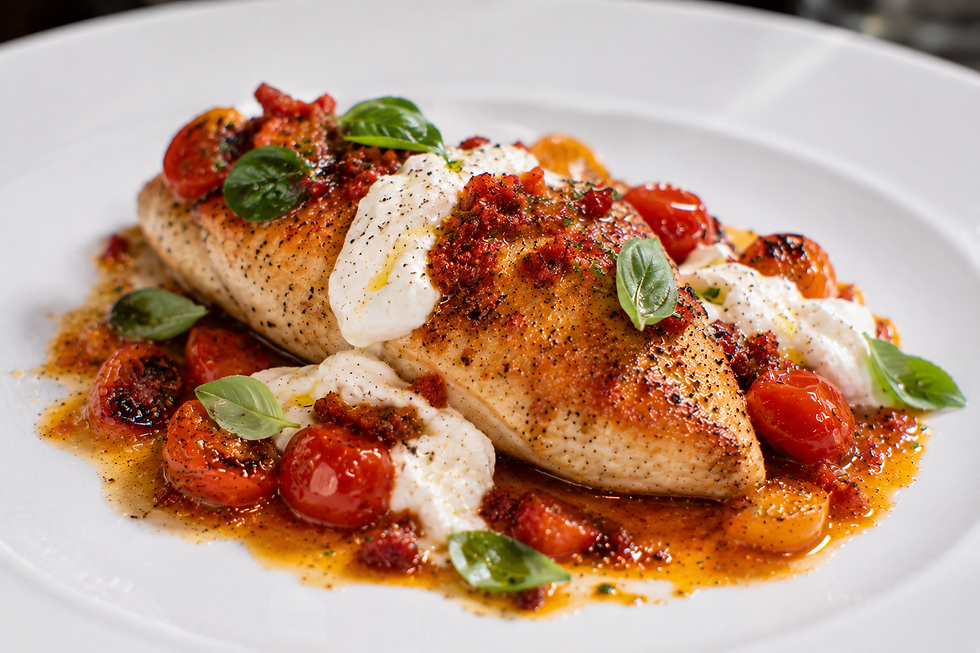
This plate is a handshake between two regions that face each other across the arch of the Italian boot. From Calabria comes nduja di Spilinga, a soft spreadable salume closer to chilli paste than to sausage. From Puglia comes burrata di Andria, a pouch of mozzarella filled with cream and torn curd. Calabria brings heat and fat, Puglia cold and cream, and the chicken sits between them.
Everything turns on how those two behave under heat. The nduja is not fried and not browned. It is melted into rendered chicken fat until it dissolves into a red pan sauce carrying the pork fat, salt and capsaicin onto the meat. The burrata never sees the flame: it is torn open at the last moment, off the heat, over the hot chicken.
The roasted cherry tomatoes are the third element and deliberately the quietest. They supply acidity to stop the nduja fat coating the palate, and that is all. This is not a tomato dish. The two names on it are Spilinga and Andria.
Yield: 4 servings. Prep: 20 minutes. Cook: 30 minutes. Rest: 8 minutes. Total: about 1 hour. Difficulty: intermediate. Course: secondo. Region: Calabria and Puglia.
The Story
Nduja belongs to Spilinga, a village of barely twelve hundred people on the slopes of Monte Poro above the Tyrrhenian coast of Vibo Valentia. It is made from the cheapest parts of the pig, fat, belly trim and offcuts, ground fine with a very large proportion of local peperoncino, stuffed into a casing, smoked over oak or beech and cured for months in mountain air. The chilli preserves as much as the salt does. The name is thought to come from the French andouille, carried south in the Napoleonic decade. The village still holds its sagra della nduja every August, but the origin is poverty cooking.
Burrata belongs to Andria, on the Murge plateau of Puglia, and is much younger. It was created around 1900 on a masseria near the town, where the Bianchini family needed a use for the scraps left from working mozzarella curd. They shredded them, mixed them with fresh cream to make stracciatella and sealed the mixture inside a pouch of stretched curd. It travelled badly and had to be eaten within a day, which kept it a local secret for decades. It has carried IGP status since 2016, and the kitchen rule never changed: as fresh as possible, and cold until it is torn.
Putting the two together is not traditional. It works because each is the extreme of its category: nduja the hottest and fattiest thing in the southern salumeria, burrata the coolest and creamiest thing in the southern caseificio.
Ingredients
For the chicken
Boneless chicken breasts, skin on, 4 of about 7 oz (200 g) each
Kosher salt, 2 tsp (10 g), for the dry brine
Freshly ground black pepper, 1/2 tsp (1 g)
Extra virgin olive oil, 2 tbsp (30 ml)
For the nduja sauce
Nduja di Spilinga, 2 1/2 oz (70 g)
Garlic cloves, thinly sliced, 2
Dry white wine, 1/3 cup (80 ml)
Chicken stock, unsalted, 1/2 cup (120 ml)
Extra virgin olive oil, 1 tbsp (15 ml)
For the roasted tomatoes
Cherry tomatoes, halved, 10 oz (285 g)
Extra virgin olive oil, 1 tbsp (15 ml)
Fine sea salt, 1/4 tsp (1.5 g)
Dried oregano, preferably Pugliese on the stem, 1/2 tsp
For finishing
Burrata di Andria, 1 ball of 8 oz (225 g), at room temperature for 20 minutes
Fresh oregano or marjoram leaves, 1 tbsp
Extra virgin olive oil, a few drops per plate
Flaky sea salt, a small pinch per plate
Preparation
Step 1

Pat the breasts dry, salt both sides and leave them uncovered on a rack in the refrigerator for at least 2 hours, ideally 6. The base method is short: dry brine, sear the skin hard, finish gently, pull at 160°F (71°C) and rest 8 minutes while carryover takes it to a safe 165°F (74°C). Everything else is about the nduja and the burrata.
Step 2

Heat the oven to 400°F (200°C). Toss the halved cherry tomatoes with the olive oil, sea salt and oregano and spread them cut side up on a small tray. Roast 18 to 20 minutes, until the edges catch colour and the halves collapse slightly but still hold together. Leave them on the tray. Do not add sugar and do not reduce them to a sauce: their job is acidity against the pork fat, not a second red element.
Step 3

Wipe the breasts dry again. Heat a heavy pan over medium high heat with the olive oil, lay them skin side down and press flat for 20 seconds so the whole surface makes contact. Sear 6 to 7 minutes without moving them, until the skin is deep gold and lifts cleanly. Turn, give the second side 2 minutes, then move them to a warm plate. The fat left in the pan is what the nduja melts into, so keep all of it.
Step 4

Take the pan off the heat and let it drop to medium low, which matters more than it sounds. Add the olive oil and sliced garlic, cook 30 seconds without colour, then add the nduja in small pieces. Stir with a wooden spoon. Within a minute it loses its shape, the fat runs orange red and the solids separate as fine grains. What must not happen is a hot pan frying those solids dark and turning everything bitter.
Step 5

Pour in the wine, raise the heat and scrape the base clean, letting the alcohol boil off for a minute. Add the stock and simmer 2 to 3 minutes, stirring, until fat and liquid come together into a loose glossy sauce rather than a red slick over a puddle. If it refuses, take it off the heat and whisk hard: this is an emulsion and it answers to agitation, not heat. Taste before any salt.
Step 6

Return the breasts and their juices to the pan, skin side up so the crust stays out of the sauce. Cover loosely and cook over low heat 4 to 6 minutes, basting once or twice, until the thickest point reads 160°F (71°C). Move them to a warm rack and rest 8 minutes. Slide the roasted tomatoes and their tray juices into the sauce off the heat and swirl once, no more.
Step 7

Drain the burrata well and set it on a board. Slice the rested breasts on a slight angle, plate them, then tear the burrata open with your hands over the hot meat. Never cut it with a knife and never put it in the pan. The cream should slump against the chicken, meet the sauce at the edges and stay white in the middle. Finish with oregano leaves, olive oil and flaky salt.
Plating
Use warm plates but not hot ones. The chicken and the sauce want heat; the burrata wants as little as possible, and a plate out of a warming drawer melts the cream before it reaches the table.
Spoon the sauce down first and lay the sliced breast over it, skin upwards and slices leaning together. Set the tomato halves around the meat rather than on it. Tear the burrata last, in two or three ragged pieces. The plate should show three clear colours, the red of the sauce, the gold of the skin and the white of the cream, none stirred into the others.
Serve grilled bread on the side, not underneath, where it turns to a soft red sponge. Nothing else is needed, and a green salad dressed in lemon is the right thing to follow.
Professional Technique
The first technique is melting the nduja rather than cooking it. It is not a sausage with chilli in it. It is a soft emulsion of finely ground pork fat and lean trim carrying a very high proportion of dried Calabrian chilli, held by salt and months of curing. Heated gently in an already fatty pan it does not fry: the emulsion relaxes, the fat liquefies and runs deep orange red, and the solids drop out as fine grains suspended in it. That released fat is the sauce. Because capsaicin is fat soluble, the heat travels with it, which is why melted nduja tastes far hotter and rounder than the same weight spread cold on bread.
The temperature ceiling is the whole discipline. Above roughly 285°F (140°C) the lean particles and the dried chilli scorch, and scorched chilli turns acrid in a way no stock corrects. That is why the pan comes off the heat before the nduja goes in and why the wine follows quickly. Wine and stock are then emulsified into that free fat by agitation and a short simmer, not by reduction. Over reduce and it splits back into an oil slick over thin liquid.
The second technique is the burrata, and it consists mainly of keeping it away from heat. The filling is stracciatella, shredded mozzarella curd suspended in fresh cream, a delicate emulsion of milk fat, water and casein. Past about 120°F (50°C) it breaks: the cream separates, whey runs out, and what should be glossy white slumps into a watery pool. So it is torn off the heat, over meat that has rested 8 minutes and dropped well below searing temperature, and it is torn by hand. A knife opens the pouch cleanly and lets the filling escape in one flood; hands tear the curd irregularly and let the stracciatella spill slowly.
Texture and Moisture Control
Four textures share this plate and three are fragile. The skin has to stay crisp, which is why it is seared hard, kept face up during the covered finish and never submerged. The moment skin sits in liquid it softens, and no later heat brings it back.
The meat is lean and unforgiving. Between 140°F (60°C) and 160°F (71°C) the fibres contract and squeeze out water; past 165°F (74°C) it is gone for good. The covered finish brings the centre up slowly without driving moisture out, and the 8 minute rest lets the fibres relax and reabsorb juice pushed to the middle. That rest also makes the burrata possible, because it drops the surface below the point at which cream breaks.
The sauce is a fat and water emulsion and separates if reduced too far or held too long. Keep it loose, and if it splits, pull it off the heat and whisk in a tablespoon of cold stock. The tomatoes go in last and off the heat, since a long simmer turns them to pulp and thins the sauce. The burrata adds moisture too, so the sauce should sit slightly tighter in the pan than looks right.
Professional Mise en Place
Only the dry brine needs planning. The rest is a 30 minute sequence in one pan, and the rule of service is that the burrata is torn last.
Equipment and tools
Heavy stainless or cast iron pan wide enough for four breasts
Small tray for the tomatoes and a spatula for the juices
Instant read probe thermometer, non negotiable on a lean cut
Wooden spoon and a small whisk for the emulsion
Prepared ahead
Chicken dry brined uncovered on a rack, 2 to 6 hours ahead
Tomatoes roasted and left on their tray, up to 3 hours ahead
Nduja weighed and broken into small pieces, garlic sliced
Service setup
Burrata out of the refrigerator 20 minutes before service, in its water
Rested breasts on a warm rack, skin side up, never covered with foil
Sauce loose and barely warm, whisked once before it goes down
Plates warm but not hot, grilled bread cut and ready
Chef Tips
Buy real nduja di Spilinga and read the label. Genuine product is soft enough to spread straight from the refrigerator and lists pork, chilli and salt with little else. Firm sliceable sausages sold as nduja behave differently in a pan: they do not melt, they fry, and the sauce never forms.
Start with 2 1/2 oz (70 g) even if you like heat. The capsaicin dissolves into the fat and spreads through the sauce, so the same weight tastes far stronger here than on bread. You can melt in another spoonful at the end; you cannot take it out.
Buy the burrata on the day and never freeze it. One more than two or three days old has lost the loose cream inside and tears open into something closer to damp mozzarella. If it comes vacuum packed, drain it well and give it the full 20 minutes out of the refrigerator.
If the sauce tastes flat rather than hot, it needs acid and not more nduja. A teaspoon of tomato tray juice, or a few drops of white wine vinegar off the heat, lifts the whole pan. Salt is rarely the answer: the nduja has brought plenty.
Common Mistakes
Frying the nduja in a screaming hot pan. The dried chilli and the lean particles scorch above roughly 285°F (140°C) and turn acrid, and nothing removes that taste. Drop the heat to medium low before it goes in and stir until it dissolves.
Putting the burrata anywhere near heat. In the pan, under a grill or on a plate straight from the oven, the cream emulsion breaks past about 120°F (50°C) and releases whey. Tear it off the heat over rested meat and serve at once.
Cutting the burrata with a knife. A clean cut releases the whole filling at once and leaves a flat white disc in a puddle. Tear it by hand so the curd comes apart irregularly.
Turning it into a tomato dish. Doubling the tomatoes, simmering them down or adding passata buries the Spilinga chilli under sweetness and makes this one more chicken in red sauce.
Salting the sauce before tasting. Nduja is a cured salume carrying a lot of salt, and the sauce is often seasoned enough on its own. Taste after the stock has gone in and before you reach for the salt.
Wine Pairing
All five bottles are dry and all five come from the two regions on the plate. Chilli heat and a fat based sauce are the hard part: sweetness makes capsaicin taste hotter and heavy oak makes it harsh, so what is wanted is acidity, moderate alcohol and soft tannin.
Cirò Rosso Classico DOC: Gaglioppo from the Calabrian coast, the most local red here. Pale, high in acidity and light on tannin despite its alcohol, which is exactly what a chilli sauce needs, since firm tannin and capsaicin amplify each other. Its dried herb and sour cherry character sits well against the smoke in the nduja.
Cirò Bianco DOC: Greco Bianco from beside the same vineyards, the cooling answer rather than the matching one. Crisp citrus and a waxy texture handle the pork fat, and the low alcohol keeps the heat from building. Served at 46°F (8°C) it does for the mouth what the burrata does for the plate.
Locorotondo DOC: The white of the Valle d Itria, from Verdeca and Bianco d Alessano a short drive from Andria. Delicate, dry and almost saline, with a soft almond finish that meets the milk fat of the burrata without competing. Choose it if the burrata matters most to you.
Salice Salentino DOC: Negroamaro from the Salento, the Pugliese red that best tolerates chilli. Ripe and generous with dark plum fruit, it keeps a bitter edge that resets the palate between forkfuls. Pick a bottle with little or no new oak, because oak tannin and capsaicin turn rough together.
Castel del Monte Nero di Troia Riserva DOCG: The most serious bottle here, grown on the Murge limestone around Andria itself, which makes it the geographic partner of the burrata. Nero di Troia gives spice, dark fruit and fine grained tannin, and limestone keeps the acidity high enough to cut the fat. Serve it at 61°F (16°C) and let the chicken carry it, not the chilli.
Storage & Reheating
Burrata does not store once torn. Eat it on the day. Anything left should go on bread within a few hours, never refrigerated overnight and never reheated.
The chicken and the sauce keep well. Store them separately in airtight containers, the meat up to 3 days and the sauce up to 4. The sauce sets solid and orange when cold, which is only pork fat behaving as pork fat, and loosens again over gentle heat. It tastes better on the second day.
Reheat the chicken in a covered pan with a spoonful of stock over the lowest heat for 5 to 6 minutes, never in a microwave, then crisp the skin 60 seconds in a dry hot pan. Warm the sauce separately over low heat, whisking in a teaspoon of cold stock to bring the emulsion back. The sauce freezes for up to 2 months; the cooked chicken does not freeze well and the tomatoes collapse entirely.
Nutrition
Per serving, based on 4 servings, one breast with sauce, tomatoes and a quarter of the burrata:
Calories: 690 kcal
Total Fat: 47 g
Saturated Fat: 19 g
Trans Fat: 0.5 g
Unsaturated Fat: 25 g
Cholesterol: 190 mg
Sodium: 1150 mg
Total Carbohydrates: 8 g
Fiber: 1.5 g
Total Sugars: 5 g
Added Sugars: 0 g
Protein: 55 g
Lactose: 3 g
Principal micronutrients: calcium, phosphorus, vitamin A, vitamin C, niacin, selenium
These figures are estimates. Sodium is high because both the nduja and the dry brine contribute, and the fat total depends on how much rendered chicken fat stays in the sauce.




Comments