Roman Rigatoni with Milk-Fed Veal Pajata | Rigatoni con la Pajata

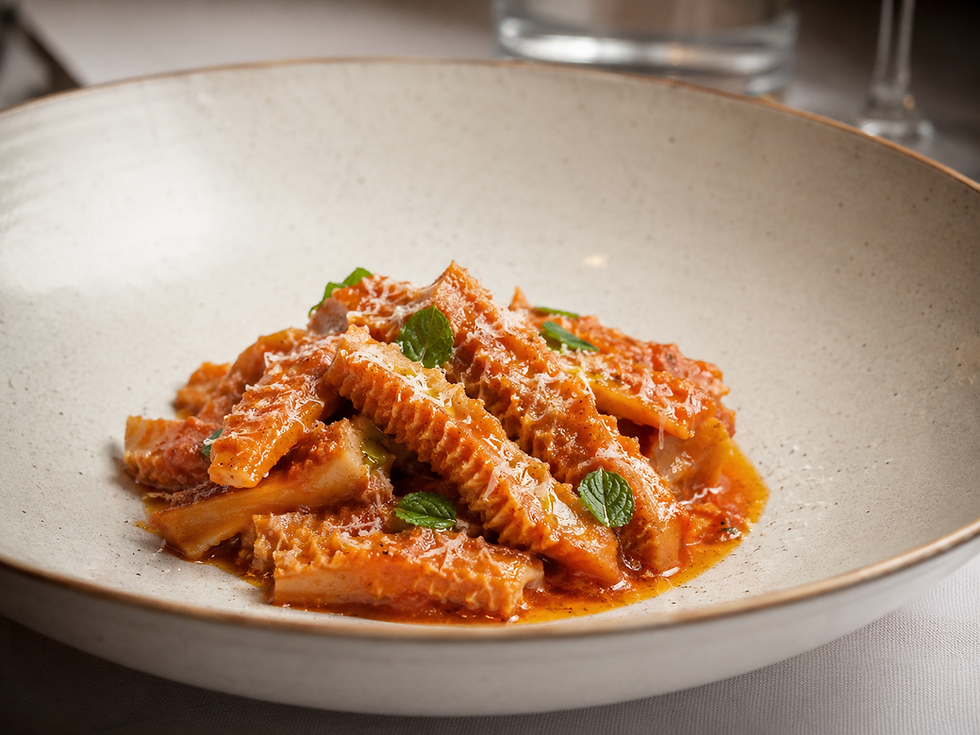
Rigatoni con la pajata is the most Roman of all Roman pastas, and the one that divides visitors from locals. Pajata is the small intestine of a milk-fed calf, cleaned on the outside but left full of the milk the animal was drinking. Tied into rings and simmered for hours in tomato, that milk sets into a soft, savory cream that thickens the sauce from inside, and the rigatoni carry it with a generous shower of Pecorino Romano. This version follows the trattorie of Testaccio step by step and adds only what a restaurant kitchen adds: exact temperatures, careful handling and a sauce finished to a gloss.
Yield: 6 servings. Prep: 40 minutes. Cook: 2 hours 15 minutes. Rest: 10 minutes. Course: primo piatto. Region: Lazio.
The Story
Pajata belongs to the cucina del quinto quarto, the cooking of the fifth quarter. Tradition says that when a carcass was divided in old Rome, the four prime quarters went to those who could pay for them, and what remained, the head, the tail, the tripe, the heart and the intestines, stayed with the poor. From that remainder Roman cooks built a whole repertoire: coda alla vaccinara, trippa alla romana, coratella with artichokes, and pajata, served with rigatoni or on its own as a main course in its sauce.
The heart of this cooking is Testaccio, the working district by the Tiber where the city built its great public slaughterhouse at the end of the nineteenth century, designed by the architect Gioacchino Ersoch. Tradition says the slaughtermen were often paid partly in offal, and that the osterie around the Mattatoio learned to cook it better than anyone. The slaughterhouse stopped working in the 1970s, but the dishes stayed in the neighborhood, and Testaccio is still where Romans go for a plate of rigatoni con la pajata.
The ingredient itself has had a difficult recent history. After the BSE crisis, European rules classified the bovine intestine as a risk material and from 2001 veal pajata disappeared from Italian kitchens. For years Romans made the dish with the intestine of milk-fed lamb, pajata d'abbacchio, which is still cooked and loved today. When the rules were changed in the middle of the last decade, veal pajata came back to the trattorie, and its return was celebrated in Rome as a small piece of the city's identity given back.
The cheese is Pecorino Romano DOP, the sharp, salty sheep's milk cheese whose name recalls its origin in the countryside of Rome. Today most of it is made in Sardinia, which shares the protected area with Lazio and the province of Grosseto in Tuscany. Its salt and its tang are the counterweight to the sweet, milky cream of the pajata. This recipe keeps every element of the Testaccio original, the battuto, the cloves, the white wine, the long simmer, and gives it the precision of a modern kitchen.
Ingredients
Pajata must come from a milk-fed calf, slaughtered before weaning, so that the intestine holds only coagulated milk. Buy it from a butcher who handles offal regularly and ask for it already stripped of fat, or plan the extra time to do it yourself. It must be very fresh, pale pink, with a clean, milky smell, and it must stay cold until the moment it goes into the pan. In the United States it is a special order that only some butchers can source legally, and only from inspected suppliers; do not attempt the dish with an intestine of unknown origin. Use Italian whole peeled tomatoes of a quality you would eat from the can, and a real Pecorino Romano DOP grated at the last minute.
For the pajata
Milk-fed veal pajata, cleaned of fat, 2 1/4 lb (1 kg)
Kitchen twine, about 10 short lengths
Fine sea salt, 1 tsp (6 g)
For the sauce
Pork lard (strutto), 2 tbsp (26 g)
Extra virgin olive oil, 2 tbsp (30 ml)
Yellow onion, finely chopped, 1 medium, about 5 oz (140 g)
Garlic, finely chopped, 2 cloves
Flat leaf parsley, finely chopped, 2 tbsp (8 g)
Whole cloves, 2
Dried chili, crumbled, 1 pinch
Dry white wine from the Castelli Romani, 1/2 cup (120 ml)
Italian whole peeled tomatoes, passed through a food mill, 42 oz (1.2 kg)
Fine sea salt, 1/2 tsp (3 g), plus more to taste
Black pepper, freshly ground, to taste
For the pasta and the finish
Rigatoni, bronze-die, 1 lb (450 g)
Coarse salt, for the pasta water, 1 1/2 tbsp (25 g)
Pecorino Romano DOP, finely grated, 3 oz (85 g), divided
Black pepper, freshly ground, for the table
Preparation
Step 1

Clean the pajata. Lay the intestine on a cold board and rinse the outside quickly under cold running water. With your fingers and the tip of a small knife, pull away any remaining fat and the thin, transparent membrane that holds the loops together, working gently so the wall is never pierced. Never wash the inside: the milk it contains is the soul of the dish. Cut the intestine into lengths of 10 to 12 inches (25 to 30 cm), bring the two ends of each length together and tie them tightly with twine to form a closed ring. Season the rings lightly with salt and keep them in the refrigerator, below 40°F (4°C), until the sauce base is ready.
Step 2

Make the battuto. Put the lard and the olive oil in a wide, heavy pan that will hold the rings in one layer, and set it over low heat. Add the onion, the garlic and the parsley and cook them for 8 to 10 minutes, stirring often, until the onion is soft, translucent and sweet, without any color at the edges. Lard is the traditional Roman fat for this sauce: it gives a round, savory depth that oil alone does not, and the oil keeps it from feeling heavy. A gentle start matters, because browned garlic turns bitter over a two hour simmer.
Step 3

Sear the rings and add the wine. Raise the heat to medium high, add the cloves and the chili, then lay the pajata rings in the pan in a single layer. Let them color for 2 to 3 minutes on each side, turning them with tongs, never with a fork, until they are lightly golden and firm. Pour in the wine and let it bubble for 2 to 3 minutes, until the sharp smell of alcohol has gone and only about 2 tbsp of liquid remain. The quick sear tightens the wall of the intestine, so it holds its contents during the long cooking, and the wine lifts the browned juices from the pan into the sauce.
Step 4

Simmer the pajata in the tomato. Add the milled tomatoes and the salt, stir gently around the rings and bring the sauce to a bare simmer. Partly cover the pan and cook over the lowest heat for 1 1/2 to 2 hours, turning the rings every 20 minutes and adding a few spoonfuls of hot water if the sauce thickens too fast. The surface should only tremble, never boil hard. The pajata is ready when a thin knife slides into a ring without resistance and the sauce is dense, glossy and deep red, with drops of orange fat on the surface. At the end the center of a ring must read at least 160°F (71°C) on a probe thermometer, the safe temperature for variety meats.
Step 5

Finish the sauce. Lift the rings onto a board, let them cool for 5 minutes, then cut away the twine and slice each ring into pieces about 1 1/2 inches (4 cm) long, holding the knife over the pan so that every drop of cream that escapes falls back into the sauce. Return the pieces to the pan, stir gently and taste. Correct the salt with care, remembering that the Pecorino will add more, and finish with a few turns of black pepper. Remove the cloves. The milk released from the cut ends melts into the tomato and gives the sauce its characteristic creamy, almost pink edge.
Step 6

Cook the rigatoni. Bring 4 1/2 quarts (4.3 liters) of water to a rolling boil, add the coarse salt and the rigatoni, and stir during the first minute so they do not stick. Cook them for 2 minutes less than the time on the package, so they are still firm at the center. Meanwhile keep the sauce hot over very low heat. Lift out 1 cup (240 ml) of the cooking water before draining. Rigatoni are the classic shape for this sauce: their ridges hold the tomato and their wide tubes catch the pieces of pajata.
Step 7

Toss the pasta in the sauce. Drain the rigatoni and add them to the pan of sauce over medium heat. Toss and stir for 1 to 2 minutes, adding the reserved cooking water a few spoonfuls at a time, until the pasta is al dente and coated in a sauce that clings to it and shines. Take the pan off the heat, add half of the Pecorino and toss again for 30 seconds. Adding the cheese off the heat keeps it from turning stringy, and the starch from the pasta water binds the cheese, the fat and the tomato into one smooth sauce. Let the pasta rest for 1 minute before plating.
Plating
Serve in warm, shallow bowls, heated to about 140°F (60°C) so the sauce does not set on contact. Lift the rigatoni with tongs and a spoon and build a compact mound in the center of each bowl, then spoon the pieces of pajata on top and around, so every guest has four or five pieces and the creamy cut ends face up.
Spoon a little of the remaining sauce over the top, then cover with a generous layer of the remaining Pecorino Romano and a turn of black pepper. Nothing else goes on the plate: no basil, no oil, no garnish. The dish is eaten at once, while the cheese is just softening on the hot sauce, with more Pecorino on the table for those who want it.
Professional Technique
The key number is time at a low temperature. The wall of the intestine is rich in collagen and needs long, gentle cooking to become tender, while its milky contents need heat to set into a soft cream. A bare simmer, with the sauce at about 195°F (90°C), gives both in 1 1/2 to 2 hours. A hard boil makes the rings contract violently, and they burst before the wall is tender.
The hidden variable is the integrity of the rings. Every ring that opens in the pan spills its milk too early, and the cream disappears into a grainy sauce. Tight knots, a short sear before the tomato goes in, tongs instead of a fork and slow stirring keep the rings closed until you decide to cut them. The release of the cream belongs at the end, on the board, where it can be folded into a finished sauce.
The doneness test is double. A knife must slide into the thickest ring as into soft butter, and the probe must read at least 160°F (71°C) at the center. The sauce itself is ready when a spoon dragged across the bottom of the pan leaves a track that closes slowly, and when the fat begins to separate at the edges in small orange drops.
Texture and Moisture Control
The ideal plate has three textures: firm, chewy rigatoni; tender pajata with a soft, creamy center; and a sauce that is thick enough to cling to the ridges of the pasta but loose enough to move in the bowl. All three depend on how much water stays in the pan.
Mill the tomatoes rather than blending them. The food mill removes seeds and hard cores and gives a sauce of even density, while a blender beats in air and turns the sauce pale and thin. Add water during the simmer only a little at a time and only when needed, because the pasta water at the end will loosen the sauce further.
The finish with pasta water is the last control. Add it in small amounts while tossing, and stop when the sauce flows slowly back toward the center of the pan when you tilt it. Too little water and the Pecorino makes the sauce pasty; too much and it slides off the rigatoni and pools in the bowl.
Professional Mise en Place
The sauce with the pajata can be made a day ahead and is even better after a night in the refrigerator, so service is only reheating, cooking the pasta and tossing. Work in this order, and keep everything that touches raw pajata separate from the rest of the station.
Equipment and tools
Wide, heavy sauté pan or braiser with a lid, large enough for one layer of rings
Small sharp knife, kitchen twine, tongs, probe thermometer
Food mill for the tomatoes
Large pot for the pasta, colander, microplane or fine grater
Prepared ahead
Pajata cleaned and tied into rings, up to 12 hours ahead, kept below 40°F (4°C)
Battuto of onion, garlic and parsley chopped, up to 4 hours ahead
Tomatoes milled, up to 1 day ahead, refrigerated
Sauce with the pajata cooked, cut and finished, up to 2 days ahead, refrigerated
Service setup
Sauce reheated gently to a simmer 15 minutes before service
Pasta water at a rolling boil, salted
Pecorino grated just before service, kept covered
Bowls warmed, tongs, spoon and pepper mill on the pass
Chef Tips
Ask your butcher for the pajata the day you will cook it. Offal is the most perishable meat there is, and a single day in the refrigerator changes its smell and its texture. If it must wait, keep it on ice in the coldest part of the refrigerator.
Make more sauce than you need. In many Roman families the pajata is cooked once and served twice: the sauce dresses the rigatoni, and the rings left whole are eaten as a main course with bread. Keep a few rings uncut for the second day.
Use a white wine from the Castelli Romani, such as a Frascati, in the sauce. It is the wine Roman cooks have always had at hand, and its fresh acidity keeps the long simmer from tasting flat.
Grate the Pecorino Romano with a fine grater just before serving. Pre-grated cheese dries out, loses its aroma and clumps in the hot sauce instead of melting into it.
Common Mistakes
Washing the inside of the intestine. The milk inside is what makes the cream of the sauce. Rinse only the outside and leave the contents untouched.
Loose knots. Rings that open in the pan lose their contents and the sauce turns grainy. Tie each ring tightly and check every knot before searing.
Boiling the sauce. Hard boiling bursts the rings and toughens the wall. Keep the sauce at a bare tremble for the whole cooking time.
Piercing the rings with a fork. Every hole lets the milk escape. Turn the rings with tongs or a wide spoon.
Undercooking. Pajata cooked for less than about 1 1/2 hours stays chewy and rubbery. Use the knife and the thermometer, not the clock alone, and make sure the center reaches 160°F (71°C).
Salting too early and too much. The sauce reduces by half and the Pecorino is salty. Salt lightly at the start and correct only at the end.
Swapping the cheese. Parmigiano Reggiano is too mild and too sweet for this dish. The sharp, salty Pecorino Romano is what balances the sweetness of the milk.
Wine Pairing
Cesanese del Piglio DOCG: The great red of Lazio, from the hills of Ciociaria southeast of Rome. Its red cherry fruit, soft spice and lively acidity cut the richness of the pajata, and its moderate tannins do not clash with the tomato. Serve it slightly cool, at about 60°F (16°C).
Frascati Superiore DOCG: The white of the Castelli Romani and the wine of the Roman osterie. Its fresh acidity and almond finish clean the palate after the cream of the sauce and the salt of the Pecorino, the way Romans have always drunk it with this dish. Serve it chilled, at about 50°F (10°C).
Montepulciano d'Abruzzo DOC: From the neighboring region to the east, a red with dark fruit, a full body and soft tannins. It stands up to the depth of the long braised sauce and to the sharpness of the cheese. Serve at about 62°F (17°C).
Cerasuolo d'Abruzzo DOC: A deep pink wine made from Montepulciano, with the fruit of a red and the freshness of a white. It is an excellent choice for guests who find a red too heavy with offal, and its acidity matches the tomato perfectly. Serve at about 54°F (12°C).
Storage & Reheating
Refrigerator: keep the sauce with the pajata in an airtight container for up to 2 days, cooled to room temperature within 1 hour of cooking. Do not store the dressed pasta: rigatoni left in the sauce absorb it and turn soft. Freezer: the sauce with the pajata can be frozen for up to 2 months, although the cream becomes slightly grainy after thawing; thaw it overnight in the refrigerator.
Reheat the sauce in a covered pan over low heat with 2 to 3 tbsp of water, stirring gently, until it simmers and the pajata is hot at the center, at least 165°F (74°C). Then cook fresh rigatoni and toss them in the sauce as described. Leftover rings can be reheated the same way and served as a main course with crusty bread.
Nutrition
Per serving, based on 6 servings:
Calories: 715 kcal
Total Fat: 31 g
Saturated Fat: 12 g
Trans Fat: 0 g
Unsaturated Fat: 18 g
Cholesterol: 265 mg
Sodium: 950 mg
Total Carbohydrates: 66 g
Fiber: 5 g
Total Sugars: 7 g
Added Sugars: 0 g
Protein: 37 g
Lactose: about 1 g
Principal micronutrients: vitamin B12, zinc, iron, lycopene, calcium
These figures are estimates, calculated on the quantities listed and rounded to the nearest whole number. The values for pajata vary widely with the animal and the amount of milk in the intestine, so the fat and cholesterol figures are approximate.



Comments