
Italian Sardinian Seadas | Seadas Sarde

Seadas are the great fried sweet of inland Sardinia: a thin semolina case wrapped around warm fresh pecorino and finished with honey. They are sweet and savoury at the same moment, and they are eaten within a minute of leaving the oil, because everything that makes them good is fleeting. The crackle of the pastry, the cheese still stretching, the honey barely warm. Nothing about them is difficult, and almost everything about them is a question of timing.
Yield: 8 seadas, 4 servings of two. Prep: 45 minutes. Rest: 30 minutes. Cook: 15 minutes. Total: about 1 hour 30 minutes. Difficulty: intermediate. Course: dolce. Region: Sardinia, the Barbagia and the central highlands.
The Story
Seadas, sebadas in much of the island, come from the pastoral interior rather than the coast: the Barbagia, the Ogliastra, the high country around Nuoro and Fonni. They were shepherd food before they were anything else. The name is generally traced to seu, the Sardinian word for tallow or animal fat, a reminder that the dough was worked with lard long before butter reached these kitchens. In the spring, when the ewes were in full milk and fresh cheese was made daily, seadas were the obvious thing to do with a surplus that would not keep for long in a warm climate and had no market beyond the village. They arrived at the table hot, as a proper course in the middle of a meal, and nobody thought of them as a dessert.
The cheese decides the dish. What goes inside is pecorino of two or three days, barely pressed, still white and still faintly sour, the kind a shepherd would have on hand rather than buy. That young acidity is the whole point: it pushes back against the honey and keeps the seada from collapsing into simple sweetness. In the Ogliastra the filling is often scented with lemon, further north orange appears instead, and some households add a spoonful of the cheese from the day before for a sharper note. A few still use goat milk cheese, which gives a tighter filling. The variations are real but narrow. What never changes is that the cheese is fresh, local, and made to be eaten young.
Seadas reached restaurant menus in the second half of the twentieth century, and that is where the confusion about their place in a meal began. Sardinian cooks still argue about it, and the honest answer is that both readings are traditional: sweet and savoury were not separate territories in a pastoral kitchen. What did carry them out of the shepherds' huts is the feast. Seadas belong to weddings, to village saints' days, to Carnival, to the long lunches where somebody stands at the pan and fries them in sequence while the table waits. The dish survived because it was never precious, and because a fried sweet arriving hot at a crowded table has never needed an argument in its favour.
Ingredients
Four elements only, and two of them decide the result: a young acidic sheep cheese and a honey with some character. Buy the cheese from a counter that sells it fresh by the piece rather than sealed and aged, and weigh it after any rind has been cut away. The quantities below make 8 seadas of about 4 1/2 inches (11 cm), which is the traditional size in the Barbagia.
For the dough
Fine semolina flour, semola rimacinata, 2 cups (300 g)
All purpose flour, 1/2 cup (65 g)
Lard, strutto, softened, 3 tbsp (40 g)
Warm water, about 2/3 cup (160 ml), added gradually
Fine sea salt, 1/2 tsp (3 g)
Fine semolina flour for dusting the work surface, 2 tbsp (20 g)
For the cheese filling
Fresh pecorino sardo, young and acidic, 14 oz (400 g) after trimming
Finely grated lemon zest, from 1 large unwaxed lemon
Fine semolina flour, for the setting tray, 2 tbsp (20 g)
Fine sea salt, 1 small pinch
For frying
Sunflower or peanut oil, 6 cups (1.4 L), enough for the pastry to float
For finishing
Mild wildflower honey, 1/2 cup (170 g)
Chestnut honey, for a darker bitter finish, optional, 2 tbsp (40 g)
Granulated sugar, for dusting, 1 tbsp (12 g)
Finely grated lemon zest, from 1/2 lemon
Preparation
Step 1
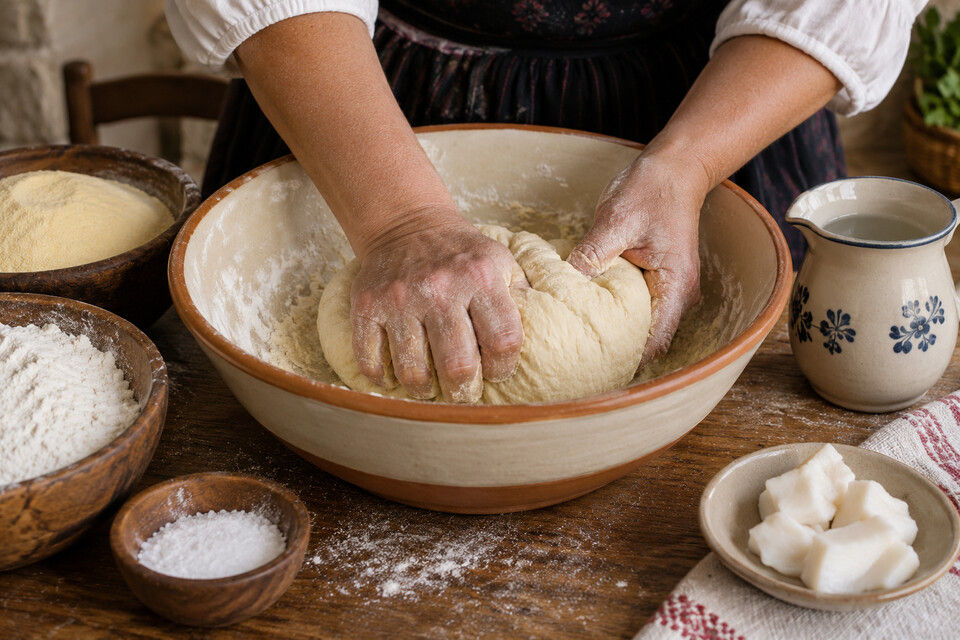
Mix the semolina dough. Combine the semolina flour, the all purpose flour and the salt in a wide bowl. Rub the softened lard through with your fingertips until no lumps remain and the mixture feels faintly sandy. Add the warm water a little at a time and stop as soon as the dough comes together. Knead firmly for 8 to 10 minutes: semolina needs time to hydrate, and the dough should end smooth, elastic and distinctly firm, closer to fresh pasta than to pastry.
Step 2

Rest the dough. Wrap it tightly and leave it at room temperature for 30 minutes. This rest is not optional. Freshly kneaded semolina dough springs back against the pin, and pushing it thin too early leaves it uneven or torn, which is exactly how a seada bursts in the oil later. Do not refrigerate it, since cold lard stiffens the dough and undoes the point of the rest.
Step 3
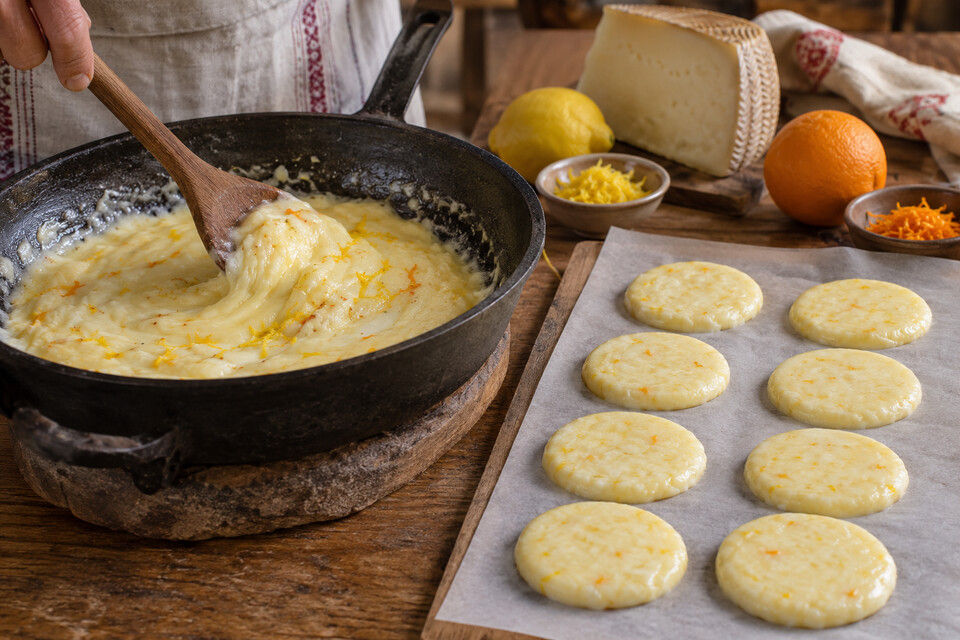
Warm and set the cheese. Grate the pecorino coarsely and put it in a heavy pan over the lowest possible heat with the lemon zest and the salt. Stir constantly. You want it to soften into a single elastic mass that pulls behind the spoon, and no further: the moment it releases clear fat or watery whey it has gone too far. Spread it on a semolina dusted tray about 1/4 inch (6 mm) thick and let it cool completely.
Step 4

Roll the sheets. Cut the cooled cheese into 8 rounds of about 2 1/2 inches (6 cm) with a cutter. Divide the dough into 4 pieces, keep three covered and roll the fourth to about 1/16 inch (1.5 mm), thin enough to read print through. Cut two discs of roughly 4 1/2 inches (11 cm) per portion. Work quickly: a rolled semolina sheet dries fast, and a dry edge will not seal. Keep every finished disc under a cloth.
Step 5

Fill and seal. Centre a cheese round on one disc, leaving a clear border of about 3/4 inch (2 cm). Brush that border with water, keeping flour off it, because flour on a sealing edge acts as a dry barrier and guarantees a leak. Lay the second disc on top and press outward from the cheese, driving every trace of air out before you close the rim. Seal firmly, then trim with a fluted wheel to the traditional scalloped circle.
Step 6
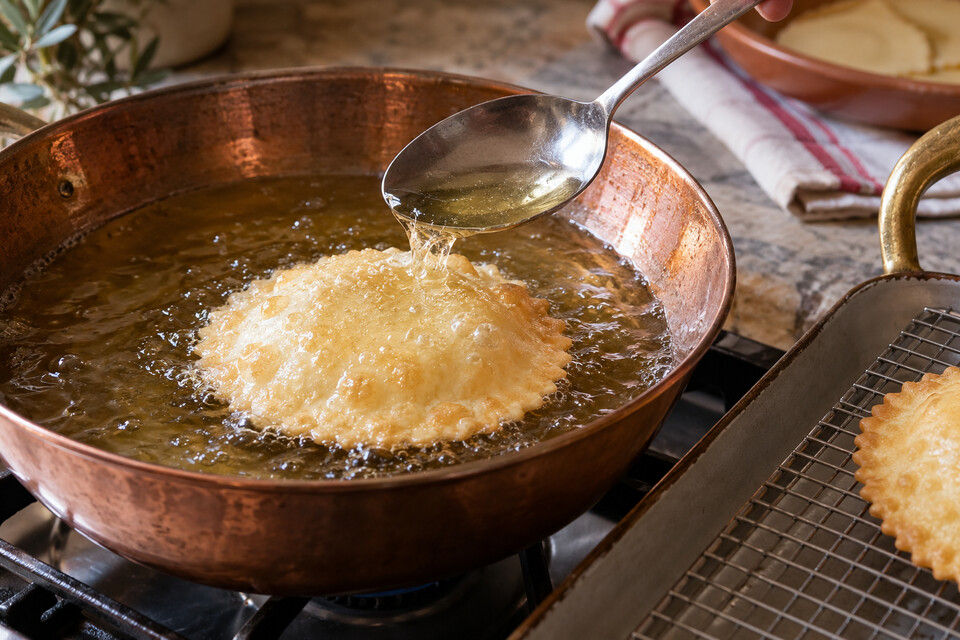
Fry one at a time. Bring the oil to 350°F (175°C) and check it with a thermometer rather than by eye. Slide in a single seada and spoon hot oil over the upper surface continuously so it puffs and colours evenly. Give it 90 seconds to 2 minutes a side, until deep gold and blistered. Never crowd the pan: two seadas drop the temperature, the pastry absorbs fat instead of sealing, and the cheese finds a weak point.
Step 7

Honey and serve. While the last one fries, warm the honey until it is just fluid and fragrant. Do not let it boil, which drives off the aroma and leaves nothing but sugar. Lift each seada onto a rack for a few seconds only, dust it lightly with sugar, set it on a warm plate and spoon the honey over the top so it runs down the ridges. Finish with lemon zest and serve immediately.
Plating
Serve two seadas per person on a warm plate, never a cold one, and never stacked. Cold porcelain sets the cheese within a minute and the honey stiffens on contact, so warm the plates alongside the oil. Lay the seadas slightly apart so the fluted edges stay visible and neither one steams the other.
Spoon the honey at the plate rather than in the kitchen, and use enough that it pools a little at the base. A thread of darker chestnut honey drawn across the lighter one gives the bitterness somewhere to register without taking over. Finish with lemon zest grated at the last second and nothing else. There is no sauce, no cream and no ice cream on this plate in Sardinia, and the dish is better for it.
Professional Technique
The technical problem of a seada is a fresh acidic cheese sealed inside a fried case. Young pecorino has to melt into a mass that stretches and it must not liquefy, and the window between those two states is narrow, perhaps 15 degrees wide. Fresh cheese holds its water inside a loose protein network that ageing has not yet tightened. Warmed gently, that network softens and the curd turns elastic. Pushed harder, the proteins contract, expel their whey and let the butterfat run free, and the filling becomes a puddle no seal will contain.
This is why the cheese is warmed barely, over the lowest heat, with constant movement, and why the lemon zest goes in at that stage rather than at the end. The zest is not a perfume here. It is a regulator. Its acidity keeps the casein proteins slightly dispersed at the moment they are most inclined to knit together and expel liquid, so the mass stays smooth and stretching rather than separating into fat and whey. It is also why the cheese must be young: an aged pecorino has lost the water and the pH that make this possible.
The pastry solves the other half. A semolina sheet rolled to 1/16 inch (1.5 mm) and dropped into oil at 350°F (175°C) sets its surface in seconds, because the water just under the skin flashes to steam and drives the oil back out. Thin and deep fried, the case is cooked and rigid before the filling has climbed past the point where it would run. Roll thicker, or fry shallow and cooler, and the order reverses: the cheese melts first and the seada empties into the pan.
Texture and Moisture Control
Three textures have to arrive together: the case brittle and blistered, the cheese soft and stringing, the honey fluid. Each fails on its own schedule. The pastry loses its crackle within four or five minutes of leaving the oil, faster under honey, which is why seadas are fried to order. The cheese sets as it cools and turns rubbery at room temperature, and the honey stops running on a cold plate.
Water is the enemy at every stage. Surface whey on the grated cheese becomes steam inside a sealed pastry and blows the seam open, so the cheese is drained and the cooled disc is dry to the touch before it goes in. Trapped air does the same: it expands, lifts the top sheet and tears the rim, which is why you press outward from the centre rather than crimping the edge. The border stays free of flour, because flour absorbs the brushing water and leaves a dry line that never bonds.
Oil temperature is the last control. At 350°F (175°C) the pastry seals and stays dry inside. Below about 325°F (165°C) it drinks oil and turns heavy and pale, and above 375°F (190°C) the outside browns before the dough has cooked.
Professional Mise en Place
Everything except the frying and the honey can be done ahead, and the last stage runs on a 3 minute cycle per seada, so set the pass up before the oil goes on the heat.
Equipment and tools
Heavy deep pan or narrow fryer and a probe thermometer
Round cutter of 2 1/2 inches (6 cm) and one of 4 1/2 inches (11 cm)
Fluted pastry wheel for the traditional scalloped rim
Heavy small pan for the cheese, small pan for the honey
Spider or slotted spoon, cooling rack, clean cloths for the rolled sheets
Prepared ahead
Cheese warmed, spread, cooled and cut into discs, up to 1 day ahead, covered and cold
Dough made and rested, up to 4 hours ahead, wrapped at room temperature
Seadas assembled and sealed, up to 2 hours ahead, on a semolina dusted tray under a cloth
Honey measured, lemon zested, sugar ready in a small sieve
Service setup
Oil at 350°F (175°C) and holding, thermometer in the pan
Plates warm, rack beside the pan, honey fluid over the lowest heat
Assembled seadas within reach, covered, at room temperature
Chef Tips
Buy the cheese from a counter that cuts it fresh and ask how old it is. Anything past about a week has lost the sourness and the water the filling depends on, and no adjustment in the pan brings either back.
Test one seada before you commit the batch. Fry it, cut it open and look: the filling should stretch when you pull the halves apart, not run. If it runs, the cheese went too far in the pan and the remaining discs are better remade.
Roll thinner than feels comfortable. Cooks almost always stop too thick, and a heavy case is the commonest reason a seada tastes doughy instead of crisp. If you can see the shape of your hand through the sheet you are close.
Choose the honey deliberately, because it is half the flavour of the plate. Mild wildflower honey lets the cheese speak, chestnut honey adds a bitter edge that suits the salt, and a heavily perfumed orange blossom honey buries both.
Common Mistakes
Overheating the cheese. Once young pecorino releases clear fat and watery whey it has separated, and it will not come back together. Keep the heat at its lowest, stir without stopping, and take the pan off as soon as the mass pulls behind the spoon.
Leaving flour on the sealing edge. Flour absorbs the water you brush on and leaves a dry line that never bonds, so the rim opens in the oil. Brush a clean border and keep the dusting flour well away from it.
Trapping air with the filling. Air expands in the pan, lifts the top sheet and splits the seam. Press outward from the cheese and drive it all out before you close the edge.
Frying more than one at a time. Two seadas pull the oil below the temperature at which the pastry seals, so it soaks fat, stays pale and gives the cheese time to escape. One at a time, with a pause for the oil to recover.
Boiling the honey. Honey heated hard loses its aroma and tastes of nothing but sugar. Warm it only until it flows.
Wine Pairing
Malvasia di Bosa DOC: The island's own answer and the most complete one. Aged oxidatively under a veil of yeast, it brings bruised apple, almond and dried fruit over a firm acid spine, so it carries the honey without adding weight. That nutty depth meets the salt of the pecorino directly. Serve it cool, around 54°F (12°C).
Girò di Cagliari DOC: A sweet Sardinian red and a genuinely local pairing. Its red fruit and warm spice sit beside chestnut honey, and the modest tannin gives the palate something to push against after the cheese fat. The sweetness stays moderate rather than syrupy: a heavier dessert red flattens the sour note in the filling.
Moscato d'Asti DOCG: The technical choice for anything deep fried. Low alcohol, light sweetness and a fine persistent bead scrub fat off the palate in a way still wines cannot, while the grapey aromatics sit naturally with honey and lemon zest. Its acidity keeps the finish clean.
Recioto di Soave DOCG: Dried garganega gives a sweet wine with unusually high acidity and a note of almond and white flowers. It has the concentration to stand up to the honey and the acid to stop the pairing turning cloying, and the almond edge echoes the toasted semolina crust.
Vin Santo del Chianti Classico DOC: The mainland option when the Sardinian bottles are out of reach. Long oxidative ageing in small casks builds walnut, dried apricot and caramel over a dry finishing acidity, and its oldest companion is salty cheese, exactly what sits inside the pastry. Serve at cellar temperature, not chilled.
Storage & Reheating
A fried seada does not keep, so store the components instead. Assembled uncooked seadas hold on a semolina dusted tray, covered, for up to 24 hours in the refrigerator, and they freeze well: open freeze them on the tray, then bag them for up to 2 months and fry them straight from frozen, adding about 45 seconds a side. The cheese discs keep 1 day covered and cold, the dough 4 hours at room temperature.
If you have fried seadas left over, keep them uncovered at cool room temperature for a few hours only and reheat them on a rack in a 350°F (175°C) oven for 5 to 6 minutes, never in a microwave, which steams the pastry soft and turns the filling to rubber. Honey goes on after reheating, freshly warmed.
Nutrition
Per serving, based on 4 servings of two seadas each:
Calories: 720 kcal
Total Fat: 38 g
Saturated Fat: 17 g
Trans Fat: 0 g
Unsaturated Fat: 19 g
Cholesterol: 70 mg
Sodium: 690 mg
Total Carbohydrates: 74 g
Fiber: 3 g
Total Sugars: 28 g
Added Sugars: 26 g
Protein: 22 g
Lactose: 1.5 g
Principal micronutrients: calcium, phosphorus, vitamin A, vitamin B2, zinc, selenium
These figures are estimates. Oil absorption varies with temperature control, and most of the frying oil is not eaten.


Comments