
Italian Pink Grapefruit Sorbet | Sorbetto al Pompelmo Rosa

Pink grapefruit is the one citrus that arrives at the sorbet machine carrying a problem, and the problem is not acidity. It is bitterness, and bitterness does not behave the way sharpness does. Handled badly the sorbet finishes hard and medicinal; handled properly it finishes long, faintly resinous and deeply refreshing, which is exactly why it belongs at the end of a heavy meal rather than at the beginning.
Yield: 6 servings, about 1 quart (950 ml). Prep: 25 minutes. Chill and mature: 4 hours. Churn: 25 minutes. Harden: 3 hours. Total: about 8 hours. Difficulty: intermediate. Course: dolce. Region: Sicily and Calabria.
The Story
Sorbet is the oldest thing in the Italian dessert repertoire, and Sicily owns it. Snow was cut from the slopes of Etna and the Madonie in winter, packed into stone pits called neviere and insulated with ash, straw and chestnut leaves, then sold through the summer to the nevaioli who turned it into flavoured ices. The Arab presence on the island brought sugar cane and the word sharbat, and the two things together produced the ancestor of everything in an Italian gelateria case today.
The craft left the island and became famous elsewhere. Francesco Procopio dei Coltelli, born near Palermo, opened his shop in Paris in 1686 and sold Sicilian ices to a city that had never tasted them, and the Cafe Procope is still standing. By the eighteenth century sorbet had a fixed role at the Italian table that had nothing to do with dessert: a small unsweetened glass served between courses at long formal dinners, to reset the palate before the roast arrived. Citrus, and bitter citrus above all, was the preferred flavour for that job.
Pink grapefruit itself is a recent arrival and not an Italian fruit by origin. Grapefruit appeared in the Caribbean in the eighteenth century as a chance cross of sweet orange and pomelo, and the pink and red cultivars were selected in Texas and Florida in the twentieth. Italy planted them commercially only after the Second World War, in the citrus belt around Catania and Siracusa and in the plain of Gioia Tauro in Calabria, always in small volumes beside the oranges and lemons that pay the bills.
That late arrival is why there is no single village recipe to defend here. What exists instead is a technique, carried down through the Sicilian sorbet tradition and applied to a fruit the tradition never had, in a country that has always taken bitter flavours seriously at the end of a meal. The sorbet belongs to the family of amaro finishes, next to the digestivo and the bitter chocolate, rather than to the family of sweet puddings.
Ingredients
Buy the fruit by weight and taste one before committing. Grapefruit varies enormously: Star Ruby is deeply pigmented and markedly bitter, Ruby Red is milder and sweeter, and a pale blushing supermarket fruit may be almost neutral and will need far less correction.
For the sugar syrup
Water, 1 cup (240 ml)
Granulated sugar, 1 cup (200 g)
Dextrose, 3 tbsp (35 g), or an additional 2 tbsp (25 g) granulated sugar
Glucose syrup, 1 tbsp (20 g)
Fine sea salt, 1/4 tsp (1.5 g), plus a little more to adjust
For the grapefruit base
Pink grapefruit, ripe, 5 to 6 fruits, about 4 1/2 lb (2 kg) whole
Strained pink grapefruit juice from the above, 2 1/2 cups (600 ml)
Fresh lemon juice, strained, 2 tbsp (30 ml)
Finely grated pink grapefruit zest, 1/2 tsp (1 g), optional
For finishing
Pink grapefruit segments, membrane removed, 12 to 18
Flaky sea salt, a very small pinch per plate
Fresh mint or lemon verbena leaves, small, 6 to 12
Extra virgin olive oil, mild and fruity, a few drops per plate, optional
Preparation
Step 1
Make the syrup and chill it hard. Combine the water, sugar, dextrose, glucose syrup and salt in a small saucepan and bring to a bare simmer, stirring only until every crystal has dissolved. Do not reduce it: you are dissolving sugar, not concentrating it, and evaporation throws the balance out. Cool to room temperature, then refrigerate to 39F (4C) or below, at least 2 hours. It can be made 5 days ahead.
Step 2
Cut the fruit for gentle juicing. Wash and dry the grapefruit. If you want the optional zest, take it now with a rasp grater, stopping the moment you see white. Halve each fruit across the equator, through the segments rather than along them, so the reamer meets flesh and not the tough central core. Set the halves cut side up.
Step 3
Juice with light pressure only. Work each half on a hand reamer or a citrus press with a slow even downward motion and stop while the flesh still looks wet. Never twist the fruit hard against the cone, never fold the rind back to wring out the last drops, and never use a lever press that torques the peel. The white pith and the segment walls must stay intact in the shell.
Step 4
Strain without pushing. Pour the juice through a fine mesh sieve and let it pass under its own weight, helped by a gentle swirl of the sieve rather than a ladle. Whatever stays in the sieve, pulp, segment wall, seeds, goes in the bin: pressing it through is the fastest way to ruin the sorbet. Measure out 2 1/2 cups (600 ml) and add the lemon juice.
Step 5
Taste both parts cold and correct. Taste a spoonful of the cold syrup, a spoonful of the cold juice, then the two mixed. Judge the bitterness now, at refrigerator temperature, never warm. If the bitter edge dominates rather than frames, add fine salt a scant pinch at a time, stirring and tasting between each. Three or four pinches across the batch is normal. Do not reach for more sugar.
Step 6
Combine and mature the base. Stir the cold juice into the cold syrup, add the zest if you are using it, cover and refrigerate 4 hours. The rest is not idle time: the sugars hydrate fully, any zest oil diffuses, and the base settles to a uniform temperature, which shortens the churn. Stir once and taste again, still cold, before it goes into the machine.
Step 7
Churn until it holds a soft ribbon. Pour the base into a prefrozen machine and churn 20 to 25 minutes. Watch the texture, not the clock: it is ready when it thickens visibly, lightens in colour as air works in, and falls from the paddle in a ribbon that holds its shape for a second. Overchurning warms the mix by friction and coarsens it, underchurning leaves it loose and it sets into a block.
Step 8
Transfer and harden. Scrape the sorbet into a chilled shallow metal container, press parchment directly onto the surface to keep frost off it, close the lid and freeze at least 3 hours. A deep tub freezes slowly from the outside in and grows large crystals at the centre, so spread it no more than 2 inches (5 cm) deep and use the coldest part of the freezer.
Plating
Take the container out of the freezer and let it stand at room temperature for 5 to 10 minutes before you touch it. Sorbet straight from a domestic freezer at 0F (minus 18C) is too hard to read and tastes of almost nothing. Chill the glasses instead, and keep the plates cold.
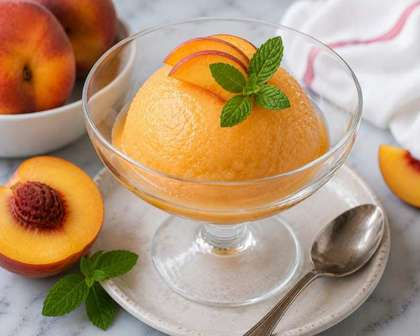
Serve it in small chilled glass coupes, or in the hollowed shells if you kept them, as one generous scoop or two neat quenelles shaped with a warmed spoon. Lay two or three grapefruit segments beside it, add a very small pinch of flaky salt on the fruit rather than on the sorbet, and finish with a single mint or lemon verbena leaf. A few drops of mild olive oil around the base is worth trying, since the fat rounds the bitterness. Serve immediately, with a cold spoon.
Professional Technique
The bitterness of pink grapefruit is not vague and it is not acidity. It is a specific compound, naringin, a flavonoid glycoside concentrated in the fruit, and it registers through an entirely different mechanism than citric acid. Acid is sharp, fast and gone. Naringin arrives slowly, leaves slowly, and builds across successive mouthfuls, which is why the second spoonful of a badly balanced grapefruit sorbet tastes more bitter than the first.
Sugar does not remove it. Sweetness competes for attention and pushes the bitterness into the background, but the naringin is still there and still accumulating, and a sorbet sweetened until it disappears has lost the fruit and gained a cloying finish. Salt works better. Sodium suppresses bitter perception at the receptor itself, so a few pinches of fine salt attenuate the bitterness more effectively than several tablespoons of extra sugar, and without touching sweetness or the freezing behaviour of the base.
Then there is where the naringin lives. The white pith under the peel and the tough walls dividing the segments are loaded with it, far more than the juice, and both release it the instant they are crushed. That is the whole reason the juicing is gentle: light pressure, no twisting, no lever press, nothing pushed through the sieve. Every extra millilitre extracted by force carries a disproportionate load of bitterness with it.
Finally, temperature. Cold suppresses bitter perception, so a base that tastes balanced while warm will taste aggressively bitter once frozen, because the sugar reads less sweet too while the accumulation does not go away. Judge the syrup and the base cold, always.
Texture and Moisture Control
A sorbet has no fat and no egg to hide behind, so texture is entirely a question of ice crystal size, and crystal size is decided by how fast the water freezes and how hard the mix is agitated while it does. A properly prefrozen machine and a base already at refrigerator temperature carry the mix through the critical zone quickly and grow small crystals. A warm base in a marginal machine grows large ones, and no later churning breaks them down.
Agitation does two jobs. It stops the crystals linking into a solid mass, and it works a little air in, which is what makes a frozen block yield under a spoon. Grapefruit takes air reluctantly compared with a puree, so watch for the moment the colour lifts and the paddle leaves a ribbon. That signal beats any stated time.
After that the enemy is the freezer. Every temperature swing melts the smallest crystals and refreezes their water onto the larger ones, and a week of that turns a smooth sorbet grainy. Parchment on the surface, a tight lid, a shallow container and the coldest shelf all fight the same battle. Serve within four days.
Professional Mise en Place
Almost everything here happens the day before, and only the tempering and the scooping are done to order. Get the machine bowl into the freezer a full day ahead: a bowl that is not properly frozen is the commonest cause of a failed sorbet.
Equipment and tools
Gelato machine with the bowl frozen 24 hours, or a compressor machine prechilled
Hand reamer or gentle citrus press, never a high torque lever press
Fine mesh sieve, small saucepan, rasp grater, digital scale
Shallow metal container with a lid, parchment cut to the surface
Instant read thermometer, small metal spoon in iced water
Prepared ahead
Syrup made and fully chilled, up to 5 days ahead
Juice squeezed and strained, on the day of churning only
Base combined, salted to taste and maturing, 4 hours minimum
Grapefruit segments cut and refrigerated, up to 6 hours ahead
Service setup
Sorbet out of the freezer 5 to 10 minutes before the first plate
Warm water and a cloth for the quenelle spoon, wiped between scoops
Segments, flaky salt, herbs and oil lined up cold within reach
Sorbet back in the freezer between services, never left standing
Chef Tips
Taste one grapefruit raw before you buy six. The variation between cultivars and shipments is wider than for any other citrus, and it decides how much salt the batch needs. A Star Ruby wants a firm hand with the salt, a pale mild fruit may take one pinch.
Squeeze the juice the same day you churn. Juice left overnight loses brightness and gains bitterness, because the pulp still suspended in it keeps giving up naringin. Strain it and use it within a couple of hours.
Keep the emptied shells. Scrape them clean, freeze them flat on a tray and serve the sorbet in them. It costs nothing, it looks like the Sicilian sorbet houses it comes from, and a frozen shell holds temperature far longer than glass.
If the churned sorbet is too soft to scoop, do not keep churning and do not add sugar. Get it into the shallow container and into the freezer: the cause is almost always a bowl that was not cold enough, and the freezer will finish the job.
Common Mistakes
Squeezing the fruit hard for more juice. The pith and the segment walls hold far more naringin than the juice, and torquing the halves crushes both into the bowl. You gain 10 percent volume and a sorbet nobody finishes.
Pushing the pulp through the sieve. Let the juice pass under its own weight and throw the residue away, however much is sitting in there.
Tasting the base warm. Cold suppresses bitter perception, so a base balanced on a warm spoon freezes into something harsh. Judge everything at refrigerator temperature.
Correcting bitterness with sugar. It masks without removing, and the sorbet turns flat and cloying while the bitterness still accumulates underneath. Reach for salt, a pinch at a time.
Churning a warm base in a lukewarm bowl. The mix crawls through the freezing zone and grows coarse crystals no later churning can undo. The bowl needs a full 24 hours.
Boiling the syrup down. A simmer to dissolve the sugar is all it needs. Reducing it concentrates the sugar and the sorbet will not set firm.
Serving it straight from the freezer. At 0F (minus 18C) it is too hard to taste and too hard to scoop. Five to ten minutes on the bench is the whole difference.
Wine Pairing
Moscato d'Asti DOCG: The most forgiving match and the one to pour if there is only one bottle. Low alcohol, gentle sweetness and soft carbon dioxide all work against the naringin: sweetness pushes it back, the bubbles scrub the palate between spoonfuls, and the peach and orange blossom aromatics meet the citrus without crowding it. Serve at 43F (6C).
Moscato di Noto DOC: The Sicilian answer, from the same corner of the island as the sorbet tradition. Fuller and more overtly floral than the Piedmontese Moscato, with a candied citrus peel note that runs alongside the grapefruit rather than against it. Choose the lighter still version, so the alcohol does not amplify the bitter finish.
Greco di Bianco DOC: From the Calabrian coast near the grapefruit plantations of Gioia Tauro, and the most interesting bottle here. The dried grapes give it its own bitter orange and peel character, so instead of covering the naringin it answers it, and the real acidity under the sweetness keeps the pairing from turning heavy.
Malvasia delle Lipari DOC: An Aeolian wine with a saline thread running through its apricot and dried fig sweetness, and that salinity is why it belongs here: salt suppresses bitter perception on the wine side exactly as it does in the sorbet. Its moderate sugar never overwhelms a dessert with little of its own.
Colli Orientali del Friuli Picolit DOCG: The elegant choice, and the one for a table that dislikes sweet wine. Picolit is only lightly sweet, with high acidity and a faintly bitter almond finish that sits beside the grapefruit as a partner rather than a corrective. Serve it cool but not iced, around 50F (10C).
Storage & Reheating
Nothing here is reheated, so storage is only about protecting texture. Keep the sorbet in a shallow airtight metal container with parchment pressed flat onto the surface, on the coldest shelf and away from the door. It is at its best for 4 days, still good for a week, and by two weeks it has coarsened whatever you do.
The syrup keeps refrigerated in a sealed jar for 5 days and freezes indefinitely, so a double batch is worth making. Strained juice does not keep: a few hours at most, since it gains bitterness as it stands. Cut segments hold 6 hours and no longer.
If the sorbet has set too hard or has frosted over, never let it melt and refreeze. Move it to the refrigerator for 20 minutes, or scrape the frost away and temper the rest on the bench. A block that has genuinely gone grainy can be broken up and churned again from cold, which recovers most of the texture once.
Nutrition
Per serving, based on 6 servings of about 2/3 cup (160 ml):
Calories: 195 kcal
Total Fat: 0.2 g
Saturated Fat: 0 g
Trans Fat: 0 g
Unsaturated Fat: 0.1 g
Cholesterol: 0 mg
Sodium: 65 mg
Total Carbohydrates: 49 g
Fiber: 0.5 g
Total Sugars: 47 g
Added Sugars: 38 g
Protein: 0.8 g
Lactose: 0 g
Principal micronutrients: vitamin C, lycopene, potassium, folate, vitamin A
These figures are estimates and the sugar total moves with the ripeness of the fruit.


Comments