
Italian Baked Tomino Cheese with Turin Breadstick and Hazelnut Crust | Tomini al Forno in Crosta di Grissini Torinesi e Nocciole
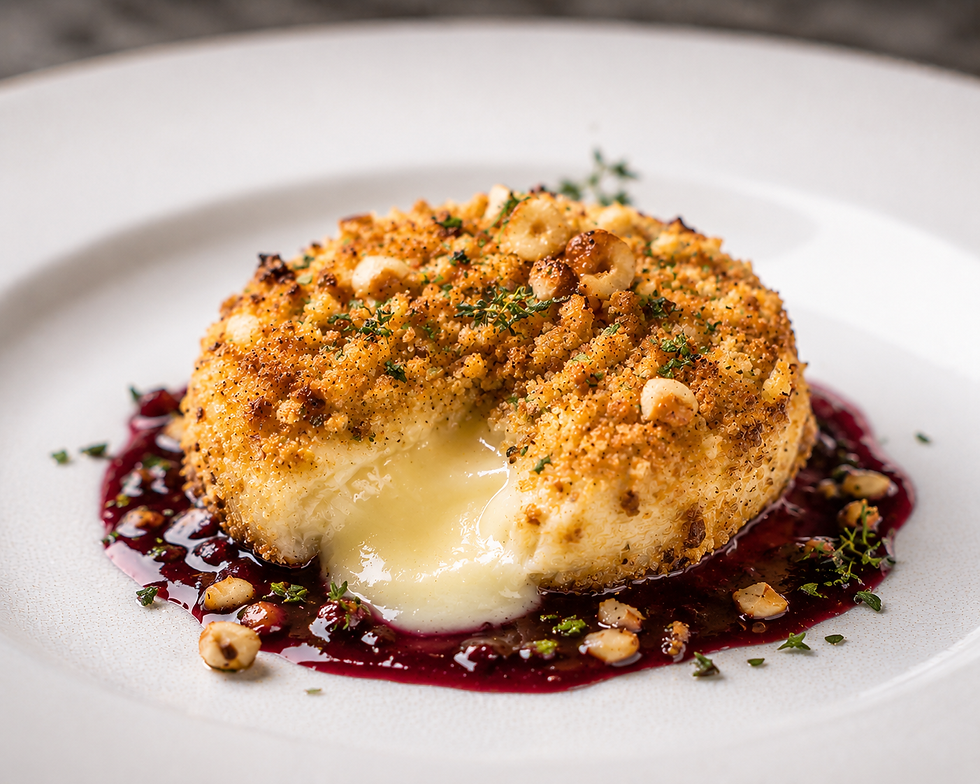
Tomino is the small fresh cheese of the Piedmont hills, milky, soft and barely salted, and Turin has one clever answer to the question of how to serve something so delicate hot: wrap it in crushed grissini and Tonda Gentile hazelnuts and bake it very fast.
What reaches the table is a thin golden shell around a warm, spoonable heart, sweet with milk and finished with a thread of chestnut honey.
Yield: 4 servings. Prep: 25 minutes, plus 1 hour chilling. Cook: 7 minutes. Total: about 1 hour 35 minutes. Difficulty: intermediate. Course: main course or antipasto. Region: Piedmont, Turin.
The Story
Tomino belongs to the Piedmontese valleys, where small farms turned surplus milk into little rounds of fresh cheese that needed no ageing and no cellar. Made from cow's milk, sometimes with a little goat's or sheep's milk added, a tomino is set with rennet, drained in its mould and eaten within days. The name is a diminutive of toma, the larger Alpine cheese of the same country. Where a toma is pressed and matured for months, a tomino is barely finished: white, soft, milky and lightly salted, with the faint tang of the pasture.
Turin gave the cheese its crust. Tradition holds that the grissini were born in the city in 1679, when the baker Antonio Brunero was asked by the court physician to make a light, digestible bread for the sickly young Duke Vittorio Amedeo II. He stretched the dough by hand into long thin sticks, and the Turin breadstick was born. Napoleon is said to have been so taken with them that he called them the little sticks of Turin. Ever since, every trattoria and every home kitchen in the city has kept crushed grissini somewhere near the stove, used the way other regions use dry breadcrumbs: brittle, fragrant and quick to brown.
The hazelnut completes the picture. The Langhe hills around Alba grow the Tonda Gentile, a round nut with a sweet, almost buttery flavour that is protected as a PGI product and toasted in every Piedmontese pastry shop. Set against a bland cheese, it supplies the aroma the tomino lacks. In the old Turin osterie the cheese was often fried and served with green sauce, the bagnet verd, or with a fiery red sauce. Baking it under a grissini and hazelnut crust is the lighter modern version of that habit, but it keeps the same logic: something crisp, something milky, and one sharp or sweet note to cut across them. The Piedmontese have always liked a contrast on the plate, and a warm cheese under a crisp crust is the shortest way to get one.
Even today a good tomino is a local product, sold at village markets and dairies across the Cuneo, Turin and Biella provinces, and the best are made in the morning and sold that same week. That freshness is exactly what makes this recipe difficult, and it is why the method below is built around the cheese rather than around the crust.
Ingredients
For the tomini
Fresh tomini, well chilled, 4 rounds of 3 1/2 oz (100 g) each
All purpose flour, 1/2 cup (60 g)
Large eggs, 2
Whole milk, 1 tbsp (15 ml)
Fine sea salt, 1/4 tsp (1.5 g)
Extra virgin olive oil, 1 tsp (5 ml), for brushing the parchment
For the crust
Thin grissini torinesi, 3 oz (85 g)
Skinned Tonda Gentile hazelnuts, 2 oz (55 g)
Unsalted butter, melted, 2 tbsp (28 g)
Fresh thyme leaves, 1 tsp (1 g)
Freshly ground black pepper, 1/4 tsp (0.5 g)
Finely grated lemon zest, from 1/2 lemon
For serving
Wild rocket and radicchio, mixed, 3 oz (85 g)
Extra virgin olive oil, 2 tbsp (30 ml)
Fresh lemon juice, 2 tsp (10 ml)
Chestnut honey, 4 tsp (20 g)
Flaky sea salt, 1 pinch
Toasted hazelnuts, chopped, 1 tbsp (8 g), reserved from the 2 oz above
Fresh chives, snipped, 1 tbsp (3 g)
Piedmontese green sauce, bagnet verd, 4 tbsp (60 ml), optional
Preparation
Unwrap and chill the tomini
Take the tomini out of their wrappers, pat each one completely dry with paper towels, and check that the surface is intact. A wet surface will not hold flour, and a torn one will leak in the oven. Set the rounds on a small plate lined with parchment and put them in the coldest part of the refrigerator while you prepare everything else. They should not leave the cold until the moment they go into the oven.
Toast and crush the crust
Toast the hazelnuts in a dry skillet over medium heat for 4 minutes, until fragrant and lightly golden, then cool them and chop them finely with a knife. Reserve 1 tablespoon for the plates. Crush the grissini in a bag with a rolling pin until the pieces look like coarse sand, with a few larger flakes left in. Toss them with the hazelnuts, thyme, pepper, lemon zest and melted butter until the crumbs look damp and evenly buttered. The butter is what browns the crust within minutes.
Set up the breading line
Put the flour and salt on one plate, the eggs beaten with the milk in a shallow bowl, and the crumb mixture on a wide tray. Work with one tomino at a time and keep the others cold. Roll the round lightly in flour, shake off the excess, dip it in the egg and let the drips fall away. Press it into the crumbs on every side, including the edges, cupping the crust on with your palm without squeezing the cheese.
Coat a second time and chill
Dip each breaded tomino a second time in the egg and again in the crumbs. The second coat seals the seams where the first one is thin and gives the crust enough thickness to stand as a shell. Set the rounds on a parchment lined tray at least 2 inches (5 cm) apart, cover loosely and refrigerate for 1 hour, or up to 6 hours. The egg sets and the crumbs dry against the cold surface, which is exactly what you want before the oven. Do not skip the hour, since a cold, dry coat is the only reason the crust survives the heat. Brush the parchment lightly with the olive oil before you lay the rounds down, so the base crisps and does not stick.
Bake hot and fast
Place a heavy baking sheet on the middle rack and heat the oven to 475°F (245°C) for at least 20 minutes. Slide the parchment with the cold tomini onto the hot sheet, keeping them 2 inches (5 cm) apart, and bake for 6 to 7 minutes, until the crust is deep golden, dry and rigid. Check one at 6 minutes: an instant read thermometer in the centre should show 113 to 118°F (45 to 48°C), and the cheese should give slightly when nudged with a spoon. If the crust shows the first crack or a thread of whey, pull the tray at once.
Dress the greens and serve
While the cheese bakes, toss the rocket and radicchio with the olive oil, lemon juice and a pinch of flaky salt. Rest the tomini on the tray for 1 minute so the crust firms, then lift each one with a wide offset spatula onto a warm plate. Drizzle with the chestnut honey and the reserved hazelnuts, and send them out within 3 minutes.
Plating
Use warm plates, not hot ones, at about 100°F (40°C), so the cheese does not keep cooking underneath. Lay a small handful of dressed greens off centre and set one tomino beside it, resting on its own flat base rather than on the leaves, which would steam the underside of the crust.
Cut a small window in the top of the crust at the table so the centre relaxes into a soft pool. Drizzle the honey in a thin thread over the cut, never over the crust, then finish with the chopped hazelnuts and a pinch of flaky salt. Serve immediately, with a knife and a fork, and bring extra grissini to the table for scooping. The chives go on last, in a small pinch, and a teaspoon of the green sauce, if you use it, sits at the edge of the plate as a sharp counterpoint to the honey.
Professional Technique
The difficulty of a baked tomino is not the crust, it is the cheese. A tomino is a fresh, high moisture curd with almost no structure: no ageing, no pressed protein matrix, only milk solids holding water. Once the centre climbs past about 131°F (55°C), the curd loosens, fat and whey begin to run, and the round slumps out of its shell. The crust, still damp and soft, cannot contain it and splits at the seam. So the usual order of baking has to be inverted: you do not cook the cheese and hope the crust follows, you dry and fix the crust and only just warm the cheese.
That means tomini straight from the refrigerator at about 38°F (3°C), a preheated sheet, and an oven at 475°F (245°C). For 6 to 7 minutes the outer millimetres of egg and crumbs dehydrate and fuse to the surface while the core rises from cold only as far as 113 to 118°F (45 to 48°C), warm and just yielding. A moderate oven at 350°F (175°C) would need 15 minutes to colour the crust, and by then the centre would be far past collapse.
Spacing and timing finish the job. The rounds sit 2 inches (5 cm) apart so hot air reaches every side, so steam from one cheese does not soften its neighbour, and so a tomino that does leak cannot fuse with the next. The heat stored in the crust also keeps moving inward after the tray leaves the oven, and the centre gains another 6 to 9°F (3 to 5°C) within two minutes. Serve within 3 to 4 minutes, before the heart slumps and the steam softens the shell.
Texture and Moisture Control
Three things must be true at once: a dry, brittle crust, a warm, creamy centre and no puddle on the plate. Moisture is the enemy of the first and the essence of the second, so the recipe keeps them physically apart. The double coating of cold egg forms a protein layer that sets in the first two minutes of baking and acts as a lid. Grissini crumbs are very dry and low in moisture, so they drink the surface whey of the cheese and turn crisp instead of pasty, which fresh breadcrumbs never would.
Butter in the crumbs matters too. It carries heat into the crust and browns it in minutes, and its milk solids add a toasted note. Too much makes the crust greasy, too little leaves it pale and dusty. The centre should look like thick cream, not liquid: if it runs across the plate, it passed 131°F (55°C). Keep the greens lightly dressed and set beside the cheese, and put the honey on the cut, so it soaks the cream and not the crunch. Serving temperature completes the picture: a tomino at 120°F (49°C) feels creamy and sweet, while one at 140°F (60°C) tastes flat and greasy.
Professional Mise en Place
Almost everything happens before service. Only the bake, the rest and the plating are à la minute, and together they take less than ten minutes.
Equipment and tools
Heavy baking sheet and parchment paper
Instant read thermometer with a thin probe
Wide offset spatula for lifting the tomini
Three shallow plates or trays for the breading line
A small bowl of ice water and a clean towel to keep your hands cool while breading
Prepared ahead
Hazelnuts toasted and chopped, up to 2 days ahead
Crumb mixture made and refrigerated, up to 1 day ahead
Tomini breaded twice and chilled on the tray, up to 6 hours ahead
Greens washed and dried, dressing measured separately
Chives snipped and honey warmed slightly in its jar so it pours in a thin thread
Service setup
Oven at 475°F (245°C) with the sheet inside for at least 20 minutes
Plates warmed to about 100°F (40°C)
Honey, flaky salt and hazelnuts at the pass
Tomini kept in the refrigerator until the oven door opens
Chef Tips
Buy the tomini the day you bake them and choose rounds with a slightly firm, dry surface and no whey in the packaging. A tomino that weeps will not hold flour, and no coating rescues it.
Crush the grissini by hand in a bag, never in a food processor, which turns them to dust. You want coarse sand with some larger flakes, so the crust has relief and a proper crunch.
Bake a single test tomino first. Every oven runs differently, and if the test round slumps at 6 minutes, shorten the next batch by 45 seconds and trust the thermometer over the clock.
For more contrast, serve a spoon of green sauce, the bagnet verd, or grilled radicchio beside the cheese, but keep it beside, never under, so the base stays crisp.
Wet your hands and chill them under cold water before breading. Warm fingers soften the surface of the cheese and leave prints in the crust, and a cool touch keeps the rounds firm and the coating clean.
Common Mistakes
Baking at a moderate temperature. A 350°F (175°C) oven needs 15 minutes to colour the crust, and by then the centre is far past 131°F (55°C) and leaking. Use 475°F (245°C) for 6 to 7 minutes.
Starting with cheese that has warmed up. The cold core is your only buffer. Tomini left on the counter for 20 minutes collapse before the crust sets, so keep them refrigerated until the oven opens.
Crowding the tray. Rounds closer than 2 inches (5 cm) trap steam and soften each other's crust, and one leaking cheese glues itself to the next.
Skipping the second coat. A single coat is thin at the edges, and that is exactly where the cheese breaks through. Coat twice and chill for at least 1 hour.
Pressing the crumbs too hard. Squeezing the cheese while you coat it bruises the curd and pushes whey into the crust. Cup the crumbs on with a light palm and let them cling on their own.
Plating and waiting. A tomino left more than 4 minutes slumps and its shell goes soft. Seat the guests first and bake last.
Wine Pairing
Erbaluce di Caluso DOCG: Choose the dry still version. Erbaluce has a high, mineral acidity and a citrus and white flower profile that cuts through the milk fat of the tomino and clears the palate after each bite of crust. Its light saline finish keeps the hazelnut from feeling heavy.
Gavi DOCG: Cortese grown on the calcareous hills of Alessandria, dry, with crisp lemon and green apple acidity and a mineral, slightly almond finish. It is the cleanest match for the delicate milk of the tomino, lifting the butter in the crust and leaving the hazelnut in the foreground. Serve it well chilled, at about 46°F (8°C).
Roero Arneis DOCG: Arneis is rounder and softer than Erbaluce, with pear, almond and a faintly bitter finish. That almond note echoes the toasted hazelnut, while moderate acidity balances the warm cream without overpowering a cheese that is itself delicate.
Alta Langa DOCG: A brut metodo classico from the same hills. Fine bubbles and crisp acidity lift the butter in the crust, and the brioche and toasted almond notes of the lees meet the crumbs. It is the best answer when the tomini open the meal.
Dolcetto d'Alba DOC: For those who want a red. Dolcetto is low in acidity, with soft, fine tannin and a cherry and bitter almond finish. It is light enough not to bury the tomino, and the almond bitterness matches the hazelnut. Serve it slightly cool, at about 60°F (16°C).
Storage & Reheating
Baked tomini do not keep well. Once the cheese cools it sets and turns rubbery while the crust softens, so serve them at once. If one is left over, refrigerate it in an airtight container for up to 1 day and reheat it on a rack at 400°F (200°C) for 6 to 8 minutes, until the crust crisps again. The centre will be firmer than the first time. Never use a microwave.
The breaded, unbaked rounds keep much better. Cover them loosely on a parchment lined tray in the refrigerator for up to 6 hours, or freeze them on the tray until solid, transfer them to a container and keep them for up to 1 month. Bake them straight from frozen at 475°F (245°C) for 8 to 9 minutes, checking that the centre reads 113 to 118°F (45 to 48°C). The crumb mixture keeps 3 days in a sealed jar.
Nutrition
Per serving, based on 4 portions:
Calories: 540 kcal
Total Fat: 38 g
Saturated Fat: 16 g
Trans Fat: 0.7 g
Unsaturated Fat: 21 g
Cholesterol: 135 mg
Sodium: 690 mg
Total Carbohydrates: 30 g
Fiber: 3 g
Total Sugars: 7 g
Added Sugars: 4 g
Protein: 22 g
Lactose: 1.5 g
Principal micronutrients: calcium, phosphorus, vitamin B12, vitamin E, manganese
These figures are estimates and vary with the cheese and the amount of crust that adheres.


Comments