
Wine Pairing: A. Margaine Le Brut Premier Cru Brut
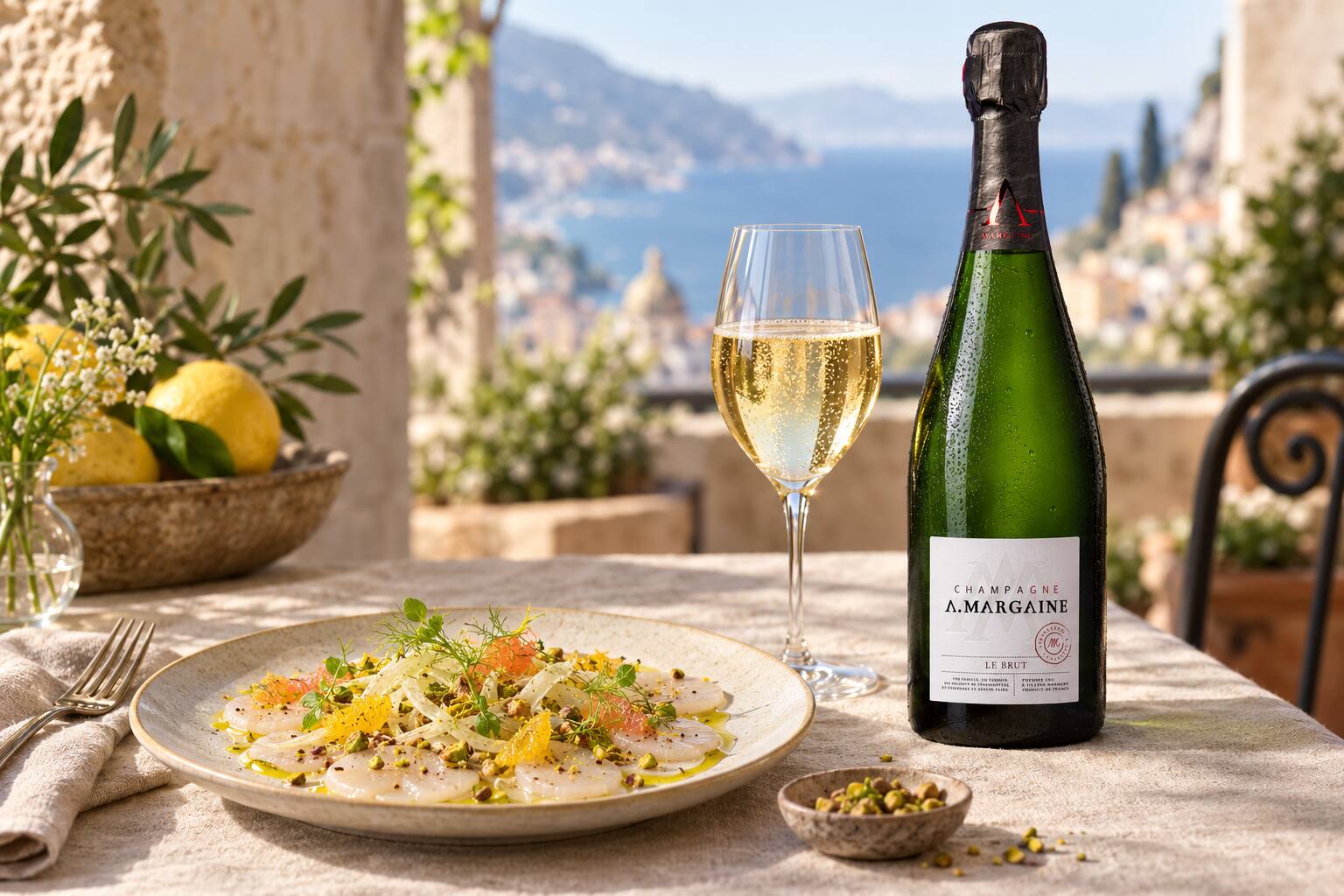
A. Margaine Le Brut Premier Cru Brut is a Chardonnay-led grower Champagne from Villers-Marmery, the distinctive white-grape enclave on the eastern Montagne de Reims. The exact U.S. release considered here is built on the 2020 harvest and combines brightness, chalky definition, reserve-wine depth and a measured Brut dosage.
Its profile is more nuanced than the phrase non-vintage Champagne may suggest. The wine joins 50% base-year fruit with 50% reserve wines drawn from five earlier harvests, then uses partial malolactic fermentation and stainless-steel élevage to balance creamy texture with citrus precision. It is a serious aperitif, but its real strength appears at the table.
The pairing approach therefore favors Italian dishes with saline ingredients, delicate sweetness, crisp textures and controlled richness. Shellfish, fried vegetables, risotto and chilled veal all reveal a different part of the wine without obscuring the fine mousse or mineral finish.
Because a non-vintage blend can change over time, every technical detail below refers to the specifically verified base-2020 release disgorged in November 2022, not to a generalized house formula or a different bottling.
Cuvée Identity and Exact Release
The official wine name is A. Margaine Le Brut Premier Cru Brut. It is a non-vintage Champagne from a récoltant-manipulant estate, meaning the family grows the grapes and produces the wine under its own name. The Premier Cru wording identifies the classification of Villers-Marmery within the Champagne appellation.
For this release, the blend is 93% Chardonnay and 7% Pinot Noir. Half comes from the 2020 harvest. The remaining half consists of reserve wines from 2014, 2015, 2016, 2018 and 2019. Young fruit provides lift, while older components bring breadth, softer contours and subtle developed aromas.
The bottle reference is equally specific. It carries the dark green A. Margaine bottle, black foil with the red house mark, and the white Le Brut label naming Villers-Marmery and Premier Cru. Buyers should match those details and confirm disgorgement information supplied by the retailer or importer.
Villers-Marmery and the Eastern Montagne de Reims
Villers-Marmery sits on the eastern side of the Montagne de Reims. The broader area is strongly associated with Pinot Noir, yet this village is celebrated for Chardonnay. That local exception gives A. Margaine a recognizable identity: the wines combine chalky tension with a little more shoulder and spice than many Côte des Blancs examples.
The verified vineyards for this release are rooted in chalk and clay. Chalk supports drainage and a bright, linear impression, while clay can contribute body and a more tactile middle palate. The result is neither austere nor overtly tropical. It is a Champagne of orchard fruit, citrus, white flowers and mineral freshness.
Premier Cru on the label should be read as origin rather than a stand-alone guarantee. The more important questions are how the vineyards are farmed, how parcels are selected and how base and reserve wines are assembled. Here, village, Chardonnay emphasis and multiyear reserves work together.
Chardonnay-Led Blend
Chardonnay accounts for 93% of the exact blend. It supplies lemon, green pear, white peach and floral lift, but also creates the line of acidity that refreshes fried food, cuts through creamy sauces and keeps seafood pairings precise.
The 7% Pinot Noir is small in volume but useful in effect. It adds contour, a faint red-fruit suggestion and savory weight. It does not turn the cuvée broad or vinous; instead, it prevents the Chardonnay from feeling overly narrow and helps the wine hold its place beside richer dishes.
This proportion explains why the wine works with scallop, fennel, lemon, anchovy and Parmigiano Reggiano. Chardonnay follows freshness and salinity, while Pinot Noir and reserve wines provide enough body for browned or creamy elements.
Reserve Wines and the 2020 Base
Reserve wines represent 50% of the assemblage. They come from 2014 through 2016 and from 2018 and 2019, so the cuvée draws on both mature and relatively youthful material. This substantial share is one reason the bottle offers more depth than a simple harvest-driven entry cuvée.
The 2020 base brings ripe, clear fruit and energy. Reserve wines contribute layers that can suggest pastry, dried flowers, almond and preserved citrus. Their purpose is not to make the Champagne taste old; they create continuity and give the palate a composed, complete shape.
Blending also makes the wine more flexible with food. A Champagne based only on brisk primary fruit might suit raw seafood but struggle with risotto or veal. Mature components add breadth for those dishes while the current base preserves a clean finish.
Vinification and Partial Malolactic Fermentation
The wines are raised in stainless steel, a choice that protects fruit clarity and limits overt wood influence. Stainless steel keeps the focus on citrus, orchard fruit, chalk and the natural texture created through blending and bottle maturation.
Approximately 70% of the exact release completed malolactic fermentation. This partial approach softens some sharper malic acidity and can add a gentle creamy sensation, while the portion that does not complete it helps retain tension and definition.
The finished balance is therefore not severe. It has enough roundness for risotto, tuna sauce and fried batter, yet remains brisk enough to reset the palate. That combination is especially useful in Italian cooking, where richness is balanced by citrus, herbs, capers or bitter greens.
Bottle Aging, Disgorgement and Dosage
The exact release spent at least 24 months sur latte, aging on its lees in bottle before disgorgement. Lees contact supports a finer mousse and introduces subtle bread, cream and nut tones without overwhelming the village character.
Disgorgement took place in November 2022. The dosage was 7 grams per liter, placing the wine comfortably within the Brut category. At this level, dosage rounds acidity and helps integrate reserve-wine complexity, but the Champagne remains dry in impression.
Dosage should never be interpreted alone. Seven grams per liter can taste generous in a low-acid wine or nearly invisible in a taut one. Here, Chardonnay acidity, chalk-derived freshness and a dry mineral finish absorb the dosage, leaving balance rather than sweetness.
History of A. Margaine
The Margaine family traces its winegrowing history in Villers-Marmery to 1796. The estate's modern identity remains closely tied to the village and to Chardonnay, which forms an island of white grapes within the Pinot Noir-dominant Montagne de Reims.
Today the work is presented as a father-and-daughter collaboration between Arnaud and Mathilde Margaine. The family describes a parcel-by-parcel approach in which vineyard conditions, exposure and vintage are observed separately before the wines are assembled.
That continuity matters in Le Brut. The cuvée is designed as a broad reading of the estate's vineyards rather than a single-parcel statement. Reserve wines preserve memory across years, while the changing base harvest keeps each release distinct.
Appearance, Aroma and Palate
In the glass, the Champagne shows pale straw gold with a fine, active bead. The mousse is persistent but not aggressive, supporting a creamy first impression before the wine narrows toward a more mineral finish.
The aroma opens with lemon peel, green pear, white peach and fresh apple. With air, it develops white flowers, ginger, chalk, almond and restrained pastry. Reserve wines appear as depth and quiet complexity rather than overt oxidation.
On the palate, citrus and orchard fruit lead. Gentle creaminess follows, then saline and chalky sensations tighten the finish. Pinot Noir adds a small amount of weight, while partial malolactic fermentation smooths the middle without diminishing the refreshing close.
Technical Profile
Appellation: Champagne AOC, France. Village: Villers-Marmery Premier Cru, eastern Montagne de Reims. Producer: Champagne A. Margaine. Cuvée: Le Brut Premier Cru Brut. Style: non-vintage, Chardonnay-led grower Champagne.
Exact release: 50% 2020 base wine and 50% reserve wines from 2014, 2015, 2016, 2018 and 2019. Grape composition: 93% Chardonnay and 7% Pinot Noir. Soils: chalk and clay. Élevage: stainless steel. Malolactic fermentation: approximately 70%.
Lees aging: at least 24 months sur latte. Disgorgement: November 2022. Dosage: 7 grams per liter. Bottle evaluated: 750 ml. Recommended service: 46–50°F. Suggested drinking period: now through approximately 2030 when stored correctly.
Zafferano & Co. Wine Rating
★★★★☆ — Zafferano & Co. Editorial Evaluation
This four-star evaluation reflects clarity, reserve-wine integration, fine mousse and unusually versatile table performance at its price level. No Wine Spectator score is used because a score for this precise base-2020, November-2022-disgorged release was not verified.
The wine is not intended to compete with a long-aged prestige cuvée in sheer scale. Its achievement is balance: Chardonnay precision, enough reserve-wine depth for food, a dosage that supports rather than sweetens, and a finish that remains clean through an entire meal.
Serving Temperature and Glassware
Serve the bottle at 46–50°F. The lower end suits the first pour and lighter appetizers. As the wine approaches 50°F, reserve-wine notes, floral detail and creamy texture become more expressive.
Use a tulip-shaped Champagne glass or a small white-wine glass. A narrow flute preserves bubbles but compresses the aromatic range. A broad coupe releases carbonation too quickly and makes the wine feel flatter than it is.
Decanting is unnecessary. Open the bottle slowly, pour modest servings and allow each glass to evolve. Avoid keeping the bottle buried in ice for the entire meal; a cool sleeve or brief return to the ice bucket preserves freshness without muting the wine.
Storage and Bottle Care
Store the bottle in a dark, vibration-free place with a stable temperature near 50–55°F. Short-term refrigeration is acceptable, but a kitchen refrigerator is not ideal for extended aging because it is cold, dry and subject to vibration.
Keep the bottle away from heat, direct light and rapid temperature changes. Provenance matters more than minor price differences. A bottle that has remained cool and stable will show a finer mousse and clearer fruit than one exposed to warm retail storage.
After opening, use a proper sparkling-wine stopper and refrigerate. The wine is best on the day of service, though a well-sealed bottle can remain lively into the next day. A spoon in the neck does not reliably preserve carbonation.
Current U.S. Price and Buying Advice
Current verified U.S. listings place a 750 ml bottle at approximately $55–$70. The lower end reflects an in-stock listing for the exact cuvée, while the upper end reflects specialist-retailer pricing. Taxes, shipping and local availability can raise the final cost.
Because Le Brut is non-vintage and the assemblage changes, ask the retailer for base-year or disgorgement information when those details are not shown. The technical profile in this article belongs to the base-2020 release disgorged in November 2022.
Inspect foil, label and fill level. The black foil should carry the red A. Margaine mark, and the white front label should read Champagne A. Margaine and Le Brut. Avoid bottles with obvious heat damage, seepage, pushed corks or badly stained labels unless provenance is documented.
Food Pairing Logic
The wine's first pairing tool is acidity. It cuts through frying oil, butter, cream and tuna-based sauces. Its second is the mousse, which refreshes the palate after crisp batter or a creamy spoonful of risotto.
Chardonnay provides citrus, apple and chalk, making it compatible with shellfish, fennel, lemon and delicate herbs. Reserve wines add enough pastry and nut character for toasted crumbs, pistachios, browned butter and Parmigiano Reggiano.
The dosage is low enough to preserve a dry finish but sufficient to soften briny or lightly bitter ingredients. Avoid very sweet desserts, heavily reduced tomato sauces and aggressive chile heat. Those flavors can make the wine seem thinner or more severe.
Scallop Carpaccio with Sicilian Citrus, Crisp Fennel and Bronte Pistachios
Scallop Carpaccio with Sicilian Citrus, Crisp Fennel and Bronte Pistachios is the most transparent expression of the Chardonnay-led side of this Champagne.
The natural sweetness of raw scallop echoes the ripe center of the 2020 base. Citrus mirrors the wine's lemon profile, fennel follows its freshness, and pistachio connects with subtle nut tones created by reserve wines and lees aging.
Keep the citrus dressing precise rather than sharp, and use only enough salt to define the scallop. The goal is to let the mousse and chalky finish remain visible.
Fritto Misto di Mare
Fritto Misto di Mare demonstrates why Brut Champagne belongs at the table rather than only at the start of a celebration.
Bubbles lift the fried coating, acidity controls the oil, and the wine's saline finish follows squid, shrimp and small fish. Gentle reserve-wine breadth prevents the pairing from feeling sharp or austere.
Serve the fritto immediately, with a light coating and fresh lemon on the side. Heavy batter or excessive frying color can dominate the wine's floral and mineral detail.
Champagne Risotto with Seared Scallops, Oscietra Caviar and Chives
Italian Champagne Risotto with Seared Scallops, Oscietra Caviar and Chives brings out the cuvée's creamy and saline dimensions.
Partial malolactic fermentation and lees aging meet the texture of rice, while Chardonnay acidity prevents the dish from becoming heavy. Seared scallop reflects ripe fruit, and caviar extends the chalky, maritime finish.
Use a restrained amount of cheese and maintain a fluid all'onda texture. Too much Parmigiano can obscure the Champagne's finer citrus and floral notes.
Italian Fried Zucchini Blossoms
Italian Fried Zucchini Blossoms offers a lighter fried pairing built around delicacy rather than marine intensity.
The mousse clears the crisp coating, and the wine's white-flower character follows the blossoms. A mild ricotta filling can echo the creamy middle palate, while anchovy adds a saline counterpoint.
Avoid dense batter and strongly seasoned fillings. The blossom should remain the central flavor so Chardonnay precision is not lost.
Vitello Tonnato Piemontese
Vitello Tonnato Piemontese is the most savory pairing in the sequence and shows the value of the small Pinot Noir component.
Acidity refreshes the tuna sauce, while reserve wines and Pinot Noir give enough breadth for veal. Capers and anchovy reinforce the Champagne's saline finish without requiring a heavier wine.
Serve the dish cool, not refrigerator-cold, and keep the sauce smooth rather than excessively thick. Let the Champagne warm slightly toward 50°F as the pairing develops.
Relevant Grower Champagne Producers
A. Margaine is a reference point for Chardonnay in Villers-Marmery. Across grower Champagne, Pierre Péters and Pierre Gimonnet & Fils offer incisive Chardonnay-led expressions, while Agrapart & Fils and Larmandier-Bernier explore mineral, low-dosage styles with strong vineyard definition.
Vilmart & Cie provides a useful Montagne de Reims comparison with broader texture and significant oak influence. Egly-Ouriet represents a more Pinot Noir-driven, powerful interpretation. These producers are not substitutes; they show how site, grape balance, reserve wines and élevage shape style.
Le Brut occupies an accessible and gastronomic position within that landscape. Its stainless-steel clarity and large reserve-wine component make it both direct and layered, especially when served with food.
How to Read the Label
A. Margaine identifies the producer. Le Brut names the cuvée and sweetness category. Premier Cru refers to the classified village of Villers-Marmery, while Champagne is the protected appellation.
Non-vintage does not mean undated or anonymous. The exact bottle studied here has a 2020 base, reserve wines from five specified years and a November 2022 disgorgement. Those details are more informative than the absence of a vintage year on the front label.
The front label cannot communicate every production detail. Serious buyers should keep the retailer's lot information or importer sheet with their cellar record, especially when comparing different releases of the same cuvée.
Why Champagne Can Only Come from Champagne
Champagne is a protected geographical appellation in northeastern France. Grapes must come from the delimited region, and production follows rules governing vineyard origin, pressing, secondary fermentation, bottle aging, disgorgement and release.
The traditional method creates bubbles through a second fermentation in the same bottle that reaches the consumer. Aging on the lees after that fermentation contributes mousse texture and developed aromas.
Excellent sparkling wines are made in Franciacorta, Trentodoc, Alta Langa, Cava and many other regions, but they cannot legally be called Champagne. A. Margaine Le Brut belongs specifically to Champagne and expresses Villers-Marmery within it.
Professional Pairing Perspective
A coherent menu can begin with scallop carpaccio, move to fried zucchini blossoms, continue with Champagne risotto and finish with vitello tonnato. Fritto misto can replace the blossoms when a more maritime progression is desired.
Serve the first glasses near 46°F and allow later pours to approach 50°F. The wine will move from citrus and chalk toward pear, flowers, cream and almond, creating a natural progression through the dishes.
One 750 ml bottle provides roughly five moderate restaurant pours. For a multi-course tasting, keep portions controlled so the Champagne remains energetic from the first dish to the last.
Final Assessment
A. Margaine Le Brut Premier Cru Brut is a precise, food-friendly grower Champagne with more depth than its accessible position might imply. The exact base-2020 release combines 93% Chardonnay, 7% Pinot Noir and a 50% reserve-wine component spanning five earlier harvests.
Stainless-steel élevage preserves clarity, partial malolactic fermentation adds measured creaminess, and at least 24 months on the lees refines the mousse. A November 2022 disgorgement and 7 grams per liter dosage complete a dry, balanced profile.
At approximately $55–$70 per 750 ml bottle in the United States, it offers a compelling route into village-focused grower Champagne. Its finest quality is usefulness: it can move from raw scallop and citrus to fried seafood, risotto and veal while remaining fresh, articulate and unmistakably Champagne.


Comments