
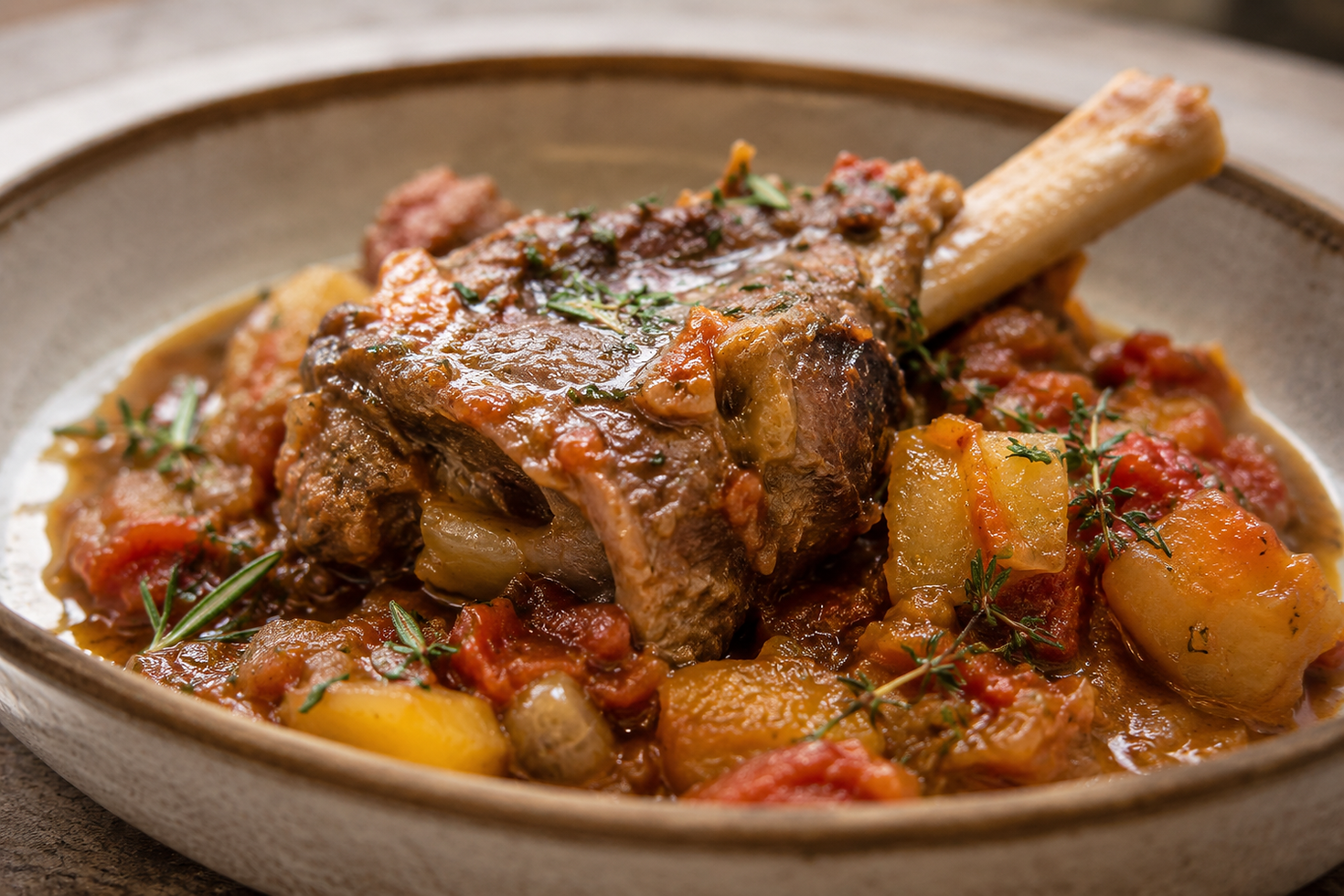
Italian Basilicata Lamb | Agnello alla Lucana con Patate

This is the plainest lamb dish in Basilicata and the one cooked most often. Everything goes into one pan raw and uncovered: lamb on top, potatoes underneath, onion and garlic between them, rosemary and oregano over everything, a glass of white wine down the side. Nothing is browned first, nothing is braised, nothing is added later.
What makes it work is the geometry. The lamb sits above the potatoes and renders downward for the whole cooking time, so every drop of fat and juice lands on starch waiting to absorb it. The potatoes at the bottom steam in that fat and finish soft and heavy with flavour; the ones at the edge catch the dry heat and go crisp. The lamb meanwhile roasts in an atmosphere kept humid by the potatoes releasing their own water, which is why it stays moist without ever being covered.
It is worth saying what this dish is not. It is not the Potenza version, braised on the stove with bay and vinegar, nor the Senise version finished with dried peppers. This is the country version of the mountain villages: one pan, an oven, and the sense to let the potato do the work.
Yield: 6 servings. Prep: 30 minutes. Cook: 1 hour 35 minutes. Rest: 15 minutes. Total: about 2 hours 20 minutes. Difficulty: easy. Course: secondo. Region: Basilicata, the Lucanian uplands and the Pollino villages.
The Story
Basilicata is the most thinly populated region in southern Italy and one of the highest, and its sheep have always outnumbered the people who keep them. The animal behind this dish is the Gentile di Lucania, a hardy upland breed developed from Merino crossings and raised across the Lucanian Apennines for wool and milk. Its lambs are small, lean and strongly flavoured, and they were killed for one week of the year.
The dish is roasted rather than braised because of who owned an oven. Most village houses did not. What the village had was the forno a legna of the baker, fired before dawn for the week's bread, and a custom that let families bring their own pans once the loaves came out. The oven was then in its long falling curve, near 425°F (220°C) and dropping steadily, which is the perfect profile for lamb and potatoes in one tray. Lucanian Easter cooking was built around that window and this is its clearest survivor.
The potato belongs to the same landscape. The fields above Terranova di Pollino and the Sarmento valley grow potatoes at over 3,000 feet (900 m), in cold nights and thin soils that give a dense, low water tuber with firm flesh. That density is what this method needs, because a watery potato collapses into the lamb fat instead of holding its shape. Where a northern kitchen would have reached for butter to enrich a roast, Basilicata had a potato bred, without anyone planning it, to soak up fat and stay whole.
Ingredients
For the lamb
Bone in lamb shoulder and ribs, cut into large pieces, 3 1/2 lb (1.6 kg)
Garlic cloves, thinly sliced, 5
Fresh rosemary, leaves stripped and chopped, 2 tbsp (5 g)
Dried oregano, preferably on the branch, 1 1/2 tsp (2 g)
Extra virgin olive oil, 1/3 cup (80 ml)
Fine sea salt, 2 tsp (12 g)
Freshly ground black pepper, 1 tsp (2 g)
For the potatoes
Firm yellow mountain potatoes, peeled, 2 1/4 lb (1 kg)
Yellow onions, sliced 1/4 inch thick, 2 medium
Extra virgin olive oil, 2 tbsp (30 ml)
Fine sea salt, 1 tsp (6 g)
Dried oregano, 1 tsp (1 g)
For the pan
Dry white wine, 3/4 cup (180 ml)
Hot water, 1/2 cup (120 ml)
Bay leaves, 2
Pecorino di Filiano, coarsely grated, 1 1/2 oz (40 g)
For finishing
Extra virgin olive oil, 1 tbsp (15 ml)
Flat leaf parsley, chopped, 1 tbsp (4 g)
Freshly ground black pepper, to taste
Preparation
Seasoning the lamb an hour ahead
Cut the lamb into large pieces of about 3 inches (8 cm), bones in and fat on. Cut small slits in the thicker pieces and push a sliver of garlic into each. Rub the meat with half the olive oil, then with the rosemary, oregano, salt and pepper, and leave it at room temperature a full hour so the seasoning moves into the muscle rather than sitting on it.
Cutting the potatoes for the bottom of the pan
Cut the peeled potatoes into wedges of about 1 1/2 inches (4 cm), larger than most recipes ask for and deliberately so: smaller pieces disintegrate in ninety minutes of fat. Do not rinse them. The surface starch you would wash away is what binds the rendered fat later. Toss them with the onions, the second measure of oil, the salt and the oregano.
Loading the pan in two layers
Heat the oven to 425°F (220°C). Choose a heavy roasting pan or earthenware dish that holds everything in a layer roughly 2 inches (5 cm) deep. Spread the potatoes and onions across the bottom, tuck in the bay leaves and press the surface flat. Lay the lamb on top in one layer, fat side up, so every piece sits over potato and none touches the metal.
The first hot phase
Pour the wine down the side of the pan rather than over the meat, so it reaches the potatoes without washing the seasoning off the lamb, and add the hot water the same way. Put the pan on a low shelf uncovered for 30 minutes at 425°F (220°C). This phase sets the colour and drives surface moisture off the potatoes before any fat has rendered, which stops them turning to paste.
Dropping the heat and letting it render
Lower the oven to 350°F (175°C) and continue 45 to 55 minutes, still uncovered. This is where the work happens: the lamb fat melts and runs down through the potatoes, the onions collapse and the wine reduces to almost nothing. Baste twice and turn the pan front to back once, but otherwise leave the door shut.
Judging when the lamb is done
Start checking at 1 hour 15 minutes. The lamb is ready when a skewer meets no resistance and the meat has pulled back from the bone, or at around 175°F (79°C) at the centre, far higher than a roast leg would want because this cut needs its collagen broken down.
The final crisping and the pecorino
Raise the oven to 450°F (230°C), scatter the pecorino over the potatoes around the edge of the pan and not over the lamb, and give it 8 to 10 minutes. The cheese melts and dries into a thin salty crust. Watch this stage: the onion sugars are already caramelised and the step from deep gold to burnt is short at that temperature.
Resting in the pan
Rest the pan 15 minutes uncovered. The lamb reabsorbs the juice it has been losing and the potatoes drink whatever fat is still loose, which is why the pan looks wet out of the oven and almost dry at the table. Do not cover it with foil or the crust softens within five minutes.
Plating
The pan goes to the table. This is not rustic styling: the potatoes at the bottom sit in the last of the fat and lose it the moment they are lifted onto a cold dish. If you must transfer, use a warmed earthenware dish and scrape the roasting pan into it.
Serve each person both kinds of potato, because the plate needs both: the soft dark ones from the centre that taste entirely of lamb, and the crisp gold ones from the edge. Put two or three pieces of lamb on top with a spoonful of the pan juices, and let people take the bones in their hands, which is how it is eaten in Basilicata.
Finish with a thread of raw olive oil, a grind of pepper and a little parsley. Nothing else belongs on the plate. Beside it, bitter greens dressed with oil and lemon or raw fennel are what the region serves, and both are there to cut the fat.
Professional Technique
The controlling idea is the potato as a fat sink, and it works because of what happens to starch in hot fat rather than hot water. Potato starch granules gelatinise between about 136°F (58°C) and 150°F (66°C), swelling and turning porous as they absorb what is around them. Here that is rendered lamb fat carrying dissolved meat juices, so the granules take up flavoured fat exactly when they are most absorbent. That is why these potatoes taste of lamb all the way through instead of being coated in it.
The two stage oven curve is the other half, and the part most cooks get wrong by using a single temperature. The 30 minutes at 425°F (220°C) drive surface water off the potato before the lamb has rendered anything. A potato that meets fat while its surface is still wet cannot absorb, because the water is in the way, and it ends up greasy outside and bland in the middle. Once that dry skin exists, the lower 350°F (175°C) phase renders the lamb slowly and the potato drinks.
Layer depth is the third variable and the one nobody thinks about. At around 2 inches (5 cm) the pan gives both textures at once, because the centre of the bed stays humid and steams while the perimeter, against hot metal and dry air, roasts. Spread it thin and you lose the soft centre; pile it deeper and you lose the crisp edge.
Texture and Moisture Control
The dish is cooked entirely uncovered and yet it does not dry out. The humidity comes from the potatoes. Two and a quarter pounds of potato and two onions release a great deal of water in the first forty minutes, and in a pan loaded to a proper depth that vapour passes upward through the lamb before it escapes, so the meat roasts in a humid microclimate of its own making. Cover the pan with foil and nothing colours: the lamb poaches in its own steam.
Inside the lamb the usual braising chemistry applies at roasting temperature. Shoulder is a working muscle laced with collagen, and collagen only begins converting to gelatin above about 160°F (71°C). This is why a centre of 175°F (79°C) would be a disaster in a rack of lamb and is correct here. Pull it at 145°F (63°C) and the meat is pink, tough and chewy; carry it to 175°F (79°C) over an hour and a half and the collagen has gone, leaving meat that pulls from the bone.
The rest at the end is a moisture transfer, not a pause. Meat straight from a hot oven is still contracting and pushing juice outward, and serving it at once loses that juice to the plate. Fifteen minutes lets the fibres relax and reabsorb, and what does escape lands on the potatoes. Past twenty minutes the pan cools below serving temperature.
Professional Mise en Place
There is little to organise here, which is the point, but the two things that matter both happen before the pan goes in: the lamb seasoned an hour ahead, and a pan of the right size.
Equipment and tools
Heavy roasting pan or earthenware dish, about 13 by 9 inches (33 by 23 cm)
Sharp paring knife for the garlic slits
Large bowl for tossing the potatoes and onions
Long spoon for basting and a skewer for testing
Instant read thermometer
Prepared ahead
Lamb cut, larded with garlic, oiled and seasoned 1 hour ahead
Potatoes peeled and cut up to 2 hours ahead, held dry, never in water
Onions sliced and tossed with the potatoes, on the day
Herbs chopped and pecorino grated, on the day
Oven at 425°F (220°C) 20 minutes before the pan goes in
Service setup
Pan resting uncovered for 15 minutes, never under foil
Serving dish warmed only if you transfer out of the pan
Bitter greens or fennel dressed, on their own dish
Bread on the table for the bottom of the pan
Raw olive oil, pepper and parsley within reach
Chef Tips
Choose the potato before you choose the lamb. A firm, dense, low moisture yellow potato is the difference between this dish and a greasy tray. A floury baking potato disintegrates by the hour mark and a very waxy salad potato refuses to absorb anything.
Do not brown the lamb first. The instinct from braising is wrong here, because a seared crust slows the rendering the potatoes underneath are waiting for. The colour comes from the first 30 minutes at high heat, with the fat running as it browns.
Use oregano on the branch if you can get it. Lucanian dried oregano sold in bunches is far more aromatic than the powdered kind, and crumbling it between your palms releases the oils.
If the pan looks dry at the hour mark, add hot water and not stock, two tablespoons at a time down the side. Stock brings salt that concentrates as everything reduces, and the pan already has wine, pecorino and an hour of rendered fat in it.
Common Mistakes
Cutting the potatoes too small. Pieces under an inch cannot survive ninety minutes in fat and collapse into a mash at the bottom of the pan. Cut them to about 1 1/2 inches (4 cm) and accept that they look too big going in.
Rinsing or soaking the cut potatoes. It washes off the surface starch that binds the rendered fat, and a soaked potato carries water into the pan that has to be driven off before anything can absorb. Cut them and use them dry.
Covering the pan with foil. It traps the vapour the potatoes are releasing, nothing browns, the lamb steams instead of roasting and the crust never forms. This dish is cooked uncovered from the first minute to the last.
Spreading everything thin on a sheet pan. A shallow layer gives uniformly crisp potatoes and loses the soft ones that have taken up the lamb fat, which are the reason for the dish. Use a pan that holds the load about 2 inches (5 cm) deep.
Wine Pairing
Aglianico del Vulture Superiore DOCG: The regional red and the structural answer to a fatty roast. Grown on the volcanic slopes of Monte Vulture, it has firm tannin and unusually high acidity for a southern red, and both work on the rendered fat that coats the palate here. Its dark plum and smoky mineral character picks up the caramelised edges of the pan. Give it an hour open.
Matera Greco DOC: A dry white from the other side of the region, around the ravines of Matera, and the choice when the lamb is young and mild. Greco is firm and slightly waxy, with pear and herb notes and a bitter twist at the end, and that bitterness is what lets it stand up to oregano and rosemary. Enough weight for the potatoes, enough acidity to cut the oil.
Grottino di Roccanova Bianco DOC: The most local bottle here, made in a village of the Agri valley where the wine is still aged in cellars cut into the sandstone. A dry, lightly aromatic white built on Malvasia with a saline, almost chalky finish, made for exactly this kind of food. Serve it cool and pour it generously.
Cirò Rosso Classico DOC: From the Calabrian coast just south of Basilicata, a Gaglioppo based red lighter in colour than its weight suggests. Its dried herb and orange peel character sits beside rosemary and oregano, and the tannin is fine and dusty rather than grippy, which suits lamb roasted rather than braised. Serve it at around 59°F (15°C).
Primitivo di Manduria DOC: The Puglian neighbour, for anyone who wants generosity rather than tension. Ripe black fruit, soft tannin and a warm finish match the sweetness the onions and the caramelised potato edges bring. Choose a dry bottling rather than the sweet style made from the same grape, and keep it at 61°F (16°C) so the alcohol does not dominate.
Storage & Reheating
This is one of the dishes that improves on the second day, which is why Lucanian families cook a pan larger than they need. Keep lamb and potatoes together with all the pan juices in a sealed container for up to 3 days. Do not store the meat separately: the fat that keeps it moist is among the potatoes.
Reheat in the oven and nowhere else. Spread the leftovers in a pan, add two tablespoons of hot water, cover for 10 minutes at 350°F (175°C), then uncover for another 8 to 10 minutes to bring back the crust. A microwave turns the potatoes to paste and the lamb rubbery in under two minutes.
The cooked dish freezes for up to 2 months, though the potatoes lose their crisp edges permanently. If you know you are freezing it, freeze the lamb with the juices and cook fresh potatoes on reheating. Thaw overnight in the refrigerator, never on the counter.
Nutrition
Per serving, based on 6 servings:
Calories: 720 kcal
Total Fat: 42 g
Saturated Fat: 15 g
Trans Fat: 0.4 g
Unsaturated Fat: 24 g
Cholesterol: 160 mg
Sodium: 880 mg
Total Carbohydrates: 36 g
Fiber: 4 g
Total Sugars: 4 g
Added Sugars: 0 g
Protein: 48 g
Lactose: 0.2 g
Principal micronutrients: vitamin B12, zinc, iron, potassium, vitamin C, niacin, phosphorus, selenium
These figures are estimates. The fat total depends on how fatty the lamb is and how much rendered fat you spoon off before serving, and the carbohydrate figure moves with the potato portion.


Comments