

Italian Sardinian Candied Orange Peel with Almonds and Honey | Aranzada Nuorese con Mandorle e Miele
Updated: Sep 14
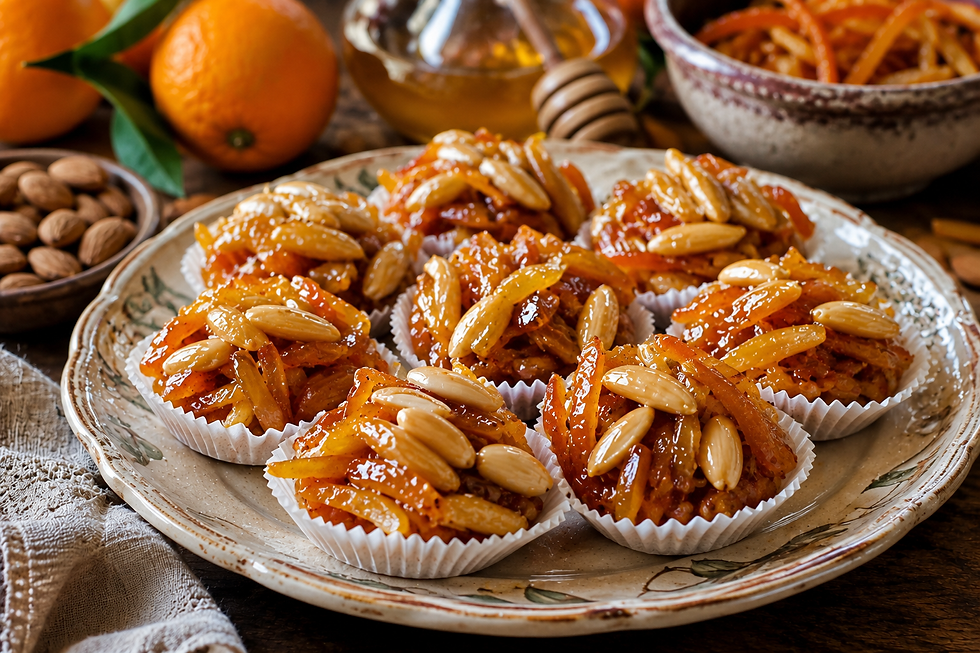
Aranzada is the sweet that Nuoro brings out when something important is happening. Three things hold it together: orange peel candied and cut into fine threads, almonds sliced and toasted, and honey cooked to one precise stage. There is no flour, no egg, no butter and no leavening in it. What you taste is citrus, nut and honey with nothing standing between them, which is exactly why the sweet is difficult to make well. Every fault shows on the tongue immediately.
The work is patience far more than skill. The peel has to lose its harsh bitterness through repeated boiling in fresh water, then take on sugar slowly over days rather than hours. The honey has to reach the soft ball stage and stop there. The almonds have to be toasted before they ever meet the honey, because once they are in it they will never toast again. Get those three things right and the aranzada sets soft and sticky in its paper cup, glossy and fragrant, still faintly bitter underneath.
Makes about 20 small cups, serves 10 to 12. Prep: 45 minutes. Candying: 3 days, mostly unattended. Cook: 30 minutes. Active total: about 2 hours.
The Story
Aranzada belongs to Nuoro and to the Barbagia villages that circle it, and the name comes straight from arantzu, the Sardinian word for orange. It is a wedding sweet before it is anything else. In the old order of Nuorese hospitality the aranzada was made by the women of the house in the days before the ceremony, set into small pleated paper cups, and carried to the table among the other dolci di festa at baptisms, confirmations and the feast of the patron saint.
The ingredients tell you what the interior of Sardinia had and what it prized. Almonds grew everywhere. Honey came from the hives on the macchia, and in this part of the island that often means corbezzolo, the bitter strawberry tree honey that is the most Sardinian flavour there is. Oranges were the luxury, brought up from the coastal gardens, and the peel that any other kitchen would have thrown away became the body of the sweet rather than a scrap of it. That reversal is the whole point. A bitter fruit skin, a bitter honey and a sweet nut meet in the middle, and the confection works only when the bitterness survives in a controlled form. Nuorese pastry shops still sell aranzada in the same paper cups, by weight, and the good ones are still soft weeks after they were made.
Ingredients
For the candied orange peel
Thick skinned untreated oranges, 6 large, about 3 lb (1.35 kg)
Granulated sugar, 4 cups (800 g)
Water, 2 cups (480 ml)
Fresh lemon juice, 1 tbsp (15 ml)
Cold water for blanching, about 12 cups (2.8 L) across four changes
For the aranzada
Candied orange peel, cut into fine threads, 10 oz (285 g)
Sliced almonds, 2 cups (200 g)
Sardinian corbezzolo honey, or a fragrant wildflower honey, 1 cup (340 g)
Fresh orange juice, 2 tbsp (30 ml)
Fine sea salt, 1 pinch, about 1/16 tsp (0.4 g)
For finishing
Small pleated paper confectionery cups, about 20
Cold water for wetting the hands, 1 cup (240 ml)
Preparation
Removing the peel and trimming the pith
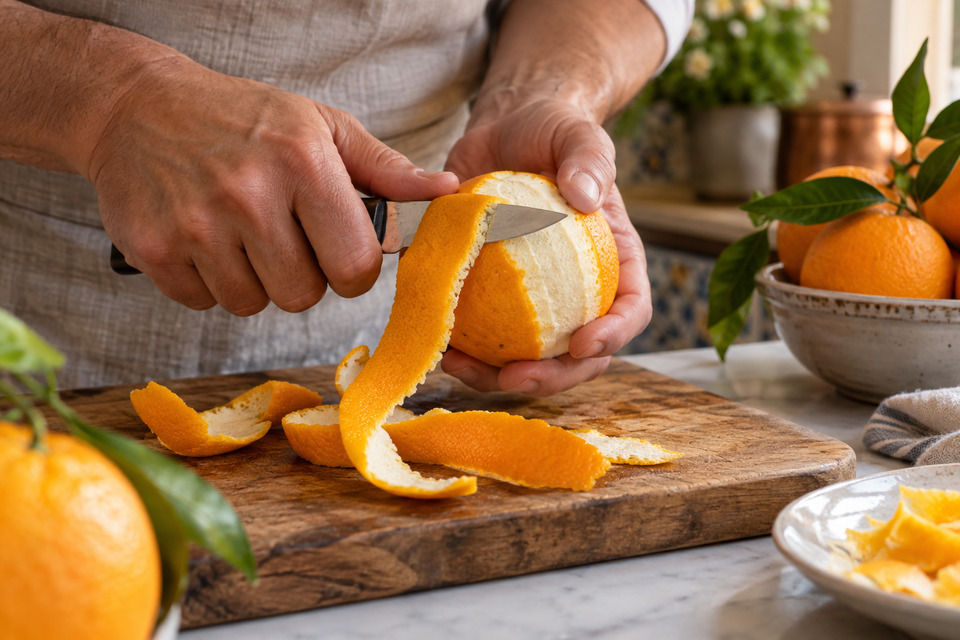
Scrub and dry the oranges. Cut the peel away in wide strips, taking the coloured zest together with a layer of white albedo about 1/8 inch (3 mm) thick. Do not pare down to bare zest. The albedo is what gives the finished threads their chew, and without it the aranzada turns thin and papery. Trim off only the coarse ragged pith on the inner face, keeping the strips as even in thickness as you can manage.
Blanching the peel in four changes of water
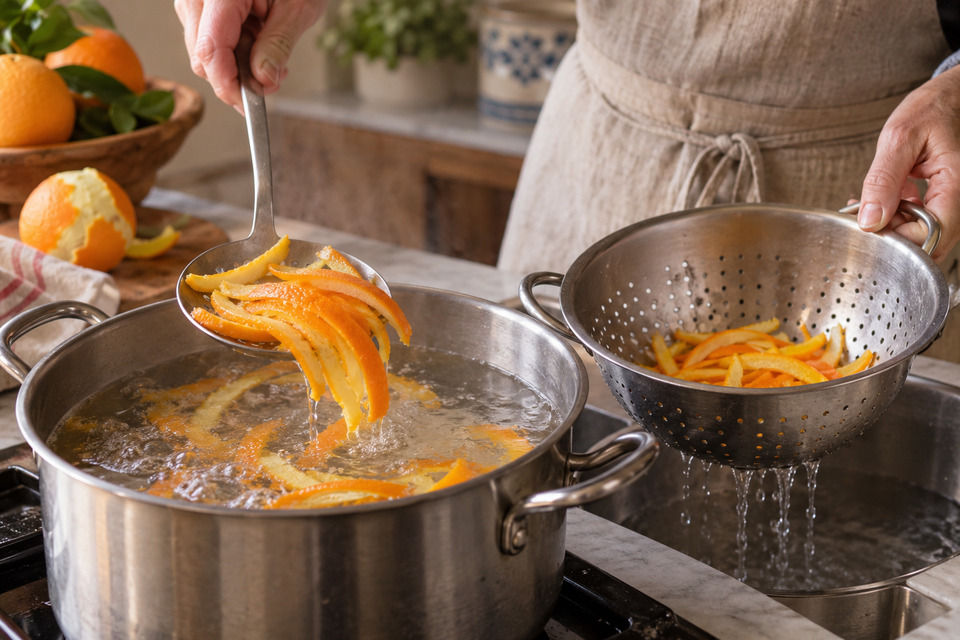
Cover the strips with cold water, bring to a rolling boil, boil for 2 minutes, and drain completely. Refill the pan with fresh cold water and repeat. Do this four times in all, using new water every single time. Taste a sliver after the third round and again after the fourth. The peel should be soft enough to pierce with a fingernail and bitter only in the background, never sharp on the back of the tongue.
Cutting the threads and candying them in rising syrup
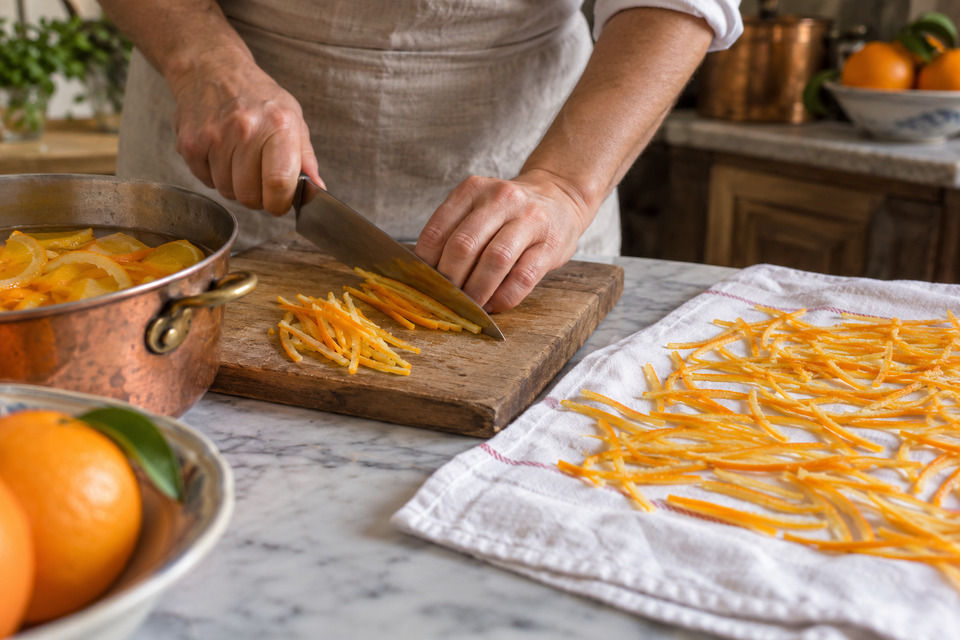
Cut the drained peel into threads about 1/8 inch (3 mm) wide. Bring 2 cups (480 ml) water, 1 1/2 cups (300 g) of the sugar and the lemon juice to a simmer, add the threads, simmer 10 minutes and leave them in the pan overnight. On each of the next two days lift the threads out, dissolve another 1 1/4 cups (250 g) sugar into the syrup, return the peel, simmer 10 minutes and rest again.
Toasting the almond slivers
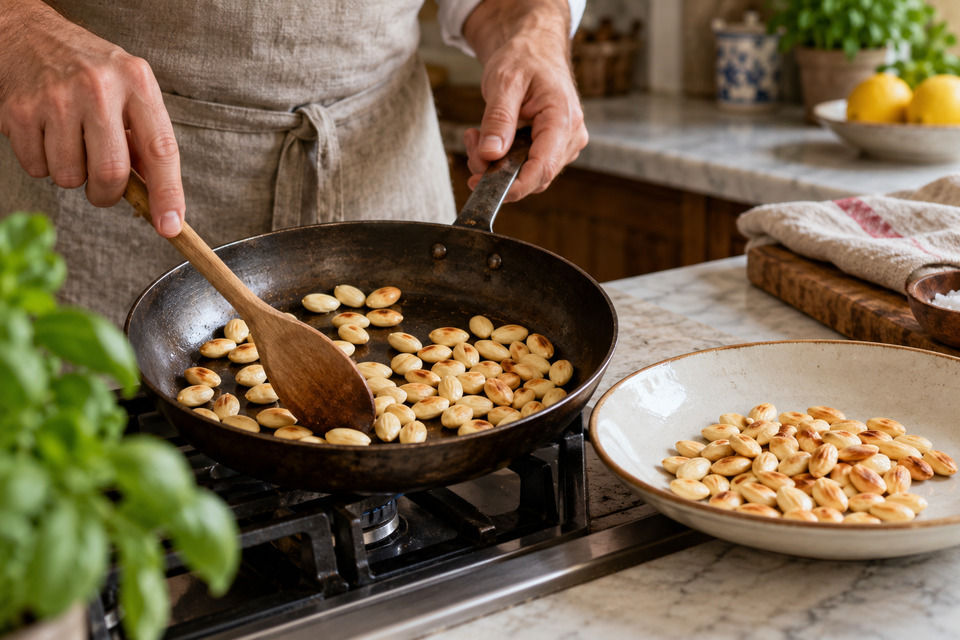
Spread the sliced almonds in a single layer on a sheet pan and toast at 325°F (160°C) for 7 to 9 minutes, shaking the pan once, until they are pale gold and smell of warm nut rather than of raw starch. Tip them straight onto a cold plate so the residual heat of the pan cannot carry them past that colour. Let them cool fully. Warm almonds will soften the moment they touch the honey.
Cooking the honey to the soft ball stage
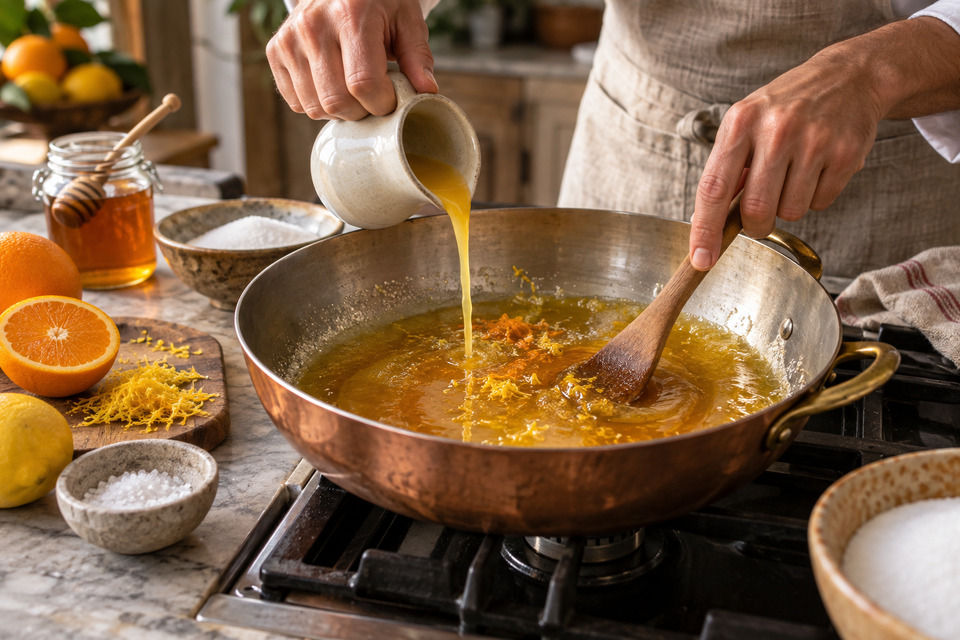
Put the honey, the orange juice and the salt in a wide heavy pan and set it over low heat with a thermometer clipped to the side. Bring it up slowly, without stirring hard, to 240°F (115°C). Watch the last 10 degrees closely, because honey climbs fast once the free water has gone. A drop of it pushed into iced water should gather into a soft ball that flattens between your fingers.
Folding the candied peel into the honey

Take the pan off the heat for a moment, drain the candied threads well, and fold them in with a wooden spoon so every thread is coated. Return the pan to the lowest heat and stir for 6 to 8 minutes, until the mass pulls away from the sides in one piece and there is no loose syrup pooling under it. Then fold in the cooled almonds, off the heat, in two additions.
Shaping the aranzada in paper cups
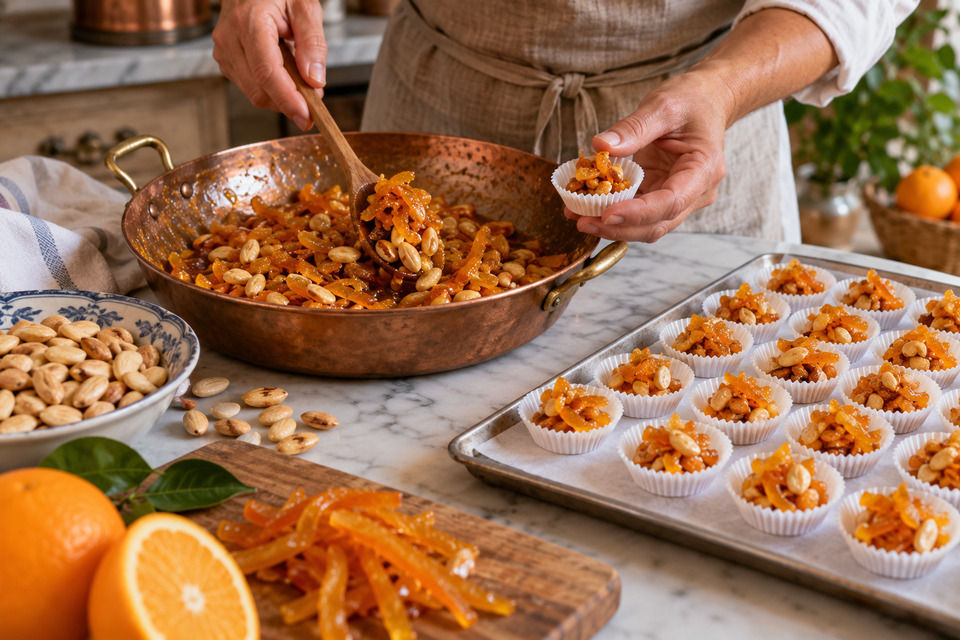
Work while the mixture is still hot and pliable. Set out the paper cups, keep a bowl of cold water beside you, and wet your hands before each portion so the honey slides off your fingers instead of clinging. Lift roughly 1 tbsp (20 g) at a time, press it into a loose dome and settle it into a cup. Leave the cups untouched at room temperature for 2 hours to set.
Plating
Aranzada is served at room temperature, in the paper cup it was shaped in, and the cup is part of the object rather than packaging to be peeled off. One or two per person is the right quantity. On a tray, set the cups close together in rows so the glossy amber domes read as a single surface, which is how they appear in the windows of the Nuorese pasticcerie.
Add nothing to the top. No icing sugar, no chocolate, no candied cherry and no mint. The sweet is already carrying three strong flavours and any garnish simply muddles them. If it is going onto a plate rather than a tray, choose plain white or the cream and brown of Sardinian ceramic, and give each cup a good margin of empty space. For a dessert assortment keep the company dry and almond based, papassini or amaretti di Oristano, and serve espresso alongside.
Professional Technique
The candying is the technique that makes or breaks this sweet, and it rests on two separate pieces of chemistry. The first is the blanching. The bitter compounds in the albedo are water soluble, so every boil in fresh water carries a measurable fraction of them out of the peel and down the drain. One boil is not enough and the aranzada is harsh. Four boils leave the peel bitter only in the background, which is the target, because a peel scrubbed completely clean of bitterness has nothing left to push back against the honey.
The second is osmosis, and it is the reason the syrup has to start weak and get stronger over days. Sugar and water move across the cell walls of the peel in both directions, toward the higher concentration. Drop blanched peel straight into a heavy syrup and the gradient runs the wrong way with force: water rushes out of the peel faster than sugar can come in, the cell walls collapse, and the threads turn hard, shrunken and glassy. Raising the syrup by roughly 250 g of sugar a day keeps the gradient gentle enough that sugar enters while the structure stays intact and the thread stays soft. That is why real candying is measured in days and not in hours, and why peel boiled once in a strong syrup will never be aranzada.
Texture and Moisture Control
The finished aranzada should be sticky and yielding, never brittle and never hard. Everything about that comes down to the honey temperature. At 240°F (115°C) the sugars have lost enough water to bind the mass when it cools but not enough to set into a crystalline or glassy solid. Go 10 degrees further and the cooled sweet cracks under the tooth instead of giving way.
Moisture arrives from two directions and both need managing. The candied threads carry syrup on their surface, so drain them properly before they go in, or the extra liquid will thin the honey and the aranzada will never firm up at all. The almonds carry none, which is why they are added last and off the heat: held in hot honey they draw moisture out of it, go leathery and lose the clean snap that is the only crisp element in the whole confection. The contrast between soft thread and crisp almond is the texture of the dish.
Professional Mise en Place
The candying runs across three days, so the service day itself is short. Everything except the honey must be finished and cooled before the pan goes on the heat, because once the honey passes 230°F (110°C) there is no time to look for anything.
Equipment and tools
Sharp paring knife for the peel and a long thin blade for cutting the threads
Wide heavy saucepan for the honey, with a sugar thermometer that clips to the side
Large pan for blanching, a colander and a cooling rack
Sheet pan for the almonds and a cold plate to stop them toasting
Wooden spoon, two bowls of cold water and about 20 pleated paper cups
Prepared ahead
Three days ahead: blanch, cut and begin candying the peel, one syrup step per day
The morning of: drain the candied threads on a rack for 1 hour so they are tacky rather than wet
The morning of: toast the almonds and cool them completely on a cold plate
Taste the honey before you commit to it, since the whole sweet takes its character from that one jar
Service setup
Paper cups laid out on a tray before the honey ever goes on the heat
One bowl of cold water for the hands and a second for the spoon
Thermometer clipped to the pan, wooden spoon and drained threads within reach
A clear two hour window at room temperature for the cups to set before anything is moved
Chef Tips
Use unwaxed fruit. Wax sits on the zest, survives blanching and leaves a dull film on the finished threads, so buy untreated oranges or scrub them hard in warm water first.
If you can find corbezzolo honey, use it and say so. Its bitterness runs alongside the orange rather than against it, and it is the flavour that marks the sweet as Nuorese rather than generic.
Keep a second bowl of cold water for the spoon as well as the hands. A wet spoon releases the mass cleanly and saves a great deal of scraping.
Make it at least one day before you serve it. The citrus oil, the almond and the honey need a night in a closed tin to settle into one flavour instead of three.
Common Mistakes
Paring the peel down to bare zest. The albedo is not waste, it is the chew. Strips taken without it candy into brittle slivers with no body. Leave about 1/8 inch (3 mm) of white on and remove only the ragged inner fibres.
Blanching once, or blanching in the same water. The bitter compounds dissolve into the water, so reusing it simply puts them back. Four boils, fresh cold water every time, drained completely in between.
Candying in a heavy syrup from the start. The osmotic shock pulls water out of the peel faster than sugar goes in and the threads harden into glass. Begin weak and build the syrup up across three days.
Adding raw almonds to the honey. Almonds do not toast in a wet sugar medium, they merely soften. Toast them separately to pale gold, cool them fully, and fold them in off the heat as the last action before shaping.
Taking the honey past the soft ball stage. A few degrees too far and the cooled aranzada shatters instead of yielding. Trust the thermometer at 240°F (115°C) and confirm it with the cold water test before you fold anything in.
Wine Pairing
Malvasia di Bosa DOC: The Planargia classic and the closest thing Sardinia has to a native answer for this sweet. Its oxidative depth brings dried apricot, toasted almond and a bruised citrus note that lands almost exactly on the candied peel, and the saline bitter finish meets the corbezzolo honey on equal terms instead of being flattened by it.
Girò di Cagliari DOC: A sweet red from the Campidano, historically the bottle poured with Sardinian festival sweets. Its dried fig and orange peel aromatics echo the dish directly, while the soft tannin gives a little grip that cuts the clinging honey and keeps each mouthful from blurring into the next.
Cagliari DOC: The Moscato and Nasco bottlings under this denomination bring grapey floral lift and a fresher, lighter sweetness. That aromatic top note rides over the almond and refreshes the palate, making it the choice when the aranzada closes a long meal and a heavier dessert wine would simply add weight.
Storage & Reheating
Let the cups set for 2 hours, then store them in a tin or an airtight box at cool room temperature, in a single layer or separated by parchment. They keep for 4 to 6 weeks and they stay soft, because the sugar concentration binds the free water that would otherwise let mould take hold. Do not refrigerate. Cold firms the honey, dulls the orange aroma and draws condensation onto the surface when the cups come back out.
Never reheat aranzada. If the room has been cold, simply leave the closed tin out for an hour before serving and the sweet will soften on its own. Freezing serves no purpose here and the thaw leaves the threads weeping into the paper. If you are sending them as a gift, pack the cups snugly in a rigid tin so they cannot slide and lose their domes in transit.
Nutrition
Per portion, based on 20 cups:
Calories: 195 kcal
Total Fat: 5 g
Saturated Fat: 0.4 g
Trans Fat: 0 g
Unsaturated Fat: 4.4 g
Cholesterol: 0 mg
Sodium: 22 mg
Total Carbohydrates: 37 g
Fiber: 1.8 g
Total Sugars: 34 g
Added Sugars: 30 g
Protein: 2.4 g
Lactose: 0 g
Principal micronutrients: vitamin E 2.4 mg, magnesium 26 mg, calcium 30 mg, potassium 95 mg
Allergens: tree nuts, almonds. Contains no gluten, no dairy, no egg and no lactose. Honey makes this unsuitable for infants under 12 months and for a vegan diet. These figures are estimates and shift with the thickness of the peel, the quantity of syrup retained in the threads and the exact size of each portion.


Comments