
Italian Basil Parmesan Butter | Burro al Basilico e Parmigiano
Updated: Sep 11

Burro al Basilico e Parmigiano is a finishing butter that lives or dies on one single question: does the basil stay green. Basil is the most fragile leaf in the Italian pantry. The moment a leaf is bruised, left wet, or touched by a warm blade, the cells break open and the enzymes inside them start working on the chlorophyll. The colour slides from bright green to olive, then to brown, then to the dull black that ruins the look of the whole preparation. A compound butter makes that risk worse than a sauce does, because the herb is sealed inside fat for several days and every damaged cell keeps leaking pigment into the surrounding butter. Everything in this recipe is arranged to prevent that reaction rather than to disguise it after the fact.
The second half of the formula is Parmigiano Reggiano grated to a powder on the finest holes available. Ground that fine, the cheese stops behaving like an inclusion and starts behaving like a seasoning. It salts the butter, it carries the savoury glutamate depth that makes a simple plate taste finished, and it gives melted butter enough body to cling to hot pasta instead of sliding to the rim of the bowl. Because the cheese arrives already salted, this butter is seasoned last and tasted before any salt at all is considered.
Used correctly, one cool coin of it dropped onto a bowl of just drained spaghetti with a spoonful of the starchy cooking water builds a glossy green sauce in about fifteen seconds, with no pan, no extra heat and no cream. That is the whole purpose of the preparation: concentrated basil perfume, aged cheese and good fat, delivered at the very last moment so the aroma is still alive when the plate reaches the table.
Serves 12 as a finishing portion of about 1 tablespoon each. Prep: 25 minutes. Blanching and shocking: 3 minutes. Chilling: 2 hours. Total: about 2 hours 30 minutes.
The Story
Basil and Liguria are inseparable, and the reason is agricultural rather than romantic. The basil grown on the terraces above Genoa, particularly in the Pra district on the western edge of the city, is a small leaved cultivar picked young, before the plant flowers and before the leaf develops the camphor note that larger southern basil carries. That leaf received European protected designation status in 2005 as Basilico Genovese DOP, with rules covering the growing zone, the size of the leaf at harvest and the ban on flowering plants. Ligurian growers have always insisted that the delicacy of the perfume is the point, and that the perfume is also the first thing lost to rough handling.
This is exactly why traditional Ligurian pesto is pounded in a marble mortar with a wooden pestle instead of chopped. The marble stays cool, the wood does not cut, and the leaf is crushed and torn open slowly rather than sliced thousands of times a second by a hot steel blade. Genoese cooks were describing the blackening problem long before anyone had a word for enzymatic oxidation. They simply knew that a bruised, warm, wet leaf turns dark and bitter, and they built their technique around keeping it cool, keeping it dry and working fast.
The butter in this preparation comes from the other half of northern Italy. Where the south finishes a dish with olive oil, the Po valley and the Alpine provinces finish with butter, and that habit runs through risotto, filled pasta and vegetable cookery. Parmigiano Reggiano, made across Parma, Reggio Emilia, Modena, Bologna west of the Reno and Mantua south of the Po, is the natural companion to that butter. Bringing a Ligurian herb together with Emilian cheese and northern butter is not a historical dish with a fixed recipe. It is the logical meeting point of three ingredients that Italian kitchens have always finished pasta with, assembled into one portionable block so the work happens before service rather than during it.
Ingredients
Main Components
Unsalted butter of good quality, 8 oz (225 g), softened to 65°F (18°C)
Fresh Genovese basil leaves, picked from the stems, 1 packed cup (25 g)
Parmigiano Reggiano aged 24 months, grated to a powder, 2 oz (55 g)
Additional Ingredients
Lemon zest, grated on the finest holes, 1 tsp (2 g)
Fresh lemon juice, strained, 1 tsp (5 ml)
Black pepper, ground to order, 1/4 tsp (0.5 g)
Fine sea salt, added only after tasting, up to 1/4 tsp (1.5 g)
Ice water for shocking the blanched basil, 4 cups (1 liter)
Coarse salt for the blanching water, 1 tbsp (18 g)
Optional Components
Reserved starchy pasta water for finishing, 2 tbsp (30 ml) per portion
Toasted pine nuts, chopped, 2 tbsp (16 g), folded in for a pesto leaning version
Garlic confit, mashed to a paste, 1 tsp (5 g), for a rounder and sweeter garlic note
Preparation: Base Components
Start with the basil, because every later step depends on the state of the leaf. Pick the leaves off the stems by hand rather than cutting them, discarding anything yellow, spotted or limp. Wash them in a large bowl of cold water, lifting the leaves out of the water instead of pouring the water through them, so grit falls to the bottom and stays there. Dry them properly. This is the step most cooks rush and it is the one that decides the outcome, because surface water carries into the butter as tiny droplets that break the emulsion and speed up browning. Spin them gently, then lay them in a single layer on a dry cloth and leave them five minutes.
Now divide the pile. One third of the leaves will be blanched for colour, two thirds stay raw for perfume. Bring a small pan of water to a hard boil with the coarse salt and set a bowl of ice water beside it. Drop in the third that is destined for blanching, count ten seconds, and lift them straight into the ice. Ten seconds is enough to deactivate the enzymes that cause blackening without cooking out the aroma. Leave them in the ice only until cold, no longer, then squeeze them dry in a cloth, hard, until the bundle is compact and no green water runs out.
Blend that squeezed basil with 1 tablespoon of the softened butter until you have a smooth, deeply green paste. Working it with fat rather than water suspends the pigment and protects it from air. Keep this paste cold and covered while you prepare everything else, and keep the raw two thirds of the leaves whole, dry and shaded until the last possible moment.
Preparation: Assembly
Bring the remaining butter to 65°F (18°C), which is soft enough to fold but still matte and plastic rather than shiny. Butter that has gone greasy and glossy has begun to separate and will never hold the cheese evenly. Put it in a wide bowl and work it with a flexible rubber spatula for a minute until it is uniformly smooth. Do not use an electric mixer. Whipping drives air into the butter, which lightens it, makes portion weights inconsistent, and gives the basil far more oxygen to react with over the following days.
Only now cut the raw basil. Stack the dry leaves, roll them loosely into a cigar, and slice through the roll once with a very sharp, cool, dry knife. One decisive pass, not repeated chopping. A dull blade crushes instead of cutting, and a blade warmed by a nearby stove or by a hot dishwasher cycle will visibly darken the cut edges within seconds. Go straight from the board into the butter, without letting the shreds sit on the board, which is where most blackening happens.
Fold in the green basil butter paste first, then the raw shreds, then the grated Parmigiano, the lemon zest and the pepper. Fold rather than beat, cutting down through the mass and turning it over on itself, until the colour is even and there are no pale streaks left. Add the lemon juice last, a few drops at a time, folding between each addition. Water is the enemy of a butter emulsion, so the juice goes in slowly enough for the fat to absorb it. Taste at this point, at cool room temperature, and only then decide about salt. Two ounces of Parmigiano carries a real quantity of sodium and many batches need none at all.
Preparation: Finishing
Scrape the bowl down completely and fold the mass over on itself five or six more times to be certain the seasoning reaches the edges as well as the centre. Lay a sheet of parchment on the bench and spoon the butter along it in a rough line about 1 1/2 inches (4 cm) thick, leaving generous paper at both ends. Fold the near edge of the parchment over the butter, then press a ruler or the back of a sheet pan against the base of the roll and pull the paper towards you underneath it. That drag compacts the cylinder and forces out the trapped air pockets that otherwise show as holes in the sliced coins.
Twist both ends of the paper tight, like a sweet wrapper, and refrigerate at 38°F (3°C) for at least 2 hours. The log needs that time to set hard all the way to the middle. A butter that is cold outside and soft inside will smear rather than slice. For portions destined for service, chill the log fully, then cut with a thin knife warmed in hot water and wiped dry between every cut. The warm blade parts the fat cleanly, the wiping prevents drag marks, and the coins come off with a smooth face rather than a torn one.
If the butter is intended for a buffet or a bread service instead of portioned coins, pack it into a small terrine, smooth the top with an offset spatula and press a disc of parchment directly onto the surface. Contact with paper rather than air is what keeps the exposed top layer from darkening in the refrigerator over the following two days.
Final Plating and Presentation
On hot pasta, which is the clearest use for this butter, the method is worth doing precisely. Drain the pasta a little early, keeping it slightly firmer than you want to eat it, and reserve a mug of the cooking water. Tip the pasta into a warm bowl rather than back into the hot pan, add one coin of butter per portion and 2 tablespoons (30 ml) of the starchy water, and toss hard. The starch in the water and the fat in the butter bind into a glossy coating in a few seconds. Working in the bowl instead of over the flame is deliberate: direct heat splits the emulsion and cooks the basil, and a split sauce looks oily and tastes flat.
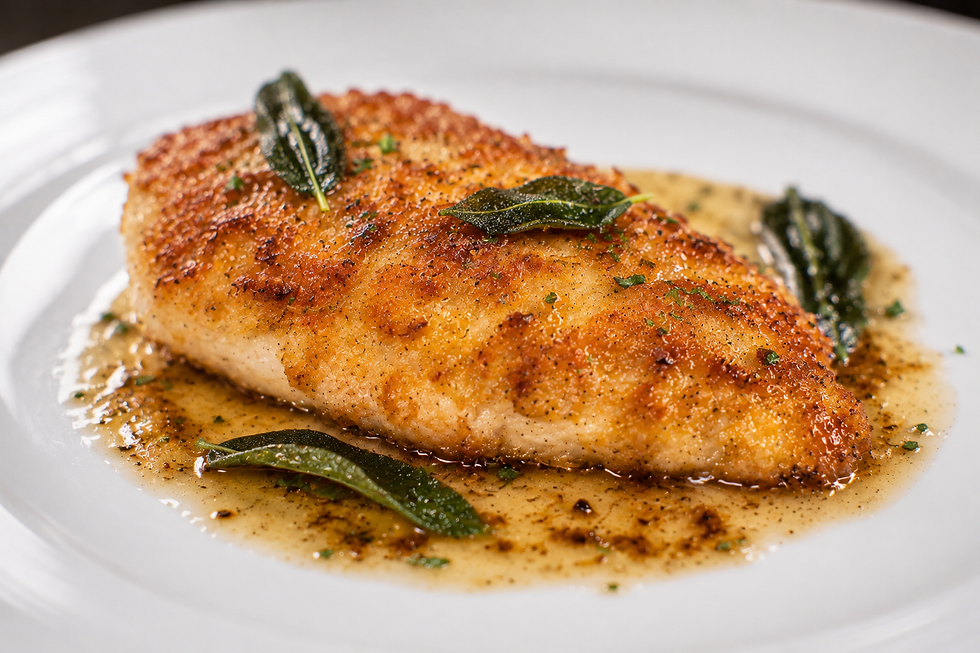
On grilled vegetables, chicken breast or a thick fillet of white fish, place a single cold coin on the hot surface at the pass and send the plate immediately. The diner watches it melt, which is part of the pleasure, and the aroma rises as it goes. On warm bread or crostini, soften only the portion being served and spread it thin, so the cheese and herb read as flavour rather than as a thick layer of fat.
Keep the garnish restrained. A single small basil leaf, undamaged and dry, placed beside the butter says everything that needs saying. Do not shower the plate with extra grated cheese, which flattens the green colour and pushes the salt too high, and do not add oil on top of a dish that is already carrying butter. The visual signature of this recipe is a clean green fleck through pale yellow fat, and anything piled over it hides the one thing the work went into.
Professional Technique
The two stage basil method is the technical heart of this recipe and it exists because no single treatment of the leaf gives both colour and smell. Blanching for ten seconds denatures polyphenol oxidase and the chlorophyllase that together turn a cut leaf dark. It buys stable green that will hold for days. But the same brief heat also drives off the light volatile compounds, chiefly the linalool and methyl chavicol that give basil its lifted, sweet, faintly aniseed perfume. Blanch the whole batch and you get a butter that looks beautiful and smells of almost nothing.
So one third goes through the heat to supply pigment, and two thirds stays raw to supply aroma. The blanched share is emulsified into a little butter immediately, which suspends the pigment particles in fat where oxygen reaches them poorly. The raw share is cut at the last second, with a single stroke of a sharp cold blade, and buried in fat within moments of being cut. Fat is a far better barrier against oxygen than any wrapping, which is why herbs hold their colour longer in butter or oil than they do loose in a container.
Grating the Parmigiano to a powder rather than to shreds matters for a separate reason. Shredded cheese stays as discrete pieces, so the butter tastes uneven and the salt lands in bursts. Powder disperses through the fat, seasons every bite identically, and dissolves cleanly when the butter melts into pasta water instead of sitting as chewy threads. A rasp style grater run in one direction over a cold, dry piece of cheese gives exactly that. Grate it just before use, because finely grated Parmigiano loses its own aroma within an hour of being cut.
Texture and Moisture Control
The finished butter should be firm and cleanly sliceable at refrigerator temperature, creamy and spreadable at cool room temperature, and glossy when it melts. It should never weep visible water and it should never break into a pool of clear oil with solids underneath. Each of those faults traces back to a moisture or temperature error made earlier.
Water arrives from three places: basil that was not dried, blanched basil that was not squeezed hard enough, and lemon juice added too fast. Butter is already an emulsion of roughly 16 percent water inside 82 percent fat, and it can take a little more water only if that water is worked in gradually. Dumped in at once it forms droplets too large for the fat to hold, and those droplets separate on standing and show as beads on the cut face of the log. If you see that happen, fold the butter again at cool room temperature and it will usually come back together.
Temperature is the other control. Below about 58°F (14°C) butter is too hard to fold and the cheese will not disperse. Above about 70°F (21°C) the fat crystals that give butter its structure begin to melt and the mass turns shiny and slack. Sixty five degrees Fahrenheit, or 18 degrees Celsius, sits in the working window. If the butter turns glossy while you are mixing, stop, put the bowl in the refrigerator for five to ten minutes, and carry on once it is matte again. On the plate, judge the quantity by how the food looks after tossing: coated and shining is correct, a ring of fat around the rim of the bowl means too much butter or too little starchy water.
Professional Mise en Place
This is a preparation that must be fully staged before the first leaf is picked, because once the basil is cut you have seconds, not minutes. Everything cold should already be cold and everything sharp should already be sharp.
Equipment and Tools
Rasp style fine grater, dry and clean, for the cheese and the lemon zest
Thin bladed slicing knife, freshly sharpened and kept at room temperature, never warm from a wash cycle
Small saucepan for blanching and a bowl large enough to hold 4 cups (1 liter) of ice water
Flexible rubber spatula and a wide mixing bowl, both chilled if the kitchen is warm
Clean cotton cloth for drying and for squeezing the blanched basil
Parchment sheets and a straight edged ruler or sheet pan for rolling the log
Instant read thermometer to confirm the butter sits at 65°F (18°C)
Advance Preparation Steps
Take the butter out of the refrigerator 60 to 90 minutes ahead so it reaches working temperature on its own rather than being forced with heat
Wash and dry the basil up to 2 hours ahead and hold it loosely covered in the refrigerator, dry, never sitting on a wet cloth
Blanch, shock, squeeze and blend the green paste up to 1 day ahead and keep it sealed and cold
Grate the Parmigiano immediately before mixing, not in advance
Zest the lemon last, since zest loses its oils quickly once removed from the fruit
Serving Setup
Portion the chilled log into coins, lay them on a parchment lined tray separated so they do not fuse, and hold at 38 to 40°F (3 to 4°C)
Bring out only the number of coins needed for the current service period
Label the wrapped log with the date and the flavour, because several compound butters look identical once rolled in paper
Keep a warm bowl of water and a cloth at the pass for wiping the portioning knife between cuts
Have warm serving bowls ready for pasta, since a cold bowl chills the butter before it can emulsify
Chef Tips
Dry the basil until a leaf pressed against the back of your hand leaves no mark of moisture at all. Wet basil is the single most common cause of a butter that turns dark by the second day.
Cut the raw leaves with one stroke of a cold sharp blade and get them into the fat immediately. Shreds left waiting on a board oxidize faster than anything else in the recipe.
Taste before you salt, never after. Parmigiano aged 24 months brings enough sodium that most batches need no added salt at all, and a butter that is too salty cannot be corrected.
Finish pasta in a warm bowl off the flame, with a spoonful of starchy cooking water. Heat under the pan splits the emulsion and cooks away the basil perfume you spent the whole recipe protecting.
Common Mistakes
Blanching all of the basil instead of one third: the result looks perfect and smells of nothing. The heat that fixes the colour also drives off the volatile aromatic compounds. Blanch only the share intended for pigment and keep the rest raw, cut at the last second.
Using a food processor or an electric mixer for the whole batch: the blades warm the herb, the machine whips air into the butter, and the finished product is pale, light and inconsistent by weight. Aerated butter also oxidizes faster because there is oxygen trapped inside it. Fold by hand with a spatula.
Adding the lemon juice all at once: butter can absorb a small amount of extra water only if the water goes in gradually. A single addition leaves droplets too large to hold, and the log weeps on the cut face the next day. Add it drop by drop, folding between additions.
Melting the butter over direct heat when finishing a dish: an emulsion held together at cool temperatures will split when it is boiled, giving a greasy plate and a dull olive colour instead of a glossy green one. Add it off the flame, in a warm bowl, with starchy water and vigorous tossing.
Wine or Beverage Pairing
The butter brings three things to the glass: the fat and lactic sweetness of dairy, the salty and savoury weight of aged Parmigiano, and the green, faintly aniseed lift of fresh basil. Fat needs acidity to cut it, salt needs fruit to answer it, and the herb note asks for a wine with its own vegetal or citrus character rather than one built on oak. Ligurian and neighbouring northwestern whites do all three at once, which is unsurprising given that this is basil country.
Riviera Ligure di Ponente Pigato DOC. This is the home match. Pigato grown on the Ligurian coast carries a resinous, herbal edge and a saline finish that sit directly alongside basil rather than competing with it, while the ripe stone fruit underneath gives enough weight for the Parmigiano. The texture is fuller than most seaside whites, so it holds its own against butter without needing high alcohol to do it.
Cinque Terre DOC. A blend led by Bosco with Albarola and Vermentino, grown on terraces above the sea, giving a bone dry white with cutting acidity and a distinctly briny finish. That salinity plays against the salt already in the cheese instead of amplifying it, and the sharp acid strips the butter fat from the palate between mouthfuls. Best when the butter is served on pasta or on grilled fish.
Gavi DOCG. Cortese from southern Piedmont, just over the hills from Genoa, is all green apple, white flowers and a firm mineral spine. Its restraint is the asset here: there is no oak, no tropical fruit and no residual sugar to muddle the basil, only clean acidity that resets the palate after each buttery bite. A reliable choice when the butter is finishing gnocchi or a delicate vegetable dish.
Lugana DOC. Turbiana from the southern shore of Lake Garda gives a rounder, slightly waxy white with citrus peel and almond notes and unusually persistent acidity for its weight. That extra body matches the richness of a cheese heavy butter better than a very lean wine would, and the bitter almond finish echoes the faintly bitter edge that fresh basil leaves behind.
Franciacorta DOCG. When the butter is served on crostini or as part of an aperitivo, a traditional method sparkling wine from Lombardy is the sharpest tool available. The bubbles and the high acidity scour fat from the palate mechanically, while the autolytic bread and hazelnut character from lees ageing finds common ground with the nutty crystalline notes of long aged Parmigiano.
For a table without alcohol, a cold infusion of lemon verbena with a squeeze of lemon and no sugar works along the same lines: green aromatics and acidity, with nothing sweet to fight the cheese.
Storage and Make Ahead Options
Wrapped tightly in parchment and then in a sealed bag or box, the log keeps 5 days at 38 to 40°F (3 to 4°C). The basil is the limiting factor, not the dairy. Expect the colour to be at its brightest on days one and two and to soften gradually after that. Keep it away from onions, garlic and cured fish in the refrigerator, because butter absorbs neighbouring aromas readily through its fat.
For longer holding, freeze it. Cut the chilled log into coins first, freeze them spread on a tray until solid, then transfer them to a sealed container so they do not fuse into a single block. They keep 2 months at 0°F (minus 18°C) with the colour essentially locked in place, which is the honest advantage of freezing this particular butter. Take out only what is needed and let the coins soften for a few minutes at room temperature, or drop them frozen straight onto hot pasta, which works perfectly well.
Do not thaw and refreeze, and do not return a coin that has been warmed at the pass to the main log. Repeated softening and chilling coarsens the crystal structure of the fat and the butter turns grainy. The green basil paste from the first stage can be made a full day ahead and refrigerated sealed, which splits the work neatly across two sessions if the kitchen is busy.
Nutrition Information
Approximate values for one portion of 1 tablespoon (14 g), based on 12 portions from the full batch.
Calories: about 115
Total Fat: 12 g
Saturated Fat: 7.5 g
Trans Fat: 0.4 g, naturally occurring in dairy fat
Unsaturated Fat: 3.6 g, mostly monounsaturated
Cholesterol: 33 mg
Sodium: 75 mg, almost all of it from the Parmigiano Reggiano
Total Carbohydrates: 0.2 g
Fiber: 0.1 g
Total Sugars: 0.1 g
Added Sugars: 0 g
Protein: 1.6 g
Lactose: less than 0.1 g, since butterfat retains very little and aged Parmigiano is effectively lactose free
Micronutrients: calcium about 50 mg, vitamin A about 110 micrograms retinol equivalent, vitamin K from the basil, phosphorus about 30 mg, and small amounts of vitamin E and vitamin B12
Allergens: contains milk. The Parmigiano Reggiano is made with animal rennet, so the butter is not suitable for a strict vegetarian diet. The optional pine nuts introduce a tree nut allergen. These figures are estimates calculated from standard ingredient composition tables and will shift with the fat content of the butter and the age of the cheese.
About the Recipe
This recipe belongs to the family of finishing preparations rather than to the family of dishes. It exists so that a kitchen can put the flavour of fresh basil and aged cheese onto a plate in one motion at the moment of service, instead of building it from scratch under pressure. The version here deliberately keeps the ingredient list short. There is no garlic in the base formula and no pine nut, because the aim is not a chilled pesto but a clean green butter in which the herb is the loudest voice and the Parmigiano supplies the salt and the savoury depth underneath it.
The reason it earns a place in a professional refrigerator is consistency. A log made once on a quiet morning gives twelve identical portions, each one carrying the same amount of basil, cheese, acid and pepper. That reliability is difficult to achieve when the same flavours are assembled dish by dish during service.
Summary
Burro al Basilico e Parmigiano is a straightforward preparation with one demanding requirement: the basil must stay green. That is achieved by drying the leaves completely, blanching one third of them for ten seconds to fix the pigment while keeping two thirds raw for aroma, cutting the raw leaves once with a cold sharp blade, and getting everything into soft butter at 65°F (18°C) within moments. Parmigiano Reggiano grated to a powder seasons the butter, so salt is judged only after tasting.
Rolled tight in parchment, chilled for two hours and sliced with a warm knife, the log yields twelve clean coins that keep 5 days refrigerated or 2 months frozen. Its best use is the simplest one: a coin dropped onto just drained pasta in a warm bowl with a spoonful of starchy water, tossed off the heat until it turns glossy. Handle the herb with care at every stage and the reward is a butter that looks as fresh on the fifth day as it did on the first.


Comments