
Italian Parmigiano Crusted Chicken Breast | Petto di Pollo in Crosta di Parmigiano con Burro e Salvia
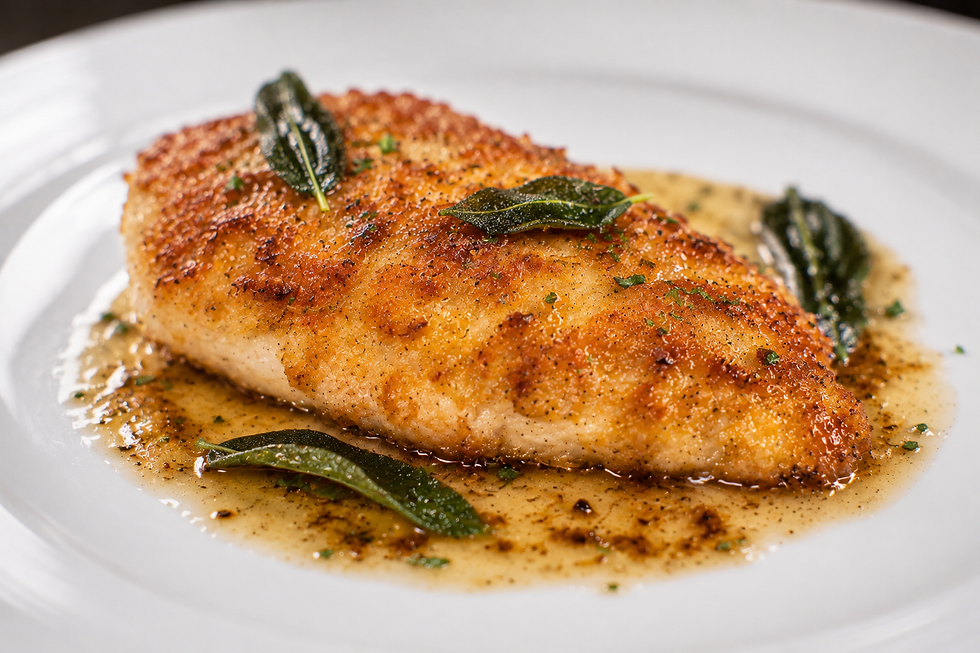
This is a chicken breast that wears a crust of nothing but cheese. There is no egg, no breadcrumb, no batter: a dried piece of meat, a veil of flour so thin it is almost invisible, and a firm press into coarsely grated Parmigiano Reggiano. What holds it together is the cheese itself, which behaves in a hot pan like nothing else in the Italian pantry.
The cooking fat is the other half of the dish. Butter and sage, burro e salvia, is the sauce of the Po valley, and here it is not spooned over at the end but used as the medium the crust sets in. The sage perfumes the butter from the first minute; the butter, clarified so it can take the heat, turns the grated cheese into a golden sheet that snaps under a knife.
Everything depends on temperature. Too cold and the cheese sweats into a pale rubbery patch. Too hot and the milk sugars scorch into bitterness before the chicken is cooked. The window is narrow, easy to hold once you know where it is, and the rest of the recipe exists to keep you inside it.
Yield: 4 servings. Prep: 25 minutes. Cook: 16 minutes. Rest: 5 minutes. Total: about 50 minutes. Difficulty: intermediate. Course: secondo. Region: Emilia, the Parmigiano Reggiano provinces of Parma, Reggio Emilia and Modena.
The Story
Parmigiano Reggiano is made in a strip of the Po plain that runs from Parma through Reggio Emilia and Modena into part of Bologna and Mantova, and in that strip the cheese is not a garnish. It is a cooking ingredient with its own uses, and the habit of pressing grated cheese onto meat instead of breadcrumb belongs to farmhouse kitchens where a wheel was always open and stale bread was not always available. The grating from the last dry edge of a wheel, too hard to eat as a table cheese, is exactly what makes the best crust.
Butter, not olive oil, is the fat of this territory. The same dairy economy that produces the cheese produces cream and butter in quantity, and the cooking of Emilia, Lombardy and the Veneto is built on it: risotto, brasato, filled pasta, and burro e salvia, the plainest sauce in the northern repertoire. Sage was the herb at the kitchen door because it survives the damp Po winters when basil has long gone, and its resinous flavour is one of the few that does not disappear inside hot butter.
What this dish is not is a cotoletta. The Milanese and Bolognese cutlets are breaded, egged and often finished with prosciutto or a sauce, and they come from a different lineage, the veal escalope of the northern cities. A cheese crusted breast is a poorer and quicker idea, a way of making an unremarkable piece of poultry taste of the most expensive thing in the larder by using very little of it. Chicken arrived late in this role, since the Emilian farm cooked its hens boiled or in umido and kept the pan for veal and pork, but the technique transferred cleanly once chicken breast became an everyday cut.
Ingredients
For the chicken
Boneless skinless chicken breasts, 4, about 6 oz (170 g) each
Fine sea salt, 1 tsp (6 g)
Freshly ground black pepper, to taste
All purpose flour, 3 tbsp (24 g), for a very light dusting
For the Parmigiano crust
Parmigiano Reggiano, 24 months, coarsely grated, 5 oz (140 g)
Freshly grated nutmeg, 1 small pinch
Finely ground black pepper, 1/4 tsp (0.5 g)
For the sage butter
Unsalted butter, 6 tbsp (85 g), to be clarified
Extra virgin olive oil, 2 tbsp (30 ml)
Fresh sage leaves, large, 12
Garlic clove, peeled and left whole, 1
For finishing
Dry white wine, 3 tbsp (45 ml)
Unsalted butter, cold, 1 tbsp (14 g)
Lemon, 1/2, for zest only
Flaky sea salt, a small pinch per portion
Preparation
Even out the breasts
Lay each breast flat and slice it horizontally through the thickest part to open it into two thinner pieces, or butterfly it and press it out to a uniform 1/2 inch (13 mm). Do not pound it thin like a cutlet: below that thickness the meat is cooked before the crust has coloured. Trim the tapering tail so every piece has the same depth.
Salt the meat and dry the surface
Season both sides with the fine sea salt and black pepper and leave the pieces on a rack, uncovered, for 15 minutes at room temperature. Then blot each side firmly with paper towel until the surface feels tacky rather than wet. Salt draws moisture out, and that moisture is the enemy of the crust: free water steams under the cheese and lifts the whole sheet off in one piece.
Clarify the butter and infuse the sage
Melt the 6 tbsp (85 g) of butter in a small saucepan over low heat without stirring. The white milk solids sink and a foam rises. Skim the foam, then pour the clear golden fat into your saute pan and stop before the milky layer at the bottom follows it. Add the olive oil, the whole garlic clove and all 12 sage leaves, and set the pan over medium low heat so the leaves begin to sizzle very gently.
Coat in flour and Parmigiano
Spread the flour on a plate and the grated Parmigiano, mixed with the nutmeg and fine pepper, on a second one. Pass each piece of chicken through the flour and slap it hard between your palms so almost nothing remains, then lay it on the cheese and press down with the flat of your hand. Turn it and press again. You want a dense even layer that stays put when you lift the piece, not a loose heap.
Set the crust in the sage butter
Lift the sage out with a fork the moment it turns translucent and stiff, before any leaf darkens, and reserve it on paper. Remove the garlic. Bring the fat to 300F to 340F (150C to 170C), which is a steady quiet sizzle and no more, and lay the chicken in without moving it. Give it 4 to 5 minutes until the underside is a set amber sheet, then turn once with a fish spatula and repeat on the second side.
Finish, rest and mount the pan juices
Check the centre at 160F (71C) and lift the pieces onto a rack, crust side up, never onto paper or a plate. Rest 5 minutes: the temperature climbs to about 165F (74C) and the juices settle. Meanwhile pour off most of the fat, deglaze the pan with the white wine, let it reduce by half and swirl in the cold tablespoon of butter off the heat to a glossy spoonful of sauce.
Plating
Warm the plates, but only to about 120F (50C). A plate straight from a hot cabinet raises steam under the chicken and the crust softens from below within a minute, which is the most common way a perfectly cooked version of this dish is ruined between the pan and the table.
Set each piece whole, crust side up and slightly off centre. Do not slice it in the kitchen and fan it out: every cut releases juice that runs under the cheese. Spoon the mounted pan juices onto the plate beside the chicken and around it, never over the crust. Lay two or three of the crisped sage leaves directly on top, grate a little lemon zest over the meat and add a pinch of flaky salt.
What goes alongside should be dry or served separately. Roasted potatoes, dressed rocket added at the last second, or braised chard in a side bowl all work. Anything wet belongs in its own dish where it cannot reach the crust.
Professional Technique
The technique here is butter and sage used as a cooking medium for a cheese crust, and it works because Parmigiano Reggiano is not a melting cheese. A 24 month wheel holds roughly 30 percent water against 30 percent fat, and that low moisture changes everything. Put mozzarella in hot fat and the water inside slackens its protein network: the cheese flows and runs off the meat. Aged Parmigiano has too little water to soften. What it has evaporates, the fat renders out into the butter, and the protein and calcium lattice left behind dries and crystallizes into a rigid golden lamina welded to the chicken.
That reaction has a narrow window, and holding the pan between 300F and 340F (150C and 170C) is the most important number in the recipe. Below it the cheese loses water too slowly, sweats fat and sets pale and leathery. Above it the lactose and free amino acids of a long aged cheese brown much faster than the chicken cooks, and the crust turns bitter while the centre is raw. The fat must be clarified, or at least cut with olive oil, for the same reason: the caseins in whole butter scorch near 250F (120C), well below the heat the crust needs, so whole butter blackens and flavours the cheese with burnt milk before the lamina sets.
The sage goes into the butter at the start. Its aroma sits in terpenes, mainly thujone, camphor and cineole, which are fat soluble and volatile: they leave the leaf within a minute of gentle heat and stay in the butter. Left in the pan they turn bitter, so the leaves come out while still green and go back on as a garnish. The last condition is mechanical. The crust forms only on a breast dried and passed through the thinnest veil of flour, which gives the cheese something to grip as its fat melts away. Egg wash traps water against the meat and steams the cheese soft.
Texture and Moisture Control
Two things have to be true at once: the crust brittle and the meat still juicy. They pull against each other, because the crust wants a dry hot surface and the chicken wants to leave the heat early. The resolution is thickness and resting. At 1/2 inch (13 mm) the meat reaches 160F (71C) in about the same 9 minutes the crust needs to set on both sides, and the 5 minute rest carries it to 165F (74C) by carryover instead of by more pan time. Push the breast past 170F (77C) and the muscle fibres contract hard, squeeze out water and turn chalky, and no crust rescues that.
Moisture control is about where the water goes. The dry salting and the blotting remove surface water before cooking. The rack instead of a plate removes it after: chicken set on a flat surface sits in its own condensation and the underside of the crust goes soft in under two minutes. Turning the pieces only once matters for the same reason, since each flip breaks the seal between cheese and meat and lets steam escape upward through the lamina.
Professional Mise en Place
This is a fast dish with one narrow window, so everything is measured and lined up before the pan goes on the heat.
Equipment and tools
Wide heavy saute pan, stainless or carbon steel, big enough for 4 pieces without crowding
Small saucepan for clarifying, fine sieve, instant read thermometer
Coarse side of a box grater, two wide plates for flour and cheese
Fish spatula and a wire rack set over a tray
Prepared ahead
Butter clarified up to 1 week ahead and refrigerated
Parmigiano grated up to 4 hours ahead, loosely covered, never sealed airtight
Breasts butterflied, salted and dried, held on a rack in the refrigerator up to 3 hours
Sage picked, washed and dried completely, since a wet leaf spits in the fat
Service setup
Thermometer in the fat and checked before the chicken goes in
Plates warmed to about 120F (50C) and no hotter
Rack ready beside the pan, wine and cold butter measured for the deglaze
Crisped sage leaves held dry on paper, away from any steam
Chef Tips
Grate the Parmigiano yourself on the coarse holes, the same day. Powdery pre grated cheese carries anticaking starch and has lost its fat to the air, so it sinters into a dull layer instead of crisping. Coarse shreds trap air, and that is what makes the crust brittle.
Use a 24 month wheel rather than a 36 month one. The older cheese is drier and richer in free amino acids, which sounds like an advantage and is not: it browns and turns bitter in the same window where a 24 month cheese merely turns golden.
Keep the thermometer in the fat, not only in the meat. It is the one reliable way to hold 300F to 340F (150C to 170C), and the pan drops sharply the moment four cold pieces go in, so expect to lift the heat briefly and then bring it back down.
Cook in two batches if the pan is not genuinely wide. Crowded pieces trap steam, the fat temperature collapses and every crust comes out pale.
Common Mistakes
Using whole butter instead of clarified. Its milk solids scorch near 250F (120C), far below the heat the cheese needs, so the pan blackens and the crust tastes of burnt milk. Clarify it, or at minimum cut it with olive oil.
Dipping the chicken in egg. Egg holds water against the meat and steams the cheese into a pale pad that peels away in one sheet. This crust needs a dry surface and a bare dusting of flour.
Leaving the sage in the pan throughout. Sage gives up its aroma in the first minute and then turns bitter and acrid. Infuse, lift the leaves out while green, and put them back at the plate.
Pounding the breast thin. A thin escalope cooks through long before the cheese sets, so you either accept a pale crust or dry the meat out waiting for one. Keep it at 1/2 inch (13 mm).
Resting the chicken on a plate. Condensation collects underneath and softens the crust in two minutes. Rest it crust side up on a wire rack, never covered with foil.
Wine Pairing
Colli Bolognesi Pignoletto DOCG: The local answer, grown on the hills that close the Parmigiano plain to the south. Its high malic acidity cuts the clarified butter cleanly, and the faint white pepper and hay note on the finish sits alongside the sage rather than competing with it.
Lugana DOC: Turbiana on the clay of the lower Garda gives a white with real texture and a bitter almond close. That body is what a cheese crust needs: a thin wine simply vanishes under 5 oz of aged Parmigiano, while this one has enough weight to answer the salt and the glutamates.
Soave Superiore DOCG: Garganega grown on volcanic soil, with a saline mineral cut and a soft almond bitterness. The sapidity works against the savoury depth of long aged cheese, and there is no oak or heavy fruit to blur the sage.
Franciacorta DOCG: Metodo classico is the classic foil for anything crisp and fatty. The bead scours the palate between mouthfuls of buttery crust, and the fine autolytic bread and hazelnut character from long lees ageing runs parallel to the toasted cheese instead of contrasting with it.
Alto Adige DOC Pinot Nero: For a red on the table, this is the one. Light tannin, high acidity and a dried herb and sour cherry profile handle white meat without smothering it, and mountain Pinot Nero has the earthy resinous edge that makes sense of sage. Serve it at 57F (14C).
Storage & Reheating
Eat this the moment it is made. Cooked pieces keep refrigerated in a container lined with paper towel, loosely covered rather than sealed, for up to 2 days. Never wrap them tightly: trapped steam turns the crust to paste overnight. Keep the sauce in a separate jar.
Reheat in a dry oven, never in a pan or a microwave. Set the pieces crust side up on a rack over a tray at 325F (165C) for 8 to 10 minutes, until the centre is warm and the crust has dried again. A pan refries the cheese and turns it bitter, a microwave steams it soft. Rewarm the sauce separately.
Do not freeze the cooked chicken: the crust survives freezing but not thawing, since water released from the meat goes into the cheese. Raw butterflied and salted breasts freeze for up to 2 months, then thaw overnight and dry thoroughly before flouring.
Nutrition
Per serving, based on 4 portions:
Calories: 560 kcal
Total Fat: 36 g
Saturated Fat: 18 g
Trans Fat: 0.8 g
Unsaturated Fat: 16 g
Cholesterol: 175 mg
Sodium: 1080 mg
Total Carbohydrates: 6 g
Fiber: 0 g
Total Sugars: 0.5 g
Added Sugars: 0 g
Protein: 53 g
Lactose: 0.2 g
Principal micronutrients: calcium, phosphorus, selenium, vitamin B12, niacin, vitamin A, zinc
These figures are estimates. Parmigiano Reggiano and salt together carry most of the sodium, and a good part of the cooking fat stays in the pan and is poured off rather than eaten.


Comments