
Italian Prosciutto Chicken Breast | Petto di Pollo con Prosciutto di Parma e Salvia

Four whole chicken breasts, each one covered with two slices of Prosciutto di Parma and a pair of sage leaves pressed underneath, seared until the ham turns brittle and finished in a short pan sauce of white wine, stock and cold butter. The ham is not a garnish here. It is the seasoning, the fat and the heat shield all at once, and every decision in the method follows from that.
The dish stands next to saltimbocca alla romana without being it. That one is veal, thin and quick. This is a thick white breast that needs protecting from the metal, and the cured ham does exactly that: a dry layer that browns hard while the meat below it stays under the temperature at which it would squeeze out its own juice.
Yield: 4 servings. Prep: 20 minutes. Cook: 25 minutes. Rest: 5 minutes. Total: about 50 minutes. Difficulty: intermediate. Course: secondo piatto. Region: Emilia, the hills of the province of Parma.
The Story
Prosciutto di Parma comes from a narrow strip of Emilia and from nowhere else. The production zone is limited to part of the province of Parma, between the Enza and the Stirone, above the damp plain and below the high Apennine, where the air that crosses the passes arrives dry enough to cure a leg of pork slowly and without smoke. The ingredient list of the finished ham is two items long: Italian pork and sea salt. No nitrates, no nitrites, no sugar, no spice. A ham that has spent at least twelve months in those rooms and passes inspection gets the five pointed ducal crown burned into the rind, and that brand is the only reason to pay for it.
The recipe itself is kitchen arithmetic rather than tradition. Chicken breast became an everyday cut in Italy only after the war, cheap, lean and slightly dull, while at the salumeria the ends of the leg, the pieces too short or too soft to slice for a plate, went out at a fraction of the price. Emilia cooks in butter and lard rather than oil, and the combination of cured pork, sage and butter already ran through the region on tortelli and on veal. Putting it over a chicken breast cost almost nothing and solved the breast's only real problem, which is that on its own it has neither fat nor salt.
Sage supplies the third element. Salvia officinalis is a perennial that survives Po valley winters at the edge of any kitchen garden, and its faintly camphorous, resinous note is the classic Italian answer to pork fat, from Roman saltimbocca to Lombard butter sauces. The leaf is tough enough to hold its perfume through a sear, which few herbs manage, but only if it is kept off the metal. That single detail, where the sage sits, separates this dish when it works from the same dish when it tastes of ash.
Ingredients
For the chicken
Boneless skinless chicken breasts, 4, about 6 oz each (170 g each)
Prosciutto di Parma, 8 slices of medium thickness, about 4 oz (115 g)
Fresh sage leaves, large, 8
Fine sea salt, 1/4 tsp (1.5 g), for the bare side only
Freshly ground black pepper, 1/2 tsp (1 g)
Extra virgin olive oil, 2 tbsp (30 ml)
For the pan sauce
Shallot, small, finely minced, 1, about 1 oz (30 g)
Unsalted butter, 1 tbsp (14 g)
Dry white wine, 1/2 cup (120 ml)
Unsalted chicken stock, 3/4 cup (180 ml)
Fresh sage leaves, 2
For finishing
Cold unsalted butter, cut into cubes, 1 1/2 tbsp (21 g)
Lemon juice, 1 tsp (5 ml), only if needed
Freshly ground black pepper, to taste
Flaky sea salt, a few grains per plate, optional
Preparation
Step 1
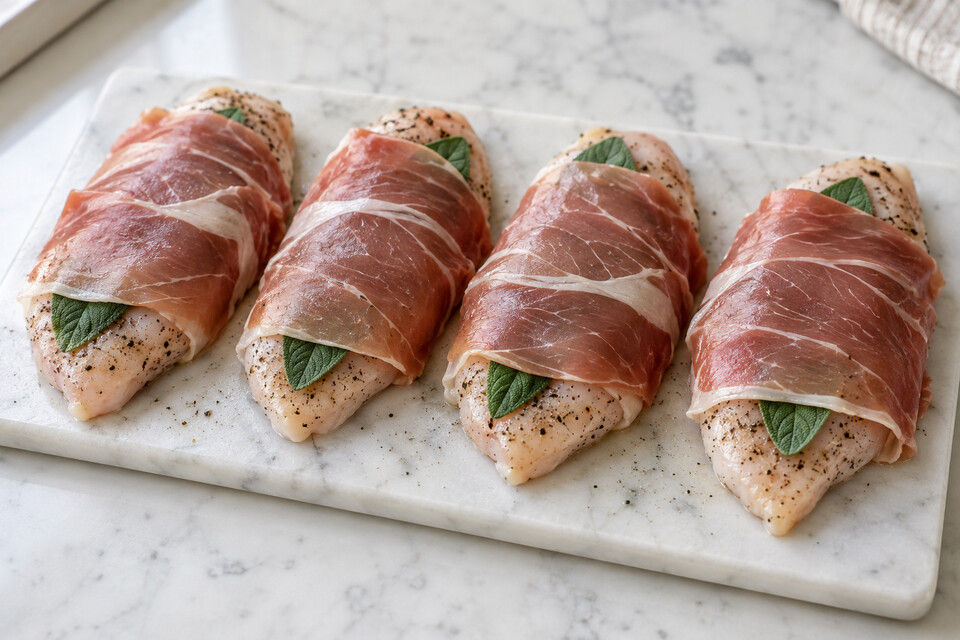
Pat the breasts thoroughly dry with paper towel and trim any ragged edge. Season the bare side, the one that will not carry ham, with the fine sea salt, and both sides with pepper. Press two sage leaves flat against the top of each breast, then lay two slices of Prosciutto di Parma over them, overlapping slightly and covering the whole surface. Press down with the flat of your hand: the damp meat grips the ham and no toothpick is needed. The sage must finish underneath the ham, never on top of it.
Step 2
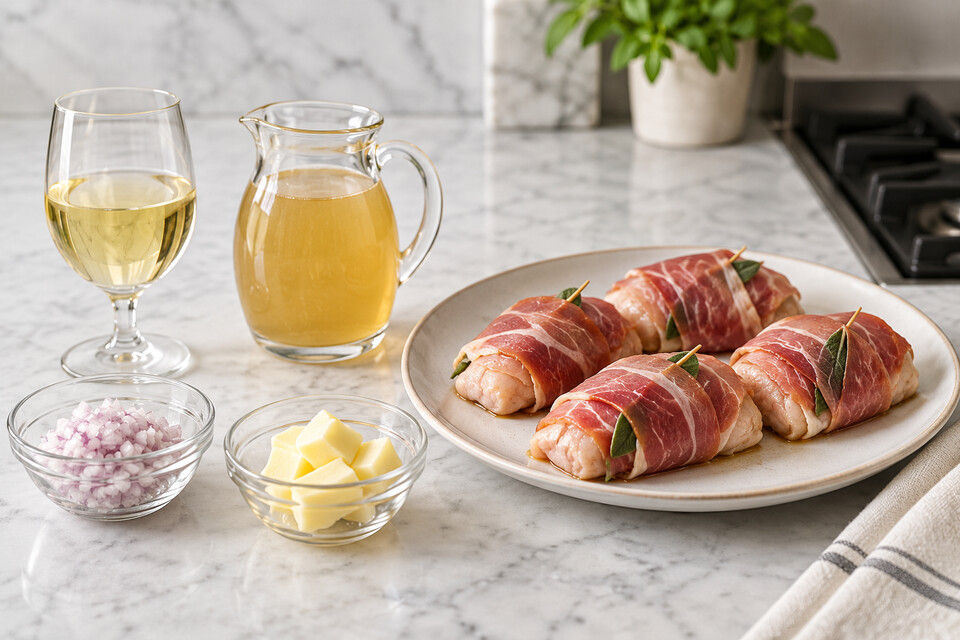
Set the sauce up before any heat goes on. Mince the shallot fine, measure the wine and the stock into separate cups, cut the finishing butter into cubes and put them back in the refrigerator so they stay hard. Once the ham meets the pan the dish runs for less than fifteen minutes without a pause.
Step 3

Heat the olive oil in a wide heavy skillet over medium high heat until it just shimmers. Lay the breasts in ham side down, without crowding them, and leave them completely alone for 3 to 4 minutes. Press each one once with a spatula so the entire ham surface meets the metal. It is ready when the ham has gone deep amber and the edges have lifted and stiffened. Turn each breast once, only once, and give the bare side 5 minutes.
Step 4
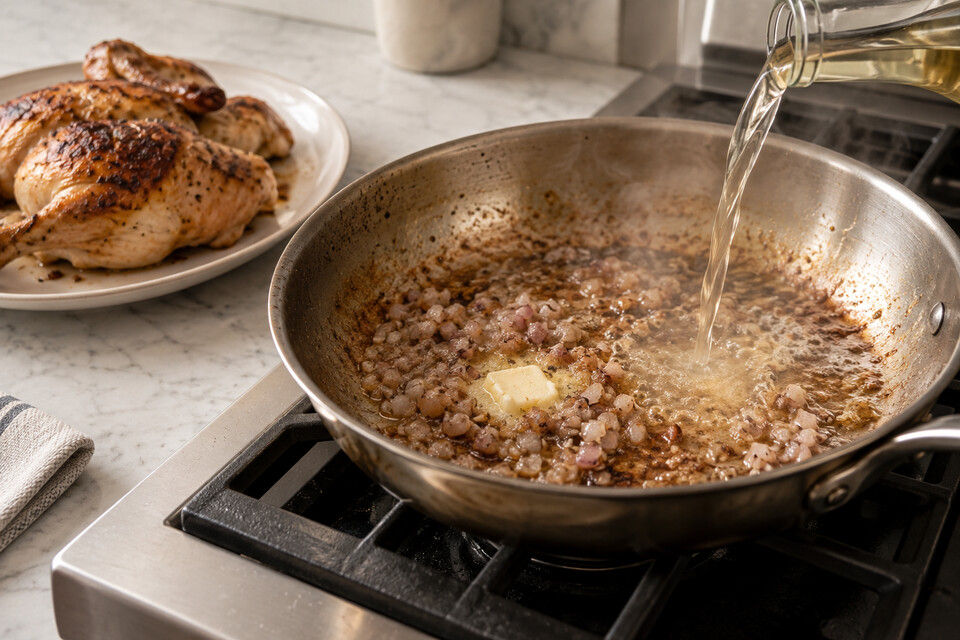
Move the breasts to a plate, ham side up, while they are still short of done. Lower the heat to medium, add the tablespoon of butter and the shallot to the same pan and cook for about 1 minute, until translucent, scraping the browned residue off the base as it softens. Pour in the white wine, stir everything loose and let it reduce by half, roughly 2 minutes.
Step 5

Add the stock and the two sage leaves, bring to a gentle simmer and settle the breasts back into the pan ham side up, along with any juices they have released on the plate. The liquid should come no more than a third of the way up them: the ham must stay clear of it. Simmer gently for 3 to 5 minutes, until the thickest part of the breast reads 160°F (71°C) on an instant read thermometer.
Step 6

Lift the breasts onto a warm plate and rest them for 5 minutes, during which carryover takes them to a safe 165°F (74°C). Meanwhile raise the heat under the pan and reduce the liquid until it coats the back of a spoon. Take the pan off the heat, wait until it stops bubbling and whisk in the cold butter one cube at a time until the sauce turns glossy. Taste for salt last, and add lemon juice only if it reads flat.
Step 7

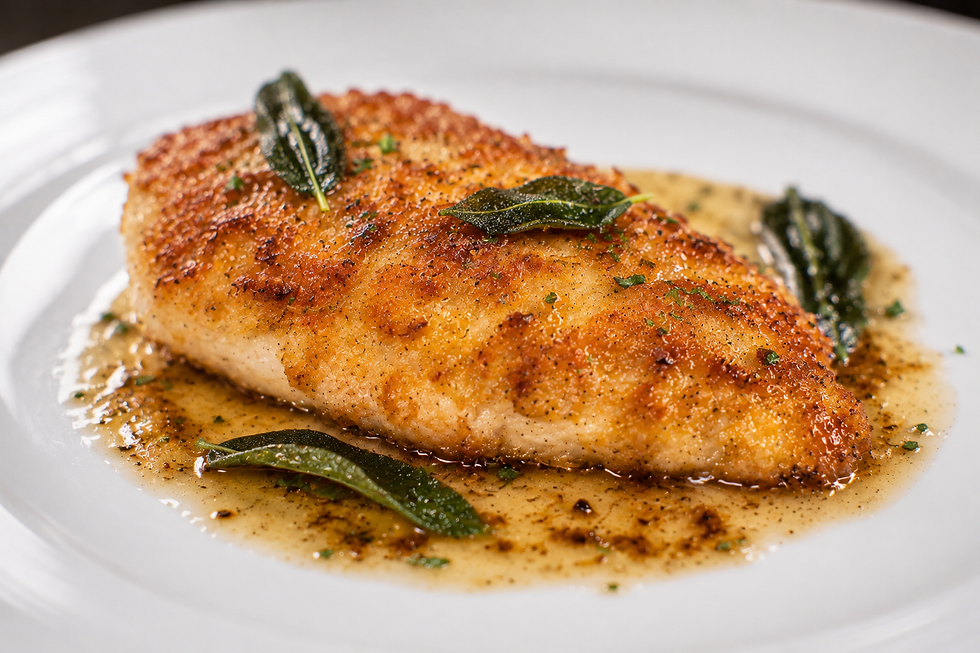
Set each breast on a warm plate with the ham facing up and the crisp edge toward the diner. Spoon the sauce around the base of the meat, never across the top. Finish with pepper and a few grains of flaky salt on the bare meat rather than on the ham, then carry the plates out while the crust still makes a sound under the knife.
Plating
Warm the plates to just above hand temperature and no hotter. A cold plate sets a mounted butter sauce into a dull film within seconds, and a scorching one keeps reducing it until it breaks. Choose a flat plate rather than a bowl: there is very little liquid here and it should sit in a shallow pool.
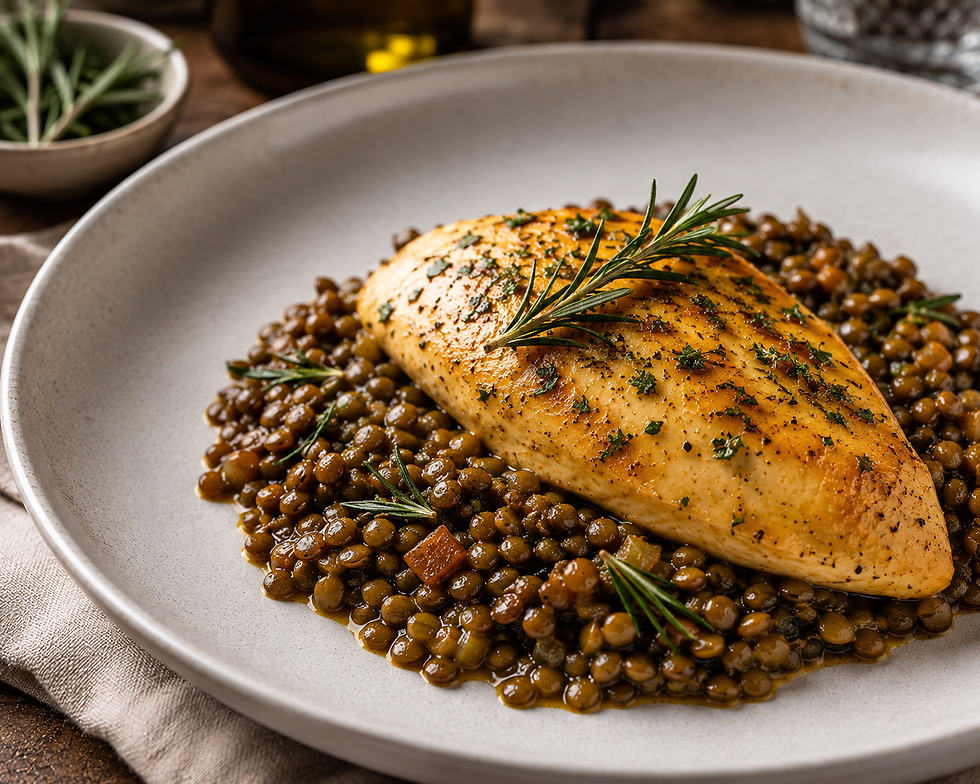
Serve the breast whole, ham side up, placed slightly off centre with the crisp edge toward the diner. If you prefer it sliced, cut it across the grain into three thick pieces, keep the ham cap on each one and fan them so the cut faces show white against the amber. The sauce goes around the base in a broken ring, roughly two tablespoons per plate. Alongside, buttered new potatoes, peas stewed in their own water or plain spinach are the whole of what this dish wants.
Professional Technique
Prosciutto di Parma is not raw meat and it does not behave like raw meat in a pan. Its proteins were denatured by salt and by twelve months or more of drying, and its free water is extremely low, which means heat has almost nothing left to cook. What heat does instead is finish the drying that the curing rooms started. The slice tightens, the surface dehydrates, the fat clarifies and runs out, and in three to four minutes a limp pink sheet becomes brittle and amber. That is a dehydration process, not cooking, and it is the reason the ham side goes into the pan first and takes the hottest surface available.
Because the ham is doing the drying, the chicken underneath is not. The breast never touches the metal: it sits above a layer that is already cooked, already dry and steadily giving up fat, so the flesh in contact with that layer stays well below the temperature at which its own fibres contract and press out their water. The ham is a heat shield with a second function, since salt migrates downward into the damp surface of the meat for the whole of the sear and seasons it from the outside in. Nothing else on a stove does both jobs at once.
Two consequences follow, and both are easy to get wrong. Prosciutto di Parma carries roughly five per cent salt on its weight, so two slices deliver close to 1.4 g of salt to each portion, about as much as a cook would add deliberately: the ham side is therefore not salted at all, and only the bare side takes a pinch. And the sage belongs between the ham and the flesh. Laid on the outside it meets the pan directly, carbonises in under a minute and turns bitter, while pressed against wet meat under the ham it steams in place and perfumes the breast from the surface inward.
Texture and Moisture Control
A chicken breast has no collagen worth melting and almost no intramuscular fat, so it offers one narrow window and no second chance. Its fibres begin to contract at around 140°F (60°C) and by 170°F (77°C) they have wrung out most of their water, which is why the difference between juicy and chalky here is ten degrees rather than ten minutes. Pull the meat at 160°F (71°C), rest it 5 minutes and let carryover finish the job at 165°F (74°C). Probe the thickest point from the side, keeping the tip clear of the ham, which reads hotter than the flesh.
Crispness, meanwhile, is a question of humidity. The dried ham reabsorbs moisture from anything it touches, which is why the simmering liquid stops a third of the way up the breast, why the ham faces upward from the moment it leaves the sear, and why the sauce is spooned around the meat rather than over it. The sauce needs the opposite care: cold butter whisked in off the heat holds as an emulsion only below about 190°F (88°C), and a sauce boiled after mounting separates into oil and a thin puddle.
Professional Mise en Place
Equipment and tools
A wide heavy skillet of 12 in (30 cm), in steel or iron rather than a thin nonstick pan that loses its heat when four breasts go in. Tongs, a thin flexible spatula, an instant read thermometer and a rack set over a plate for the rest.
Prepared ahead
The breasts can be dressed with sage and ham up to 4 hours ahead and kept uncovered on a rack in the refrigerator, which dries the ham surface further and improves the sear. Mince the shallot, measure wine and stock, cube the finishing butter and keep it cold. Warm the plates.
Service setup
Plates at about 140°F (60°C), the stock within reach of the pan, the butter cubes in a small bowl on ice. Sear to order: this is a fifteen minute dish from first sear to plate and it does not hold. If you must stagger portions, sear in two batches and keep the finished sauce warm off the flame.
Chef Tips
Ask for the ham cut slightly thicker than you would for a plate of affettati, around 1/16 in (1.5 mm). Paper thin slices set for eating cold disintegrate in a hot pan and weld to the metal instead of crisping into a sheet.
Even thickness matters more than weight. If one end of a breast is much thinner, fold it under itself and hold it with a toothpick rather than pounding the whole piece flat, which tears fibres and opens channels for juice to escape.
If the ham is not crisping, the pan is either too cool or too crowded. Four breasts in a small skillet will steam; two at a time in a properly heated one is faster overall and gives a better crust on every portion.
Keep the fat left in the pan after the sear. Clarified ham fat scented with sage is the best thing in the kitchen for frying bread or potatoes the following day.
Common Mistakes
Salting the chicken as usual. Two slices of Prosciutto di Parma bring about 1.4 g of salt to each portion. Salt the ham side as well and the pan sauce, which concentrates afterwards, becomes undrinkable.
Turning the breasts more than once. Every turn shears the ham sideways off the wet meat and drops the sage out from under it. One turn, ham side down first, and leave it alone in between.
Laying the sage on top of the ham. In direct contact with the pan a sage leaf blackens in well under a minute and tastes of ash. Under the ham it steams and gives up its oils slowly.
Spooning the sauce over the ham. A crust built over four careful minutes softens in about ten seconds under warm liquid. The sauce belongs around the base of the meat.
Cooking to be on the safe side. Taken to 175°F (79°C) the breast has lost a fifth of its water and no sauce brings it back. Pull at 160°F (71°C) and let the rest carry it to 165°F (74°C).
Wine Pairing
Lambrusco di Sorbara DOC: The wine of the same province, in its dry version, and the most natural bottle on the table. Pale, high in acidity and finely sparkling, it scrubs the ham salt and the butter off the palate between mouthfuls, and its light sour cherry fruit never overwhelms white meat. Serve it cold, around 54°F (12°C).
Colli Bolognesi Pignoletto DOCG: Emilian white from the hills just east of the ham country. Firm citrus acidity cuts the mounted butter, and the faintly bitter almond note on the finish runs alongside the resin of the sage instead of arguing with it. Light enough to leave a lean breast intact.
Lugana DOC: Turbiana from the southern shore of Garda, broader and rounder, with white peach, almond and a saline finish. Choose this one when the sauce is generously buttered: it has the body to meet a thick breast and a texture that runs with the emulsion rather than slicing through it.
Alto Adige DOC Pinot Nero: For anyone who wants a red. Cool climate Pinot Nero brings tannin light enough not to clash with lean white meat, sour cherry acidity that answers the salt of the cure, and a herbal, undergrowth edge that sits beside sage. Serve at 57°F (14°C), cooler than a red normally goes.
Storage & Reheating
Store the meat and the sauce in separate airtight containers in the refrigerator for up to 2 days. Left sitting in liquid the ham softens into something limp and salty within an hour, and the sauce picks up a cured pork edge that dominates it. Accept from the start that the crust belongs to the first service and cannot be stored.
To reheat, bring the breast to room temperature for 15 minutes, then warm it covered in a 300°F (150°C) oven for 8 to 10 minutes, ham side up. For a partial recovery of the crust, finish it ham side down in a dry pan over medium heat for about 1 minute. Warm the sauce over the lowest possible heat without ever letting it simmer, and if it has separated, whisk a teaspoon of cold butter into it off the flame to bring it back together.
The cooked breast freezes for up to 1 month, well wrapped, though the ham comes out leathery and is better peeled off. Do not freeze the sauce: a butter emulsion separates irreversibly on thawing. Sliced cold and dressed with olive oil and pepper, leftovers make a better lunch than any reheating does.
Nutrition
Per serving, based on 4 servings:
Calories: 430 kcal
Total Fat: 24 g
Saturated Fat: 10 g
Trans Fat: 0 g
Unsaturated Fat: 13 g
Cholesterol: 150 mg
Sodium: 1050 mg
Total Carbohydrates: 2 g
Fiber: 0 g
Total Sugars: 1 g
Added Sugars: 0 g
Protein: 46 g
Lactose: 0.2 g
Principal micronutrients: niacin, vitamin B6, vitamin B12, selenium, phosphorus, zinc
These figures are estimates. Almost all the sodium arrives with the cured ham, so the total moves sharply depending on how thickly it was sliced and whether the bare side of the breast was salted at all.


Comments