
Italian Contemporary Sicilian Caponata | Caponata Siciliana Contemporanea

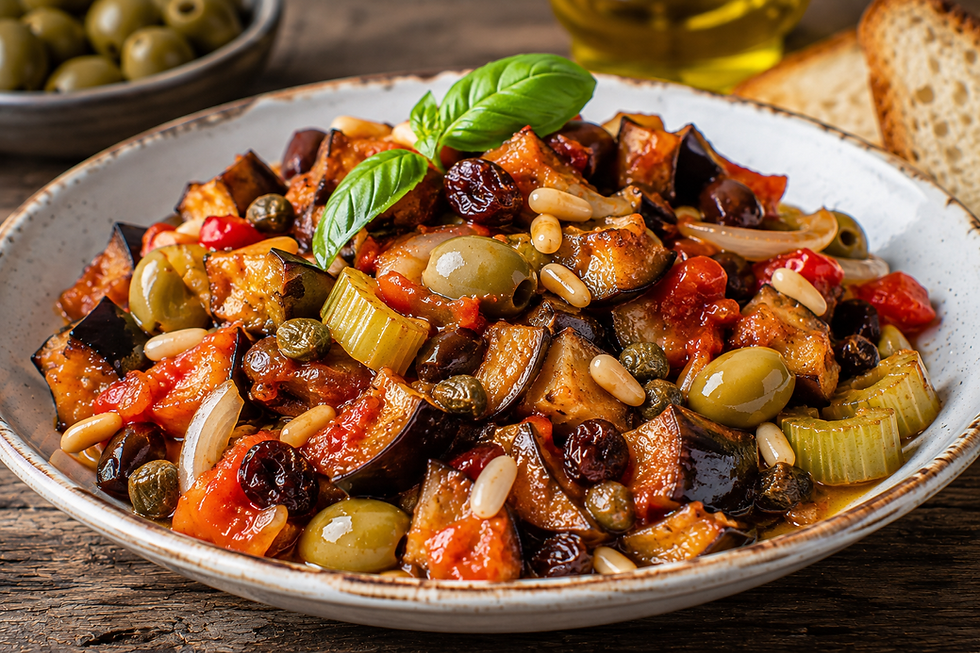
This is caponata cooked the way a modern Sicilian kitchen cooks it: every component cooked on its own, the dish assembled only at the end. The eggplant goes into a hot oven or an air fryer instead of a deep pan of oil. The celery is blanched and shocked. The pepper is roasted and peeled. The onion is sweated slowly. Nothing is stewed together into a single soft mass.
The sweet and sour is weighed rather than judged. Vinegar and sugar are measured to the gram, tasted as a syrup before they meet the vegetables, and adjusted in the pan rather than in the jar. That removes the main flaw of homemade caponata, an agrodolce that swings from batch to batch and usually lands too sharp on day one and too sweet on day three.
The result eats differently. Each vegetable keeps its colour, shape and bite, the dressing coats rather than soaks, and the dish is served at a controlled temperature. It is the flavour every Sicilian recognises, delivered with the edges still on it.
Yield: 6 side dish servings. Prep: 45 minutes. Cook: 50 minutes. Rest: 2 hours minimum. Total: about 4 hours including the rest. Difficulty: intermediate. Course: contorno or antipasto. Region: Sicily.
The Story
Caponata changed more in the last forty years than in the two centuries before them, and the change happened in restaurant kitchens rather than in homes. The dish Sicilian families still make in August, in a wide pan, in volume, destined for jars and for the table over the following week, is a preserve first and a course second. It is cooked long, dressed hard and left to settle, because that is what keeps it. Its softness is a function of storage.
Professional kitchens on the island began pulling that logic apart in the 1980s and 1990s, when Sicilian cooking started being plated rather than served from a communal dish. Once caponata had to arrive on an individual plate, the things that made it a good preserve made it a poor course: uniform texture, a single colour, a dressing that had flooded everything, and a temperature out of cold storage that muted every aroma. Cooking the components separately was the obvious answer, and it is now standard from Palermo to Ragusa.
The eggplant is where the argument still runs. Sicilian eggplant, the long violetta and the round tunisina, grows on the coastal plains of Pachino, Licata and the Piana di Catania, and traditionally it is deep fried in abundant oil, which is why classic caponata is heavy. Roasting it at high heat in a thin film of oil gives the same collapse and sweetness with a fraction of the fat, and cubes that hold their shape. Purists object. The cooks doing it answer that they are still frying, with hot air instead of hot oil.
Ingredients
For the eggplant
Eggplant, long violetta or globe, 2 lb (900 g)
Fine sea salt, 2 tsp (12 g), for drawing water
Extra virgin olive oil, 3 tbsp (45 ml)
For the vegetables
Celery, inner pale stalks only, 7 oz (200 g)
Red bell pepper, 1 large, about 7 oz (200 g)
White onion, thinly sliced, 7 oz (200 g)
Extra virgin olive oil, 3 tbsp (45 ml)
Cherry tomatoes, halved, 7 oz (200 g)
Fine sea salt, 1/2 tsp (3 g)
For the agrodolce
White wine vinegar, 1/3 cup (80 ml)
Granulated sugar, 1 3/4 oz (50 g)
Water, 2 tbsp (30 ml)
For finishing
Salted capers, rinsed, 1 1/2 tbsp (20 g)
Green olives, Nocellara del Belice, pitted and torn, 2 1/2 oz (70 g)
Pine nuts, toasted, 1 1/2 tbsp (20 g)
Golden raisins, soaked in warm water, 1 1/2 tbsp (20 g)
Basil leaves, torn, 10
Extra virgin olive oil, 1 tbsp (15 ml)
Toasted almonds, chopped, 1 tbsp, optional
Preparation
Step 1
Salt and drain the eggplant. Cut it into even cubes of about 3/4 inch (2 cm). Toss with the 2 teaspoons of salt in a colander and leave 30 minutes over a bowl. Rinse quickly and dry thoroughly in a towel, squeezing gently. This draws out water and collapses the sponge structure so the cubes take up far less oil, which matters as much in the oven as in a fryer.
Step 2
Roast the eggplant. Heat the oven to 425°F (220°C) or an air fryer to 400°F (205°C). Toss the dried cubes with the 3 tablespoons of olive oil until every face is coated, spread them in one layer with space between them and roast 22 to 26 minutes, turning once. They are ready when deep golden at the edges and completely soft inside. Use two trays rather than crowding one.
Step 3
Blanch the celery. Peel the strings from the pale stalks and cut them into 1/2 inch (1 cm) pieces. Boil 3 minutes in well salted water, then drain into iced water. Blanching and shocking sets the green, kills the raw astringency and leaves the celery snapping instead of soft, which is the clearest difference between this and a stewed caponata.
Step 4
Roast and peel the pepper. Char it over a flame or under a broiler until black on all sides, then seal it in a covered bowl for 10 minutes. Rub the skin away, remove seeds and ribs, and cut the flesh into 1/2 inch (1 cm) squares. Unpeeled pepper skin rolls into tough curls once the acid hits it and never softens again.
Step 5
Sweat the onion. Warm the 3 tablespoons of olive oil in a wide pan over low heat and cook the onion 12 to 15 minutes, stirring often, until soft and translucent but not coloured. Browning pushes the dish toward a caramelised flavour that competes with the agrodolce. Add the cherry tomatoes and the 1/2 teaspoon of salt, raise the heat and cook 6 minutes until they collapse and the pan is nearly dry.
Step 6
Build and taste the agrodolce. Warm the vinegar, sugar and water in a small saucepan until the sugar dissolves, then simmer 2 minutes to a light syrup. Taste it hot, on a spoon. It must be sharply sweet with the vinegar clearly ahead, because the vegetables blunt it considerably. If it tastes balanced in the pan it will taste flatly sweet on the plate. Adjust by the teaspoon, not by eye.
Step 7
Combine over heat. Add the roasted eggplant, the drained celery, the pepper, the capers, the olives and the drained raisins to the onion and tomato pan and fold gently. Pour the syrup over, raise the heat and cook 3 to 4 minutes, folding twice, until the liquid reduces to a glossy coating and no longer pools. Do not stir hard: the eggplant is fragile now and stirring turns it to purée.
Step 8
Rest, then correct. Off the heat, scatter over the pine nuts and half the basil, cool to room temperature uncovered, then refrigerate at least 2 hours and ideally overnight. Before serving, taste it cold and again at room temperature, because acidity reads much weaker cold. Correct with a few drops of vinegar or a pinch of sugar, then finish with the remaining basil, the last olive oil and the almonds.
Plating
Serve this at 64°F (18°C), not cold. Taking it out of the refrigerator 40 minutes before service does more for the finished dish than anything else, because cold suppresses both the vinegar and the aromatics, and a caponata eaten straight from the fridge tastes of almost nothing but sugar.
Plate it in a shallow bowl or a wide low ring rather than as a mound on a flat plate, and keep the portion modest, around 4 oz (115 g), since it is intense. Build height by spooning rather than pressing, so the cubes stay visible and the plate reads as separate vegetables held together rather than as a paste.
Finish at the table, not in the kitchen. Tear the basil over at the last second, since torn basil browns within minutes of meeting acid, and add the almonds, the final drops of olive oil and a few whole capers on top so the first bite carries them. Served as an antipasto rather than a contorno, a slice of grilled bread goes underneath, never beside.
Professional Technique
Separate cookery is the whole method. Celery, pepper, onion and eggplant have different water contents, cell wall structures and ideal cooking times, and a single pan can only ever be correct for one of them. Cooking each to its own endpoint and combining for the last four minutes means the celery is still crisp when the eggplant is fully collapsed. That combining stage is not cooking, it is dressing, and it is timed to reduce the syrup.
Oven roasting replaces deep frying without losing its effect. Frying works on eggplant because the water inside flashes to steam and blows the spongy tissue open while the outside sets. A 425°F (220°C) oven with a thin coat of oil on every face does the same thing more slowly, provided the cubes are dried and given space. The rule is contact: oil on every surface, no crowding, one turn halfway. Oil poured over a crowded tray gives a pale, steamed, greasy result worse than frying.
Weighing the agrodolce makes the dish repeatable. The working ratio is 50 grams of sugar to 80 millilitres of vinegar, made as a syrup and reduced separately so its balance can be judged before it disappears into the vegetables. Traditional caponata adds vinegar and sugar straight to the pan and corrects by taste, which works for a cook who has made it three hundred times and fails for everyone else.
Texture and Moisture Control
Eggplant is mostly water held in an open cellular structure, and that structure is what makes it absorb oil like a sponge. Salting for 30 minutes pulls out much of that water and partially collapses the cells before any heat arrives, so the cubes take up less oil and hold their shape through the final fold. Drying after rinsing matters just as much: a wet cube steams and never reaches the golden stage.
The finished dish has to coat, not swim. The tomatoes are cooked almost dry before anything joins them, and the agrodolce goes in as a reduced syrup, so the final four minutes concentrate a glaze instead of boiling a liquid. If there is a pool in the base of the pan at the end, keep it over the heat a minute longer, folding gently, until the liquid clings.
Temperature governs how all of it is perceived. Chilling firms the eggplant and dulls the acidity, which is why caponata tastes sweeter cold than it did warm, and why correcting the seasoning while the pan is hot gives a dish that lands flat the next day. Let it reach 64°F (18°C) and taste again. Resting overnight is not optional either: the capers, olives and raisins need that time to give their flavour into the dressing.
Professional Mise en Place
This dish is almost entirely mise en place, since it is better made a day ahead and needs nothing at service but tempering and a garnish. Salt the eggplant first, then handle the pepper and celery while it drains.
Equipment and tools
Two sheet pans, or an air fryer basket, for the eggplant in a single layer
Wide low sided saute pan for the onion and the final fold
Small saucepan and a digital scale for the agrodolce
Colander, bowl of iced water and a clean towel
Prepared ahead
Whole caponata made 1 day ahead, which improves it measurably
Pepper charred, peeled and diced up to 2 days ahead
Celery blanched, shocked and refrigerated up to 2 days ahead
Pine nuts and almonds toasted and stored airtight at room temperature
Service setup
Caponata out of the refrigerator 40 minutes before service
Basil kept whole and torn only at the moment of plating
Vinegar and sugar within reach for the final correction
Plates at room temperature, never warmed and never chilled
Chef Tips
Use only the pale inner celery. The dark outer stalks are stringy and aggressively bitter, and no amount of blanching fixes either problem. One head gives roughly the 7 oz (200 g) of usable heart this recipe needs, and the rest goes into stock.
Cut every vegetable to a considered size. A 3/4 inch (2 cm) eggplant cube against a 1/2 inch (1 cm) celery and pepper dice is the proportion that works, since eggplant shrinks by about a third in the oven and the pieces finish matched on the plate.
If the agrodolce lands too sharp after resting, do not add sugar straight to the dish. Warm a tablespoon of the caponata liquid with a pinch of sugar until it dissolves, then fold it back in. Dry sugar stirred into cold caponata stays granular and sits in one corner of the bowl.
Make double and jar half. Packed hot into sterilised jars, covered with a film of olive oil and refrigerated, caponata keeps two weeks and improves for the first five days. It is one of the few dishes where leftovers outrank the first service.
Common Mistakes
Cooking everything in one pan. The fastest route to uniform mush, because celery needs 3 minutes and eggplant needs 25.
Crowding the eggplant tray. Cubes touching each other trap steam and come out pale, floppy and oily. Use two trays.
Skipping the salting. Unsalted eggplant absorbs roughly twice the oil and disintegrates during the final fold.
Judging the agrodolce in the pan. It must taste too sharp on the spoon, because the vegetables blunt it and chilling blunts it again.
Leaving the pepper skin on. Once acid hits it, unpeeled skin curls into tough transparent strips that never soften.
Serving it straight from the refrigerator. Cold suppresses the vinegar and the basil and leaves only sugar. Forty minutes at room temperature transforms the same bowl.
Wine Pairing
Etna Bianco DOC: Carricante grown on volcanic soil at altitude gives the highest natural acidity of any Sicilian white, and acidity is what an agrodolce needs, since a soft wine tastes flabby the moment vinegar arrives. Its flinty, saline character stands against the capers and olives, and the bitterness on the finish meets the celery rather than fighting it.
Grillo Sicilia DOC: The island workhorse and the most forgiving match here. A modern stainless Grillo brings grapefruit, white peach and a herbal edge with enough body to handle the roasted eggplant, and its faint saltiness lines up with the olives. Serve it at 50°F (10°C), cold enough to keep the acidity sharp against the sugar in the dressing.
Cerasuolo di Vittoria DOCG: Sicily's only DOCG and the classic red answer to caponata. The Frappato in the blend gives bright red cherry and low tannin, the Nero d'Avola gives the structure, and served cool at 57°F (14°C) the combination handles the vinegar without turning metallic the way a tannic red would. It also picks up the sweetness of the raisins directly.
Etna Rosso DOC: Nerello Mascalese from the volcano is pale, high in acid and firmly mineral, closer to a mountain red than a southern one. That acidity lets it survive the agrodolce, and its dried herb and sour cherry work with the tomato and basil. Choose a young bottling, since oak and age push it toward flavours the dish does not want.
Faro DOC: A small production red from the hills above Messina, built on the same Nerello grapes as Etna but rounder and more savoury. It has the acidity to take the vinegar and just enough tannin to cut through the oil in the roasted eggplant, and its saline, almost briny finish is a direct echo of the capers. Serve it lightly chilled.
Storage & Reheating
Caponata is one of the rare dishes better stored than fresh. Refrigerated in an airtight glass container under a thin film of olive oil, it keeps 5 days and peaks on days two and three, once the capers, olives and raisins have given their flavour into the dressing. Glass matters: the acidity reacts with bare metal and picks up a dull taste within a day.
It is not reheated. The dish is served cold or at room temperature by definition, and warming it softens the celery and pepper the whole method was built to keep crisp. Take out what you need 40 minutes before serving. If you want it hot, use it as a garnish for roasted fish rather than heating the bowl.
For longer storage, pack it hot into sterilised jars, seal and process in a boiling water bath for 25 minutes, which gives several months of shelf life, though the texture softens into a traditional preserve rather than this dish. Do not freeze it: eggplant cells rupture on thawing and the result is watery and structureless.
Nutrition
Per serving, based on 6 side dish portions:
Calories: 215 kcal
Total Fat: 13 g
Saturated Fat: 1.8 g
Trans Fat: 0 g
Unsaturated Fat: 11 g
Cholesterol: 0 mg
Sodium: 480 mg
Total Carbohydrates: 23 g
Fiber: 6 g
Total Sugars: 15 g
Added Sugars: 8 g
Protein: 3 g
Lactose: 0 g
Principal micronutrients: vitamin C, vitamin A, vitamin K, potassium, manganese, folate, vitamin E
These figures are estimates. Roasting rather than deep frying the eggplant cuts the fat of a classic caponata by roughly half, and sodium depends on how thoroughly the capers and olives are rinsed.



Comments