
Sicilian Sweet and Sour Eggplant | Caponata Siciliana
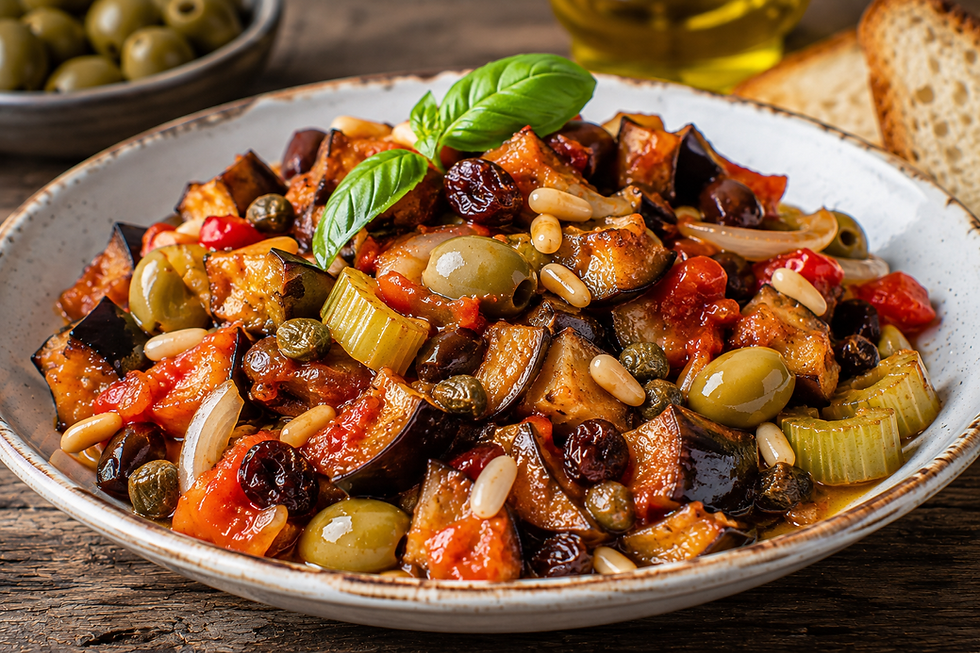
Caponata is judged on one thing, and it is not the eggplant. It is the agrodolce: the ratio of vinegar to sugar, how far the two are reduced together, and whether the result lands as a bright sweet and sour glaze or a sour stew with sugar stirred in.
This is the sweet and sour version, built around that balance rather than a long ingredient list. The vinegar and the sugar are reduced into a syrup that coats the vegetables, and a second sweetness comes from red onion cooked slowly until it caramelizes. There are no raisins and no pine nuts: they push the sugar past the point where the cook can still control it.
Every component is cooked separately and combined only at the end, which is the traditional method, and the dish then rests overnight. Caponata made in the morning and served at lunch is a much worse dish than the same pan eaten the next day.
Yield: 6 servings. Prep: 40 minutes. Cook: 50 minutes. Rest: 12 hours minimum. Difficulty: intermediate. Course: antipasto or contorno. Region: Sicily, the agrodolce tradition.
The Story
The name is still argued about. The most repeated explanation traces it to capone, the Sicilian word for the lampuga, a firm fleshed fish served in sweet and sour sauce on wealthy tables; when the sauce reached kitchens that could not afford the fish, eggplant took its place. Another derivation points to the Latin cauponae, the portside taverns where sailors ate cheap pickled vegetables, and a third to the Catalan caponada, from the centuries when Sicily was ruled from Aragon.
The agrodolce is older and better documented. Sugar cane arrived with the Arabs in the ninth century and was milled around Palermo for centuries, while vinegar had been a Mediterranean staple since Roman times. Putting the two together was first a way of keeping food: vinegar, sugar and oil bought cooked vegetables several days of life in a hot climate with no refrigeration, which is why caponata was carried to the fields and eaten cold. The flavour was a consequence of the method.
There is no single caponata. Sicilian cookery writers have counted dozens of documented versions, some with peppers, some with potatoes, some finished with almonds or toasted breadcrumbs. The best known variant is the Catanese one, which adds red and yellow peppers and leans less sweet. What holds them together is not the vegetable list but the vinegar and the sugar.
Ingredients
For the eggplant
Globe eggplants, firm and glossy, 2 lb (900 g)
Coarse sea salt, for purging, 2 tbsp (30 g)
Sunflower oil or mild olive oil, for frying, 3 cups (700 ml)
For the vegetable base
Celery, inner pale stalks only, 6 oz (170 g)
Red onions, medium, thinly sliced, 10 oz (285 g)
Extra virgin olive oil, 1/4 cup (60 ml)
Tomato passata, 3/4 cup (180 ml)
Green olives, Nocellara if possible, pitted and halved, 3/4 cup (110 g)
Capers packed in salt, rinsed twice, 3 tbsp (30 g)
For the agrodolce
White wine vinegar, 1/3 cup (80 ml)
Granulated sugar, 3 tbsp (38 g)
Fine sea salt, 1/2 tsp (3 g)
Freshly ground black pepper, to taste
For finishing
Almonds, toasted and coarsely chopped, 1/4 cup (30 g)
Basil leaves, torn at the last moment, 10
Extra virgin olive oil, 1 tbsp (15 ml)
Red and yellow peppers, 2, only for the Catania variant
Preparation
Salt and purge the eggplant
Trim the eggplants and cut them into cubes of about 1 in (2.5 cm), even so they fry at the same rate. Layer them in a colander with the coarse salt, set a plate and a weight on top and leave them for 45 minutes over the sink. Rinse briefly, squeeze gently in a clean towel and dry properly. Wet eggplant lowers the oil temperature and absorbs far more fat.
Fry the eggplant in small batches
Heat the frying oil to 340°F (170°C) and check it with a thermometer. Fry the cubes in four or five small batches, never crowding the pan, for 3 to 4 minutes each until deep gold and soft at the centre. Lift them onto a rack rather than paper and let the oil recover between batches.
Blanch and sweat the celery
Peel the coarse strings off the pale inner stalks and slice them on a slight angle. Drop them into salted boiling water for 2 minutes, then into cold water to stop the cooking. Drain well and sweat them in a wide pan with a spoonful of olive oil for 4 minutes, until they lose their raw edge but still snap. Celery is the crunch in a caponata and the first thing lost to overcooking.
Caramelize the red onion
In the same pan add the rest of the olive oil and the sliced red onion with a pinch of salt. Cook over medium low heat for 15 to 18 minutes, stirring often, until the slices are limp and visibly browned at the edges. You are not softening them, you are caramelizing them: this is the sweetness the sugar later joins rather than replaces. Rushing over high heat gives scorched edges and raw sharpness underneath.
Cook down the tomato, olives and capers
Add the passata to the onions and cook for 8 to 10 minutes until it darkens and pulls away from the side of the pan. Stir in the halved olives and the rinsed capers and give them 2 minutes more. Taste for salt cautiously, because both are salty and the dish reduces further. The tomato is a binder, not the main flavour.
Reduce the vinegar and sugar
In a small saucepan combine the vinegar and the sugar and bring them to a simmer, swirling until the sugar dissolves completely. Let it reduce by about a third, until it is glossy and coats the back of a spoon, which takes 3 to 4 minutes. Keep the heat moderate: vinegar driven hard turns harsh and flat. Reserve a teaspoon of raw vinegar for the end.
Fold everything together
Return the celery to the pan with the tomato base, pour in the reduced agrodolce and stir once. Add the fried eggplant last and fold gently with a spatula so the cubes stay whole. Cook uncovered for 4 to 5 minutes until a spoon dragged across the pan leaves a trail that closes slowly. Off the heat, add the reserved raw vinegar and grind in black pepper.
Rest overnight, then taste
Spread the caponata in a wide dish so it cools quickly, cover it at room temperature and refrigerate it for at least 12 hours. Do not adjust the seasoning before this rest. A hot caponata always tastes sharper than the cold one it becomes, because much of the acetic acid leaves the pan as it cools and the sugar reads more clearly.
Plating
Take the caponata out of the refrigerator 60 to 90 minutes before service. Cold flattens the olive oil and leaves the acid exposed, so a caponata eaten straight from the fridge tastes of nothing but sourness. Room temperature is part of the recipe.
Serve it in a shallow bowl or on a flat plate, spooned rather than shaped, in a loose mound that lets the pieces stay visible. Caponata should look like separate vegetables that agree with each other, not a purée. Add the almonds and the basil only as it goes out, because both soften within minutes of touching the vinegar.
Finish with a thread of raw olive oil. It belongs on the table as an antipasto with bread, or beside grilled fish, roast lamb or swordfish, where it does the work of both a sauce and a vegetable.
Professional Technique
The technical centre of this dish is the agrodolce ratio. The quantities here give roughly two parts vinegar to one part sugar by volume, and the working range runs from two to three parts vinegar. Below two the dish reads as a sweet chutney; above three the vinegar stops being a seasoning and becomes the flavour. Fix that ratio first and treat everything else as secondary.
Reducing the two together rather than adding them separately is what turns them into a glaze. Sugar dissolved in vinegar and simmered gains body and coats the eggplant instead of running to the bottom of the pan. It also drives off part of the sharpest aromatic fraction while keeping the acidity, which is why a reduced agrodolce tastes rounder than the same quantities added raw.
The choice of vinegar matters more than most recipes admit. White wine vinegar at around six per cent acidity is the right tool: clean, neutral and consistent, so the eggplant and the tomato stay visible behind it. Red wine vinegar is heavier and stains the dish a dull purple. Apple cider vinegar adds a fruitiness that fights the olives. Balsamic is wrong in every direction.
Texture and Moisture Control
Eggplant is mostly air. Its flesh has an open cell structure that behaves like a sponge, which is why an untreated cube swallows an astonishing amount of oil in the first thirty seconds. Salting collapses part of that structure and pulls out water, so the cube that goes into the pan is denser and takes up far less fat. The oil does the rest: at 340°F (170°C) the surface sets immediately and seals, while at 280°F (140°C) the same cube sits and drinks.
The other vegetables are managed for contrast rather than softness. The celery is blanched and barely sweated so it keeps an audible snap against the yielding eggplant. The onion is caramelized but not collapsed, so it still reads as onion. If everything arrives at the same texture the caponata turns into a relish, which is why the traditional method cooks the components apart.
Moisture at the end is judged by the trail test. Drag a spoon across the bottom of the pan: the gap should close over two or three seconds. If it closes instantly there is too much liquid and the dish will pool on the plate; if it does not close at all the agrodolce has gone too far and will set sticky once cold. Caponata tightens in the refrigerator, so stop while it still looks marginally loose.
Professional Mise en Place
Caponata suits a professional kitchen because it has to be made in advance. Nothing here is done to order.
Equipment and tools
Wide heavy sauté pan, at least 12 in (30 cm)
Deep pan for frying plus a probe thermometer
Colander, plate and weight for purging the eggplant
Cooling rack over a tray, used instead of kitchen paper
Small saucepan for the agrodolce, flexible spatula for folding
Glass or ceramic storage container, never aluminium
Prepared ahead
Eggplant salted, rinsed and dried, up to 3 hours ahead
Celery blanched and refreshed, up to 1 day ahead, kept refrigerated
Agrodolce reduced and cooled in a sealed jar, up to 5 days ahead
Almonds toasted and chopped, kept dry and separate
The finished caponata made 1 to 2 days before it is served
Service setup
Caponata out of the refrigerator 60 to 90 minutes before service
Almonds and basil held separately and added only on the plate
Good olive oil in a pouring bottle at the pass
Bread or crostini ready if it goes out as an antipasto
Chef Tips
Read the acidity on the vinegar label. Italian white wine vinegars run from five to seven and a half per cent, a spread wide enough to change the dish. If yours is at the strong end start with a quarter cup and work up; if it is mild, a full third of a cup is right.
If it is too sour the day after, do not add tomato, which dilutes everything and muddies the colour. Dissolve a teaspoon of sugar in a tablespoon of warm water, fold it through and give the dish another hour to settle. If it is too sweet, a teaspoon of raw vinegar folded in cold corrects it faster than anything done in a hot pan.
For the Catania variant, cut two red and yellow peppers into wide strips, fry them separately until the skin blisters, then fold them in with the eggplant. Cut the sugar back to two tablespoons, because peppers bring their own sweetness and the balance shifts without anyone touching the vinegar.
Buy capers packed in salt rather than brine and rinse them twice. Brined capers carry vinegar of their own, which lands on top of a dish that is already balanced, and they go soft where salted ones stay firm.
Common Mistakes
Cooking everything in one pan. The eggplant steams instead of frying, the celery goes limp and the onion never caramelizes, and the result is a uniform soft mass. Each component is cooked apart and they meet only in the last five minutes.
Frying in oil that is not hot enough. Below about 320°F (160°C) eggplant absorbs oil rather than sealing against it, and a greasy caponata cannot be rescued later. Use a thermometer, fry in small batches, and let the oil recover between them.
Skipping the salting. Purging draws out water and collapses part of the sponge, which is what stops the cubes soaking up fat. Unsalted eggplant also carries more bitterness. Forty five minutes under a weight is not a step to shorten.
Adjusting the agrodolce while it is still hot. A hot caponata tastes far sharper than the cold dish it becomes, and cooks who correct in the pan almost always oversweeten it. Season once, rest overnight, adjust the following day.
Using balsamic vinegar. Its sweetness and caramel character bury the clean acidity the dish is built on and darken the colour to a muddy brown. Caponata is made with white wine vinegar and sugar kept separate, so the cook controls both.
Serving it cold or the same day. Both faults produce the same complaint, that the caponata is simply sour. Cold mutes the oil and the sweetness while leaving the acid untouched, and a dish eaten within hours has not settled.
Wine Pairing
Vinegar is the difficulty. A wine with less acidity than the dish tastes flat and slightly sweet beside it, so everything here needs bright natural acidity and no residual sugar. Sicily supplies the answers, and a red has to be light and served cool to survive the agrodolce.
Grillo Sicilia DOC: The straightforward choice, and the one most often poured with caponata on the island. Grillo has real weight for a white, with citrus peel, a herbal edge and a saline finish that echoes the olives and the capers. Its acidity is high enough to sit level with the vinegar instead of being flattened by it.
Etna Bianco DOC: Carricante grown on volcanic soil, and the most precise match here. Austere, almost stony, with a lime and green apple attack and a finish that stays dry and mineral, which is what a sweet and sour dish needs: no fruit sweetness to add to the sugar already there. The texture also carries the fried eggplant.
Cerasuolo di Vittoria DOCG: The Nero d'Avola and Frappato blend from the south east, and the red to reach for first. Frappato brings red cherry, light tannin and a floral lift, while Nero d'Avola adds body to meet the tomato. Serve it at 57°F (14°C) and the fruit stands up to the agrodolce without a tannic clash.
Etna Rosso DOC: Nerello Mascalese, pale and high in acidity, with fine tannin and a smoky red fruit character. That acidity is why it works where fuller Sicilian reds fail: a wine has to match the vinegar rather than be softer than it. It is also the better choice if the caponata sits beside grilled fish or lamb.
Faro DOC: A rarity from the hills above Messina, built on Nerello Mascalese and Nerello Cappuccio. It is lighter than Etna Rosso and more herbal, with a dried Mediterranean scrub aroma that runs alongside the basil and the capers. Slightly chilled, its gentle tannin leaves the sweet and sour balance untouched.
Storage & Reheating
This is a dish that improves with keeping, which is why it was invented. Between 24 and 48 hours the vinegar finishes working into the eggplant and the separate components start to taste like one thing. It is at its best on the second day and still excellent on the third.
Store it in glass or ceramic with a tight lid, never in aluminium or bare metal, because the vinegar reacts and picks up a metallic taste within hours. It keeps refrigerated for 5 days. Take out only what will be eaten and return the rest to the cold, since the oil on the surface is part of what preserves it.
Caponata freezes for up to 2 months, although the eggplant softens on thawing, so freeze it only if the alternative is throwing it away. Thaw it overnight in the refrigerator, never in a microwave. There is no reheating step: the dish is served at room temperature, so take it out 60 to 90 minutes ahead.
Nutrition
Per serving, based on 6 servings as an antipasto or contorno:
Calories: 265 kcal
Total Fat: 19 g
Saturated Fat: 2.5 g
Trans Fat: 0 g
Unsaturated Fat: 16 g
Cholesterol: 0 mg
Sodium: 610 mg
Total Carbohydrates: 21 g
Fiber: 6 g
Total Sugars: 12 g
Added Sugars: 6 g
Protein: 3 g
Lactose: 0 g
Principal micronutrients: potassium, vitamin C, vitamin K, folate, manganese
These figures are estimates. Fat is the most variable line, because the oil the eggplant retains depends on how well it was purged and how hot the oil was held. Sodium depends on how thoroughly the capers were rinsed. The dish is naturally vegan.


Comments