
Traditional Sicilian Caponata | Caponata Siciliana Tradizionale

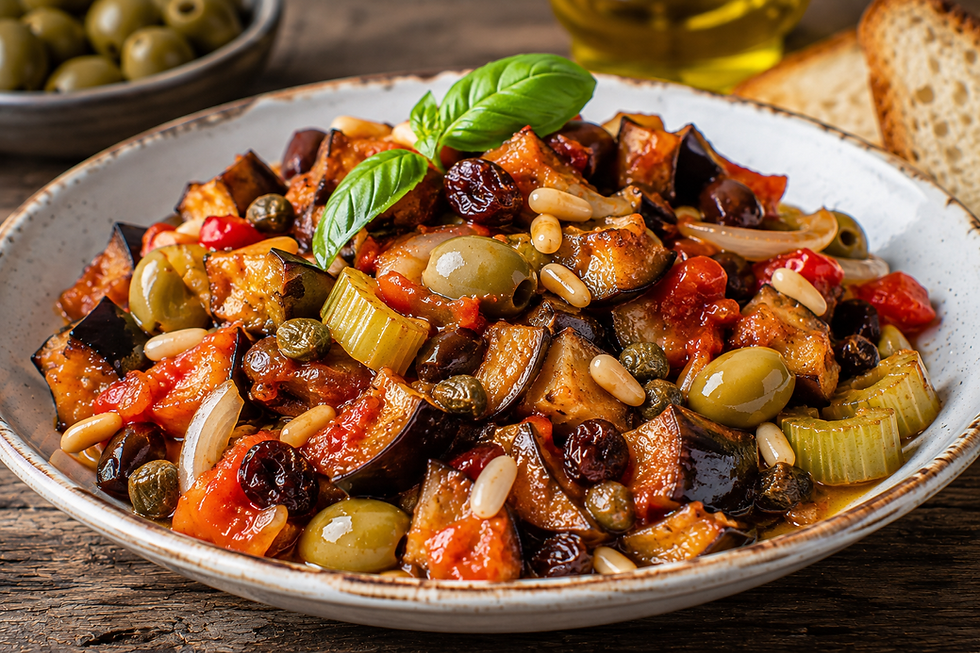
This is the caponata of Palermo, made the way it has been made in the city for two centuries. Eggplant fried in deep oil, celery blanched, onion cooked slowly to sweetness, green olives, salted capers, a little tomato, and an agrodolce of wine vinegar and sugar poured into the hot pan and driven off over the heat. Nothing else.
What separates it from every modern reading of the dish is the rest. A caponata eaten the day it is made tastes of its parts. Left covered for at least twelve hours, the vinegar loses its edge, the sugar stops reading as sweetness and the eggplant absorbs the sauce until the whole tastes of one thing rather than eight. It is then served at room temperature, never hot and never chilled.
Yield: 6 servings as a contorno or antipasto. Prep: 40 minutes. Salting: 1 hour. Cook: 50 minutes. Rest: at least 12 hours. Difficulty: intermediate. Course: contorno and antipasto. Region: Sicily, Palermo.
The Story
The name comes from the sea. Capone is the Sicilian word for the lampuga, the fish English speakers call dolphinfish, and on noble tables it was served in a sweet and sour sauce of vinegar, sugar and onion. The fish was expensive and the sauce was not, so kitchens without money kept the sauce and put fried eggplant in place of the capone. Two other origins are argued: the Catalan caponada brought by Aragonese rule, and the caupone, the harbour taverns where sailors ate.
The dish was then reworked by the monsu, the French trained cooks employed in Sicilian aristocratic households through the eighteenth and nineteenth centuries, whose title is the Sicilian pronunciation of monsieur. In their kitchens caponata acquired toasted almonds, pine nuts, raisins, sometimes bottarga or lobster, and in a few houses bitter chocolate. Underneath, the method is older and Arab: eggplant reached Sicily with the Arab conquest from the ninth century, and the balance of vinegar against sugar rests on the cane sugar those same rulers planted.
Every Sicilian province then wrote its own version, and scholars have documented dozens. Catania adds sweet peppers. Trapani and Agrigento finish with toasted almonds. Some inland kitchens still use cocoa. The Palermo version recorded here is the plainest and the hardest to get right, because there is nothing in it to hide behind. It also keeps the two rules the others often drop: the long rest, and service at room temperature.
Ingredients
For the eggplant
Globe eggplants, firm and glossy, 2 1/4 lb (1 kg)
Coarse sea salt, for purging, 2 tbsp (30 g)
Sunflower or peanut oil, for deep frying, about 4 cups (950 ml)
For the vegetable base
Inner celery stalks, pale and tender, 9 oz (250 g)
Yellow onions, thinly sliced, 10 oz (280 g)
Extra virgin olive oil, 1/4 cup (60 ml)
Fine sea salt, 1/2 tsp (3 g)
For the sauce
Tomato passata, 1 cup (240 ml)
Green olives, Nocellara del Belice, pitted and halved, 3/4 cup (120 g)
Salted capers from Pantelleria, 3 tbsp (30 g)
Freshly ground black pepper, to taste
For the agrodolce
White wine vinegar, 1/3 cup (80 ml)
Granulated sugar, 3 tbsp (38 g)
For finishing
Basil leaves, torn at the last moment, 8 to 10
Extra virgin olive oil, 2 tbsp (30 ml)
Preparation
Salting and draining the eggplant
Cut the eggplants into cubes of about 1 inch (2.5 cm), leaving the skin on, since it holds them together through frying and the long rest. Layer them in a colander with the coarse salt, set a plate and a weight on top and leave for 1 hour over a bowl. A good deal of brown liquid will run out. Rinse the cubes quickly and dry them thoroughly in a towel, since surface water spits in the oil and steams them instead of frying them.
Frying the eggplant in deep oil
Heat the oil in a deep pan to 340°F (170°C). Fry the cubes in three or four batches, never crowding the pan, for about 4 minutes each, until deep golden and no longer squeaking when pressed. Lift them out with a spider onto paper. This step cannot be shortened. Eggplant cooked in a small amount of oil absorbs it and stays raw in the middle, while eggplant fried in deep hot oil sets a skin that keeps the oil out.
Blanching the celery
String the celery with a peeler and cut it into pieces of about 1/2 inch (1 cm). Drop them into boiling salted water for 3 minutes, then lift them straight into iced water. This removes the raw green bitterness that would otherwise sit on top of the dish and fixes the colour against the dark eggplant. Drain well. The celery must still be crisp, since it cooks again in the sauce.
Rinsing the capers and preparing the olives
Capers from Pantelleria come packed in coarse sea salt and must be rinsed properly. Soak them in cold water for 10 minutes, rub them between your fingers, then rinse again and taste one. It should be floral and sharp, not simply salty. Pit the olives under the flat of a knife and halve them rather than chopping, so they keep their shape through the rest.
Stewing the onion
Warm the olive oil in a wide heavy pan over medium low heat, add the sliced onion with the fine salt and cook for about 12 minutes, stirring, until completely soft and translucent. It should not colour. The onion carries a large part of the sweetness in a traditional caponata, and that sweetness has to come from slow cooking rather than from extra sugar later.
Building the tomato sauce
Add the drained celery to the onion and cook for 5 minutes so it takes on the oil. Pour in the passata, season with black pepper and simmer gently for 10 minutes, until the sauce has thickened and lost its raw smell. Stir in the olives and the rinsed capers and give them 2 more minutes. Do not salt again yet: capers and olives are both salty and the balance can only be judged at the end.
Making the agrodolce and driving off the vinegar
Dissolve the sugar in the vinegar, then pour the mixture over the hot sauce and raise the heat. Let it bubble hard for 2 to 3 minutes, without stirring much, until the sharp smell in the steam softens and the liquid reduces to a glaze around the vegetables. This is the moment the dish is made or lost. Vinegar that is not evaporated stays acrid for days.
Folding in the eggplant and the long rest
Take the pan off the heat and fold in the fried eggplant with a wooden spoon, lifting rather than stirring, so the cubes stay whole. Taste and correct with a pinch of salt or sugar. Transfer to a wide dish, level the surface, cover and leave at cool room temperature for at least 12 hours, or refrigerate overnight. The caponata is not finished until that rest is over.
Plating
Serve caponata at room temperature, around 68°F (20°C). Cold from the refrigerator the oil is thick and the vinegar reads as sour, and hot from a pan the balance collapses. Take it out an hour before the meal and stir it once.
In Palermo it is brought out in a shallow terracotta or white dish and spooned by the guests, and that is still the best way to serve it as an antipasto with bread. On a plate as a contorno, use a ring or two spoons to make a low mound rather than spreading it flat, so the cubes stay visible.
Tear the basil over it at the last second, since basil left on top goes black in the vinegar within the hour. Add the finishing olive oil in a thin thread. Nothing else belongs on it. Alongside, serve good bread, grilled swordfish, roast lamb or a piece of hard Sicilian cheese.
Professional Technique
The technical heart of this dish is that the vegetables are cooked separately and only meet at the end. Eggplant is fried, celery is blanched, onion is stewed, and each is taken to its own correct point before it enters the pan. Cook them together and the eggplant, which has the loosest cell structure, collapses long before the celery has lost its raw edge. Keeping them apart is what leaves four distinct textures after a day of resting.
The second technique is the deep fry, which people skip and should not. Eggplant is largely air held in a spongy matrix, and in shallow oil that sponge draws the oil inward and the cubes turn greasy. At 340°F (170°C) in enough oil to float them, the surface water flashes to steam and pushes outward, keeping the oil out and setting a firm skin. That skin stops the cubes disintegrating during twelve hours in hot sauce.
The third is the evaporation of the agrodolce. Vinegar stirred in at the end as a dressing keeps its volatile acetic sharpness and dominates everything. Poured into a hot pan and boiled for 2 to 3 minutes, much of that volatile acid leaves with the steam while the sugar caramelises slightly against the pan. What remains is the rounded sweet and sour flavour that defines the dish.
Texture and Moisture Control
Salting the eggplant is the first control and it does more than season. Drawing out the vegetation water collapses part of the sponge structure, leaving less space for oil to enter, and it removes the bitter compounds concentrated in that liquid. Modern varieties are less bitter than they once were, but the moisture removal still matters.
The finished dish should be moist and glossy, never wet and never dry. The tomato goes in as passata in a modest quantity and is reduced before anything else joins it, because a caponata swimming in thin tomato tastes diluted. If it looks loose after the agrodolce has been driven off, keep the pan on the heat a minute longer before the eggplant goes in.
The rest is where the texture finally settles. Over twelve hours the fried eggplant draws sauce inward and softens, the celery relaxes but keeps a residual bite, and the oil and vinegar stop sitting apart. Do not seal the dish tightly while it is still warm, or condensation drips back and thins everything. A plate laid loosely over the surface is the traditional arrangement.
Professional Mise en Place
Caponata is made entirely in advance, which makes it one of the most useful dishes in a kitchen. Nothing is done to order except taking it out of the cold in time.
Equipment and tools
Deep heavy pan for frying and a frying thermometer
Spider or slotted spoon, trays lined with paper
Colander, a plate and a weight for salting the eggplant
Wide heavy sauté pan for the sauce
Wide shallow dish for the rest, and a plate to lay over it
Prepared ahead
The whole caponata, made 1 to 3 days ahead and kept covered
Eggplant salted and drained the morning it is fried
Celery blanched and refreshed, up to 1 day ahead
Capers soaked and rinsed, olives pitted, up to 1 day ahead
Frying oil strained and stored separately if reused
Service setup
Caponata out of the refrigerator a full hour before service
Stirred once and tasted for salt and acidity
Basil picked but not torn until the moment of plating
Finishing olive oil in a bottle within reach
Serving dish at room temperature, never warmed
Chef Tips
Make it two days before you need it, not one. The difference between twelve hours and forty eight is real, and caponata on the third day is better than on the first. This is the rare dish where planning ahead improves the result rather than simply saving time.
Judge the agrodolce by smell rather than by taste while the pan is hot. Vinegar tastes far sharper hot than it will after resting, so tasting then leads cooks to add sugar they do not need. When the steam smells rounded rather than acrid, it is done.
Use one oil for frying and another for finishing. Sunflower or peanut oil handles 340°F (170°C) cleanly, while extra virgin olive oil burns and turns bitter there. Save the good Sicilian oil for the thread poured over at the table.
If you can find Nocellara del Belice olives, use them. They are firm, mild and buttery rather than briny, and hold their shape through the rest. Ordinary green olives in brine are softer and much saltier, so rinse them and cut the added salt.
Common Mistakes
Skipping the salting. The cubes go into the oil full of water, spit violently and absorb far more oil, and the caponata comes out heavy and greasy. One weighted hour in a colander is not optional.
Frying in a shallow film of oil. The eggplant soaks up the oil instead of sealing against it and stays raw in the centre. Use enough oil to float the cubes and keep the temperature at 340°F (170°C).
Adding the vinegar off the heat. Poured in at the end as a dressing it stays acrid and never integrates. It must hit a hot pan and boil for 2 to 3 minutes so the volatile acid leaves with the steam.
Cooking the celery with everything else. It stays raw and stringy while the eggplant collapses around it. Blanch it separately for 3 minutes, refresh in iced water and add it to the onion afterwards.
Serving it the same day. Fresh caponata tastes of vinegar and separate vegetables. The twelve hour rest is part of the recipe, not a storage instruction.
Serving it hot or straight from the refrigerator. Heat blows out the balance and cold thickens the oil and sharpens the acidity. Room temperature, around 68°F (20°C), is the only correct service.
Adding the basil early. Basil turns black and metallic in vinegar within the hour. Tear it over the dish at the very last second, and never let it rest in the pan.
Wine Pairing
Etna Bianco DOC: Carricante grown on volcanic sand at altitude, and the most intelligent white for this dish. Its very high acidity is the only thing that can stand beside the vinegar without being flattened, and its stony saline finish answers the capers and the olives directly. There is no tropical fruit in it to clash with the sugar.
Grillo Sicilia DOC: The workhorse white of western Sicily and the bottle poured with caponata in Palermo itself. Grillo has a firm citrus core, moderate weight and a faintly herbal note that runs alongside the celery rather than fighting it. Its salinity handles the capers and its body meets the fried eggplant. Serve it young at 50°F (10°C).
Cerasuolo di Vittoria DOCG: The red to choose if you want one, and the only Sicilian DOCG. The blend of Nero d Avola and Frappato gives bright red cherry, low tannin and high acidity, and low tannin is essential because tannin turns metallic against vinegar. Frappato brings a perfumed lift that sits well with the basil. Serve a fresh unoaked bottling at 57°F (14°C).
Etna Rosso DOC: Nerello Mascalese from the volcano, pale and nervous and closer to a mountain red than a southern one. Its tannin is fine grained and its acidity unusually high for a red, so it survives the agrodolce where a fuller Sicilian red would taste flat. The ash and dried herb character picks up the olives. Serve it at 59°F (15°C).
Faro DOC: A rare red from the hills above Messina, built on the same Nerello grapes but with more Nocera, which adds acidity and a savoury edge. It is lighter than most people expect, and that lightness is the point against a dish this assertive. Its faint bitterness on the finish echoes the celery and the green olives.
Storage & Reheating
Caponata keeps refrigerated in a sealed glass or ceramic container for 5 days and improves for the first three. Do not store it in metal, which reacts with the vinegar and dulls the flavour. Press the surface flat and pour a thin film of olive oil over the top to seal it from the air.
There is no reheating. Caponata is a room temperature dish and warming it destroys the balance the rest created, softening the celery and pushing the vinegar forward again. Take out only what you will serve and return the rest to the cold.
It freezes acceptably for up to 2 months, though the celery loses its bite and the eggplant softens further, so freeze it only if the alternative is waste. Thaw it overnight in the refrigerator, then bring it to room temperature for an hour. Correct the seasoning after thawing, since freezing dulls both salt and acidity.
Nutrition
Per serving, based on 6 servings:
Calories: 285 kcal
Total Fat: 20 g
Saturated Fat: 2.6 g
Trans Fat: 0 g
Unsaturated Fat: 17 g
Cholesterol: 0 mg
Sodium: 620 mg
Total Carbohydrates: 24 g
Fiber: 7 g
Total Sugars: 14 g
Added Sugars: 6 g
Protein: 3 g
Lactose: 0 g
Principal micronutrients: potassium, vitamin C, vitamin K, folate, manganese, vitamin E
These figures are estimates. The fat depends almost entirely on how well the eggplant was salted and how hot the oil was, since properly fried cubes retain far less than badly fried ones. The dish is vegan as written.



Comments