
Sicilian Eggplant Stew | Caponata Siciliana

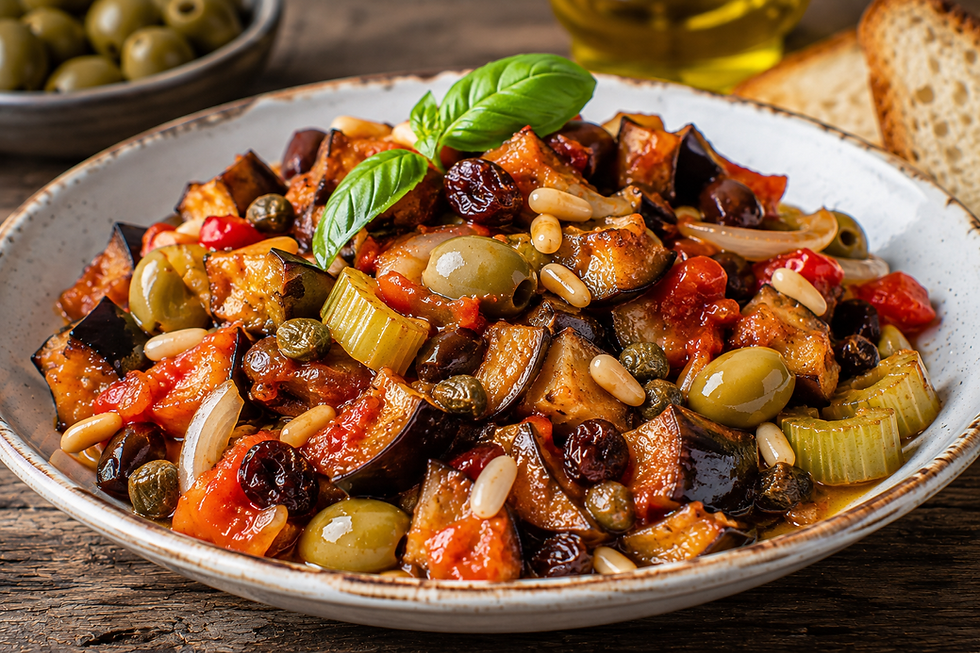
This is caponata cooked as a stew: one heavy pan, one flame, everything braised together until the vegetables give up their edges and settle into a soft dark mass held by its own juices. It is not the version built from separately fried components and assembled cold. It is a pot of vegetables eaten warm with bread or couscous, as a meal rather than a garnish.
The technique follows from that. The eggplant is browned in the pan and then goes back in to finish with everything else, so it absorbs tomato and vinegar instead of keeping its crust. The celery and onion cook down past the point of being recognisable. The agrodolce is simmered in near the end rather than poured over, which lets the acid settle into the sauce instead of sitting on top.
What you lose is the clean separation of ingredients. What you gain is depth: a sweet, sour, slightly bitter stew that tastes of the whole pot rather than of eggplant plus olives plus capers.
Yield: 6 servings as a main, 8 as a side. Prep: 40 minutes. Cook: 55 minutes. Rest: 1 hour minimum. Total: about 2 hours 35 minutes. Difficulty: intermediate. Course: vegetable main or contorno. Region: Sicily.
The Story
The name is older than the dish. One reading takes it from the caupona, the Roman tavern, where a dish of vegetables in vinegar sat on the counter all day and stayed edible. Another takes it from the capone, the Sicilian name for lampuga, served in sweet and sour sauce on the tables of the wealthy. In that reading the poor built the same sauce and put eggplant where the fish had been.
The stew form belongs to the interior and the working coast rather than the palaces. Where a household had one flame and one pan, nothing was fried separately and nothing was plated in parts. Vegetables went in as they came from the garden, in the order that suited their cooking time, and the pot stayed on the fire until everything was soft. The vinegar and sugar were preservation as much as flavour: an acidified stew kept days longer in a Sicilian August.
Its companions say the same thing. Around Trapani and San Vito lo Capo, where Sicily has been in constant contact with North Africa for a thousand years, a stew like this is eaten over couscous. Everywhere else it is eaten with bread. Caponata served this way is companatico in the literal sense: the thing that goes with the bread and makes it a meal.
Ingredients
For the vegetables
Globe eggplant, cut into 1 inch (2.5 cm) cubes, 2 1/4 lb (1 kg)
Coarse sea salt, 1 tbsp (18 g), for degorging
Celery stalks, inner and tender, sliced 1/2 inch (1 cm) thick, 4
Yellow onions, halved and sliced, 2 medium (10 oz, 285 g)
Garlic cloves, sliced, 2
Ripe tomatoes, peeled and chopped, 1 lb (450 g), or canned peeled tomatoes, drained
Extra virgin olive oil, 3/4 cup (180 ml)
For the agrodolce and finish
Red wine vinegar, 1/3 cup (80 ml)
Granulated sugar, 2 tbsp (25 g)
Green olives, Nocellara or Castelvetrano, pitted and torn, 3/4 cup (120 g)
Salted capers, rinsed well, 3 tbsp (30 g)
Golden raisins, 1/4 cup (35 g)
Pine nuts, toasted, 1/4 cup (35 g)
Bay leaves, 2
Fine sea salt, 1 tsp (6 g), or to taste
Freshly ground black pepper, 1/2 tsp (1 g)
For serving
Basil leaves, torn, 12
Extra virgin olive oil, 2 tbsp (30 ml)
Country bread or plain steamed couscous, to serve
Preparation
Step 1
Degorge the eggplant. Toss the cubes with the coarse salt in a colander, set a plate and a weight on top and leave them 45 minutes over a bowl. Rinse briefly and press them dry between two towels, hard enough to hear them squeak. Wet eggplant steams instead of browning, and in a stew that is the difference between colour and grey.
Step 2
Brown the eggplant. Heat 1/2 cup of the oil in a wide heavy pan over medium high heat until it shimmers. Add the eggplant in two batches with room between the pieces and cook 6 to 8 minutes a batch, turning, until the cut faces are properly coloured. Lift each batch into a bowl. Do not wipe the pan: the fond is the base of the stew.
Step 3
Soften the onion and celery. Lower the heat to medium, add the remaining oil and the onions with a pinch of salt and cook 8 minutes until translucent. Add the celery and cook another 8 minutes, stirring, until it bends easily and has lost its raw note. That is longer than most recipes suggest and it is deliberate: here the celery has to melt, not stay crunchy.
Step 4
Add garlic and tomato. Stir in the garlic and give it 30 seconds, then add the tomatoes and the bay leaves. Raise the heat and cook 10 to 12 minutes, breaking the tomato down with the back of the spoon, until the mixture thickens and the oil begins to separate at the edge of the pan. That separation means the water has gone and the braise can begin.
Step 5
Return the eggplant and braise. Tip it back in with any juices in the bowl, add the raisins and a pinch of salt and stir gently. Lower the heat, cover and cook 15 minutes, stirring twice. The eggplant will collapse slightly and take the colour of the tomato. If the pan looks dry, add 2 tablespoons of water, not oil.
Step 6
Add olives and capers. Stir in the torn olives and rinsed capers and cook uncovered 5 minutes. They go in late because both are salted and give that salt up into the sauce, and because long heat turns olive flesh leathery. Taste the pan now, before any vinegar goes near it, and correct the salt.
Step 7
Cook in the agrodolce. Dissolve the sugar in the vinegar until the liquid is clear, then pour it around the edge of the pan rather than into the middle. Raise the heat and cook 4 to 5 minutes uncovered, stirring, until the sharp smell has softened and the sauce looks glossy again. This short simmer folds the acid into the stew instead of leaving it on the surface.
Step 8
Rest it. Off the heat, stir in the pine nuts, grind over the pepper and leave it uncovered to cool to warm, at least 1 hour. Caponata tastes flat straight off the stove because the vinegar is still volatile and the salt has not spread. Taste again once it is warm and adjust with a teaspoon of vinegar or a pinch of sugar. Remove the bay leaves.
Plating
Serve it warm, around 95°F (35°C), not hot and not chilled. Warm is where the oil is fluid and fragrant, the sweetness reads clearly and the vinegar has stopped being sharp. Straight from the refrigerator the fat is set and it tastes dull and acidic, which is why it needs an hour on the counter.
As a main, spoon it into a warm shallow bowl, about 1 1/2 cups per person, with torn basil and a thread of raw oil over the top. Set steamed couscous alongside or a thick slice of grilled bread. The stew is loose enough to move into the couscous on its own, so do not stir them together in the kitchen.
As a contorno it goes beside grilled swordfish, roast lamb or sausages, in a smaller portion and on a plate. Do not garnish it beyond basil and oil. This is a brown dish that earned its colour by cooking, and anything green and raw on top only makes it look like it is hiding something.
Professional Technique
The method turns on using one pan and never washing it between stages. Browning the eggplant leaves caramelised sugars stuck to the base, and the water released by the onions lifts that fond back into the dish. Cook the components in separate pans and every one of those layers is thrown out with the washing up. It is why this version tastes deeper than an assembled caponata with identical ingredients.
Order of addition is the second control. Each vegetable goes in where the remaining cooking time matches what it needs: the onion has 16 minutes ahead of the tomato, the celery 8, the eggplant 15 under a lid, the olives only 5. Pine nuts go in off the heat entirely, since they soften in a wet pan without ever browning.
The agrodolce is cooked, not poured. Vinegar added at the end sits as a separate sharp layer on the palate. Simmered four minutes it loses its most volatile acetic fraction, the sugar dissolves into the tomato and the two arrive as one sweet and sour note built into the sauce. Pouring it around the edge of the pan keeps it off the eggplant, which would otherwise take a hard hit of raw acid and hold it.
Texture and Moisture Control
Eggplant is mostly water held in a sponge of cells, and that sponge collapses under heat. Salting first drives out part of the water and collapses some of the structure before it meets oil, which is why degorged eggplant absorbs far less and browns instead of stewing in its own liquid. Pressing it dry is not tidiness: a wet cube drops the pan temperature and steams.
The consistency you want is a stew that holds together on a spoon but spreads slowly on a plate, with visible oil at the edges and no free water. Free water is the common failure and comes from tomato that was not reduced far enough before the eggplant went back in. Watch for the oil separating at the end of step 4, and if it has not happened, keep going.
Resting redistributes moisture as much as flavour. Straight off the heat the eggplant is saturated and the sauce thin; an hour later the cubes have given liquid back and the whole thing has tightened into one mass. That continues overnight, which is why the second day is thicker and darker. If it tightens too far, loosen it with warm water and a little oil rather than more vinegar.
Professional Mise en Place
This is a make ahead dish by nature, so the service work is almost nothing. Everything but the final seasoning can be done a day or two before.
Equipment and tools
Wide heavy pan or braising pot with a lid, at least 12 inches (30 cm) across
Colander, a plate and a weight for degorging the eggplant
Clean towels for pressing the eggplant dry
Wooden spoon and a small bowl for dissolving the agrodolce
Shallow wide container for cooling and storing the finished stew
Prepared ahead
Eggplant cubed, salted and pressed, up to 4 hours ahead, refrigerated
Celery, onion and garlic cut, up to 1 day ahead, refrigerated
Capers rinsed and olives pitted and torn, up to 2 days ahead
Pine nuts toasted and cooled, up to 3 days ahead, in a sealed jar
The whole stew cooked, up to 3 days ahead, which improves it
Service setup
Stew out of the refrigerator 1 hour before service, uncovered
Couscous steamed or bread grilled at the last moment
Basil torn only when the plates go out, never in advance
Finishing oil and a small dish of vinegar ready for the final correction
Bowls warmed slightly, plates left at room temperature
Chef Tips
Choose firm heavy eggplants with tight glossy skin and a green stem. A light one with dull skin is old, full of developed seeds and bitter, and no amount of salting corrects that. Large globe eggplants hold their cube shape through the braise better than slender ones.
Use the inner celery stalks and keep the leaves. The pale tender stalks from the heart cook down properly, while the outer ribs stay stringy however long you give them. The leaves, chopped in with the tomato, carry more celery flavour than the stalks.
Correct the balance the day after, not the day of. Vinegar keeps softening for a day and sugar keeps integrating, so a stew that seemed sharp at midnight is usually right by lunchtime. Adjust in quarter teaspoons.
Make double. The pan is already dirty and the vegetables are already cut, and in this form it keeps four days and freezes well. It is the most useful thing in the refrigerator: it goes on bread, under a fried egg, beside cold roast meat and through warm couscous.
Common Mistakes
Skipping the salting. Unsalted eggplant carries too much water, refuses to brown and leaves the stew loose and grey. Forty five minutes under a weight and a hard press between towels is the minimum, and more heat will not replace it.
Crowding the pan when browning. Too many cubes at once drop the oil temperature and the eggplant steams in its own moisture. Work in two batches with space between the pieces.
Adding the vinegar off the heat. Poured in at the end it stays a sharp separate layer that never joins the sauce. Dissolve the sugar into it first and simmer for four minutes so the acid settles into the stew.
Putting the olives in early. Long cooking turns olive flesh rubbery and pushes their salt into the sauce before you have tasted it. Five minutes near the end is enough.
Serving it straight from the pan. Hot caponata tastes flat and acidic because the vinegar is still volatile and the salt has not spread. It needs an hour to come down to warm, and is better still the next day.
Not reducing the tomato far enough. If the eggplant goes back into a watery tomato base the stew never tightens and finishes as vegetables sitting in liquid. Wait for the oil to separate at the edge of the pan.
Wine Pairing
Vinegar is the difficulty here and sugar makes it worse: a wine with any softness tastes thin after a mouthful of agrodolce. What works is high acidity, no oak and either no tannin or very fine tannin. Because this version is served warm as a main rather than cold as an antipasto, the list reaches across the southern mainland instead of repeating the island classics.
Cirò Bianco DOC: Greco Bianco from the Ionian coast of Calabria, dry, lean and unusually high in acidity for a wine grown in that heat. That acidity is the point: it meets the vinegar without being flattened, and the faint bitter herb note sits comfortably against the celery and the olives.
Locorotondo DOC: A pale Verdeca based white from the Valle d'Itria, light in alcohol and almost neutral, which is what a strongly seasoned stew needs. It refreshes between mouthfuls rather than competing, and its slight almond bitterness picks up the pine nuts.
Tintilia del Molise DOC Rosato: A serious dry rosato with real structure and a dark berry core. Rosato is the natural answer to sweet and sour food because it brings red fruit without tannin, and this one has the acidity and the weight to handle a dish eaten warm with couscous.
Cirò Rosso Classico DOC: Gaglioppo gives a pale, high acid red with soft dusty tannin and sour cherry fruit, and served at around 57°F (14°C) it works where a fuller red would collapse. The sour edge of the fruit runs with the vinegar rather than against it.
Salice Salentino DOC: Negroamaro from Puglia, warm and savoury with a bitter almond finish that answers the eggplant directly. Choose a young unoaked bottling and pour it cool. This is the one to open when the caponata is the whole meal and there is grilled bread on the table.
Storage & Reheating
Cooled and covered it keeps in the refrigerator for 4 days and is better on days two and three than on the day it was made. Store it in shallow glass or ceramic rather than metal, since the vinegar reacts with aluminium. Cover it only once it is completely cool, because trapped steam waters it down.
It is not really a reheated dish. The normal service is to take it out an hour ahead and let it come to warm room temperature, correcting the seasoning there. For properly warm, use a low flame with a tablespoon of water and stir gently 5 minutes. A microwave overheats the edges, splits the oil out and leaves the centre cold.
It freezes for up to 2 months in a sealed container, which few vegetable dishes do, because the eggplant has already collapsed and has no structure left to lose. Thaw it overnight in the refrigerator. Expect it slightly looser: drive off the extra liquid over low heat and check the balance again, since freezing dulls the vinegar.
Nutrition
Per serving, based on 6 servings as a main course:
Calories: 390 kcal
Total Fat: 31 g
Saturated Fat: 4.5 g
Trans Fat: 0 g
Unsaturated Fat: 26 g
Cholesterol: 0 mg
Sodium: 690 mg
Total Carbohydrates: 26 g
Fiber: 8 g
Total Sugars: 15 g
Added Sugars: 4 g
Protein: 5 g
Lactose: 0 g
Principal micronutrients: vitamin C, vitamin K, potassium, manganese, copper, vitamin E
These figures are estimates. The dish is naturally dairy free. Sodium depends almost entirely on how thoroughly the capers and olives are rinsed.


Comments