
Must Know: Carbonara, Storia e Tradizione (Italian Carbonara, History and Tradition)
Updated: Aug 27

Italian Carbonara: History, Tradition and Five Modern Interpretations
Story of the Dish
Carbonara is one of the most famous pasta dishes in the world, yet it is also one of the most misunderstood.
Its ingredient list is short, but the debate surrounding it is enormous. Whole eggs or yolks only? Pecorino Romano or Parmigiano Reggiano? A dense sauce or a looser, more fluid emulsion? Should the guanciale be extremely crisp, or should part of it remain softer and meatier?
The answer depends on which period, which cook, and which style of carbonara we are discussing.
Today, carbonara is strongly identified with Rome and the cuisine of Lazio. The modern Roman version is generally built around five essential elements: pasta, eggs, guanciale, Pecorino Romano, and black pepper.
But the history of carbonara is much younger and much less rigid than many people imagine.
A Brief History of Carbonara
Carbonara does not appear in the major Italian cookbooks of the early twentieth century in the form we recognize today. Its documented history becomes much clearer after World War II.
One of the earliest published Italian recipes for carbonara appeared in the 1950s, and it was surprisingly different from the version most cooks would now call traditional. Early formulations could include pancetta rather than guanciale, different cheeses, and ingredients that would cause considerable debate today.
That tells us something important.
Carbonara did not emerge fully formed as a perfectly codified recipe.
It evolved.
Over time, especially in Rome, the dish became more clearly defined around guanciale, eggs, Pecorino Romano, black pepper, and pasta.
As the recipe evolved, so did the techniques used to prepare it.
Some cooks used whole eggs.
Others added extra yolks.
Some preferred only Pecorino Romano.
Others blended Pecorino with Parmigiano Reggiano.
More recently, professional cooks have paid increasing attention to temperature control and emulsification, producing extremely creamy sauces without adding cream.
This evolution is precisely why it makes sense to study several versions of carbonara rather than pretending that every plate must be identical.
The following five interpretations show how small technical changes can completely alter the final dish.
1. Carbonara Romana Moderna (Modern Italian Roman Carbonara)
This is the version that many people now immediately associate with modern Roman carbonara.
It is rich, intense, glossy, and deeply flavored.
The defining characteristic is the use of egg yolks only.
The yolks are mixed with Pecorino Romano and black pepper, then combined with the pasta away from aggressive direct heat. Rendered guanciale fat and starchy pasta water help create the final emulsion.
The result is a sauce that is naturally dense and creamy.
The key word is emulsion.
Carbonara should not look like scrambled eggs.
It should not be dry.
It should not become a thick cheese paste.
The sauce should cling to the pasta in a smooth, glossy layer while remaining fluid enough to move naturally on the plate.
Using only yolks creates a more concentrated flavor because the sauce contains less water than one made with whole eggs.
The yolks also contribute fat and emulsifying compounds that help bind the cheese, rendered guanciale fat, and pasta water together.
Pecorino Romano gives this version its characteristic sharpness and salinity.
The guanciale must be rendered carefully.
If the heat is too high, the exterior burns before enough fat has been released.
If the heat is too low, the meat becomes greasy rather than crisp.
The ideal result combines crisp edges with a rich, flavorful interior.
This version is especially popular today because it produces the deep yellow, intensely creamy carbonara commonly associated with contemporary Roman restaurants.
Egg: Yolks only
Cheese: 100% Pecorino Romano
Pork: Guanciale
Texture: Rich, glossy, and dense
Cream: Never
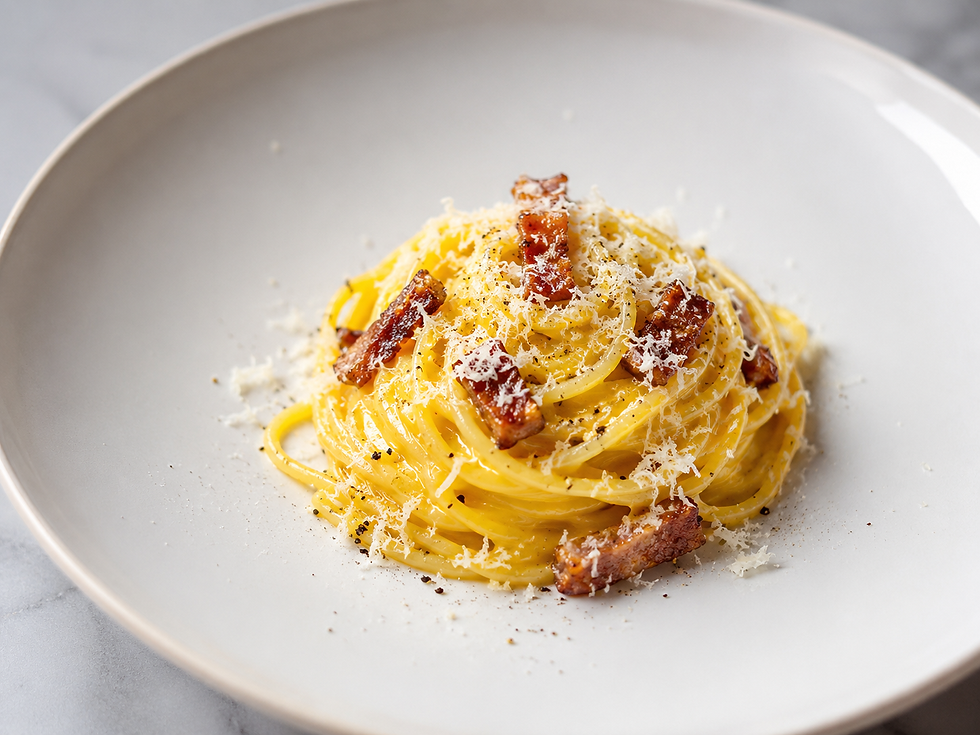
2. Carbonara Classica con Uovo Intero (Classic Italian Carbonara with Whole Egg)
The use of whole egg in carbonara is sometimes treated as incorrect by modern purists.
Historically and technically, that position is too simplistic.
Whole eggs have been used in carbonara for generations, and many respected Roman preparations combine whole eggs with additional yolks.
This method produces a noticeably different sauce.
The difference comes mainly from the egg white.
Egg white contains much more water and much less fat than egg yolk.
When some egg white is included, the sauce naturally becomes lighter and slightly more fluid.
The yolks still provide richness, while the white gives the sauce additional moisture and volume.
For that reason, a combination such as one whole egg plus additional yolks can create an excellent balance.
The result is less dense than a yolk-only carbonara.
It spreads more easily across the pasta and feels slightly lighter on the palate.
This does not make it inferior.
It simply produces a different style.
This version is especially useful for understanding how carbonara was prepared before the extremely yolk-heavy modern style became so fashionable.
The technique is still critical.
The egg mixture must be added away from strong heat.
The residual temperature of the pasta should be sufficient to gently thicken the eggs without scrambling them.
Pasta water is added only as needed.
Too much makes the sauce watery.
Too little can make it dry and heavy.
This version also demonstrates one of the most important lessons in Italian cooking:
Tradition is often broader than the simplified rules repeated online.
Egg: Whole egg plus additional yolks
Cheese: Pecorino Romano
Pork: Guanciale
Texture: Silky and slightly more fluid
Cream: Never
3. Carbonara 50/50 Pecorino e Parmigiano (Italian Carbonara with Pecorino and Parmigiano)
This version focuses on the cheese.
Instead of using only Pecorino Romano, the sauce is made with an equal blend of 50% Pecorino Romano and 50% Parmigiano Reggiano.
The purpose is balance.
Pecorino Romano is assertive.
It is salty, sharp, and unmistakably made from sheep's milk.
Parmigiano Reggiano brings a different flavor profile.
It is generally sweeter, nuttier, and rounder.
When the two cheeses are combined, the result is still recognizably carbonara, but the flavor becomes less aggressive.
The Parmigiano softens the sharper edge of the Pecorino without eliminating it.
This approach is particularly useful when serving diners who appreciate the character of Pecorino but find an all-Pecorino sauce too intense.
The 50/50 ratio also affects texture.
Parmigiano Reggiano melts and emulsifies slightly differently from Pecorino Romano, helping create a very smooth sauce when properly combined with yolks, pasta water, and guanciale fat.
The important point is that the cheeses must be finely grated.
Large pieces do not dissolve evenly.
They can form clumps and create a grainy sauce.
Temperature control matters here as much as in every other carbonara.
If the cheese mixture hits a pan that is too hot, the proteins can tighten rapidly, producing a sticky or separated sauce.
The pasta should therefore be hot enough to create the emulsion, but not so hot that the egg mixture coagulates.
This is a contemporary version, but it is not disconnected from Italian practice.
The use of Parmigiano alongside Pecorino has long appeared in professional and restaurant interpretations of carbonara.
Our version simply makes the balance deliberate and easy to understand.
Egg: Primarily yolks
Cheese: 50% Pecorino Romano and 50% Parmigiano Reggiano
Pork: Guanciale
Texture: Smooth, balanced, and creamy
Cream: Never
4. Carbonara al Parmigiano (Italian Parmigiano Carbonara)
This version removes Pecorino Romano completely and uses Parmigiano Reggiano as the only cheese.
It is not the modern Roman benchmark.
That distinction should be clear.
But it is a legitimate variation and produces an excellent pasta when prepared properly.
Parmigiano changes the personality of carbonara.
Without Pecorino, the sauce becomes less sharp and less salty.
The nuttiness of the Parmigiano becomes more noticeable.
The flavor of the guanciale also becomes more prominent because it is no longer competing with the strong sheep's-milk character of Pecorino Romano.
The result is gentler.
This can make the dish especially appealing to people who find traditional Pecorino-heavy carbonara too aggressive.
It is also interesting from a historical perspective because carbonara has never been completely frozen in one form.
Different cheeses have appeared throughout its documented development.
That does not mean every variation should be called the original carbonara.
It simply means that variation has always existed.
The best way to approach this version is to treat it as a deliberate reinterpretation rather than a replacement for the Roman standard.
A good Parmigiano carbonara should still respect the essential technique.
The guanciale is rendered slowly.
The eggs are mixed with finely grated Parmigiano.
The pasta is combined with the rendered fat.
The egg mixture is introduced away from strong heat.
Pasta water is added gradually until the correct consistency is reached.
No cream is needed.
The creaminess comes entirely from the interaction between egg, cheese, fat, and starch.
Egg: Whole egg and yolks, or yolks only
Cheese: 100% Parmigiano Reggiano
Pork: Guanciale
Texture: Smooth, delicate, and velvety
Cream: Never
5. Carbonara Cremosa Contemporanea (Contemporary Creamy Italian Carbonara)
This is the most technically controlled version of the five.
Its objective is maximum creaminess.
Not maximum heaviness.
Not maximum cheese.
Maximum emulsification.
This is the kind of carbonara increasingly associated with modern professional restaurant cooking.
The sauce is abundant, glossy, and fluid.
It coats the pasta while also leaving a small amount of creaminess around it on the plate.
The essential rule remains the same:
There is no cream in the recipe.
The creamy texture comes from egg yolks, cheese, rendered guanciale fat, and starchy pasta water.
The difference is in the level of control.
Instead of simply mixing the eggs into the pasta and hoping the temperature is correct, the cook actively manages the heat.
The egg mixture can be gradually tempered with warm pasta water.
The pasta can be moved away from the burner before the sauce is added.
The pan can be returned briefly over very gentle heat only if additional thickening is needed.
Every movement has a purpose.
The proteins in the yolks need enough heat to thicken slightly, but not enough to coagulate into visible pieces.
This temperature window is narrow.
That is why carbonara is such a useful test of technique.
The cheese mixture is also carefully balanced.
Using Pecorino Romano together with Parmigiano Reggiano creates complexity while preventing the sauce from becoming excessively salty.
The rendered guanciale fat adds body and flavor.
The pasta water supplies starch.
Together, these elements form a stable emulsion.
A properly executed creamy carbonara should look luxurious but never heavy.
The sauce should move when the plate is tilted.
It should remain glossy.
It should not form a thick solid mass as it cools.
This is the modern restaurant-style carbonara at its best.
Egg: Yolks
Cheese: Pecorino Romano plus Parmigiano Reggiano
Pork: Guanciale
Texture: Extremely creamy, glossy, and fluid
Cream: Absolutely never
Why These Five Carbonaras Taste Different
The ingredients are similar, but the results are not.
The Modern Roman Carbonara is the most concentrated, with yolks and Pecorino Romano creating a powerful and intensely savory sauce.
The Whole-Egg Carbonara is lighter and more fluid because the egg white introduces additional water.
The 50/50 Pecorino and Parmigiano Carbonara balances the sharpness of Pecorino with the sweetness and nuttiness of Parmigiano Reggiano.
The Parmigiano Carbonara removes Pecorino completely, producing the mildest and most delicate version.
The Contemporary Creamy Carbonara focuses on advanced temperature control and emulsification to create the most luxurious texture.
None of these versions requires cream.
That is one principle that remains consistent.
The creaminess of carbonara should be created naturally by technique.
What Makes a Great Carbonara
Regardless of which version you choose, several principles remain essential.
The guanciale must be rendered correctly.
The cheese must be finely grated.
The eggs should never be exposed to excessive direct heat.
The pasta water should be used as an ingredient, not simply as a rescue operation.
The pasta must finish cooking together with the sauce.
And the final consistency must be judged immediately before serving.
Carbonara changes quickly.
A sauce that looks slightly loose in the pan can become perfect by the time it reaches the table.
A sauce that already looks thick in the pan may become dry within a minute.
That final judgment is one of the skills that separates an average carbonara from an exceptional one.
Tradition and Evolution
Carbonara is now an icon of Roman cuisine, but its history shows that Italian cooking is not static.
Recipes evolve.
Ingredients become standardized.
Techniques improve.
Restaurants develop new interpretations.
Cooks debate them.
Then, over time, some of those changes become traditions themselves.
Understanding this evolution does not weaken the importance of the classic Roman carbonara.
It makes the dish more interesting.
The modern Roman formula of pasta, eggs, guanciale, Pecorino Romano, and black pepper remains the reference point.
From there, each variation can be understood for what it changes and why.
That is the real purpose of these five recipes.
Not to decide which carbonara is the only correct one.
But to understand how eggs, cheese, fat, starch, and temperature can transform the same basic dish into five noticeably different experiences.
And once those principles are understood, carbonara stops being a recipe that depends on luck.
It becomes a technique.
Join Chef Gianluca Deiana Abis for hands-on Italian cooking classes in New York City, where authentic technique, Italian tradition, and practical advice on how to travel and experience Italy come together. View upcoming NYC cooking classes and book your seat on Zafferano & Co.


Comments